Academic identity is the professional self-concept developed by individuals working within higher education, encompassing their roles as researchers, educators, and institutional members. It is a fluid, multi-dimensional construct shaped by personal values, disciplinary norms, and evolving institutional demands, often requiring a complex negotiation between individual agency and systemic pressures.
In the landscape of 2026, academic identity has moved beyond simple job descriptions to become a sophisticated intersection of personal branding, pedagogical philosophy, and scholarly contribution. As universities continue to navigate the post-digital era, understanding how these identities are formed, maintained, and challenged is essential for any professional within the tertiary sector.
The Foundations of Academic Identity
Academic identity is rarely a singular or static trait. Instead, it is a "composite identity" built from various overlapping spheres. At its core, it involves the internalisation of what it means to be a "scholar." This process is influenced heavily by the specific discipline in which one operates; a chemist’s professional identity is often tied to laboratory collaboration and empirical data, while a philosopher’s may be rooted in solitary reflection and dialectical discourse.
Sociologists often point to three primary pillars that support this identity:
- Professional Autonomy: The degree of freedom an academic feels they have to pursue their own research agendas and pedagogical methods.
- Disciplinary Belonging: The sense of membership within a global community of peers who share a common language, set of values, and methodological standards.
- Institutional Alignment: The relationship between the individual and their specific university, including their role in governance and their adherence to the institution's strategic goals.
In 2026, these pillars are frequently in tension. The rise of "managerialism" in universities—where efficiency and metrics are prioritized—often clashes with the traditional academic value of autonomy. This tension forces many to adopt a "hybrid identity," where they must act as both traditional scholars and corporate-style project managers.
The Formation Process: From Doctoral Student to Scholar
The journey toward a stable academic identity typically begins during doctoral training. This period is often described as a "liminal space," where the individual is no longer just a student but not yet a fully recognized peer. During this phase, the "hidden curriculum" of academia—learning the unspoken rules of networking, publishing, and departmental politics—plays a crucial role.
Socialization into the "community of practice," a term popularized by Etienne Wenger, occurs through mentorship and collaborative research. However, this process can be fraught with difficulty. For many, especially those from marginalized backgrounds or first-generation scholars, the formation of academic identity is hindered by "imposter syndrome." This psychological phenomenon, where individuals doubt their accomplishments and fear being exposed as a fraud, is a significant barrier to identity consolidation.
By 2026, the doctoral journey has evolved to include a stronger focus on "transferable identity." Because the number of tenure-track positions remains limited globally, PhD candidates are increasingly encouraged to develop identities that bridge the gap between academia and industry. This "porous" identity allows for a smoother transition between roles as a university researcher and a private-sector consultant or policy advisor.
The "Triple Threat" Paradigm: Balancing Research, Teaching, and Service
Historically, the ideal academic was seen as a "triple threat": an excellent researcher, a dedicated teacher, and a diligent contributor to university service. Maintaining an identity that encompasses all three is one of the most significant challenges in modern higher education.
The Researcher Identity
For many, the research identity is the "primary" identity. It is often the source of the greatest professional prestige and the main metric for promotion. It is tied to the "publish or perish" culture, which, even in 2026, remains a dominant force. The researcher identity is increasingly defined by one's digital footprint, h-index, and ability to secure external grant funding.
The Educator Identity
The educator identity focuses on pedagogy, student engagement, and the scholarship of teaching and learning (SoTL). Many academics find deep intrinsic value in this role, yet they often feel it is undervalued by their institutions compared to research output. The shift toward online and blended learning has further complicated this identity, requiring academics to see themselves as digital facilitators and content creators.
The Service and Administrative Identity
Often referred to as "academic housework," service includes committee work, peer review, and departmental leadership. While essential for the functioning of the university, it is frequently viewed as a distraction from "real" academic work. However, as one moves into senior roles, the identity of "academic leader" or "administrator" becomes more prominent, often leading to a sense of "identity drift" away from the original scholarly roots.
Digital Academic Identity: Navigating Visibility in 2026
In 2026, an academic’s identity is no longer confined to the physical campus or the pages of a journal. The "digital academic" must curate a presence across multiple platforms. This is not merely about vanity; it is a functional requirement for visibility, collaboration, and impact.
Key components of the digital academic identity include:
- Persistent Identifiers: Tools like ORCID provide a unique, persistent digital identifier that distinguishes researchers from one another, ensuring that all work is correctly attributed.
- Professional Networking: Platforms like LinkedIn and ResearchGate serve as virtual departments where ideas are exchanged and collaborations are born.
- Public Engagement: Social media and blogging allow academics to bypass traditional gatekeepers and speak directly to the public, fostering an identity as a "public intellectual."
However, this digital visibility comes with risks. The "quantified scholar" identity—where one’s worth is reduced to citation counts and social media "likes"—can lead to burnout and a focus on sensationalism over substance. Furthermore, the boundary between the "personal" and the "professional" has become increasingly blurred, leading to challenges in maintaining a private life separate from one's scholarly persona.
Comparing Identity Dimensions in Higher Education
The following table outlines the key differences between the primary roles that contribute to a modern academic identity.
| Dimension | Researcher Identity | Educator Identity | Administrator Identity |
|---|---|---|---|
| Primary Goal | Knowledge creation and discovery | Student development and learning | Institutional stability and growth |
| Key Audience | Global peers, funding bodies | Students, accreditation boards | University executive, government |
| Value Indicator | Citations, grants, publications | Student evaluations, teaching awards | Budget efficiency, KPI achievement |
| Primary Medium | Journals, conferences, labs | Classrooms, VLEs, workshops | Meetings, reports, policy docs |
| Identity Threat | Rejected manuscripts, lack of funding | High workloads, student apathy | Bureaucratic "capture," loss of research time |
Institutional Pressures and the Crisis of Identity
The environment of 2026 continues to place immense pressure on the individual academic. The "marketization" of higher education—where students are viewed as customers and research as a product—has led to what many scholars describe as an "identity crisis."
One of the most significant pressures is the rise of precarious labor. With a large percentage of teaching being conducted by adjunct or sessional staff, the ability to form a stable, long-term academic identity is compromised. It is difficult to feel like a "member of a scholarly community" when one's contract ends every six months. This "precarious identity" is characterized by anxiety and a lack of institutional loyalty.
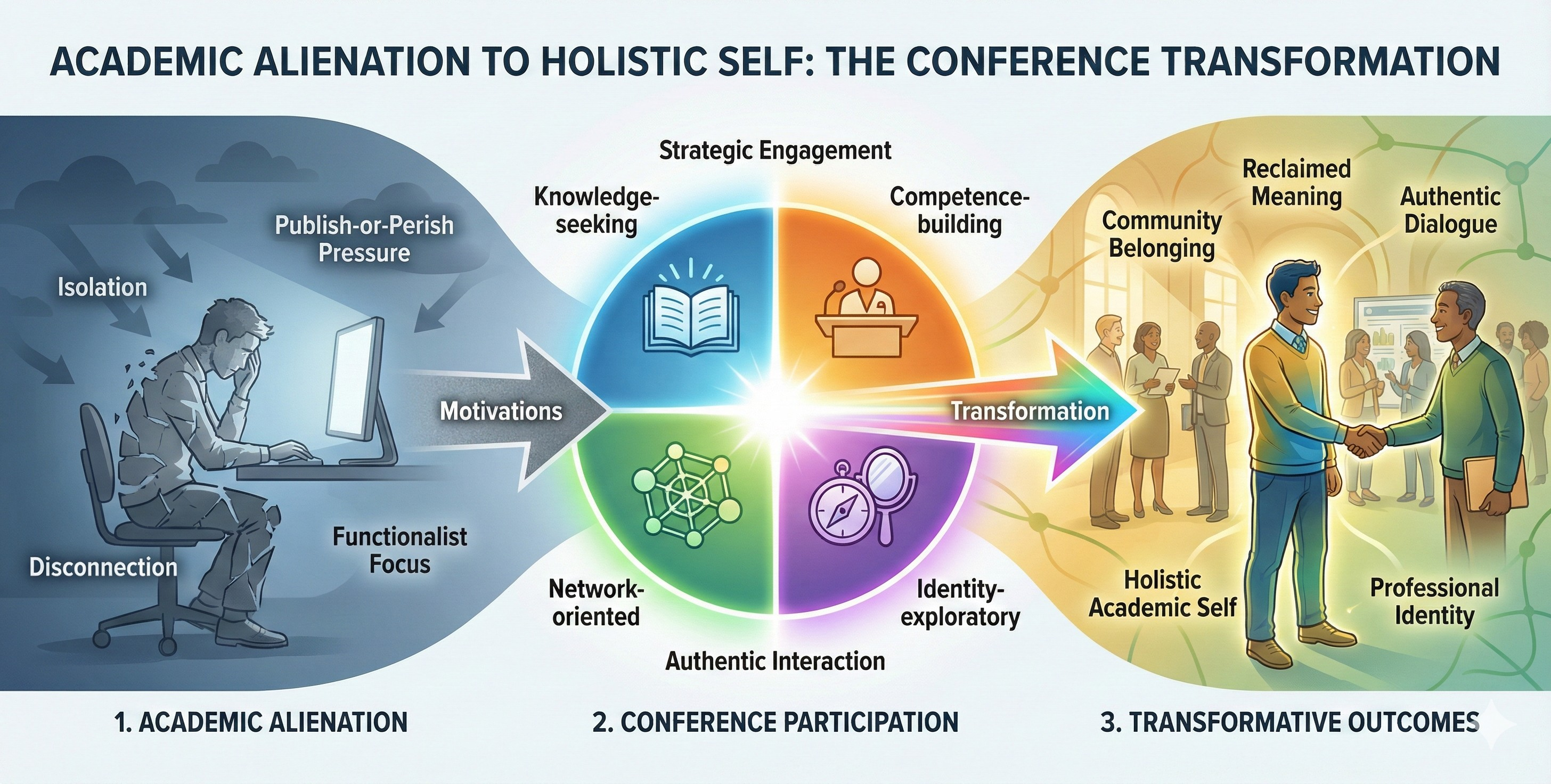
Additionally, the "metricization" of the academy has led to a shift from "intrinsic" to "extrinsic" motivation. When an academic’s identity is tied to hitting specific targets (e.g., publishing in Q1 journals), the original passion for the subject can be eclipsed by the need to satisfy an algorithm. This can lead to "identity alienation," where the work no longer feels like an expression of the self.
Managing Identity Conflict: Strategies for Professional Sustainability
Given these challenges, how can academics maintain a healthy and authentic professional identity? In 2026, the focus has shifted toward "identity work"—the active process of constructing and repairing one’s professional self.
- Finding a "Niche" Community: Small, specialized research groups or pedagogical circles can provide the "disciplinary belonging" that large, impersonal institutions often lack.
- Setting Boundaries: Protecting "sacred" time for deep work—the research or thinking that originally drew the individual to academia—is essential for maintaining the core of the academic identity.
- Embracing Multiplicity: Rather than trying to be a "triple threat" every day, successful academics often "season" their identities, focusing more on teaching in one semester and research in the next.
- Values Alignment: Periodically reflecting on personal values and how they align (or clash) with institutional goals can help in making strategic career moves, such as moving to an institution that better supports one's primary identity.
Frequently Asked Questions
Can you change your academic identity mid-career?
Yes, identity is fluid. Many scholars transition from being "pure researchers" to "teaching-focused" or "leadership-focused" roles. This often requires a conscious process of "re-tooling" and seeking new communities of practice. In 2026, these transitions are more common as career paths become less linear.
Does imposter syndrome ever go away?
While it often diminishes with experience and tenure, many senior academics report that imposter syndrome persists, especially when entering new fields or taking on high-profile leadership roles. Acknowledging it as a common systemic issue rather than a personal failing is a key part of managing it.
How does "academic identity" differ from "professional identity" in other fields?
While all professionals have an identity, academic identity is unique due to the high value placed on "collegiality" and "academic freedom." Unlike a corporate environment where identity is often tied to the company brand, an academic's identity is often more tied to their global discipline than their specific employer.
Is a digital identity mandatory for academics in 2026?
While not legally "mandatory," it is functionally necessary for most. Without a digital presence (such as a profile on the University’s staff directory or an ORCID), a scholar is effectively invisible to search engines, potential collaborators, and grant reviewers.
How do precarious contracts affect identity?
Precarious contracts often lead to a "fragmented" identity. When an individual works across multiple institutions, they may feel like an "outsider" in all of them. This makes it difficult to engage in long-term research projects or to develop deep pedagogical relationships with students.
Moving Toward an Integrated Academic Self
The most sustainable path forward in 2026 is the development of an "integrated academic identity." This involves acknowledging the different roles one must play—researcher, teacher, administrator—without letting any single role consume the entire self. It requires a high degree of "reflexivity," or the ability to look at one’s own professional practice critically.
For the modern academic, identity is not something that is "found" or "granted" by an institution; it is something that is continuously built through daily actions, choices, and reflections. By prioritizing authenticity and community over mere metrics, scholars can navigate the complexities of higher education while maintaining their passion for the pursuit of knowledge.