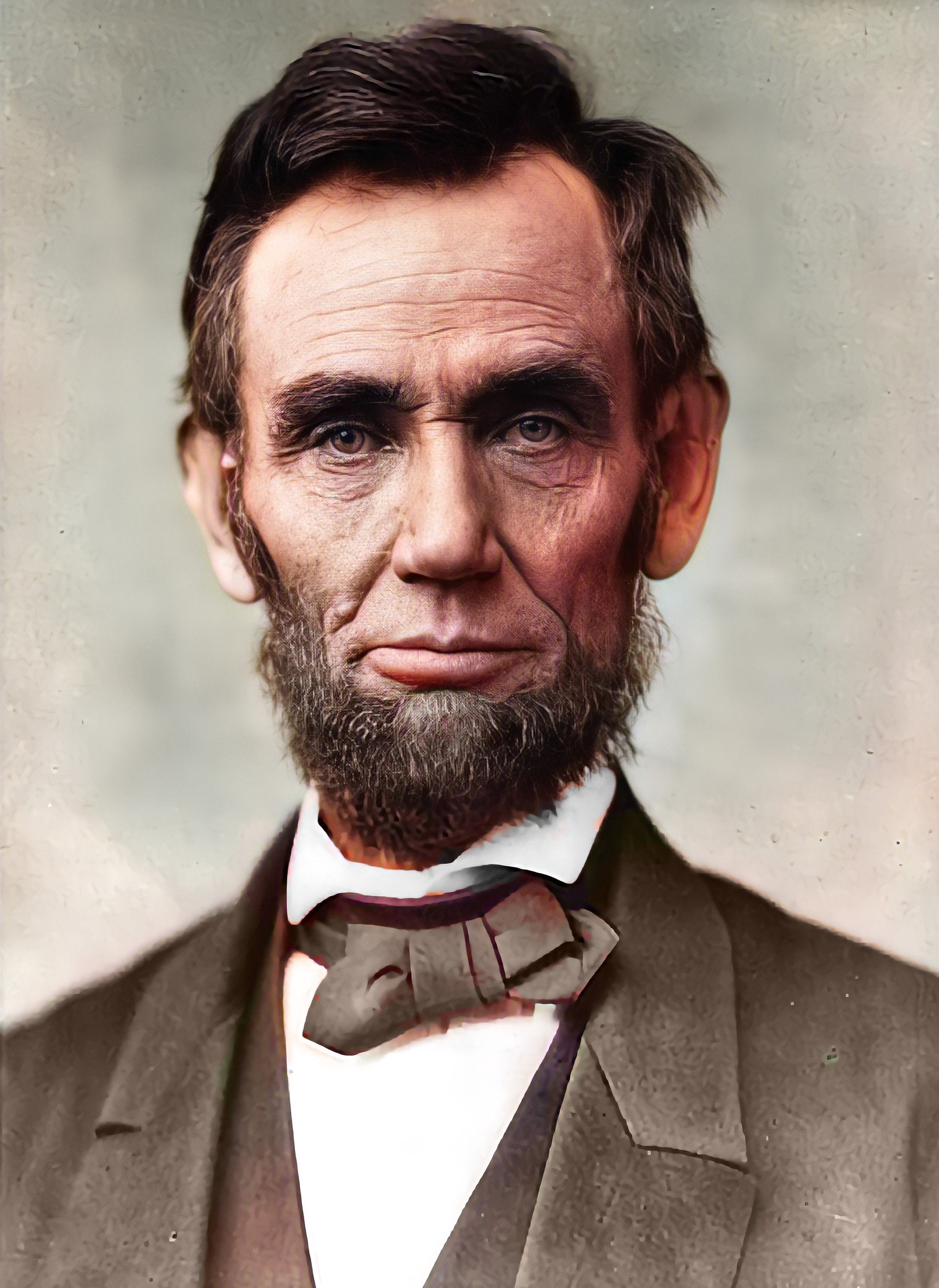
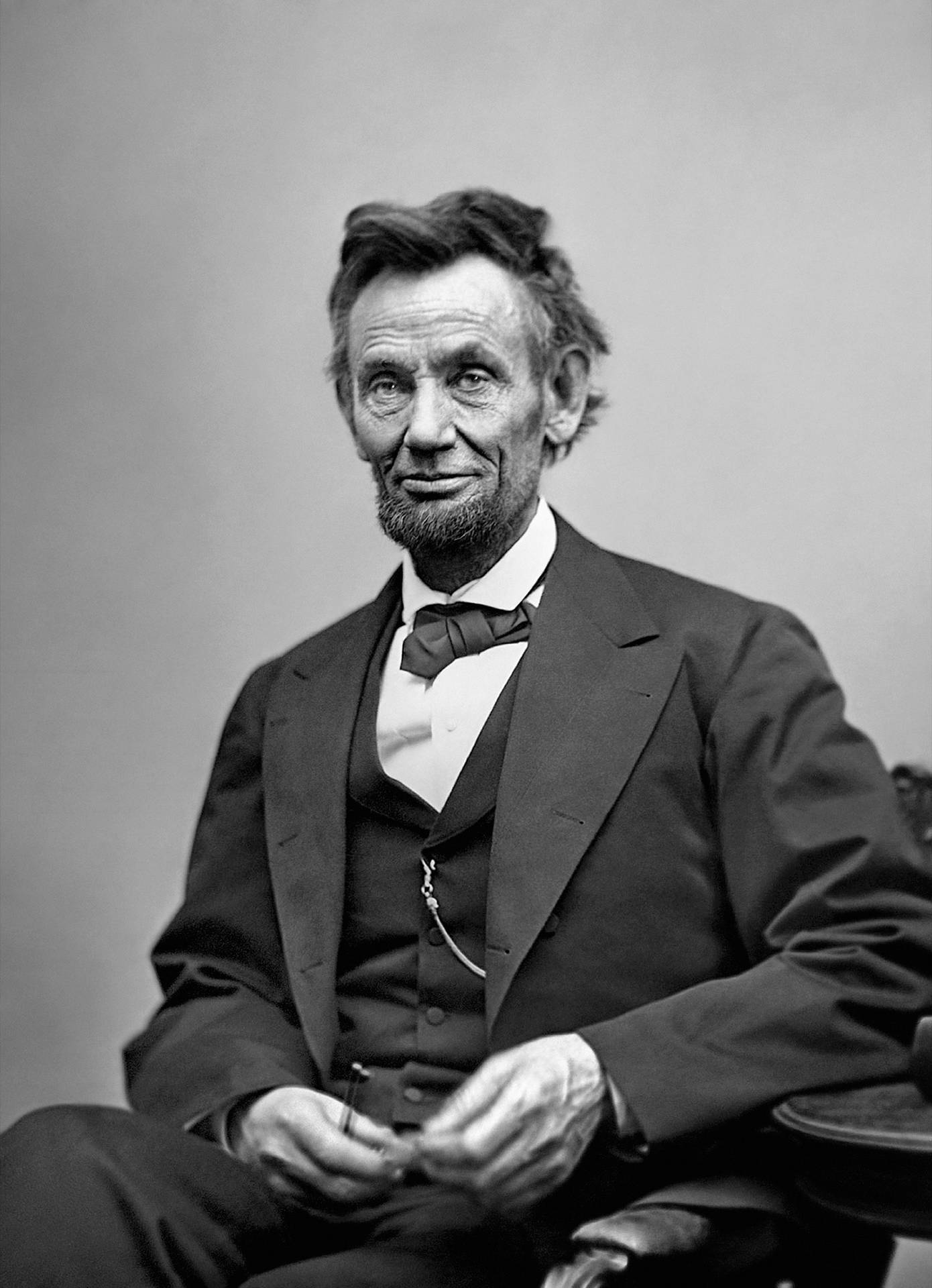
Abraham Lincoln was the 16th President of the United States, serving from March 1861 until his assassination in April 1865. He is best known for leading the nation through the American Civil War, issuing the Emancipation Proclamation, and laying the groundwork for the total abolition of slavery through the 13th Amendment.
The Frontier Origins of a Self-Made Leader
Born on February 12, 1809, in a one-room log cabin in Hardin County, Kentucky, Abraham Lincoln’s early life was defined by the hardships of the American frontier. His family moved to Indiana and later Illinois, seeking better land and economic opportunities. Lincoln’s formal education was sporadic, totaling roughly one year, yet he possessed an insatiable appetite for learning. He famously read borrowed books by firelight, mastering the Bible, Shakespeare, and Blackstone’s Commentaries on the Laws of England. This self-directed education formed the basis of his later mastery of the English language and constitutional law.
Lincoln’s transition from a physical laborer—renowned for his strength as a railsplitter—to a professional lawyer and politician is a cornerstone of the American "self-made man" narrative. In the 1830s, he settled in New Salem, Illinois, where he worked as a store clerk, postmaster, and surveyor before winning a seat in the Illinois State Legislature as a member of the Whig Party. By 1836, he had taught himself law and was admitted to the bar, eventually moving to Springfield to practice. His legal career, which spanned over two decades, saw him handle thousands of cases ranging from simple land disputes to complex corporate litigation for the Illinois Central Railroad.
The Political Ascent and the Lincoln-Douglas Debates
Lincoln’s national political career was catalyzed by his opposition to the expansion of slavery. Although he served a single, relatively quiet term in the U.S. House of Representatives (1847–1849), the passage of the Kansas-Nebraska Act in 1854 drew him back into the political fray. This legislation, which allowed settlers in new territories to decide for themselves whether to permit slavery, effectively repealed the Missouri Compromise. Lincoln viewed this as a moral and political catastrophe that threatened the integrity of the Union.
In 1858, Lincoln challenged the incumbent Stephen A. Douglas for a seat in the U.S. Senate. This campaign featured a series of seven high-profile debates across Illinois that focused almost entirely on the legality and morality of slavery. During these exchanges, Lincoln delivered his famous "House Divided" speech, arguing that "a house divided against itself cannot stand" and that the government could not endure permanently half slave and half free. While Lincoln lost the Senate race, the transcripts of the debates were published nationwide, catapulting him to national prominence. His subsequent Cooper Union speech in New York City solidified his reputation as a moderate yet firm opponent of slavery's expansion, paving the way for his 1860 presidential nomination by the newly formed Republican Party.
Presidency in Crisis: The Outbreak of the Civil War
The election of 1860 was the most polarizing in American history. Lincoln won the presidency without carrying a single Southern state, a result that triggered the immediate secession of seven Deep South states, which formed the Confederate States of America. By the time of his inauguration in March 1861, the nation was on the brink of collapse. In his inaugural address, Lincoln appealed to the "better angels of our nature," but he remained firm that the Union was perpetual and that secession was legally void.
The conflict turned violent on April 12, 1861, when Confederate forces fired on Fort Sumter in South Carolina. Lincoln’s response was decisive: he called for 75,000 volunteers to suppress the rebellion. This move prompted four more states, including Virginia, to secede. Lincoln’s primary objective was the preservation of the Union, a task that required extraordinary executive leadership. He frequently clashed with his generals, particularly George B. McClellan, whom he found overly cautious. Lincoln’s eventual selection of Ulysses S. Grant to lead the Union armies reflected his realization that the war required a strategy of total exhaustion against Confederate resources and manpower.
The Moral Pivot: Emancipation and the 13th Amendment
Initially, Lincoln maintained that the war was strictly about preserving the Union rather than ending slavery. This stance was a political necessity to keep the "border states"—Maryland, Kentucky, Missouri, and Delaware—from joining the Confederacy. However, as the war progressed, Lincoln recognized that slavery was the structural engine of the Southern rebellion and that its destruction was essential for a lasting peace.
On January 1, 1863, Lincoln issued the final Emancipation Proclamation. This executive order declared that all persons held as slaves within the rebellious states "are, and henceforward shall be free." While it did not immediately free all enslaved people, it fundamentally changed the legal status of millions and authorized the recruitment of Black soldiers into the Union Army. Approximately 180,000 African Americans served in the Union forces, providing a critical advantage in the later stages of the war. To ensure that emancipation would survive legal challenges after the war, Lincoln pushed aggressively for the 13th Amendment to the Constitution. His political maneuvering to secure the necessary votes in the House of Representatives was a masterclass in legislative strategy, ensuring that slavery was permanently abolished before the war’s end.
Wartime Diplomacy and Internal Governance
While the Civil War dominated his presidency, Lincoln also oversaw significant domestic legislation that reshaped the American economy and landscape. His administration passed several landmark bills that had been stalled by Southern opposition for years. These included the Homestead Act of 1862, which provided 160 acres of public land to settlers, and the Pacific Railway Act, which chartered the first transcontinental railroad. These initiatives were aimed at expanding the nation’s infrastructure and incentivizing Western settlement.
Lincoln also implemented the first federal income tax and established the Department of Agriculture. On the international stage, his administration worked tirelessly to prevent Great Britain and France from formally recognizing the Confederacy as an independent nation. The "Trent Affair" in late 1861 threatened to pull Britain into the war, but Lincoln’s diplomatic restraint and his administration's ability to frame the conflict as a crusade for freedom after 1863 successfully isolated the South.
| Key Milestone | Date | Historical Significance |
|---|---|---|
| First Inauguration | March 4, 1861 | Lincoln appeals for unity as the nation fractures. |
| Fort Sumter Attack | April 12, 1861 | The official commencement of the American Civil War. |
| Homestead Act | May 20, 1862 | Opened up millions of acres of Western land to settlers. |
| Emancipation Proclamation | Jan 1, 1863 | Redefined the war as a fight for human freedom. |
| Gettysburg Address | Nov 19, 1863 | Reinvigorated the Union’s commitment to democracy. |
| Second Inauguration | March 4, 1865 | Focused on "malice toward none" and postwar healing. |
| Assassination | April 14, 1865 | Lincoln shot by John Wilkes Booth at Ford's Theatre. |
The Assassination and the Tragedy of Reconstruction
Lincoln’s presidency reached its zenith in April 1865. General Robert E. Lee surrendered the Army of Northern Virginia on April 9, effectively ending the major combat of the war. Just five days later, on Good Friday, April 14, Lincoln attended a play at Ford’s Theatre in Washington, D.C. He was shot by John Wilkes Booth, a Confederate sympathizer and famous actor who believed that killing the president would restart the Southern cause. Lincoln died early the next morning, April 15, 1865.
His death was a profound shock to a nation just beginning to breathe after four years of carnage. Lincoln’s absence during the Reconstruction era is often cited by historians as one of the great "what ifs" of American history. His Second Inaugural Address, delivered just weeks before his death, urged the nation to proceed "with malice toward none; with charity for all." Without his political skill and moderate temperament, the process of reintegrating the South became much more contentious, leading to a long period of racial injustice and political instability in the late 19th century.
Measuring the Impact: Lincoln’s Legacy in the 21st Century
In 2026, Abraham Lincoln remains the most scrutinized and admired figure in American history. His legacy is not merely a collection of wartime victories but a philosophical framework for democratic governance. The Library of Congress houses over 20,000 of his papers, which continue to be a primary source for researchers studying his leadership style and rhetorical brilliance.
Lincoln’s primary legacy is the preservation of the American experiment. By refusing to allow secession, he ensured that the United States remained a single, cohesive entity capable of becoming a global power. His ability to evolve—moving from a cautious politician to a revolutionary liberator—serves as a model for adaptive leadership. Today, the Lincoln Memorial in Washington, D.C., stands as a secular shrine, symbolizing the ongoing struggle to fulfill the promise of the Declaration of Independence that "all men are created equal."
Why was Abraham Lincoln called "Honest Abe"?
The nickname "Honest Abe" originated during Lincoln’s early years in New Salem, Illinois. He earned a reputation for scrupulous honesty in his business dealings as a shopkeeper and later as a lawyer. There are numerous accounts of him walking miles to return a few cents in change to a customer or refusing to take cases if he believed the client was in the wrong. This reputation became a central part of his political brand, helping him gain the trust of voters who were often skeptical of politicians.
What was the main purpose of the Gettysburg Address?
The Gettysburg Address was delivered on November 19, 1863, at the dedication of the Soldiers' National Cemetery. While Lincoln was not the featured speaker, his 272-word speech redefined the American Civil War. He framed the conflict not just as a fight for territory, but as a test of whether a nation "conceived in Liberty" could endure. The address emphasized that the Union’s survival was essential for the survival of democracy itself, ensuring that "government of the people, by the people, for the people, shall not perish from the earth."
How did Lincoln’s views on slavery change over time?
Lincoln’s views underwent a significant evolution. He was always morally opposed to slavery, describing it as a "monstrous injustice." However, early in his career, he believed the Constitution protected slavery where it already existed. During the war, his focus shifted from containment to total abolition. This change was driven by both moral conviction and the practical realization that the Union could not be truly restored while the institution of slavery remained intact.
Who were the members of Lincoln’s "Team of Rivals"?
Lincoln’s "Team of Rivals" refers to his cabinet, which he famously populated with his chief political opponents from the 1860 Republican primary. This included William H. Seward (Secretary of State), Salmon P. Chase (Secretary of the Treasury), and Edward Bates (Attorney General). Lincoln believed that in a time of national crisis, he needed the strongest minds in the country, even if they disagreed with him. His ability to manage these powerful egos is often cited as a testament to his superior leadership.
Where can I find original documents written by Abraham Lincoln?
The most extensive collection of Lincoln’s writings is held at the Abraham Lincoln Presidential Library and Museum in Springfield, Illinois. Additionally, the National Archives in Washington, D.C., holds the original Emancipation Proclamation and the 13th Amendment. Most of these documents are now digitized and accessible to the public online, allowing students and historians to examine his original drafts and correspondence.
Exploring Lincoln’s Impact Further
To fully understand Abraham Lincoln’s influence, one must look beyond the textbook summaries and engage with his original writings. Students and history enthusiasts should prioritize visiting the Lincoln Home National Historic Site in Illinois or the Gettysburg National Military Park in Pennsylvania to grasp the physical context of his life and decisions. For those seeking deep analytical insight, reading Team of Rivals by Doris Kearns Goodwin or Lincoln by David Herbert Donald provides a comprehensive look at the complexities of his presidency. Understanding Lincoln is not just a study of the past; it is an exploration of the fundamental principles that continue to define the American identity in 2026.