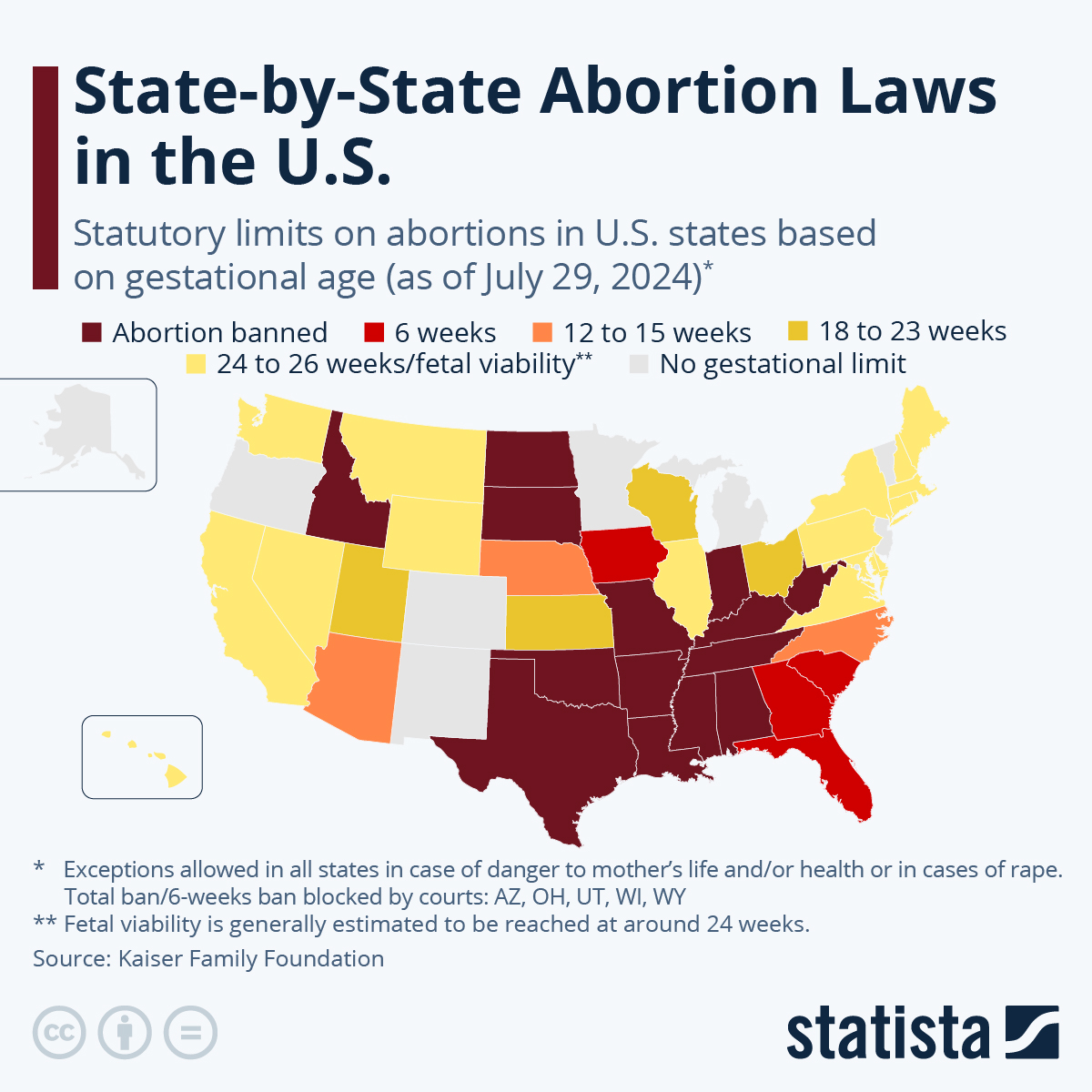
In 2024, abortion access in the United States is governed by a fragmented landscape of state-level statutes following the 2022 overturning of Roe v. Wade. Regulations vary significantly, ranging from total bans in 14 states to constitutional protections in others, often involving specific gestational limits, mandatory waiting periods, and evolving judicial stays.
The Fragmentation of Reproductive Rights in 2024
The legal status of abortion in 2024 represents one of the most complex periods of jurisdictional variance in American history. Since the Supreme Court’s decision in Dobbs v. Jackson Women’s Health Organization, the authority to regulate or prohibit abortion returned to individual state legislatures. This has resulted in a "patchwork" system where a patient's legal rights are entirely dependent on their geographic location.
In the 2024 calendar year, the landscape shifted further due to new legislative sessions, high-court rulings at the state level, and the implementation of previously contested "trigger laws." Understanding these rules requires distinguishing between states where abortion is a protected right, states where it is strictly limited by gestational age, and states where the procedure is almost entirely prohibited. Furthermore, 2024 saw significant litigation regarding the Emergency Medical Treatment and Labor Act (EMTALA) and its intersection with state bans, particularly concerning whether federal law requires hospitals to provide stabilizing abortions during medical emergencies.
States with Near-Total Prohibitions
As of 2024, 14 states have implemented near-total bans on abortion at all stages of pregnancy. These laws typically originate from "trigger bans" designed to take effect upon the reversal of Roe v. Wade or from pre-Roe statutes that were never repealed.
In states like Texas, Alabama, and Missouri, the law prohibits abortion from the moment of conception. The enforcement mechanisms in these jurisdictions are often severe, carrying criminal penalties for providers, including potential life imprisonment and substantial fines. While these laws technically include exceptions to save the life of the pregnant person, the "medical emergency" definitions are often criticized by medical professionals for being dangerously vague.
Idaho and Tennessee represent examples of states where the legal definitions of exceptions have been central to 2024 litigation. In Idaho, the conflict between state law and federal EMTALA requirements reached the U.S. Supreme Court in 2024, highlighting the tension between state criminal statutes and federal mandates for emergency care. In these high-restriction states, clinics have largely ceased operations, forcing residents to travel hundreds of miles to neighboring jurisdictions where the procedure remains legal.
Gestational Limit Tiers: 6-Week to 20-Week Restrictions
A significant portion of the country operates under gestational limits that restrict abortion after a specific point in pregnancy. These limits are typically measured from the first day of the patient's last menstrual period (LMP).
The 6-Week Limit (Early Gestational Bans)
In 2024, several states enforced "heartbeat" bills, which prohibit abortion once cardiac activity is detectable, usually around six weeks of pregnancy. This is often before many individuals are aware they are pregnant. Florida joined this group in May 2024, following a state Supreme Court ruling that allowed a 6-week ban to supersede the previous 15-week limit. Georgia and South Carolina also enforce 6-week limits, though these laws are frequently subject to ongoing litigation.
12-Week and 15-Week Limits
Some states have opted for a "middle ground" approach that allows abortion in the first trimester but prohibits it shortly thereafter. North Carolina enforces a 12-week limit with specific exceptions for rape, incest, and fetal anomalies. Nebraska also maintains a 12-week ban. Arizona spent much of early 2024 in a legal vacuum between an 1864 total ban and a 15-week limit; eventually, the 15-week limit became the primary regulatory framework for the latter half of the year after legislative intervention.
20-Week to Viability Limits
In states like Utah and Ohio, the legal status remained in flux during 2024 due to court injunctions. In many of these cases, the law defaults to a 20-week or 22-week limit while the courts determine the constitutionality of stricter bans under state constitutions. Ohio, in particular, saw the impact of a 2023 ballot initiative that enshrined reproductive rights, effectively preventing the enforcement of a 6-week ban throughout 2024.
Protected Access and the Rise of Shield Laws
Conversely, many states moved to codify abortion rights and protect providers from out-of-state litigation. States such as California, New York, Washington, and Vermont have enshrined abortion access as a fundamental right within their state constitutions or statutes.
A critical development in 2024 is the expansion of Shield Laws. These laws are designed to protect healthcare providers who offer medication abortion via telehealth to patients living in states where abortion is banned. States like Massachusetts and Connecticut have implemented robust shield protections, asserting that their state courts and law enforcement will not cooperate with civil or criminal investigations initiated by "ban states."
In these "access states," the focus has shifted from legality to affordability and capacity. With the influx of out-of-state patients, clinics in states like Illinois and New Mexico have faced significant logistical challenges, leading to longer wait times and increased reliance on non-profit abortion funds to cover travel and procedural costs.
Comparison of State Abortion Regulations (2024 Status)
The following table summarizes the regulatory status of abortion in representative states during the 2024 calendar year.
| State | Legal Status (2024) | Gestational Limit | Key Exceptions |
|---|---|---|---|
| Alabama | Ban | From Conception | Life of mother |
| California | Protected | Until Viability | Health/Life |
| Florida | Restricted | 6 Weeks | Life/Serious Health Risk |
| Illinois | Protected | Until Viability | Health/Life |
| Kansas | Legal | 22 Weeks | Life/Health |
| Mississippi | Ban | From Conception | Life/Rape |
| North Carolina | Restricted | 12 Weeks | Rape, Incest, Life, Fetal Anomaly |
| Texas | Ban | From Conception | Life of mother |
| Virginia | Legal | 26 Weeks | Life/Health |
| Wyoming | Legal (Injunction) | Until Viability | Pending Court Ruling |
Note: "Viability" typically occurs around 24-26 weeks of pregnancy. Status reflects the operational reality for the majority of 2024.
Medication Abortion and Telehealth Regulations
In 2024, medication abortion (using mifepristone and misoprostol) accounted for more than 60% of all abortions in the United States. The legal battle over mifepristone reached the U.S. Supreme Court in the case FDA v. Alliance for Hippocratic Medicine. The Court's 2024 ruling maintained the status quo, allowing the drug to remain available via mail and telehealth in states where abortion is legal.
However, the "rules" for medication abortion vary by state. Even in states where abortion is legal, some legislatures have imposed "mifepristone bans" or required that the medication be dispensed in person by a physician.
- Telehealth Access: States like Colorado allow patients to consult with a provider online and receive pills by mail.
- In-Person Requirements: States like West Virginia (where narrow exceptions exist) may require an in-person visit, even for medical management of a miscarriage.
- Mailing Restrictions: Several restrictive states have attempted to criminalize the mailing of abortion pills under the Comstock Act, though these efforts faced significant legal hurdles in 2024.
Understanding Practical Barriers and Requirements
Beyond the headline "ban" or "legal" status, 2024 abortion rules include a variety of administrative requirements that can function as barriers to care.
Mandatory Waiting Periods
Even in states where abortion is legal, such as Pennsylvania or Indiana, patients may be required to undergo a state-mandated counseling session followed by a waiting period (often 18 to 24 hours) before the procedure can be performed. This requires two separate trips to a clinic, which is often a significant financial burden for low-income patients.
Parental Involvement Laws
Most states with any level of abortion access require some form of parental involvement for minors. This usually takes the form of parental consent (a parent must sign off) or parental notification (a parent must be informed). In 2024, "judicial bypass" procedures remained the only legal recourse for minors who could not safely involve a parent, though the accessibility of these hearings varies by county.
Targeted Regulation of Abortion Providers (TRAP) Laws
Some states utilize TRAP laws to regulate the physical facilities where abortions are performed. These rules might dictate the width of hallways or require providers to have admitting privileges at nearby hospitals. While many of these were struck down previously, they have seen a resurgence in states attempting to limit the number of operational clinics without an outright ban.
2024 Ballot Initiatives
A defining feature of the 2024 legal landscape was the role of direct democracy. Voters in several states, including Florida, Arizona, and Missouri, engaged in efforts to place constitutional amendments on the ballot to protect abortion access. These initiatives sought to bypass state legislatures that had passed highly restrictive laws, creating a dynamic environment where the "rules" could be changed by popular vote in the November elections.
Is abortion legal nationwide in 2024?
No, there is no federal law or Supreme Court precedent protecting abortion nationwide in 2024. The legality of abortion is determined entirely on a state-by-state basis. While it remains legal and protected in many states, it is almost entirely banned in 14 states and heavily restricted in several others.
Can I travel to another state for an abortion?
Yes, in 2024, it is generally legal to travel from a state where abortion is banned to a state where it is legal. While some lawmakers in restrictive states have proposed "travel bans," these have faced significant constitutional challenges regarding the right to interstate travel, and as of 2024, no such ban is actively enforceable against patients.
How do 2024 rules affect medication abortion?
The 2024 Supreme Court ruling in FDA v. Alliance for Hippocratic Medicine ensured that mifepristone remains legal for use in states where abortion is permitted. In those states, patients can often access medication via telehealth. However, in states with total bans, the distribution of these pills remains a criminal offense for the provider.
What are the "exceptions" in states with total bans?
Most total bans in 2024 include an exception to prevent the death of the pregnant person. Some states also include exceptions for "serious risk of substantial and irreversible impairment of a major bodily function." Only a few states, such as Mississippi and West Virginia, include exceptions for rape or incest, and these often require a formal police report.
How is gestational age calculated under these laws?
Most 2024 state laws calculate gestational age starting from the first day of the last menstrual period (LMP). This means a "6-week ban" actually occurs only about four weeks after conception, as the first two weeks of the gestational clock occur before pregnancy even begins.
Verified Resources and Next Actions
For individuals seeking to navigate the 2024 landscape, the first step is to verify the current legal status of their specific jurisdiction, as court injunctions can change the rules overnight. Organizations like the Center for Reproductive Rights and the Guttmacher Institute provide real-time tracking of state legislation and court cases.
If you are a patient or a provider, it is essential to consult with legal experts who specialize in reproductive law, such as the Reproductive Health Services Legal Advocacy Project. Because 2024 laws often involve complex definitions of "medical emergencies," physicians should work closely with their hospital’s legal counsel to understand the specific protocols for stabilizing care under both state law and federal EMTALA mandates. For those in "ban states" seeking care, reputable clinical navigators like AbortionFinder.org or In Need of Services (INeedAnA.com) offer verified information on the nearest legal clinics and available financial assistance through regional abortion funds.