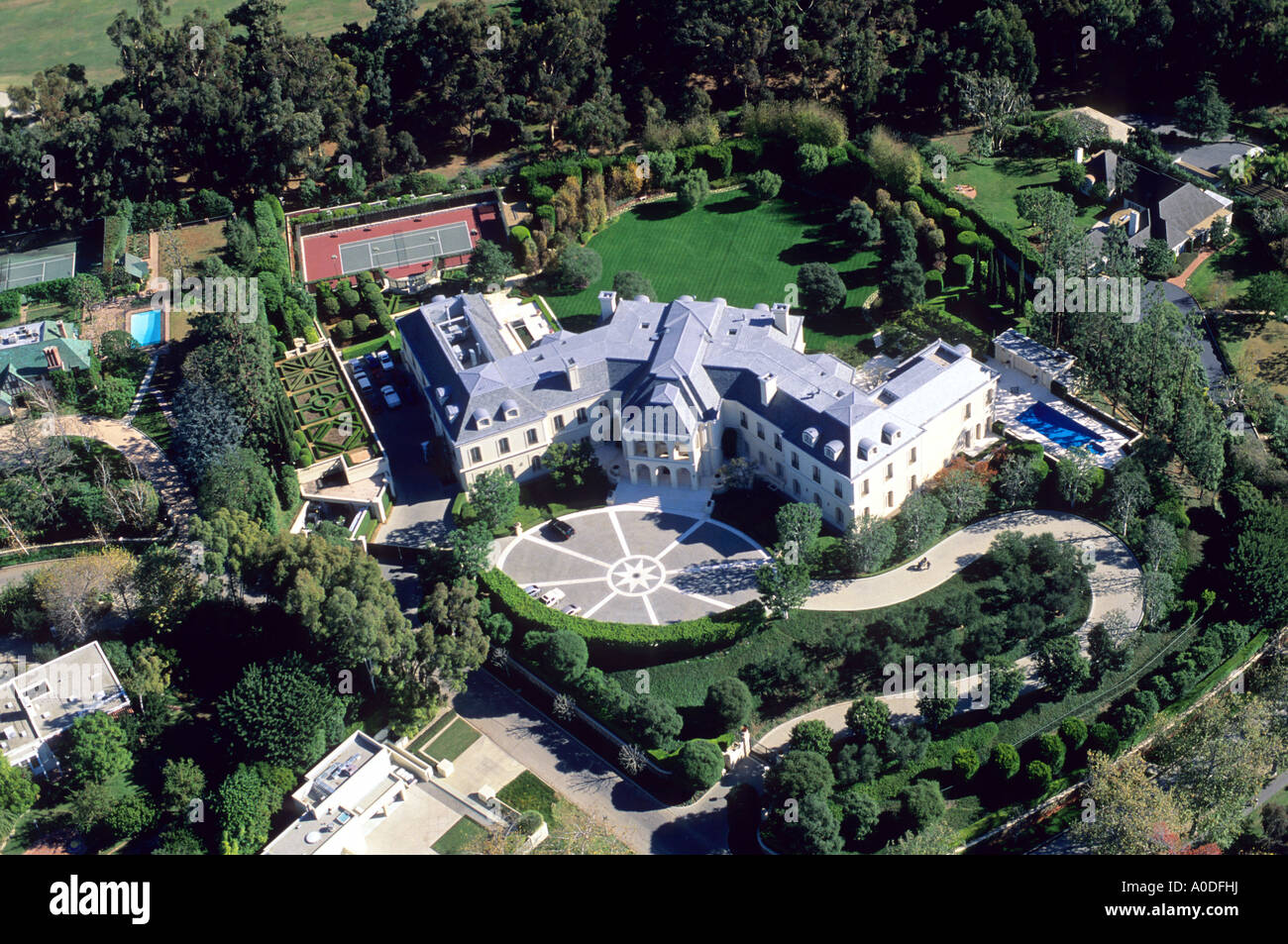
When the Aaron Spelling mansion—officially known as "The Manor"—sold in 2011 to 22-year-old British heiress Petra Ecclestone for $85 million, it marked one of the most high-profile luxury real estate transactions in American history. Ecclestone later renovated the 56,000-square-foot Holmby Hills estate and resold it in 2019 for a record-breaking $119.75 million.
The Architectural Genesis of Hollywood's Largest Private Residence
Constructed in 1988 for legendary television producer Aaron Spelling and his wife Candy, The Manor was designed to be the ultimate statement of Hollywood royalty. Built on the former site of entertainer Bing Crosby’s estate in the prestigious Holmby Hills neighborhood of Los Angeles, the French chateau-style mansion encompasses approximately 56,000 square feet of living space, making it larger than the White House.
Designed by architect James Langenheim & Associates, the estate took years to construct and generated massive media coverage long before its completion. The sheer scale of the property required custom engineering, from reinforced structural framing capable of supporting massive limestone cladding to complex climate-control systems designed to preserve extensive private art collections.
The original interior configuration featured 123 rooms tailored to the couple's specific lifestyle preferences. Unique amenities included dedicated rooms for gift wrapping, a silver storage room with controlled humidity, a private bowling alley, three rooms dedicated solely to wrapping presents, and multiple guest suites named after famous Hollywood figures. The grounds span nearly 4.7 acres of prime real estate within the "Platinum Triangle" of Los Angeles—comprising Bel Air, Beverly Hills, and Holmby Hills—featuring manicured French gardens, citrus orchards, a tennis court, a swimming pool, and parking capacity for over 100 vehicles.
For over two decades, the residence served as the focal point of the Spelling family's public and private life. Following Aaron Spelling’s passing in 2006, Candy Spelling maintained the property until placing it on the market in 2009 with an unprecedented asking price of $150 million, initiating a high-stakes sale process that captivated the global luxury real estate market.
The 2011 Sale: How 22-Year-Old Petra Ecclestone Acquired The Manor
In June 2011, after two years on the market, The Manor sold for $85 million in an all-cash transaction. The buyer was Petra Ecclestone, the then 22-year-old daughter of Formula 1 billionaire Bernie Ecclestone and Croatian model Slavica Ecclestone. The acquisition shocked traditional real estate analysts, who had expected a seasoned institutional investor, domestic tech mogul, or international sovereign fund to acquire a property of such magnitude.
- 1988: Built by Aaron Spelling
- 2011: Petra Ecclestone ($85M)
- 2019: Record Resale ($119.75M)
The story behind the acquisition involved rapid negotiation and immense purchasing power. Petra Ecclestone was seeking a West Coast residence to split her time between London and Los Angeles. Despite the original $150 million listing price, the final agreed price of $85 million represented a substantial negotiation discount while remaining one of the highest residential prices ever paid in Los Angeles County at that time.
The deal was executed swiftly, supported by an all-cash offer that eliminated financing contingencies—a critical factor for Candy Spelling, who sought a definitive exit to downsize to a Century City penthouse. Ecclestone's acquisition demonstrated how generational wealth transfer and global luxury capital were shifting the demographic of trophy-asset buyers in Southern California.
The Transformation: Modernizing a French Chateau Estate
Upon taking ownership in 2011, Petra Ecclestone embarked on an extensive, multi-million-dollar renovation to transform the property from traditional, 1980s English-country-inspired luxury into a sleek, contemporary mansion. She hired celebrity interior designer Gavin Brodin to lead a massive workforce that completed the overhaul in less than nine months.
The renovation completely re-imagined the aesthetic framework of the house:
- Color Palette and Finishes: The original pastel tones, heavy floral wallpaper, and traditional silk damask were replaced with a monochromatic palette dominated by black marble, crisp white walls, metallic accents, and dark hardwood floors.
- Structural Reconfigurations: The famous gift-wrapping rooms and specialized display spaces were repurposed into contemporary wellness suites, private massage rooms, a fully equipped hair salon, and modernized dressing rooms.
- Entertainment Facilities: The subterranean bowling alley was restored with sleek modern materials, while a private nightclub space was integrated alongside a state-of-the-art home theater, billiard room, and wine cellar.
- Lighting and Smart Home Systems: Hundreds of customized lighting fixtures, including a massive Baccarat crystal chandelier in the grand entry foyer, were installed alongside integrated home automation, security, and audio systems.
By updating the property’s aesthetic and operational infrastructure, Ecclestone successfully converted an aging custom-built mansion into a turn-key estate that appealed to modern ultra-high-net-worth individuals (UHNWIs) seeking contemporary luxury at scale.
The 2019 Record Sale: The $119.75 Million Resale Benchmark
In 2016, Petra Ecclestone listed The Manor for sale with an initial asking price of $200 million. After several years on the market and adjustments in pricing strategy, the estate sold in July 2019 for $119.75 million. At the time of closing, this transaction set the record for the most expensive home sale in Los Angeles County history, surpassing the previous record of $110 million set by a Malibu beachfront property.
The buyer in the 2019 transaction purchased the estate through a Delaware limited liability company, Spelling Manor LLC. While luxury brokers maintained strict non-disclosure agreements, public records and real estate reports linked the purchasing entity to representation associated with Middle Eastern investment capital. The transaction was brokered by top-tier Los Angeles real estate firms, including Hilton & Hyland, Westside Estate Agency, and The Agency.
The $119.75 million sale underscored several key realities of trophy real estate:
- Physical Turn-Key Value: The extensive modernizations completed by Ecclestone allowed the property to command a substantial premium over its 2011 purchase price.
- Land and Scale Exclusivity: As Los Angeles municipal codes increased restrictions on building envelope sizes (commonly known as anti-mansionization ordinances), acquiring a pre-existing 56,000-square-foot residence on nearly 5 contiguous acres in Holmby Hills became virtually unrepeatable.
- Resiliency of Ultra-Prime Assets: Despite broader luxury real estate slowdowns, unique real estate assets with historical significance consistently attract global capital.
Historical Comparison of The Manor’s Key Ownership Eras
The evolution of The Manor reflects broader changes in global architecture, real estate valuation, and interior design trends over four decades.
| Parameter | The Spelling Era (1988–2011) | The Ecclestone Era (2011–2019) | Modern Era (2019–Present) |
|---|---|---|---|
| Primary Owner | Aaron & Candy Spelling | Petra Ecclestone | Private Investment Entity (LLC) |
| Purchase Price | Land acquired 1983 (~$10.25M) | $85,000,000 (2011) | $119,750,000 (2019) |
| Interior Style | Traditional French Chateau / English Country | Contemporary Monochromatic / Glamour | Modernized Ultra-Luxury |
| Notable Features | Gift-wrapping rooms, doll museum, silver room | Baccarat chandelier, modern salon, updated bowling alley | Private wellness spa, resort grounds, security systems |
| Primary Material Palette | Ornate woodwork, heavy damask, pastel granite | Black marble, white quartz, dark hardwoods | Custom stone, structural glass, integrated lighting |
| Land Area | ~4.7 Acres | ~4.7 Acres | ~4.7 Acres |
Market Dynamics: What The Sales Reveal About Ultra-Prime Real Estate
The history of The Manor's transactions provides a clear case study in the dynamics of the global trophy-asset market. Properties of this magnitude do not follow standard residential real estate metrics, such as traditional price-per-square-foot valuations derived from local sales comps. Instead, their values are driven by scarcity, privacy, land mass, and international capital flows.
Land Value vs. Structure Value
In ultra-prime markets like Holmby Hills, land value accounts for a substantial percentage of total asset valuation. A contiguous 4.7-acre parcel in the Platinum Triangle is extraordinarily rare. Buyers at this level often treat the existing structure as an adaptable framework, knowing that acquiring an equivalent land assembly in prime Los Angeles is practically impossible due to zoning laws and neighborhood density.
The Cost of Carrying Ultra-Prime Real Estate
Holding an estate of 56,000 square feet requires massive annual operational capital. Property taxes alone on a $120 million valuation in California (under Proposition 13 base rates) exceed $1.4 million annually, plus local assessments. Operational costs—including 24/7 security teams, full-time landscaping crews, property management, climate control, and structural maintenance—can easily add several million dollars per year to the carrying costs.
The Role of Offshore Entities and Anonymity
As demonstrated in the 2019 sale, privacy is paramount for buyers operating in the nine-figure real estate bracket. High-net-worth individuals routinely utilize multi-layered limited liability companies, offshore trusts, and specialized legal counsel to execute transfers without disclosing beneficial ownership. This legal insulation protects security, prevents targeted solicitation, and minimizes personal liability.
Frequently Asked Questions
How big is the Aaron Spelling mansion compared to other famous homes?
At approximately 56,000 square feet, The Manor is larger than the White House (which is roughly 55,000 square feet). It remains one of the largest single-family private residences in Los Angeles County.
Who bought the Aaron Spelling mansion in 2011?
Petra Ecclestone, the daughter of former Formula 1 chief executive Bernie Ecclestone, purchased the estate from Candy Spelling in June 2011 for $85 million in an all-cash deal.
How much did the Spelling mansion sell for in 2019?
The estate sold in July 2019 for $119.75 million. The purchase set a record at the time for the highest residential sale price ever recorded in Los Angeles County.
Who owns the Aaron Spelling mansion today?
The property was purchased in 2019 through a Delaware entity named Spelling Manor LLC. The ultimate beneficial owner remains anonymous behind legal privacy structures, though reporting consistently links the entity to international investment capital.
What unique features were built into the original mansion?
The original construction by Aaron and Candy Spelling included three rooms dedicated exclusively to wrapping presents, a silver storage room with climate control, a doll display room, a private two-lane bowling alley, a barber shop, and parking space for over 100 cars.
Strategic Takeaways for Ultra-Prime Real Estate Analysis
Analyzing historic properties like The Manor requires looking beyond media headlines to understand the underlying economic drivers of ultra-high-net-worth real estate transactions:
- Evaluate Land Scarcity First: In land-constrained luxury enclaves like Holmby Hills or Bel Air, the acreage and zoning rights often hold long-term value better than the specific interior decor of the home.
- Account for Capital Expenditure (CapEx): Comprehensive renovations on estates over 50,000 square feet require tens of millions of dollars in capital. Modernization is essential to maintain liquidity and marketability when selling to contemporary international buyers.
- Recognize Global Capital Flows: Sales of trophy assets are rarely tied strictly to local economic conditions. Instead, they reflect global liquidity, currency movements, wealth transfer events, and international capital deployment strategies.