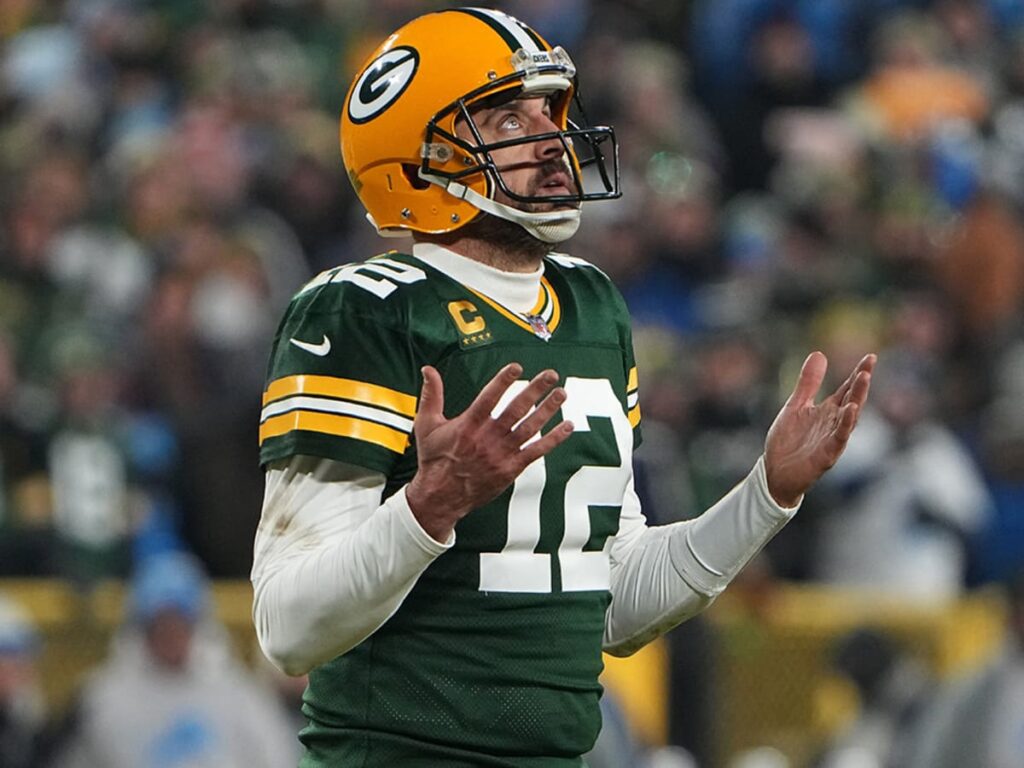
Aaron Rodgers’ current financial standing in the NFL is defined by a historic 2023 contract restructure with the New York Jets, where he accepted a $75 million fully guaranteed two-year deal. This move represented a $35 million pay cut from his previous Green Bay Packers extension, designed to provide the Jets with maximum salary cap flexibility.
The Evolution of Aaron Rodgers’ Contractual Landscape
Aaron Rodgers has long been a pioneer in NFL contract negotiations, consistently pushing the ceiling for quarterback compensation. Throughout his career, Rodgers has transitioned from a standard first-round rookie deal to becoming the league's highest-paid player on multiple occasions. His journey through the Green Bay Packers organization saw him sign four major extensions, each reflecting his status as a multi-time MVP. However, the most significant shift occurred during his transition to the New York Jets, where the focus shifted from pure "top-of-market" value to "roster-building" flexibility.
In the modern NFL, a quarterback's contract is not just about the total value; it is a complex instrument of cap engineering. For Rodgers, his later deals have prioritized "guaranteed money" over "total potential value." By securing high guarantees, he protected his earnings against injury or performance dips, while the teams used signing bonuses and "void years" to spread the financial hit across several seasons. As of 2026, the ripple effects of his 2023 restructure remain a case study in how veteran superstars can leverage their earnings to influence team competitiveness.
The Landmark 2023 New York Jets Contract Rework
When Aaron Rodgers was traded to the New York Jets in 2023, he inherited a massive contract from the Packers that would have been difficult for New York to manage while remaining competitive in free agency. To resolve this, Rodgers and the Jets front office negotiated a unique two-year deal that essentially replaced the remaining years of his previous extension.
The core of this deal was a two-year, $75 million fully guaranteed package. What made this deal "latest" in terms of its impact was the sheer amount of money Rodgers left on the table—roughly $35 million compared to the $110 million he was originally owed over that same period. This sacrifice allowed the Jets to sign key veterans and retain defensive talent. The contract was structured with a massive signing bonus and several "void years" (years added to the contract for accounting purposes only) to keep his immediate salary cap hit remarkably low during the 2023 and 2024 seasons.
Key Components of the Jets Deal:
- Total Guaranteed Money: $75 million, which was fully guaranteed at the time of signing.
- Average Annual Value (AAV): $37.5 million per year, which significantly trailed behind then-market leaders like Joe Burrow or Justin Herbert, who had surpassed the $50 million mark.
- Cap Management: The use of void years allowed the Jets to prorate his signing bonus through 2029, even though the active playing contract only spanned two seasons.
Breakdown of Salary, Signing Bonuses, and Dead Cap
Understanding Rodgers' salary requires a distinction between "cash paid" and "cap hit." The NFL salary cap is a fluid system where cash paid to a player today can be accounted for in the future. Rodgers’ contracts have frequently utilized the "option bonus" and "signing bonus" mechanisms to maximize his immediate liquidity while providing the team with breathing room.
A signing bonus is paid upfront but divided equally across the length of the contract (up to five years) for cap purposes. For example, if Rodgers receives a $35 million signing bonus on a five-year accounting deal, the team only counts $7 million against the cap each year. However, if Rodgers retires or is cut, the remaining "unamortized" bonus money accelerates into the current year as dead cap. This financial reality made Rodgers nearly "uncuttable" for the majority of his career, as the dead cap hit would have been more expensive than keeping him on the roster.
Comparison Table: Packers Extension vs. Jets Rework
| Feature | 2022 Green Bay Extension | 2023 Jets Rework |
|---|---|---|
| Total Value | $150.8 Million (3 Years) | $75 Million (2 Years) |
| Guaranteed at Signing | $101.5 Million | $75 Million |
| Annual Average | $50.27 Million | $37.5 Million |
| Signing/Option Bonus | ~$40 Million | ~$35 Million |
| Structure Strategy | Market Setting / Inflation Hedge | Roster Flexibility / Cap Relief |
| Void Years Used | Yes (2) | Yes (5) |
Performance Bonuses and Incentive Structures
Beyond the base salary and signing bonuses, Rodgers' contracts have historically included performance-based incentives. These are categorized by the NFL as either Likely To Be Earned (LTBE) or Not Likely To Be Earned (NLTBE).
- LTBE Incentives: These are based on benchmarks the player achieved in the previous season (e.g., reaching the playoffs or a certain passer rating). These count against the current year's salary cap.
- NLTBE Incentives: These are higher benchmarks the player did not reach the year before (e.g., winning the Super Bowl or MVP if they hadn't done so recently). These only count against the following year's cap if they are actually achieved.
For Rodgers, performance bonuses are often tied to team success rather than individual stats. In his later years, specifically with the Jets, the focus was on playoff wins and Super Bowl appearances. These incentives are a way for the team to pay the player more if—and only if—the investment results in elite success. While Rodgers’ 2023 deal was primarily focused on guaranteed base salary, his previous Packers deals were laden with escalators that increased his future salary based on Pro Bowl selections and All-Pro honors.
The Mechanics of Void Years and Future Dead Cap
As we look at the status of Rodgers' financial footprint in 2026, the concept of void years is the most critical element. A void year is a dummy year added to the end of a contract. The player is not expected to play that year, and the contract "voids" on a specific date (usually before the new league year).
The Jets utilized this heavily with Rodgers to spread out his $35 million signing bonus. Even if Rodgers is no longer playing in 2026, the Jets may still be carrying a cap charge for him. This is the "hangover" effect of aggressive cap management. If a player retires, all remaining prorated bonus money hits the cap immediately. For a player like Rodgers, who has commanded massive bonuses, the dead cap figure can exceed $50 million depending on the timing of his retirement. This financial tie often dictates when a player and team decide to part ways, as both must agree on a timing that doesn't cripple the team's ability to sign new players.
Comparing Rodgers to the New Guard of Quarterbacks
By 2026, the quarterback market has shifted dramatically from the era when Rodgers was the first player to cross the $50 million AAV threshold. With younger stars like Patrick Mahomes, Joe Burrow, and Lamar Jackson signing deals that approach or exceed $60 million per year, Rodgers' $75 million deal with the Jets appears remarkably team-friendly in hindsight.
The " Rodgers Effect" on the market was his insistence on shorter, high-AAV deals. Historically, quarterbacks signed 6-to-10-year "lifetime" deals. Rodgers shifted the trend toward 3-year extensions, allowing players to "double dip" into the market as the league's media revenue—and consequently the salary cap—rose. This strategy ensured that he was never stuck on an undervalued contract for long, a move that has been emulated by almost every elite quarterback entering negotiations today.
Performance and Value Correlation
NFL analysts often use "Percentage of Cap" to measure a contract's true cost. When Rodgers signed with Green Bay in 2022, his cap hit represented nearly 20% of the team's total room. In contrast, his reworked Jets deal dropped that percentage significantly, allowing the team to maintain a top-10 defense. This correlation between Rodgers' salary and the quality of the surrounding roster is the defining narrative of his late-career deals.
FAQ: Common Questions About Aaron Rodgers' Contracts
What is the difference between "guaranteed money" and "injury guarantees" in Rodgers' deals?
"Guaranteed at signing" means the player receives the money regardless of what happens. "Injury guarantees" only kick in if the player is physically unable to play. In his 2023 Jets rework, Rodgers secured $75 million that was fully guaranteed for skill, cap, and injury, providing him the highest level of financial security possible in the NFL.
How do "void years" affect the Jets' salary cap in 2026?
Void years allow the team to spread out the signing bonus over five years. If Rodgers' contract had five void years starting in 2023, the Jets would still be accounting for a portion of his initial bonus on their 2026 cap, even if he were to retire or leave the team after the 2025 season.
Why did Aaron Rodgers take a $35 million pay cut with the Jets?
The pay cut was a strategic move to improve the Jets' roster. By reducing his own salary, Rodgers allowed the front office to have more "effective cap space," which was used to bring in veteran players and provide the team with the depth necessary for a deep playoff run.
Is Aaron Rodgers still the highest-paid player in the NFL?
As of 2026, Aaron Rodgers is no longer the highest-paid player by Average Annual Value (AAV). Several younger quarterbacks have signed larger deals since his 2023 restructure. However, he remains one of the highest-earning players in NFL history in terms of cumulative career earnings.
What happens to Rodgers' contract if he retires?
If Rodgers retires, his base salary for future years is forfeited, but any previously paid signing bonus that has not yet been "accounted for" on the salary cap will accelerate. This creates a "dead cap" hit for the team, meaning they must pay the cap cost of money already spent in previous years.
Evaluating Contract Success and Team Impact
When assessing the "latest deals" and "salary bonuses" of a player like Aaron Rodgers, the final metric is always the balance between financial gain and team success. Rodgers has mastered the art of the NFL contract, moving from the aggressive, market-resetting deals of his Green Bay years to the veteran-optimized, team-friendly restructure in New York.
For fans and analysts, the key takeaway is that a contract is never just a single number; it is a timeline of cap hits, cash flows, and strategic sacrifices. As Rodgers approaches the conclusion of his career, his contracts serve as the blueprint for how elite athletes balance their personal market value with the collective goals of their franchise. To track his current impact, readers should monitor the Jets' "Active Cap" reports and "Dead Money" projections, which provide the most accurate picture of his ongoing financial relationship with the league.