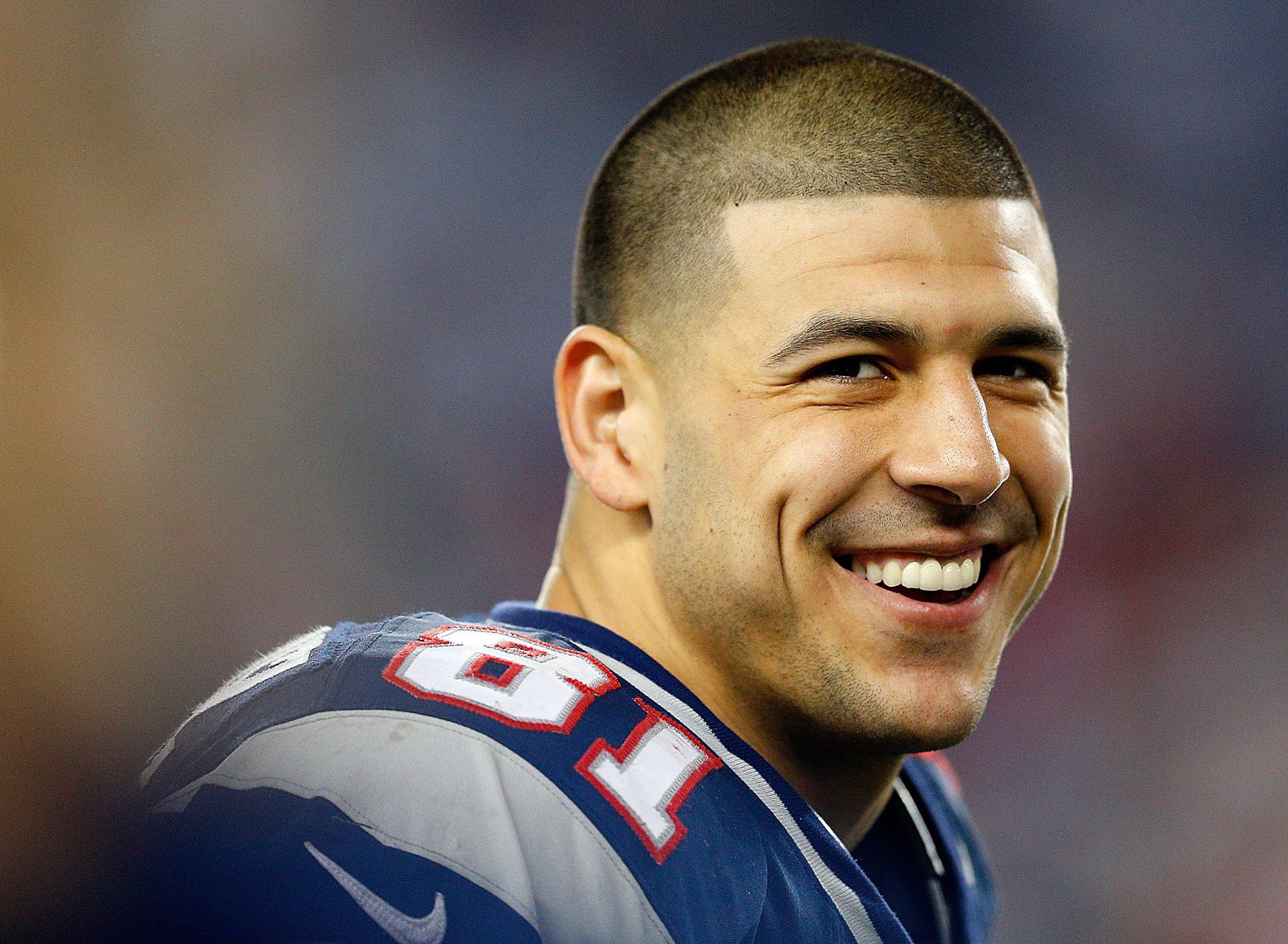
Aaron Hernandez was a former New England Patriots tight end whose elite athletic career ended abruptly following his 2013 arrest for the murder of Odin Lloyd. Convicted of first-degree murder in 2015, Hernandez died by suicide in prison in 2017. Subsequent brain analysis revealed severe Chronic Traumatic Encephalopathy (CTE), while his post-mortem legal proceedings permanently reshaped criminal jurisprudence in Massachusetts.
Early Life and Collegiate Career at Florida
Aaron Josef Hernandez was born on November 6, 1989, in Bristol, Connecticut. A prodigiously gifted athlete at Bristol Central High School, Hernandez established statewide records as a wide receiver and tight end. Following the unexpected death of his father, Dennis Hernandez, in 2006, his personal life experienced significant turbulence, yet his on-field performance made him one of the most highly recruited football prospects in the country.
Hernandez committed to the University of Florida, playing for the Gators under head coach Urban Meyer from 2007 through 2009. During his tenure at Florida, Hernandez developed into one of the nation's premier offensive weapons. As a junior in 2009, he won the John Mackey Award, recognized as the top tight end in college football, and helped lead the Gators to a BCS National Championship.
Despite his dynamic performance on the field—accumulating 111 receptions for 1,382 yards and 12 touchdowns over his college career—off-field concerns emerged. Reports of failed substance tests and an altercation at a Gainesville restaurant caused multiple National Football League (NFL) teams to lower his evaluation on their draft boards prior to the 2010 NFL Draft.
NFL Career with the New England Patriots
Selected by the New England Patriots in the fourth round (113th overall) of the 2010 NFL Draft, Hernandez quickly demonstrated that his skill set translated to the professional level. Alongside fellow 2010 draft pick Rob Gronkowski, Hernandez formed half of the most prolific tight-end duo in NFL history. Head coach Bill Belichick utilized Hernandez as a versatile "move" tight end who could line up in the inline position, in the slot, or out of the backfield as a H-back.
| Season | Receptions | Receiving Yds | Touchdowns |
|---|---|---|---|
| 2010 | 45 | 563 | 6 |
| 2011 | 79 | 910 | 7 |
| 2012 | 51 | 483 | 5 |
| Total (3 Seasons) | 175 | 1,956 | 18 |
In 2011, Hernandez caught 79 passes for 910 yards and seven touchdowns, helping lead the Patriots to an AFC Championship and an appearance in Super Bowl XLVI, where he scored a touchdown. Recognizing his central role in their offense, the Patriots signed Hernandez to a five-year, $40 million contract extension in August 2012, which included a $12.5 million signing bonus—the largest ever given to an NFL tight end at that time.
The Murder of Odin Lloyd and Criminal Trials
Hernandez's football career ended on June 26, 2013, when he was arrested at his home in North Attleborough, Massachusetts, and charged with the first-degree murder of Odin Lloyd. Lloyd, a 27-year-old semi-professional football player for the Boston Bandits, was dating Shaneah Jenkins, the sister of Hernandez's fiancée, Shayanna Jenkins.
The Murder of Odin Lloyd (2013–2015)
On June 17, 2013, Lloyd's body was discovered with multiple gunshot wounds in an industrial park in North Attleborough, less than a mile from Hernandez's residence. Investigators constructed a narrative using home security footage, cell phone location data, text messages, and physical evidence recovered from rental vehicles.
Within 90 minutes of his arrest on June 26, 2013, the New England Patriots officially released Hernandez, forfeiting the remainder of his contract.
- Trial Timeline: The trial began in January 2015 in Fall River, Massachusetts, presided over by Superior Court Judge Susan Garsh.
- Prosecution Strategy: Prosecutors argued that Hernandez orchestrated the killing due to an interpersonal grievance, recruiting associates Ernest Wallace and Carlos Ortiz to assist in transporting Lloyd to the remote location.
- Verdict: On April 15, 2015, the jury found Hernandez guilty of first-degree murder, alongside firearm possession charges. Under Massachusetts law, a first-degree murder conviction carries a mandatory sentence of life imprisonment without the possibility of parole.
Double Homicide Trial (2017)
While awaiting trial for the Lloyd murder, Hernandez was indicted in May 2014 for an unrelated double homicide that occurred on July 16, 2012, outside a Boston nightclub. The victims, Daniel de Abreu and Safiro Furtado, were killed in a drive-by shooting while stopped at a traffic light.
Prosecutors alleged that Hernandez fired into the victims' vehicle after de Abreu accidentally bumped into him inside the club, spilling a drink. Lead defense attorney Jose Baez contested the state's reliance on star witness Alexander Bradley, a former associate of Hernandez, arguing that Bradley himself had committed the shootings.
On April 14, 2017, the jury acquitted Hernandez of all murder charges in the Boston case, convicting him only of a single count of unlawful gun possession.
Death, CTE Research, and Judicial Precedents
On April 19, 2017—five days after his acquittal in the double homicide trial—Hernandez was found dead in his cell at the Souza-Baranowski Correctional Center in Shirley, Massachusetts. His death was officially ruled a suicide by hanging.
| Year | Event | Legal / Medical Significance |
|---|---|---|
| 2010 | Drafted by New England Patriots | Selected 113th overall; begins 3-year NFL career. |
| 2012 | Signs $40M Contract Extension | Largest signing bonus ($12.5M) for an NFL tight end. |
| 2013 | Arrested for Murder of Odin Lloyd | Released by Patriots; held without bail. |
| 2015 | Convicted of First-Degree Murder | Sentenced to mandatory life without parole. |
| 2017 | Acquitted of 2012 Double Homicide | Found not guilty of killing de Abreu and Furtado. |
| 2017 | Death by Suicide in Prison | Triggers post-mortem medical and legal proceedings. |
| 2017 | Stage 3 CTE Diagnosis Disclosed | Boston University reveals unusually severe CTE. |
| 2019 | Conviction Reinstated by SJC | Mass. Supreme Judicial Court abolishes abatement. |
Brain Examination and CTE Findings
Following his death, Hernandez's family donated his brain to the Boston University Center for Chronic Traumatic Encephalopathy (CTE Center). Researchers led by Dr. Ann McKee diagnosed Hernandez with Stage 3 CTE—a severity level rarely seen in an individual who died at age 27.
- Stage 1: Focal tau pathology, mild executive dysfunction or mood changes.
- Stage 2: Tau neurofibrillary tangles spread to frontal/temporal lobes; social instability, mood swings.
- Stage 3: Extensive tau spread; severe memory loss, aggression, impulse control deficits (Hernandez Diagnosis).
- Stage 4: Widespread dementia, profound cognitive impairment, severe brain atrophy.
Dr. McKee noted that Hernandez exhibited advanced damage to the frontal lobe, which governs impulse control, judgment, and emotional regulation, alongside severe atrophy of the fornix and damage to the amygdala. The diagnosis shifted broader discussions surrounding contact sports, player safety, and the potential behavioral manifestations of repetitive head impacts in young athletes.
Abolition of the Abatement Ab Initio Legal Doctrine
At the time of his death, Hernandez's direct legal appeal of his 2015 murder conviction had not yet been heard by the Massachusetts appellate court. Under the long-standing common law doctrine of abatement ab initio, if a criminal defendant dies before their direct appeal is concluded, the criminal prosecution is abated from the beginning, effectively vacating the conviction and restoring the deceased defendant to an unconvicted status.
In May 2017, Superior Court Judge Susan Garsh applied the doctrine and formally vacated Hernandez's murder conviction in the death of Odin Lloyd.
The prosecution appealed the ruling, arguing that the doctrine was outdated and denied crime victims justice. On March 13, 2019, the Massachusetts Supreme Judicial Court (SJC) issued a landmark ruling in Commonwealth v. Estate of Hernandez. The court abolished the practice of abatement ab initio in Massachusetts, ruling that when a defendant dies pending appeal, the conviction remains intact on the record, accompanied by a notation that the appeal was dismissed due to the defendant's death. As a result, Hernandez's first-degree murder conviction was permanently reinstated.
Impact on Contracts, Estates, and Victim Compensation
The legal fallout extended beyond the courtroom into civil litigation and contractual disputes:
- Contract Grievances: Following his release, the NFL Players Association (NFLPA) filed grievances on Hernandez's behalf to recover unpaid signing bonuses and guaranteed salary withheld by the Patriots. The claims were largely rendered moot or resolved unfavorably for the estate following the reinstatement of his conviction.
- Civil Suits and Estate Assets: Odin Lloyd's mother, Ursula Ward, filed a wrongful death lawsuit against Hernandez's estate. Though Hernandez's liquid assets were largely depleted by legal defense fees, settlements were pursued through insurance policies and remaining assets, such as the sale of his North Attleborough home.
Frequently Asked Questions
What was Aaron Hernandez's CTE diagnosis?
Post-mortem examination by neuropathologists at Boston University revealed that Aaron Hernandez had Stage 3 Chronic Traumatic Encephalopathy (CTE). This represented an unusually severe stage of neurodegenerative disease for a 27-year-old, characterized by significant brain tissue loss and heavy accumulations of abnormal tau protein in regions controlling memory, judgment, and impulse control.
Why was Aaron Hernandez's murder conviction initially vacated and then reinstated?
His conviction was initially vacated under abatement ab initio, a legal rule that erased convictions if a defendant died while an appeal was pending. In 2019, the Massachusetts Supreme Judicial Court formally abolished this doctrine, determining that a conviction should remain on record if the defendant dies before an appeal can be heard. Consequently, his conviction for the murder of Odin Lloyd was restored.
Was Aaron Hernandez convicted in the 2012 Boston nightclub double shooting?
No. In April 2017, a Boston jury acquitted Hernandez of murder charges relating to the deaths of Daniel de Abreu and Safiro Furtado. He was convicted only of a single count of illegal firearm possession stemming from that trial.
How did the Patriots handle Aaron Hernandez's contract after his arrest?
The New England Patriots released Hernandez immediately upon his arrest on June 26, 2013, voiding his remaining salary and withholding unpaid bonuses under the conduct detrimental to the team clause of his contract.
What was the legal result of Odin Lloyd's wrongful death suit against the estate?
The family of Odin Lloyd pursued a civil wrongful death lawsuit against Hernandez's estate. The suit was settled using funds generated from the sale of Hernandez's real estate and proceeds from insurance policies, providing financial compensation to Lloyd's family.
Understanding the Institutional Lessons of the Hernandez Case
The Aaron Hernandez narrative presents critical reference points for legal professionals, sports organizations, and medical institutions evaluating risk, athlete welfare, and post-conviction procedures:
- Legal Frameworks for Post-Mortem Appeals: The abolition of abatement ab initio in Massachusetts serves as a model for state jurisdictions re-evaluating common law rules regarding deceased appellants, prioritizing victim rights and judicial finality.
- Neurological Screening and Athlete Health: The severity of Hernandez's brain pathology underscored the necessity of improved protocols for detecting, tracking, and mitigating repetitive brain trauma in contact sports at the high school, collegiate, and professional levels.
- Organizational Risk Management: Professional sports franchises re-evaluated pre-draft character evaluations, background checks, and player support structures to better identify at-risk athletes requiring early psychological and behavioral intervention.