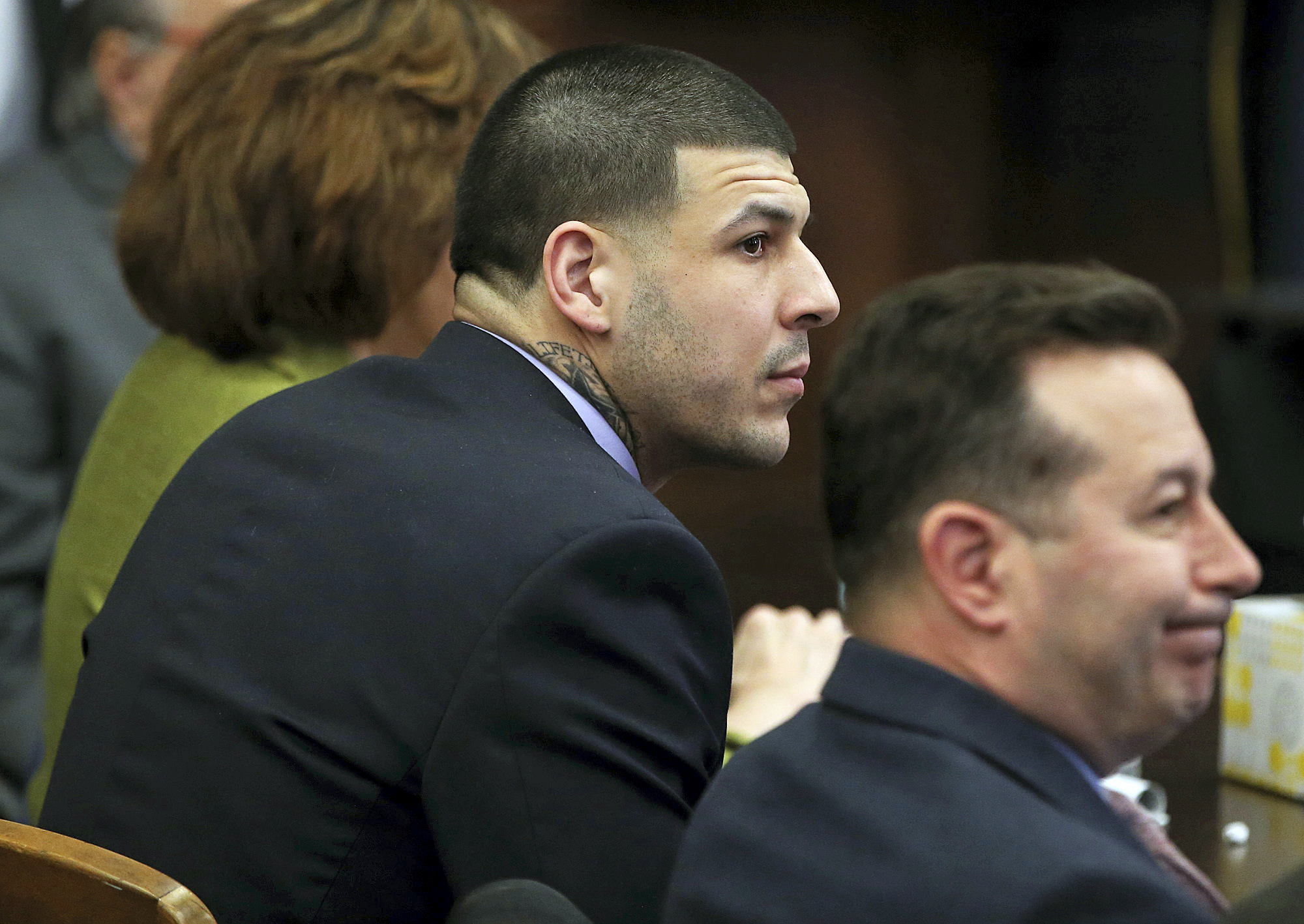
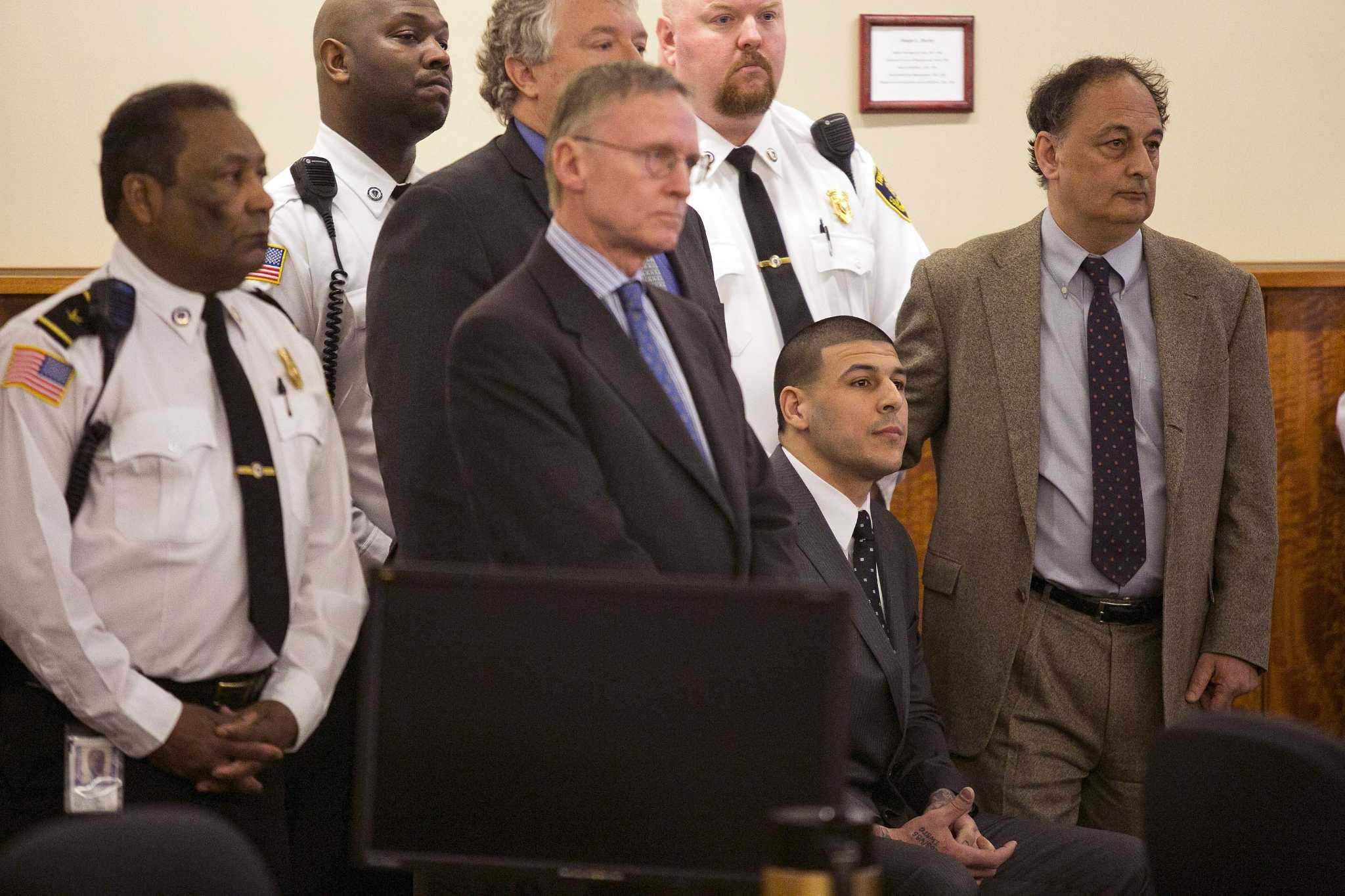
On April 15, 2015, former New England Patriots tight end Aaron Hernandez was convicted of first-degree murder for the 2013 killing of Odin Lloyd. Despite the absence of a recovered murder weapon, direct eyewitnesses, or a clear motive, the jury delivered a guilty verdict, resulting in a mandatory sentence of life imprisonment without parole.
The Context of the Trial: From NFL Stardom to the Bristol County Courtroom
Before his arrest in June 2013, Aaron Hernandez was one of the most promising young talents in the National Football League (NFL). Having signed a five-year, $40 million contract extension with the New England Patriots in 2012, Hernandez was a central player in a championship-caliber offense. However, his athletic career came to a sudden halt on June 26, 2013, when police led him from his North Attleborough, Massachusetts home in handcuffs.
The arrest stemmed from the discovery of 27-year-old Odin Lloyd’s body on June 17, 2013. Lloyd, a semi-professional football player for the Boston Bandits who was dating the sister of Hernandez’s fiancée, was found shot multiple times in an industrial park less than a mile from Hernandez’s residence. Within hours of Hernandez’s arrest, the New England Patriots officially released him, signaling a swift fall from professional athletics into a high-stakes criminal prosecution.
The trial, which formally commenced in January 2015 at the Bristol County Superior Court in Fall River, Massachusetts, quickly became a focal point for national media and legal analysts. Presided over by Superior Court Judge Susan Garsh, the proceedings required the court to evaluate extensive digital footprints, circumstantial forensics, and complex criminal liability standards over more than two months of testimony.
Why the Verdict Shocked the Public: Weighing High Expectations Against Legal Realities
When the jury returned a verdict of guilty on all counts—including first-degree murder, unlawful possession of a firearm, and unlawful possession of ammunition—many media observers and public followers were surprised. Several trial analysts had previously speculated that the prosecution had failed to establish guilt beyond a reasonable doubt due to evidentiary gaps that frequently doom capital-level murder trials.
The elements contributing to public doubt centered on three missing pieces of evidence:
- No Murder Weapon: Investigators searched local waterways, wooded areas, and storage facilities, but the .45-caliber semi-automatic handgun used to shoot Lloyd was never recovered.
- No Eyewitness Testimony: The state lacked an eyewitness who could testify directly to the moment of the shooting or confirm who pulled the trigger.
- Absence of a Clear Motive: The prosecution posited theories that Hernandez was angered by Lloyd speaking to certain individuals at a nightclub days prior, or that Lloyd held knowledge Hernandez wanted kept secret. However, no definitive, undisputed motive was established.
Despite these hurdles, the prosecution constructed a meticulous timeline built on physical and digital evidence. Under Massachusetts law, first-degree murder requires proof of deliberate premeditation, extreme atrocity or cruelty, or commission during a felony punishable by life imprisonment. The prosecution successfully convinced the jury that Hernandez acted with deliberate premeditation, demonstrating that a conviction can be secured entirely through circumstantial evidence when the chain of custody and logical inferences remain unbroken.
The Prosecution’s Case: Circumstantial Evidence and the Joint Venture Doctrine
The bedrock of the state’s prosecution, led by Bristol County Assistant District Attorney William McCauley, was a combination of technological data and a specific legal theory known as the joint venture doctrine.
Under Massachusetts criminal law, the joint venture instruction allows a jury to convict a defendant of first-degree murder without proving that the defendant personally fired the fatal shot. Instead, the Commonwealth must prove three essential elements beyond a reasonable doubt:
- The defendant knowingly joined and participated in the commission of the crime.
- The defendant possessed the requisite mental state (intent) required for the offense.
- The defendant intended to assist or encourage the commission of the crime, or was present and ready to assist if necessary.
To establish Hernandez’s participation as a joint venturer alongside co-defendants Ernest Wallace and Carlos Ortiz, the prosecution laid out a sequential narrative using home security footage, cellular tower pings, text messages, and physical forensics.
Timeline of Events (June 16–17, 2013): [June 16, 9:05 PM] Hernandez texts Odin Lloyd arranging to meet. [June 17, 1:12 AM] Hernandez picks up Wallace and Ortiz in a rented Nissan Altima. [June 17, 2:33 AM] Vehicle picks up Lloyd at his home in Boston. [June 17, 3:23 AM] Vehicle enters North Attleborough industrial park; gunshots reported shortly after. [June 17, 3:29 AM] Vehicle arrives back at Hernandez's house; security video records him carrying an object.
The home surveillance system installed at Hernandez's estate provided crucial evidence. Cameras captured Hernandez returning home minutes after the estimated time of Lloyd’s death holding an object that ballistics experts testified resembled a semi-automatic handgun. Furthermore, a discarded piece of chewed bubble gum found attached to a spent .45-caliber shell casing inside a rental car used by Hernandez yielded DNA matching Hernandez, directly linking him to the ammunition type used in the murder.
Key Evidence vs. Defense Arguments in the Odin Lloyd Murder Trial
The defense team, led by attorneys Michael Fee, James Sultan, and Charles Rankin, fought aggressively to dismantle the prosecution's circumstantial web. They argued that law enforcement suffered from "tunnel vision," focusing exclusively on Hernandez due to his celebrity status while failing to conduct a thorough investigation into alternative suspects or motives.
| Evidence Category | Prosecution Argument | Defense Rebuttal | Deliberation Outcome |
|---|---|---|---|
| Surveillance Video | Shows Hernandez holding a gun-like object inside his house shortly after the murder. | Claimed the object was a BlackBerry phone or non-lethal object; video quality was inconclusive. | Jury deemed the timeline and physical movements highly incriminating when combined with cell data. |
| Cellular Tower Pings | Tracks Hernandez's rental car moving from Boston to the North Attleborough industrial park. | Proved location and presence only, not specific actions or intent inside the dark park. | Established Hernandez's direct physical presence at the crime scene at the time of death. |
| DNA & Forensics | Hernandez's DNA found on chewed gum attached to a spent shell casing in the rental car. | Argued cross-contamination; noted shell casing was found in a rental vehicle driven by multiple people. | Tied Hernandez directly to the specific caliber and brand of ammunition used at the crime scene. |
| Co-Defendant Dynamics | Framed Hernandez as the leader who summoned Wallace and Ortiz to carry out an execution. | Portrayed Hernandez as a young man who panicked, stressing no testimony proved he gave orders. | Supported the legal threshold for "Joint Venture," eliminating the need to prove who held the gun. |
| Motive & Relationship | Asserted a breach of trust/disrespect at a night club created conflict between Hernandez and Lloyd. | Emphasized that Hernandez and Lloyd were friends and future brothers-in-law with no reason for violence. | Jury accepted that premeditation does not require a rational or fully proven personal motive. |
Strategic Defense Missteps and Key Pivots During Trial
A pivotal moment in the trial occurred during closing arguments, when defense attorney James Sultan made a tactical admission. Sultan acknowledged to the jury for the first time that Aaron Hernandez was present at the industrial park when Odin Lloyd was killed.
The defense argued that Hernandez was merely a witness—a shocked 23-year-old young man who saw his friends (Wallace or Ortiz) commit a sudden, senseless shooting and did not know what to do except go home and try to cover it up out of panic.
While this admission aimed to bolster defense credibility by addressing the overwhelming cell tower and GPS data, legal analysts noted that it carried immense risk. By placing Hernandez at the scene of the execution-style murder, the defense effectively fulfilled a major requirement of the state’s joint venture theory: establishing presence.
Once his presence at the scene was conceded, the prosecution only needed to convince the jury that Hernandez helped facilitate the logistics—such as driving the vehicle, picking up the victim, or facilitating the getaway—to secure a first-degree murder conviction. The jury deliberated for over 35 hours across seven days before reaching their unanimous guilty verdict.
Legal Aftermath: Death, Abatement Ab Initio, and Final Verdict Reinstatement
The legal proceedings surrounding Aaron Hernandez did not end with the 2015 verdict. His case later led to a significant ruling regarding appellate procedures in Massachusetts state law.
Following his conviction, Hernandez was transferred to the Souza-Baranowski Correctional Center to serve his life sentence. In April 2017, Hernandez was tried and acquitted in Suffolk County for a separate 2012 double murder involving Daniel de Abreu and Safiro Furtado. Five days after his acquittal in that trial, on April 19, 2017, Hernandez died by suicide in his prison cell.
At the time of his death, Hernandez’s direct appeal of his 2015 murder conviction for the killing of Odin Lloyd was still pending before the Massachusetts Supreme Judicial Court (SJC). Under a centuries-old legal doctrine known as abatement ab initio ("abatement from the beginning"), if a convicted criminal defendant dies before their direct appeal is exhausted, the indictment and underlying conviction are legally vacated, restoring the defendant's record to an unconvicted status.
In May 2017, Superior Court Judge Susan Garsh formally vacated Hernandez’s murder conviction in accordance with this established precedent, prompting public outcry from the victim's family and state prosecutors. The Commonwealth appealed the dismissal directly to the state's highest court.
Chronology of the Legal Status of the Conviction: - April 15, 2015: Convicted of First-Degree Murder (Guilty verdict entered). - May 9, 2017: Conviction vacated under Abatement Ab Initio doctrine following suicide. - March 13, 2019: MA Supreme Judicial Court abolishes Abatement Ab Initio; guilty verdict permanently reinstated.
On March 13, 2019, the Massachusetts Supreme Judicial Court issued a landmark decision in Commonwealth v. Hernandez. The court officially abolished the doctrine of abatement ab initio, ruling that it was outdated and unfair to victims and society. The court ordered Hernandez's first-degree murder conviction permanently reinstated on his official record, setting a binding legal precedent for all future criminal appeals in Massachusetts.
Lessons and Precedents Set by the Hernandez Trial
The trial and subsequent appellate decisions in the Aaron Hernandez case established several key insights for criminal justice practitioners, legal scholars, and law enforcement agencies:
- Potency of Digital Footprints: The case demonstrated how modern prosecutions rely heavily on digital aggregation. Cell site location information (CSLI), combined with private home surveillance systems and automated toll data, can establish timeline precision capable of overcoming a lack of eyewitnesses.
- Application of Joint Venture in Capital Cases: Prosecutors do not need to identify the primary shooter to achieve a first-degree murder conviction. Demonstrating shared intent, logistical support, and presence is sufficient under joint venture laws.
- Reform of Appellate Doctrines: The permanent reinstatement of Hernandez's conviction reshaped Massachusetts jurisprudence, ensuring that a defendant’s death while appealing no longer erases a jury’s trial verdict.
What was Aaron Hernandez found guilty of in his 2015 trial?
Aaron Hernandez was convicted of first-degree murder under deliberate premeditation, as well as two firearms charges: unlawful possession of a firearm and unlawful possession of ammunition. The verdict carried an automatic sentence of life imprisonment without the possibility of parole.
Was the murder weapon ever found in the Aaron Hernandez trial?
No. The .45-caliber semi-automatic handgun used to murder Odin Lloyd was never recovered by law enforcement. The prosecution relied on shell casings found at the crime scene, ballistics tests, and surveillance video showing Hernandez holding an object resembling a firearm to establish its existence and caliber.
What is the "Joint Venture" doctrine used in the prosecution?
The joint venture doctrine is a legal rule under Massachusetts law stating that an individual can be convicted of a crime even if they did not physically commit the final criminal act. The prosecution must prove that the defendant knowingly participated in the commission of the offense with the required criminal intent and aided or was ready to aid the primary actor.
Why was Aaron Hernandez's conviction initially erased and then reinstated?
His conviction was initially vacated under the doctrine of abatement ab initio because he died by suicide while his direct appeal was pending. However, in March 2019, the Massachusetts Supreme Judicial Court abolished this rule and officially reinstated his guilty verdict, ruling that a trial record should stand regardless of an appellant's death.
What sentence did Aaron Hernandez receive for the murder of Odin Lloyd?
Hernandez was sentenced to mandatory life imprisonment without the possibility of parole under Massachusetts state law for first-degree murder, alongside consecutive minor sentences for the associated illegal firearm and ammunition possession counts.
Key Insights from the Aaron Hernandez Verdict for Legal Observers
For legal observers analyzing high-profile prosecutions, the Aaron Hernandez murder trial serves as a study in circumstantial case management and joint liability strategies. The outcome highlights that defense strategies relying on the absence of a murder weapon or direct motive often face severe challenges when confronted with cohesive digital timelines and joint venture jury instructions.
When evaluating similar complex trials, observers should focus on three foundational elements: how digital forensics validate physical locations, how co-defendant liability laws shift the burden regarding who pulled the trigger, and how appellate courts manage post-conviction motions following a defendant's death.