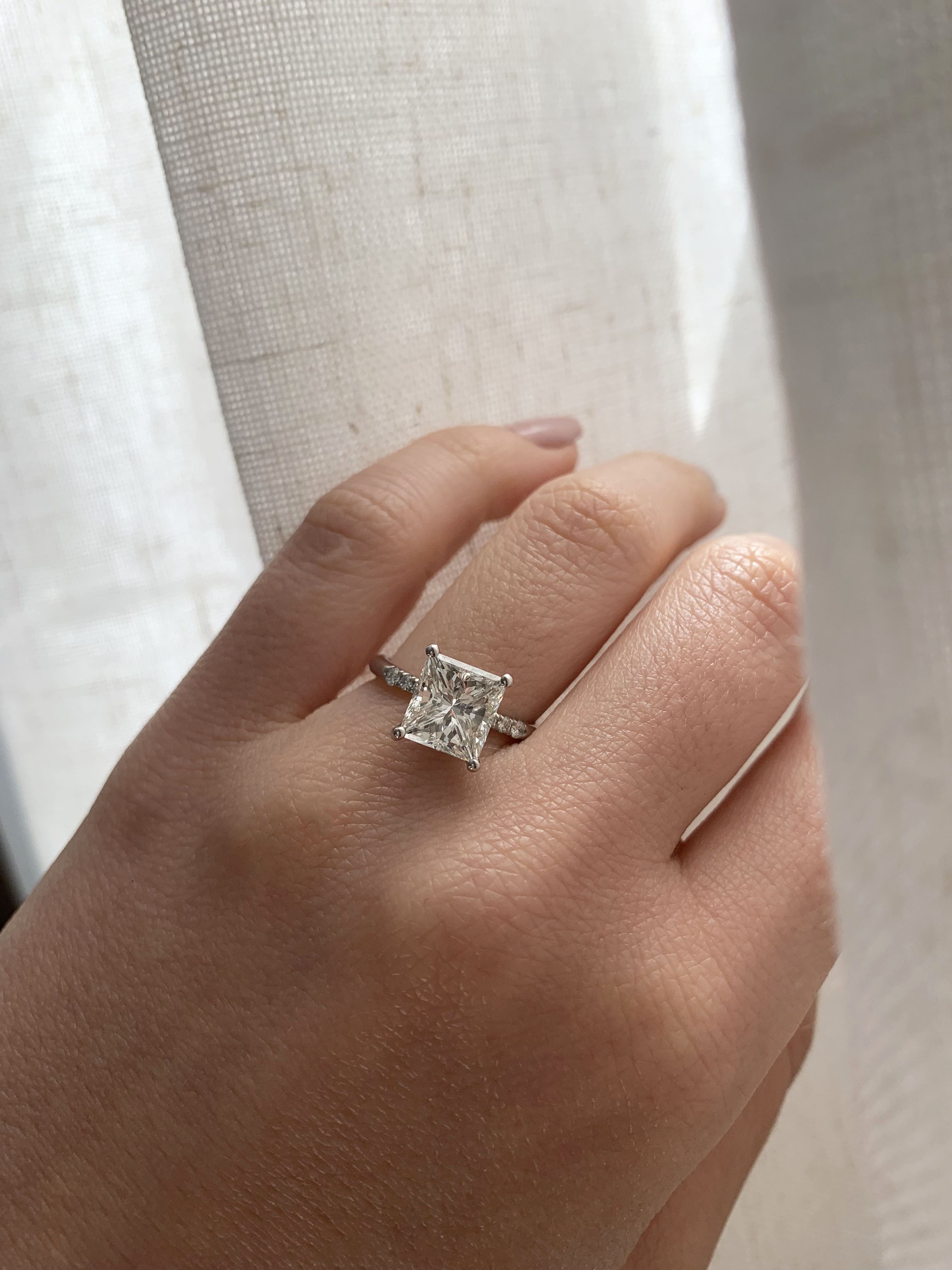
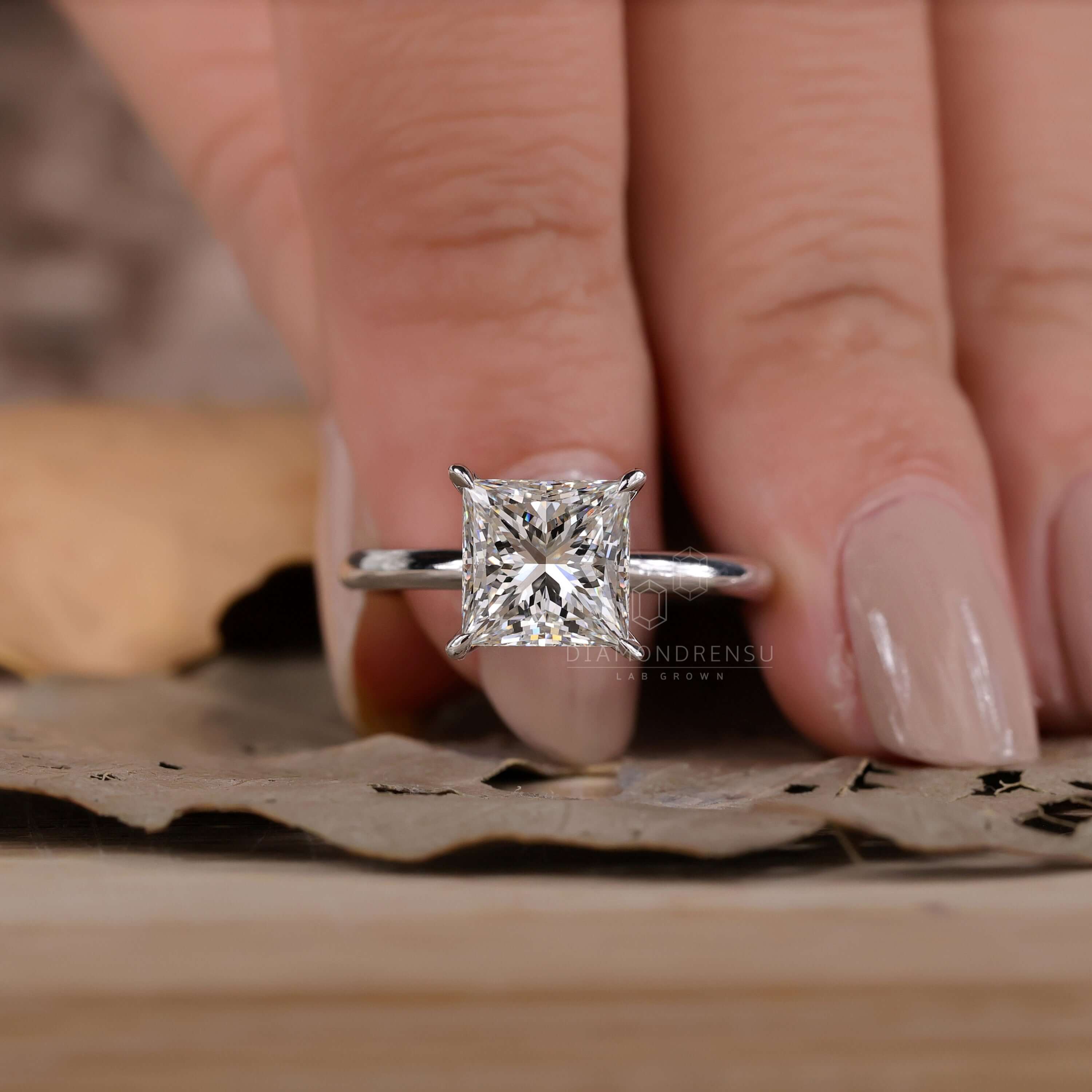
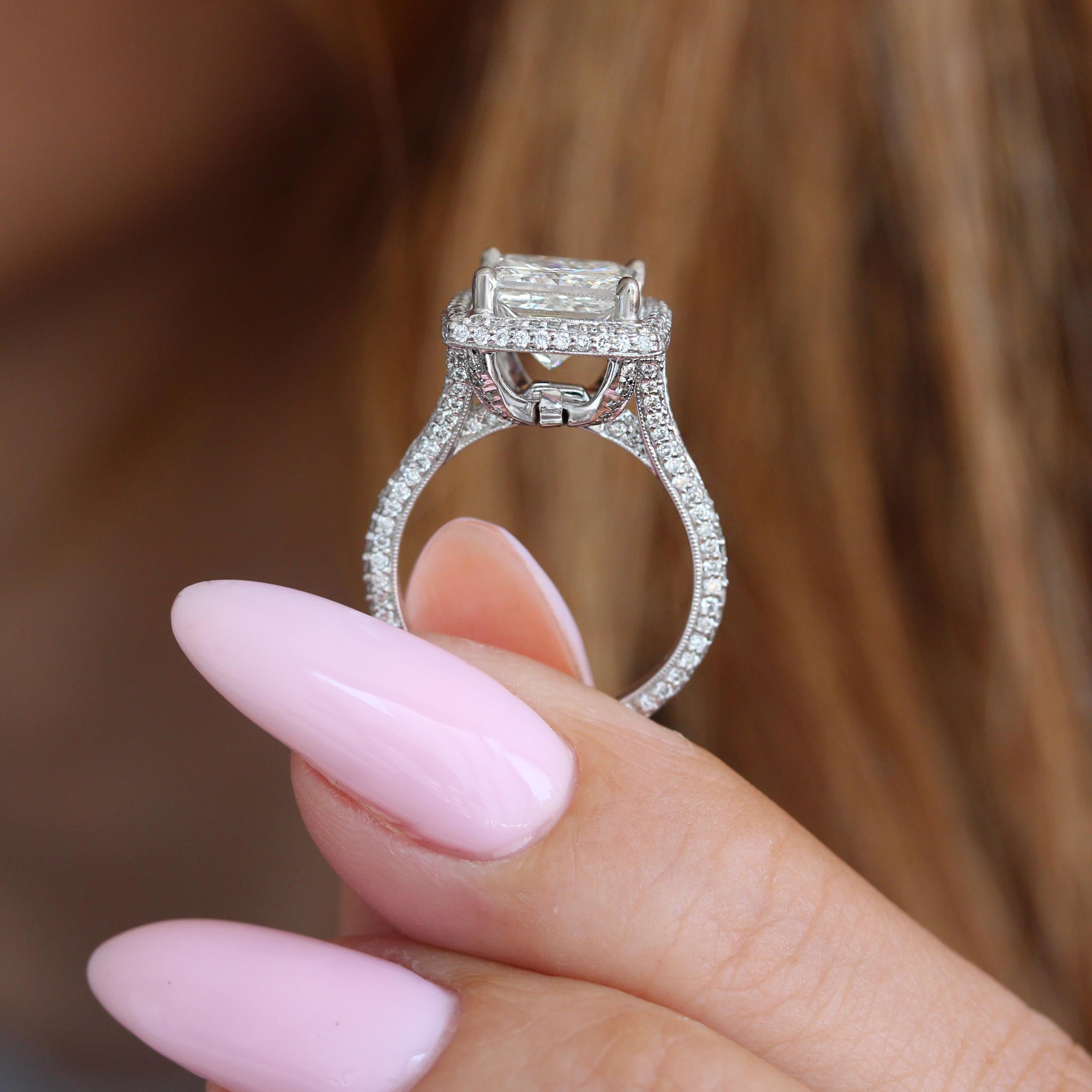
An 8-carat princess-cut diamond ring represents one of the most striking assertions of fine jewelry design, combining geometric modernism with the brilliance of a traditional brilliant cut. Acquiring a diamond of this magnitude requires balancing light performance, structural durability, color retention in sharp corners, and precise cut proportions to ensure the gemstone achieves maximum brilliance without sacrificing stability.
The Visual Impact and Dimensions of an 8-Carat Princess Cut
The princess cut is a square modified brilliant cut characterized by sharp 90-degree corners and anywhere from 50 to 58 facets. When crafted at an 8-carat weight, the diamond commands an exceptional presence on the hand. Unlike round brilliant diamonds, which distribute weight symmetrically across a circular outline, a princess cut concentrates significant carat weight in its corners and deep pavilion.
On average, a well-proportioned 8-carat princess-cut diamond measures approximately 11.5 mm by 11.5 mm to 12.2 mm by 12.2 mm across the surface table. The exact face-up surface area depends on the diamond's depth percentage and length-to-width ratio:
- Length-to-Width Ratio: A ratio between 1.00 and 1.05 yields a classic square face-up appearance. Ratios above 1.06 begin to look visibly rectangular, moving away from standard princess-cut geometry.
- Surface Area Exposure: Because of its square perimeter, an 8-carat princess cut covers a wider diagonal width (up to 16.5 mm diagonally) than a round diamond of equal carat weight, creating a dramatic visual impact on the finger.
- Carat Weight Distribution: Princess cuts are deeper than round brilliants. A significant portion of an 8-carat diamond's mass is retained beneath the girdle to preserve its facet structure, meaning proportions must be verified to avoid buying a diamond that is cut too deep ("dead weight") or too shallow ("windowing").
Evaluating the 4 Cs for Ultra-Large Princess Cuts
Selecting an 8-carat diamond differs significantly from choosing smaller stones under 3 carats. Large gem-quality diamonds magnify internal inclusions, show body color more intensely, and require strict cut quality to prevent light leakage across their wide table facets.
1. Cut Proportions and Symmetry
Unlike round diamonds, major gemological laboratories like the Gemological Institute of America (GIA) do not assign an official overall "Cut Grade" to princess-cut diamonds. Evaluation relies on analyzing individual parameters:
- Depth Percentage: Target 68% to 75%. Depths over 76% hide carat weight in the pavilion, making the diamond appear smaller face-up than its 8-carat designation suggests. Depths under 65% cause light to leak through the bottom, reducing sparkle.
- Table Percentage: Target 65% to 75%. A table below 65% offers high fire (chromatic dispersion), while a table between 70% and 75% maximizes surface brilliance (brightness).
- Polish and Symmetry: Insist on Excellent or Very Good ratings. Large facets easily reveal slight polish lines or asymmetry in corner alignment.
2. Color Grading and Tone
Large diamonds absorb and reflect more light paths, making body color more visible to the naked eye. Furthermore, square cuts concentrate color near their point corners.
- Platinum or White Gold Settings: Choose G or H color (Near Colorless) as a minimum for a bright white look without paying the extreme premium of D–F grades. An 8-carat diamond in the I or J range will display a noticeable faint yellow tint along its edges when set in white metals.
- Yellow Gold or Rose Gold Settings: An I or J color diamond provides an excellent balance of value and appearance, as warm metals absorb faint body color naturally.
3. Clarity Standards for Large Tables
An 8-carat princess cut features an expansive flat center table facet, often exceeding 8 mm in width. Inclusions directly beneath this open window are readily visible.
- Recommended Clarity Grade: VS2 or higher is strongly advised. While SI1 clarity can occasionally be eye-clean on 1-carat diamonds, an 8-carat SI1 diamond usually contains visible dark crystals, feather inclusions, or clouding under the central table.
- Location of Inclusions: Ensure that feathers or internal stress points do not extend directly into the four sharp corners. Corner inclusions create structural weakness, increasing the risk of chipping during setting or daily wear.
Light Performance: Achieving Maximum Sparkle and Scintillation
The term "sparkle" in diamond optics comprises three distinct optical phenomena: brilliance (reflected white light), fire (dispersion of light into spectral colors), and scintillation (the pattern of light and dark flashes created when the ring moves).
- Light Ray Input
- Flat Top Table (Wide open entry point)
- Refraction
- Chevron Facet Windows (2, 3, or 4 Chevron layout controls light break-up)
- Internal Reflection
- Brilliance (Bright White)
- Fire & Scintillation (Spectral Flash)
- Internal Reflection
In an 8-carat princess cut, light performance depends heavily on the chevron facet configuration on the pavilion:
- Two Chevron Facets: Produces broader, larger flashes of light and high fire. However, larger facet patterns can make inclusions more noticeable.
- Three Chevron Facets: Offers a balanced mix of broad flashes and fine, pinpoint scintillation. This is widely considered the ideal facet design for an 8-carat diamond.
- Four Chevron Facets: Creates a delicate "crushed ice" appearance with smaller, rapid flashes of light. While excellent for masking minor inclusions, it can reduce high-contrast brilliance in stones over 5 carats.
To verify light performance beyond grading certificates, request an ASET (Angular Spectrum Evaluation Tool) or IdealScope image. An ASET map reveals light leakage (indicated by black or white areas), intense light return (red), and secondary reflection (green). For an 8-carat diamond, minimal light leakage along the outer edges and center matrix is critical to ensuring maximum visual brilliance.
Technical Comparison of Cut Specifications
When reviewing diamond certificates for an 8-carat princess cut, use the following parameters to classify the quality of the stone's proportions and performance potential:
| Specification Parameter | Ideal Performance | Very Good Performance | Fair / Sub-Optimal |
|---|---|---|---|
| Length-to-Width Ratio | 1.00 – 1.02 | 1.03 – 1.05 | > 1.06 (Visibly off-square) |
| Depth Percentage | 68.0% – 73.0% | 65.0% – 67.9% / 73.1% – 75.0% | < 64.0% or > 76.0% |
| Table Percentage | 67.0% – 72.0% | 64.0% – 66.9% / 72.1% – 75.0% | < 63.0% or > 76.0% |
| Girdle Thickness | Medium to Slightly Thick | Thin to Thick | Extremely Thin or Extremely Thick |
| Polish / Symmetry | Excellent / Excellent | Excellent / Very Good | Good or Below |
| Corner Protection | Required (V-Prongs) | Required (V-Prongs) | Standard Round Prongs (High Risk) |
| Culet | None (Pointed) | Very Small | Medium to Large (Visible hole pattern) |
Setting Selection: Structural Integrity and Aesthetic Framing
An 8-carat diamond is a substantial gem that requires robust engineering to protect the stone while elevating its aesthetic presence. The four pointed corners of a princess-cut diamond are vulnerable point sources for impact damage; a sharp blow can shear off a point if it is not encased properly.
- Correct Corner Protection (V-Prong / Chevron Claw): Metal shield around corner
- Inadequate Protection (Standard Round Prong): Point exposed to side impacts
1. Prongs and Corner Safeguards
- V-Prong (Chevron Prong) Settings: This is the industry standard for square diamonds. Metal caps wrap tightly around each 90-degree corner, safeguarding the points against impact while emphasizing the geometric silhouette.
- Double-Claw V-Prongs: For an 8-carat stone, double prongs on each corner distribute tension more evenly across the large gem, securing the setting without overwhelming the corners visually.
2. Mounting Architectures
- Solitaire (Cathedral Mounting): A cathedral ring features sloping shoulders that lift the central basket above the band. This structural architecture provides strong support for a heavy 8-carat center stone while allowing generous light to enter through the pavilion profile.
- Halo Settings: Adding a halo of micro-pave diamonds around an 8-carat center stone broadens the visual footprint even further. However, because an 8-carat stone already spans over 11.5 mm, halos must be thin and delicate to avoid making the ring top-heavy or cumbersome.
- Three-Stone Framework: Flanking an 8-carat princess cut with side stones—such as trapezoids, tapered baguettes, or trillion cuts—creates a gradual visual step-down from the prominent central gem to the finger band, balancing proportions.
3. Metal Selection and Structural Weight
Platinum is the premier choice for mounting an 8-carat diamond due to its density, resistance to metal fatigue, and secure grip on large gems. If 18k gold is preferred, ensure the central head holding the diamond is constructed from platinum to secure the stone long-term.
Pricing, Valuation, and Market Realities
As diamond mass increases, rarity rises exponentially. An 8-carat natural diamond in the gem-quality spectrum represents an extreme rarity in global mining production, directly impacting valuation metrics.
Natural Diamonds
Because raw rough diamonds capable of yielding an 8-carat finished princess cut without heavy structural flaws are exceptionally rare, pricing increases non-linearly.
As of 2026, natural 8-carat princess-cut diamonds certified by the GIA typically range from $150,000 to over $500,000, depending heavily on color and clarity performance:
- An 8-carat stone with H/VS2 criteria provides an optimal balance of size and visual purity, generally trading around $180,000 – $250,000.
- Top-tier grades (D/VVS1) easily exceed $450,000+ due to investment-grade scarcity.
Lab-Grown Diamonds
Advanced chemical vapor deposition (CVD) and high-pressure high-temperature (HPHT) synthesis techniques allow growers to produce large-carat square cut stones with high purity.
- An 8-carat lab-grown princess-cut diamond carrying an IGI or GIA report typically costs between $6,000 and $15,000 depending on color, clarity, and cut precision.
- While visually and chemically identical to natural diamonds, lab-grown diamonds do not carry historical capital preservation value; prospective buyers should view lab-grown options purely as wearable luxury items rather than financial assets.
Wearability, Care, and Risk Management
Wearing an 8-carat diamond ring requires mindfulness regarding clearance, daily habits, and insurance risk management.
Daily Ergonomics
- Clearance Height: An 8-carat diamond ring typically stands 8 mm to 10 mm high off the top of the finger. This elevated profile catches more easily on clothing, car doors, and surfaces.
- Finger Weight Balance: Ensure the band width is at least 2.2 mm to 2.8 mm wide at the base. Narrow bands (under 1.8 mm) allow heavy 8-carat tops to spin or pivot sideways on the finger.
Maintenance Schedule
- Bi-Annual Prong Verification: Take the ring to a bench jeweler every six months to verify that the V-prongs have not pulled back or thinned out from daily contact.
- Ultrasonic and Steam Cleaning: Princess cuts contain tight corner junctions where oils and dirt accumulate fast, dulling light dispersion. Clean the stone regularly using warm water, mild soap, and a soft brush, backed by professional ultrasonic cleaning.
Insurance Appraisals
Securing comprehensive insurance coverage is essential prior to taking delivery of an 8-carat diamond:
- Ensure the appraisal explicitly lists the GIA/IGI certificate number, exact carat weight, millimeter measurements, and specific setting metal composition.
- Confirm that the policy covers worldwide loss, damage, theft, and unexplained disappearance, with no exclusions for structural corner chips during daily wear.
- For high-value natural stones over $100,000, insurers may require an independent appraisal from a certified gemologist (such as an ASA or Senior Member of the National Association of Jewelry Appraisers) updated every two to three years.
Frequently Asked Questions
Does an 8-carat princess cut look larger than an 8-carat round brilliant diamond?
No, a round brilliant diamond generally displays a slightly larger face-up diameter than the edge length of a princess cut of equal carat weight. However, because a princess cut has a square geometry with wide diagonal points, its corner-to-corner diagonal distance (approx. 15.5–16.5 mm) often gives the visual impression of taking up more total finger real estate.
Why does a princess-cut diamond require V-prongs instead of round prongs?
The four corners of a princess cut terminate at sharp 90-degree points where the crystal lattice is thin and vulnerable to impact. Standard round prongs leave the absolute corners exposed to side impacts, increasing the risk of chipping. V-prongs encase the point fully in a metal shield to absorb external contact.
What is the minimum clarity grade recommended for an 8-carat princess cut ring?
A minimum grade of VS2 is recommended. The expansive center table facet of an 8-carat diamond acts like a window directly into the center of the stone. Inclusions that might remain eye-clean in a 1-carat or 2-carat SI1 diamond are frequently visible to the naked eye at an 8-carat size.
How many chevrons should an 8-carat princess cut diamond have?
A three-chevron pavilion pattern is widely preferred for an 8-carat princess cut. Two chevrons can create overly large facets that make minor inclusions visible, while four chevrons can break light down into tiny pinpoints that reduce high-contrast brilliance. Three chevrons balance structural sparkle, scintillation, and fire.
Is platinum required for an 8-carat diamond setting, or can yellow gold be used?
While yellow gold can be used for the ring shank, the head and prongs supporting an 8-carat stone should ideally be constructed from platinum. Platinum is denser, far more durable under stress, and holds its shape over time without wearing thin, ensuring maximum security for a high-value central stone.
Final Purchasing Checklist: Key Inspection Steps
Before purchasing an 8-carat princess cut diamond ring, verify these structural and optical details:
- Verify Grading Certification: Require a physical, independent report from the GIA or IGI. Match the laser inscription on the diamond's girdle to the documentation using a 10x jeweler's loupe.
- Inspect Table and Depth Percentages: Confirm that depth remains strictly between 68% and 75% and table width remains between 65% and 75% to prevent severe light leakage or visual weight loss.
- Evaluate Edge Inclusion Hazards: Review the clarity plot diagram on the diamond grading report. Reject diamonds with feathers, knots, or dark crystals located inside or adjacent to the four corners.
- Confirm Structural Security: Ensure the setting utilizes thick V-prongs or protective chevron claw structures anchored to a balanced, wide band (at least 2.2 mm width) crafted in platinum or 18k solid gold.
- Review Light Maps: Examine the diamond under an ASET scope or high-resolution video lighting to verify strong center-to-corner scintillation without dead zones or light leakage across the table.