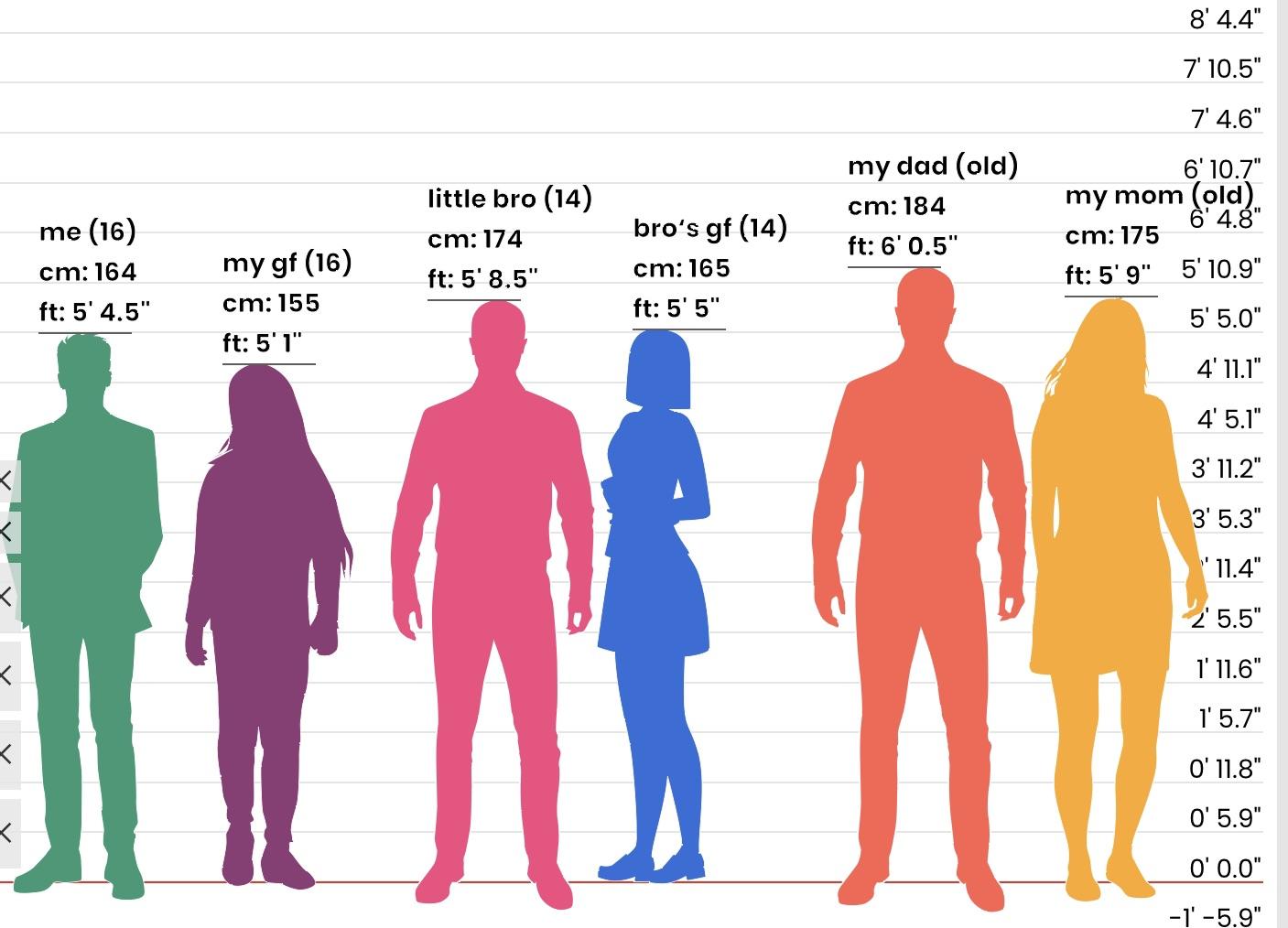
The visual difference between 6’3” (190.5 cm) and 5’10” (177.8 cm) is exactly five inches, a gap that represents the transition from "slightly above average" to "statistically elite" height. While 5’10” is taller than roughly 60% of men in the United States, 6’3” places an individual in the 97th percentile, creating significant differences in social perception, ergonomics, and physical presence.
The "shocking truth" of this comparison lies not just in the numerical difference, but in the psychological "halo effect" and the widespread phenomenon of height inflation. In 2026, where digital presence and data-driven dating metrics dominate social interactions, these five inches can dictate everything from clothing availability to perceived leadership authority. This article breaks down the technical, social, and physical realities of the 6’3” vs 5’10” showdown.
Understanding the Five-Inch Gap: A Statistical and Physical Breakdown
To understand the 6’3” vs 5’10” comparison, one must first look at the bell curve of human height. In the United States and much of Europe, the average male height is approximately 5’9” (175 cm).
A person who is 5’10” is one inch above the median. They are taller than the majority of the population but do not necessarily "stand out" in a crowd. They occupy the "upper-middle" tier of height, where most consumer products—such as cars, office chairs, and off-the-rack clothing—are designed to fit perfectly.
Conversely, a person who is 6’3” is a statistical outlier. This height is six inches above the national average. At 6’3”, an individual is taller than 97 out of every 100 men they encounter. Physically, this means their eye level is approximately at the top of a 5’10” person’s head. When standing face-to-face, the 6’3” individual looks down at a significant angle, while the 5’10” individual must tilt their head back to maintain eye contact.
This five-inch difference is roughly equivalent to the width of a standard smartphone or the height of a soda can. While it sounds small on paper, in the context of human anatomy, it represents a massive shift in limb length, center of gravity, and skeletal leverage.
The Psychology of the "6-Foot Rule" and Perceptual Bias
One of the most significant aspects of the 6’3” vs 5’10” debate is the psychological barrier of the 6-foot mark. In Western culture, 6’0” serves as a major cognitive milestone.
Individuals who are 5’10” often feel "short" in comparison to the 6’0”+ cohort, despite being taller than the average man. This is largely due to height inflation in social settings. Because many men who are 5’8” or 5’9” claim to be 5’10” on dating profiles or in casual conversation, the "perceived" 5’10” is often shorter than the "actual" 5’10”. Consequently, a man who is a true, measured 5’10” often surprises people by appearing taller than expected.
A 6’3” individual, however, exists well beyond the "6-foot threshold." They do not need to "claim" height; their stature is undeniable. This leads to the "Halo Effect," a cognitive bias where taller individuals are subconsciously perceived as more authoritative, capable, and persuasive. Studies in evolutionary psychology suggest that we associate height with strength and leadership, giving the 6’3” individual a natural advantage in first impressions, even if their actual competence is identical to their 5’10” counterpart.
Comparative Dynamics: The Practical Reality of Life at 6’3” and 5’10”
The "showdown" between these two heights isn't just about who looks better in a suit; it’s about how the world is built. Human-centered design (ergonomics) typically targets the 5th to 95th percentiles.
| Feature | 5’10” (177.8 cm) Experience | 6’3” (190.5 cm) Experience |
|---|---|---|
| Clothing | Standard "Medium" or "Large" fits well. | Often requires "Tall" sizes; sleeves/hems are frequently too short. |
| Public Transport | Comfortable legroom in economy seating. | Knees frequently hit the seat in front; cramped on planes. |
| Ergonomics | Standard desks and chairs are optimized for this height. | Desks are often too low, leading to slouching and back pain. |
| Social Visibility | Blends into crowds; easy to remain anonymous. | Highly visible; often asked to reach items on high shelves. |
| Sports Advantage | High agility; ideal for soccer, MMA, or wrestling. | High reach/leverage; ideal for basketball, rowing, or swimming. |
| Health Risks | Lower risk of joint issues and certain cancers. | Higher risk of back pain, knee issues, and circulatory strain. |
The table illustrates that while 6’3” wins in "presence," 5’10” wins in "utility." The modern world is built for the 5’10” man. From the height of kitchen counters to the length of a standard bathtub, the 5’10” individual moves through life with a level of physical "flow" that the 6’3” individual lacks. The taller man must constantly adapt—ducking under low doorways in older buildings, adjusting car seats to the maximum rear position, and struggling to find shoes in standard retail outlets.
The "Shocking Truth" of Height Inflation and Measurement
Why does 6’3” often look so much more dominant than 5’10”? The shocking truth involves the difference between "morning height" and "evening height," combined with footwear.
Every human is tallest immediately upon waking. Throughout the day, gravity compresses the spinal discs, causing a person to lose between 0.5 and 0.75 inches by the time they go to bed. A "true" 6’3” person is 6’3” at their midday average. However, if a person who is 5’9.5” claims to be 5’10” and encounters a 6’3” person who is wearing thick-soled boots (adding another 1.5 inches), the visual gap can swell to nearly 7 inches.
This creates a distorted reality. In 2026, digital verification of physical traits has become more common in professional athletics and certain high-tier modeling agencies, but in the "wild" of social interaction, the gap between 5’10” and 6’3” is often exaggerated by posture and footwear. A 6’3” man with good posture and boots can easily "tower" over a 5’10” man who slumps, making the 5-inch difference look like a foot.
Health and Longevity: The Hidden Cost of the Extra Inches
While the social "showdown" usually favors the taller man, the biological "showdown" favors the 5’10” individual. There is a documented correlation between height and longevity.
Biological research indicates that taller individuals have more cells, which statistically increases the mathematical probability of cellular mutations. Furthermore, the heart of a 6’3” individual must work harder to pump blood against gravity over longer distances compared to a 5’10” individual. Larger frames also put more significant torque on the joints—specifically the lower back (lumbar spine) and knees.
The 5’10” frame is often cited by kinesiologists as a "sweet spot" for human structural integrity. It allows for a high degree of muscle density and explosive power without the extreme lever lengths that make certain movements (like the deep squat or the bench press) mechanically disadvantaged. In the "shocking truth" of health, the 5’10” individual is often more durable over a 100-year lifespan.
Professional and Social Dynamics in 2026
In the professional landscape of 2026, the "height premium" still exists but is shifting. Historically, taller men were promoted faster and earned higher salaries—a phenomenon known as the "tallness pay gap." However, with the rise of remote work and video conferencing, the 6’3” vs 5’10” distinction is often neutralized during the initial stages of a career.
On screen, a 5’10” person and a 6’3” person look identical if their cameras are framed correctly. The "presence" of height only manifests in person. In-office "showdowns" still tend to favor the 6’3” individual during negotiations or presentations, as they literally occupy more physical space in the room.
In the dating market, the "6-foot rule" remains a persistent, if arbitrary, social filter. Data from major platforms shows that 6’3” is one of the most "right-swiped" heights, often viewed as the "ideal" height for a man—tall enough to be impressive, but not so tall (like 6’7”+) that it becomes cumbersome or intimidating. The 5’10” man, despite being taller than most women and many men, often finds himself in a "limbo" state where he is "tall" in person but "short" according to digital filters.
Frequently Asked Questions
Is 5'10" considered short for a man?
No, 5’10” is statistically above the average male height in most countries. In the United States, the average is roughly 5’9”. A 5’10” man is in the top 40% of the population. The perception of it being "short" is usually a result of height inflation by others or unrealistic standards on social media.
How much taller does a 6'3" person look compared to a 5'10" person?
A 6’3” person is 5 inches taller, which means their eye level is roughly even with the 5’10” person’s hairline or the top of their forehead. This is a very noticeable difference that is clear even from a distance. In a photo, the 6’3” person will appear to have a significantly longer torso and longer legs.
Do 6'3" men have a shorter lifespan than 5'10" men?
On average, population studies suggest that shorter individuals within a species tend to live longer than their taller counterparts. The increased risk of cardiovascular strain and cellular replication errors at 6’3” can lead to a slightly lower average life expectancy compared to 5’10”, though individual lifestyle factors like diet and exercise play a much larger role.
Can a 5'10" person "look" 6'3" with the right clothes?
No. While vertical stripes, monochromatic outfits, and high-waisted trousers can make a 5’10” person look taller than they are, they cannot bridge a 5-inch gap. Even with 2-inch elevator shoes, the 5’10” person would only reach 6’0”, still leaving a 3-inch disparity.
Which height is better for bodybuilding?
Generally, 5’10” is considered superior for bodybuilding. A 5’10” frame can be "filled out" with muscle much faster than a 6’3” frame. Taller lifters have longer muscle bellies and longer limbs, requiring significantly more muscle mass to look "thick" or "bulky" compared to a shorter lifter with a more compact frame.
The Final Verdict: Practical Optimization
If you are 5’10”, your goal should be to maximize the proportionality of your frame. Since the world is built for your height, you have the advantage of effortless movement and clothing fit. Focus on posture; a 5’10” man who stands straight often commands more respect than a 6’3” man who hunches to fit into his environment.
If you are 6’3”, your goal is ergonomic protection. Because you are living in a world designed for smaller people, you must proactively manage your joint health. Invest in custom-height desks, long-wheelbase vehicles, and "Tall" specific clothing to ensure that your height remains an asset rather than a source of chronic physical discomfort.
In the 6’3” vs 5’10” showdown, 6’3” wins the "First Impression" battle, but 5’10” often wins the "Life Efficiency" war. Both heights are well within the "attractive" range for modern society, and the "shocking truth" is that confidence and grooming often matter more than the five inches of bone that separate the two.