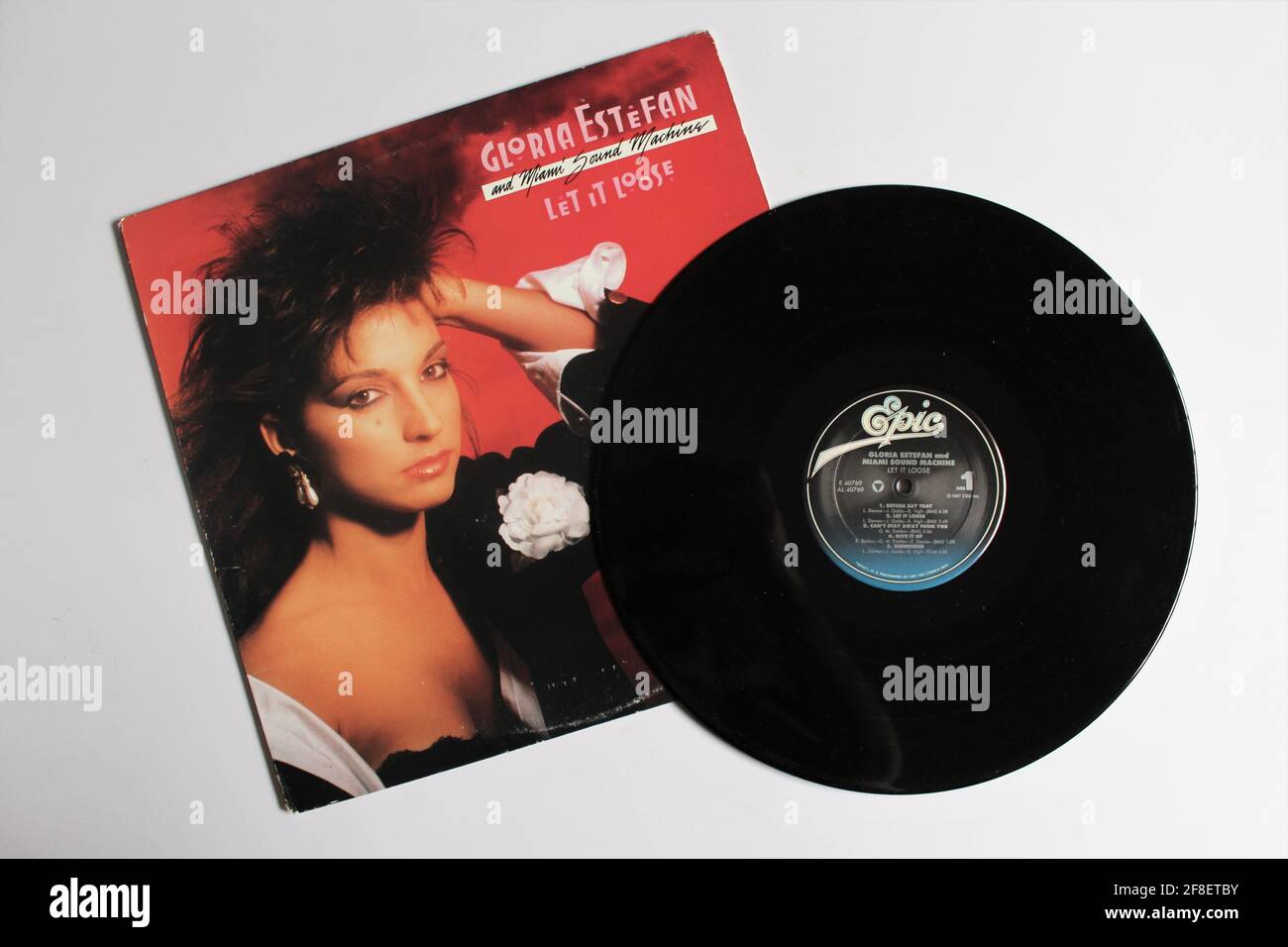
Gloria Estefan revolutionized global popular music by integrating authentic Cuban rhythms with mainstream English pop, opening doors for generations of Latin artists. Across a career spanning more than four decades, her trajectory reflects extraordinary resilience, academic brilliance, historic record-breaking awards, and a profound cultural impact that redefined the American soundscape.
Fact 1: She Spearheaded the Global Latin Pop Crossover Against Industry Resistance
Long before Latin pop became a dominant force on worldwide charts, Gloria Estefan and her band, Miami Sound Machine, fought a steep uphill battle against major record label executives. In the early 1980s, radio programmers and record executives routinely claimed that mainstream Anglo-American audiences would not accept pop songs featuring brass sections, percussion driven by Cuban clave rhythms, or bilingual production styles. Labels repeatedly urged the group to drop their Latin instrumentation or record separate, sanitized pop versions without percussion.
Estefan and her husband, producer Emilio Estefan, refused to abandon their authentic sound. Their determination paid off with the release of "Conga" in 1985. Written by band member Enrique "Kiki" Garcia, "Conga" became an unprecedented cross-genre success, climbing simultaneously onto the Billboard Hot 100, Hot Latin Tracks, Black Singles, and Dance/Club Play charts. It became the first single to score on four separate Billboard charts concurrently.
- Cuban Son / Rumba Traditions
- Miami Sound Machine Brass & Clave
- Billboard Multi-Chart Crossover: "Conga"
- Global Latin Pop Explosion (1990s–Present)
The success of "Conga" proved that cultural authenticity was an asset rather than a liability in global commercial music. Estefan followed this triumph with chart-topping ballads and dance anthems such as "Words Get in the Way," "Anything for You," "1-2-3," and "Rhythm Is Gonna Get You." By demonstrating that Latin rhythms could drive worldwide record sales, Estefan laid the structural blueprint for the 1990s Latin pop explosion, directly paving the way for artists like Ricky Martin, Marc Anthony, Jennifer Lopez, and Shakira.
Fact 2: She Survived a Near-Fatal Bus Crash and Staged a Historic Comeback
At the peak of her global fame on March 20, 1990, Gloria Estefan suffered a life-threatening injury that nearly ended her career and paralyzed her for life. While traveling on Interstate 380 near Tobyhanna, Pennsylvania, during the Get on Your Feet tour, Estefan's tour bus was rear-ended by a fully loaded semi-truck during a snowstorm.
The violent impact broke two of Estefan's vertebrae in her spine. She underwent an urgent, complex surgery at the Hospital for Joint Diseases in New York City, where surgeons implanted two eight-inch titanium rods to stabilize her spinal column. Physicians cautioned that she might never walk again, let alone withstand the physical demands of high-energy stage performances.
- March 1990: Bus Crash (Fractured Spine)
- Spinal Fusion Surgery (Titanium Rods Implanted)
- 10 Months of Intensive Physical Rehabilitation
- January 1991: Live Performance at American Music Awards ("Coming Out of the Dark")
What followed was one of the most celebrated rehabilitation turnarounds in music history:
- Intensive Rehabilitation: Estefan engaged in grueling daily physical therapy sessions lasting up to seven hours, utilizing pool therapy, electrical stimulation, and targeted movement exercises.
- Songwriting as Recovery: During her immobility, she co-wrote the triumphant ballad "Coming Out of the Dark" with Emilio Estefan and Jon Secada, turning her personal trauma into an inspirational musical narrative.
- The Historic Return: Just ten months after the accident, in January 1991, Estefan returned to the stage at the 18th Annual American Music Awards, delivering an emotional live performance of "Coming Out of the Dark."
The single debuted at the top of the charts, reaching number one on the Billboard Hot 100 in March 1991. The album Into the Light launched a massive international tour, proving her physical resilience and solidifying her status as an enduring cultural icon.
Fact 3: She Studied Psychology and Was Recruited by the CIA Before Music Stardom
Before becoming a multi-platinum recording artist, Gloria Estefan pursued a rigorous academic path grounded in the social sciences and linguistics. Raised in Miami, Florida, she attended the University of Miami, where she earned a Bachelor of Arts degree in Psychology with a minor in French in 1978.
Due to her multi-lingual fluency—speaking English, Spanish, and French effortlessly—and her high academic standing, Estefan worked as a language translator in the customs department at Miami International Airport during her university years. Her exceptional linguistic capabilities and sharp analytical skills caught the attention of federal authorities.
While working at the airport, Estefan was formally approached by representatives of the Central Intelligence Agency (CIA), who attempted to recruit her as an operative. She declined the CIA's recruitment offer to focus on her university studies and her burgeoning musical collaboration with Emilio Estefan in the Miami Latin Boys (which subsequently evolved into Miami Sound Machine). Her background in psychology later influenced her songwriting, enabling her to craft lyrics focused on emotional resilience, human behavior, and interpersonal dynamics.
Fact 4: Her Family Escaped Castro’s Cuba, Shaping Her Heritage and Activism
Gloria Estefan’s life and music are inextricably linked to the geopolitical turmoil of mid-20th-century Cuba. Born Gloria María Milagrosa Fajardo García in Havana, Cuba, in 1957, her early childhood was upended by the Cuban Revolution led by Fidel Castro.
Her father, José Manuel Fajardo, was a Cuban military officer under President Fulgencio Batista. Following Castro’s rise to power in 1959, the Fajardo family fled Havana for Miami, Florida, when Gloria was just 16 months old. Her father remained committed to anti-communist efforts, participating in the 1961 Bay of Pigs invasion, where he was captured and imprisoned for nearly two years before being released back to the United States. He subsequently enlisted in the U.S. Army and served a tour of duty in the Vietnam War. Upon his return, he developed multiple sclerosis, a condition attributed to Agent Orange exposure, and Gloria served as his primary caregiver throughout her teenage years.
- 1957: Born in Havana, Cuba
- 1959: Family Escapes to Miami Following Cuban Revolution
- 1961: Father Captured in Bay of Pigs Invasion; Later Serves in U.S. Army
- 1993: Release of "Mi Tierra" Celebrating Pre-Castro Cuban Cultural Roots
This history deeply informed Estefan’s cultural mission. In 1993, she released Mi Tierra, her first Spanish-language album, designed as a loving tribute to pre-communist 1950s Cuban musical traditions such as son, bolero, and danzón. The album went on to sell over eight million copies worldwide, proving that a Spanish-language album focused on traditional acoustic Latin styles could achieve massive global commercial success. Throughout her career, Estefan has remained a vocal advocate for human rights in Cuba, frequently utilizing her global platform to champion freedom of expression and democracy for the Cuban people.
Fact 5: She Shattered Ceiling After Ceiling with Milestone Awards and Civilian Honors
Gloria Estefan’s career is defined by historic firsts that extend beyond music sales into the highest levels of civic and artistic recognition. She has sold over 100 million records worldwide, making her one of the best-selling female vocalists of all time, and holds three Grammys along with five Latin Grammy Awards.
In November 2015, President Barack Obama awarded Gloria Estefan and Emilio Estefan the Presidential Medal of Freedom, the nation’s highest civilian honor, recognizing their pioneering contributions to American culture and Latin music integration.
In December 2017, Estefan achieved another historical milestone by becoming the first Cuban-American artist to be named a recipient of the prestigious Kennedy Center Honors, celebrating her lifelong lifetime achievements in the performing arts.
Further cementing her artistic legacy, Estefan was inducted into the Songwriters Hall of Fame in 2023. This recognition marked another historic precedent: she became the first Latina woman ever inducted into the Hall of Fame, honoring her work writing chart-topping hits across both English and Spanish languages over four decades.
Summary of Milestone Accomplishments Across Gloria Estefan's Career
The following table summarizes the key milestones, artistic eras, and historic achievements across Gloria Estefan's multi-decade career:
| Era / Year | Major Milestone or Album | Key Achievement or Cultural Impact | Historic Distinction |
|---|---|---|---|
| 1985 | Release of single "Conga" | Blended traditional Cuban clave with pop/dance beats | First single to enter four Billboard charts simultaneously |
| 1988 | Let It Loose / "Anything for You" | Transitioned to global arena superstar status | Secured her first Billboard Hot 100 #1 single |
| 1990–1991 | Spine injury & Into the Light | Survived bus crash; released "Coming Out of the Dark" | Staged one of pop music's most celebrated live comebacks |
| 1993 | Release of Mi Tierra | Multi-platinum homage to traditional 1950s Cuban music | Won Grammy Award for Best Tropical Latin Album; sold 8M+ copies |
| 2015 | Presidential Medal of Freedom | Honored for defining contributions to American culture | Awarded joint civilian honor alongside husband Emilio Estefan |
| 2017 | Kennedy Center Honors | Recognized for lifetime contributions to performing arts | First Cuban-American artist to receive the Kennedy Center Honor |
| 2023 | Songwriters Hall of Fame | Honored for catalog of cross-genre, bilingual songwriting | First Latina woman inducted into the Songwriters Hall of Fame |
Frequently Asked Questions About Gloria Estefan
What was Gloria Estefan's first major hit song in the United States?
Gloria Estefan's breakthrough hit in the United States was "Conga," released in 1985 with Miami Sound Machine. Driven by vibrant brass lines and infectious Cuban percussion, the song achieved an unprecedented crossover fit by ranking simultaneously on the Billboard Hot 100, Hot Latin Tracks, Black Singles, and Dance/Club Play charts.
How many Grammy Awards has Gloria Estefan won?
Gloria Estefan has won a total of eight Grammy Awards across her career, comprising three traditional Grammy Awards and five Latin Grammy Awards. Her 1993 album Mi Tierra won the Grammy for Best Tropical Latin Album, establishing her as a premier ambassador for traditional Latin soundscapes.
Did Gloria Estefan write her own songs?
Yes, Gloria Estefan is an accomplished songwriter who authored or co-wrote many of her biggest hits, including "Anything for You," "Words Get in the Way," "Rhythm Is Gonna Get You," and "Coming Out of the Dark." Her songwriting excellence was formally recognized in 2023 when she was inducted into the Songwriters Hall of Fame.
What is the title of the Broadway musical based on Gloria Estefan's life?
The biographical musical based on the lives and music of Gloria and Emilio Estefan is titled On Your Feet!. Premiering on Broadway in 2015, the show depicts their origin in Havana and Miami, their battle against record industry bias, the traumatic 1990 bus crash, and their legendary rise to international pop stardom.
How did Gloria Estefan contribute to the Latin Pop explosion of the late 1990s?
Gloria Estefan laid the commercial foundation for the 1990s Latin pop explosion by demonstrating to mainstream record labels that music infused with Latin rhythms could achieve massive radio play and record sales worldwide. As a executive and mentor alongside Emilio Estefan, she helped develop, produce, and launch careers for crossover stars such as Shakira, Ricky Martin, and Jon Secada.
How to Experience Gloria Estefan’s Enduring Musical Heritage Today
To fully appreciate Gloria Estefan’s legacy, listeners should explore her discography chronologically, tracing her evolution from infectious 1980s pop to traditional Latin rhythms and acoustic heritage projects.
Begin with Miami Sound Machine's Primitive Love (1985) and Let It Loose (1987) to understand how Latin percussion reshaped American radio. Follow this with her 1991 comeback album Into the Light for a study in emotional songwriting and vocal resilience. Finally, listen to her Spanish-language trilogy—Mi Tierra (1993), Abriendo Puertas (1995), and Alma Caribeña (2000)—which showcases her dedication to preserving Caribbean musical traditions for future generations.