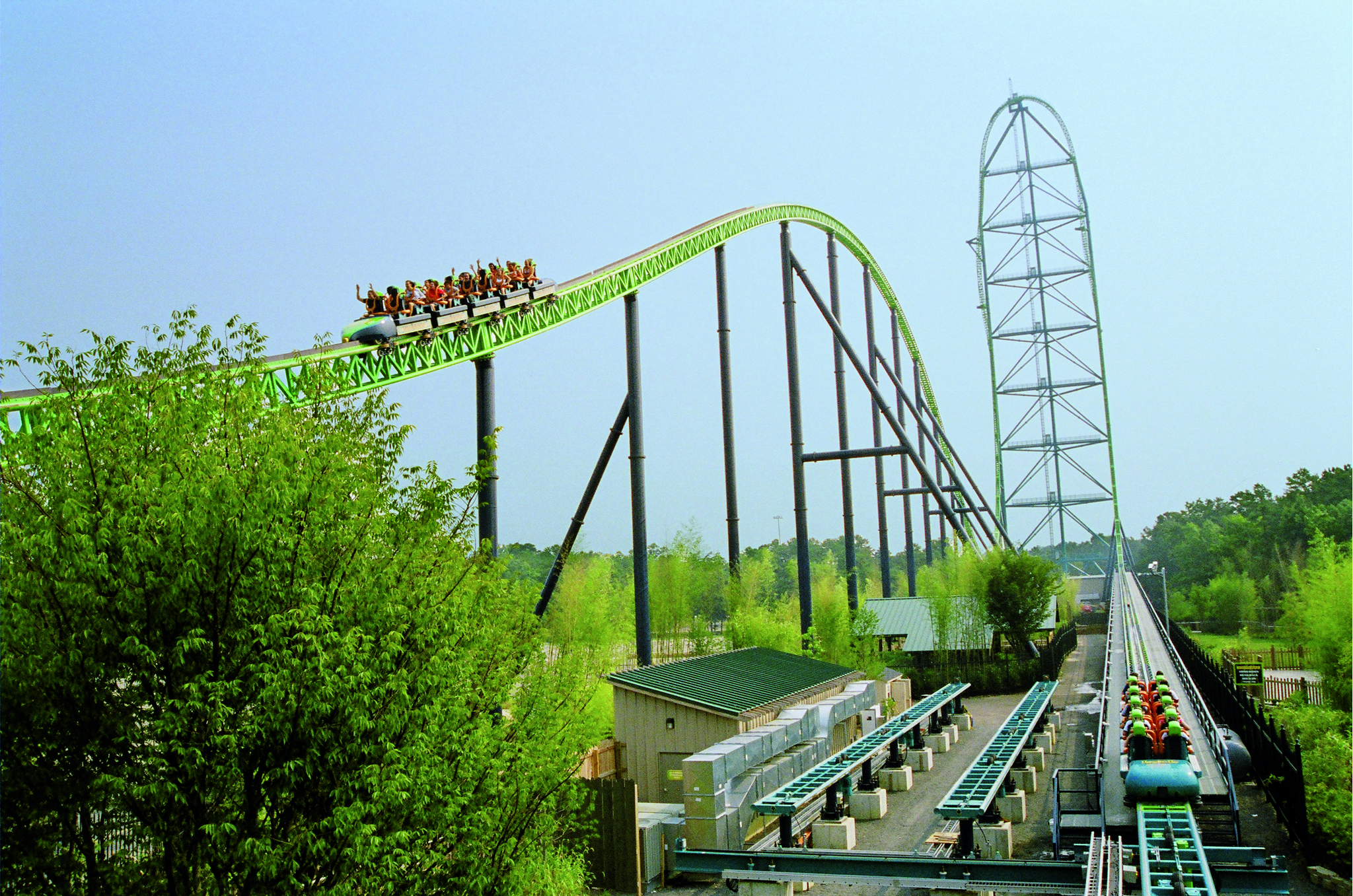
Historically, Superman: Escape from Krypton at Six Flags Magic Mountain in California holds the record as the third-tallest roller coaster in the world, reaching a structural tower height of 415 feet (126.5 meters). Depending on criteria such as active operating status and circuit design, Spain's Red Force (367.5 feet) also holds a prominent position among high-giga and strata-class rides.
Identifying the 3rd Tallest Roller Coaster: Rankings and Categorization
Determining the exact ranking of the world's tallest roller coasters requires understanding how amusement park enthusiasts and industry engineers categorize track structures. Amusement ride engineering distinguishes between shuttle roller coasters—which travel along an open-ended track before reversing direction—and complete-circuit roller coasters, which form a closed loop returning riders to the station without stopping or reversing.
In overall structural height, Superman: Escape from Krypton, located at Six Flags Magic Mountain in Valencia, California, stands at 415 feet (126.5 meters). Designed by the Swiss manufacturing firm Intamin and opened in 1997 (originally named Superman: The Escape), this reverse-freefall shuttle coaster was the first ride to break both the 100 mph (161 km/h) speed barrier and the 400-foot height boundary.
However, if rankings are strictly limited to complete-circuit roller coasters or modified by recent ride retirements and commissionings, the standings shift. Red Force, situated at Ferrari Land within PortAventura World in Salou, Spain, reaches a height of 367.5 feet (112 meters). Red Force utilizes a linear synchronous motor (LSM) launch system to catapult trains along a complete-circuit top-hat layout, making it Europe's tallest roller coaster and a primary contender in active height rankings depending on the inclusion of non-complete circuit installations.
The landscape of extreme roller coaster engineering has evolved dramatically. With historical icons like Kingda Ka (456 ft) at Six Flags Great Adventure experiencing operational changes and permanent retirements, and modern megaprojects such as Falcon's Flight (640 ft) at Six Flags Qiddiya coming online, understanding the height leaderboard requires examining both peak tower height and mechanical operational classifications.
Technical Specifications and Engineering Feats
Building a supertall structure capable of withstanding dynamic forces, rapid thermal expansion, high winds, and continuous mechanical stress demands specialized civil and mechanical engineering. Roller coasters surpassing the 300-foot (giga) and 400-foot (strata) thresholds require aerospace-grade materials, custom launch systems, and sophisticated braking mechanisms.
- Station / Launch Track (LSM Launch Acceleration up to 100-112 mph)
- 90° Vertical Ascent
- Peak Apex / Tower (367.5 ft - 415 ft Height)
- Weightless Freefall / Descent
- Magnetic Trim & Station Brakes
Drive Systems and Propulsion
Standard chain lifts are inadequate for propelling multi-ton train cars up 400-foot vertical towers within reasonable timeframes. Designers rely on advanced linear motor technologies:
- Linear Synchronous Motors (LSM): Utilizing electro-magnetic coils positioned along the launch track, LSM systems interact with permanent magnets attached to the underside of the train. By rapidly alternating the magnetic polarity along the track, the system pulls the train forward with immense acceleration, eliminating mechanical friction during the launch phase.
- Linear Induction Motors (LIM): Older electromagnetic systems generate magnetic fields in stationary coils to induce electrical currents in aluminum reactor plates mounted on the vehicle, pushing the train without physical contact.
Structural Integrity and Aero-Dynamics
Towers reaching 365 to 415 feet must endure extreme wind loads. Engineers utilize hollow structural steel columns reinforced with internal ribbing and cross-bracing lattices. Track sections feature thick steel tubular rails welded to structural spine pipes, designed to flex slightly under high G-force loads without suffering dynamic fatigue or structural failure over millions of operational cycles.
Advanced Braking Systems
To safely bring trains travelling at speeds over 100 mph to a stop, high-height coasters use magnetic eddy current brakes. Copper or aluminum fins mounted to the train pass between arrays of permanent neodymium magnets installed along the brake run. As the train passes through the magnetic field, eddy currents are generated within the metal fins, producing an opposing magnetic field that smoothly decelerates the vehicle without physical contact, wear, or risk of mechanical mechanical failure during power losses.
Comparing the World's Tallest Roller Coasters
To contextualize where the 3rd tallest roller coaster sits within global amusement engineering, the following table compares top-tier extreme roller coasters by height, top speed, circuit type, and location.
| Roller Coaster | Park Location | Peak Height | Top Speed | Track Circuit Type | Propulsion System |
|---|---|---|---|---|---|
| Falcon's Flight | Six Flags Qiddiya (Saudi Arabia) | 640 ft (195 m) | 155.3 mph (250 km/h) | Complete Circuit | LSM Launch / Terrain Drop |
| Kingda Ka (Retired) | Six Flags Great Adventure (USA) | 456 ft (139 m) | 128 mph (206 km/h) | Complete Circuit | Hydraulic Launch |
| Top Thrill 2 | Cedar Point (USA) | 420 ft (128 m) | 120 mph (193 km/h) | Open Circuit / Spike | LSM Triple-Launch |
| Superman: Escape from Krypton | Six Flags Magic Mountain (USA) | 415 ft (126.5 m) | 100 mph (160.9 km/h) | Reverse Shuttle | LSM Launch |
| Red Force | PortAventura World (Spain) | 367.5 ft (112 m) | 111.8 mph (180 km/h) | Complete Circuit | LSM Launch |
| Fury 325 | Carowinds (USA) | 325 ft (99 m) | 95 mph (153 km/h) | Complete Circuit | Traditional Chain Lift |
| Steel Dragon 2000 | Nagashima Spa Land (Japan) | 318 ft (97 m) | 95 mph (153 km/h) | Complete Circuit | Dual Chain Lift |
The Ride Experience: Physics, Speed, and Acceleration
Riding a 400-foot-class roller coaster exposes the human body to intense gravitational forces, rapid velocity shifts, and prolonged zero-gravity conditions. The experience is governed by strict laws of mechanical physics and human physiological dynamics.
Kinetic Energy and Launch Acceleration
The launch sequence converts massive quantities of electrical energy into kinetic energy within seconds. On rides like Superman: Escape from Krypton, trains accelerate from 0 to 100 mph in approximately 7 seconds, subjecting riders to sustained forward positive linear forces (around 1.5 to 2.0 Gs). On Red Force, acceleration is even faster, reaching 111.8 mph in just 5 seconds, generating forceful acceleration forces prior to the vertical ascent.
The Vertical Climb and Zero-G Apex
Upon reaching the vertical tower incline, horizontal kinetic energy is converted into gravitational potential energy ($PE = mgh$). As the train climbs straight up at a 90-degree angle, riders transition from feeling heavy compression forces at the base of the curve to near weightlessness.
At the apex of the structure, velocity drops significantly. For a brief window—ranging from 4 to 6 seconds on shuttle layouts—riders experience zero gravity (weightlessness) or airtime. During this phase, physiological sensations include:
- Inward stomach sensation: Caused by internal organs briefly shifting position due to the absence of gravitational pull.
- Visual disorientation: Heightened exposure to high-altitude panoramic horizons combined with rapid spatial motion.
The Vertical Drop and High-G Recovery
During the descent, gravitational potential energy converts rapidly back into kinetic energy. As the train plummets vertically downward, riders face directly toward the ground, experiencing prolonged freefall acceleration until the track curves back to horizontal. The pullout curve at the base subjects riders to high positive vertical forces (often peaking between 4.0 G and 4.5 G), pushing riders firmly down into their seats as magnetic brakes engage to dissipate remaining energy.
Rider Requirements, Operational Limitations, and Safety Standards
Operating rides that exceed 300 to 400 feet in height involves rigorous safety compliance, rider eligibility standards, and atmospheric constraints.
Rider & Safety Checklist
Physical Eligibility:
- Height Minimum: 48 in (122 cm) to 54 in (137 cm)
- Restraint Fit: Secure chest, lap, and shoulder harness lock
- Health Exclusions: No heart conditions, spinal issues, or pregnancy
Weather Operational Constraints:
- Wind Limits: Sustained wind speed thresholds (typically 35+ mph)
- Atmospheric Safety: Automatic shutdown during lightning (within 10 mi)
- Temperature Controls: Minimum ambient temperatures for launch hydraulics/LSM
Redundant Safety Systems:
- Dual Fail-Safe Magnetic Brakes
- Multi-Zone Computerized Block Section Control
- Ultrasonic Track and Car Frame Stress Inspection Protocols
Guest Requirements and Restrictions
Due to the intense forces exerted during acceleration and braking, parks enforce strict rider access parameters:
- Height Restrictions: Riders typically must be between 48 inches (122 cm) and 54 inches (137 cm) tall, depending on the harness type (overhead shoulder restraints vs. rigid lap bars with seatbelts).
- Health Prerequisites: Individuals with cardiovascular conditions, high blood pressure, recent surgeries, neck or back injuries, or pregnancy are restricted from riding due to high positive G-loads.
- Physical Restraint Fit: Guests must fit comfortably into seat contours so that sensor-monitored locking bars achieve maximum latch engagement before station dispatch.
Weather and Wind Thresholds
Supertall roller coasters act as large lightning rods and anemometer sensors. Rides are systematically shut down under specific environmental conditions:
- High Winds: Wind speeds exceeding 30–35 mph (48–56 km/h) at the top of the tower can cause rides to experience "rollbacks"—where the train fails to clear the crest of the tower and safely rolls backward into the launch track's magnetic braking zone.
- Electrical Storms: Operations cease immediately if lightning is detected within a 10-mile radius of the park.
- Low Ambient Temperatures: Cold temperatures alter lubricant viscosity in wheel bearings and affect electrical resistance in LSM propulsion units, requiring parks to delay morning testing until temperatures rise.
How Evolution and Recent Changes Impact Heights and Rankings
The global rankings for supertall roller coasters undergo periodic shifts due to ride modernizations, structural retirements, and ambitious international installations.
- Retirements and Redesigns: The retirement of legacy hydraulic launch coasters has reshaped height standings. Systems featuring complex hydraulic cable drums have frequently been retrofitted with modern LSM technology (such as Cedar Point's evolution from Top Thrill Dragster into Top Thrill 2), introducing tall vertical spike elements that alter peak operational height definitions.
- Emergence of Mega-Projects: Engineering innovations have enabled parks to build beyond the 400-foot boundary into terrain-assisted and hybrid designs. Modern installations incorporate terrain elevation changes, allowing coasters to achieve higher drop metrics than their pure tower heights suggest.
- Shuttle vs. Complete-Circuit Classification: As shuttle coasters with vertical spikes proliferate, coaster database authorities distinguish between total structure height and drop height. Understanding whether a record refers to the highest physical tower, highest drop distance, or fastest complete circuit clarifies discrepancies across global rankings.
Frequently Asked Questions
What is currently the 3rd tallest roller coaster in the world?
Depending on classification, Superman: Escape from Krypton at Six Flags Magic Mountain (415 ft / 126.5 m) holds the 3rd spot overall for structural tower height. When limiting the list strictly to complete-circuit operating coasters, Red Force at PortAventura World (367.5 ft / 112 m) is widely recognized as the record holder.
How fast does the 3rd tallest roller coaster travel?
Superman: Escape from Krypton reaches a top speed of 100 mph (160.9 km/h) during its linear motor launch sequence. Red Force reaches a maximum launch speed of 111.8 mph (180 km/h) in approximately 5 seconds.
What is a roller coaster rollback, and is it safe?
A rollback occurs when a launch coaster does not gather enough kinetic energy to clear the top tower structure, causing the train to roll backward down the hill. Rollbacks are planned for during the ride's engineering phase; magnetic brakes installed along the launch track automatically engage to slow and safely stop the train without driver intervention.
How long does the ride experience last on 400-foot-class coasters?
Because these rides rely on explosive acceleration and extreme vertical speeds, the total ride duration is typically brief. Most launch-to-brake cycles on 400-foot coasters take between 30 and 55 seconds, with the period of peak airtime at the top lasting approximately 4 to 6 seconds.
Are shoulder harnesses required on extreme thrill coasters over 300 or 400 feet?
Not always. While some high-speed coasters use over-the-shoulder restraints (OTSRs) or rigid vest restraints to stabilize upper body movement, many modern coasters use hydraulic lap bars with secondary seatbelts. Lap-bar restraints leave the upper body exposed, enhancing the perception of speed and vulnerability during vertical drops.
Practical Guidance for Planning Your Ride Experience
If you are planning a trip to experience the world's tallest roller coasters, strategic preparation ensures a seamless visit:
- Verify Active Operational Status: Always check official park mobile apps or ride status boards before traveling. Supertall coasters require complex maintenance and are more susceptible to temporary wind holds or mechanical downtime than standard rides.
- Target Optimal Weather Windows: Visit during clear weather conditions with low forecasted wind speeds to minimize the likelihood of operational delays due to high-altitude gusting.
- Utilize Express Pass Options: Because supertall coasters are flagship park attractions, queue times frequently exceed 60 to 90 minutes during peak seasonal periods. Expedited skip-the-line passes can help ensure multiple rides throughout the day.
- Follow Secure Loose-Article Policies: Extremely high speeds and vertical drops make flying objects hazardous. Secure all items in park-provided lockers prior to entering the queue, as many high-thrill attractions enforce zero-tolerance loose-article rules featuring metal detection at the entrance line.