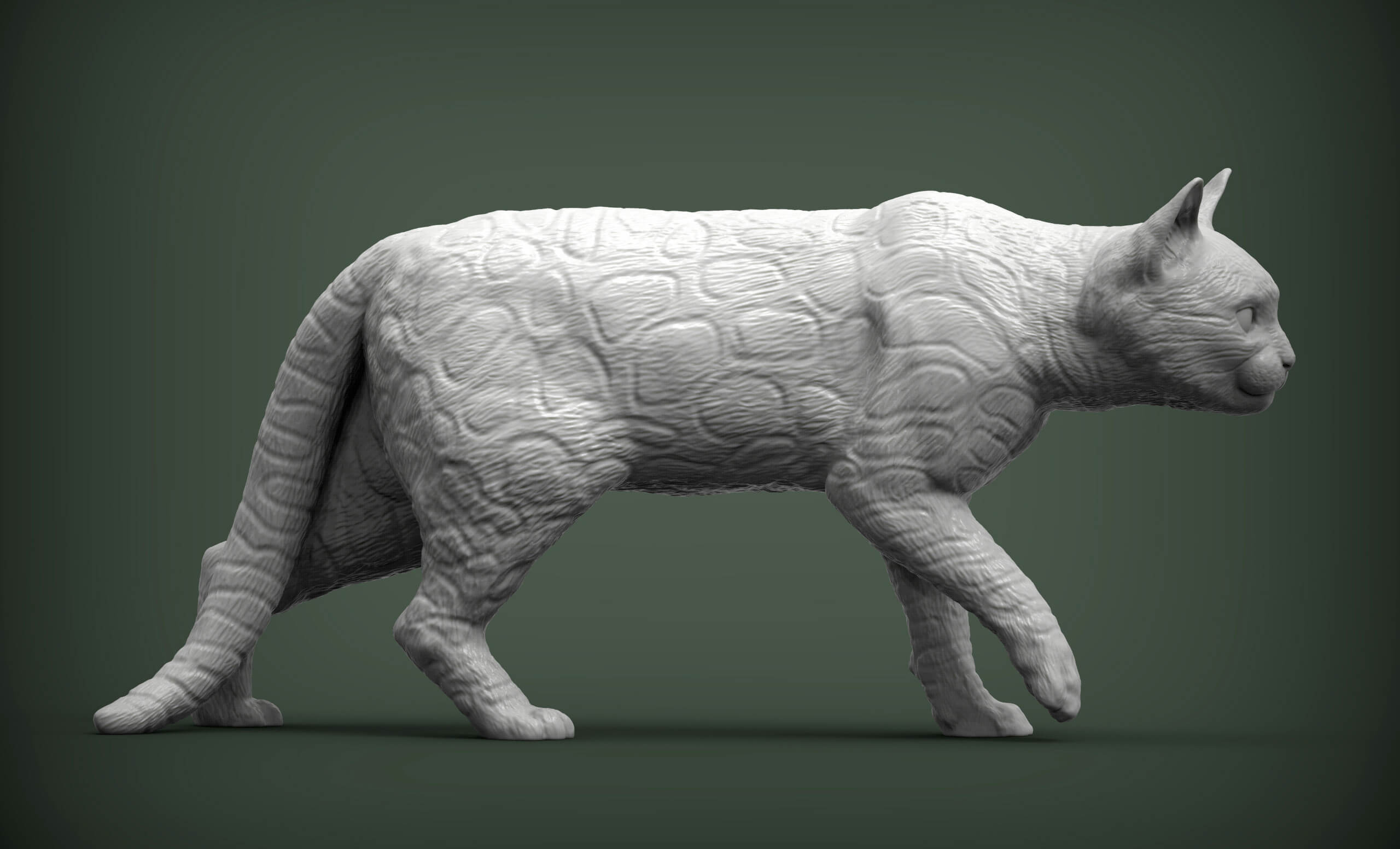
A 3D cat is a digital three-dimensional representation of a feline, utilized in industries ranging from video game development and film production to augmented reality (AR) and 3D printing. These assets vary from high-fidelity, rigged characters for cinema to optimized, low-poly models for mobile applications and watertight STL files for physical manufacturing.
In the current landscape of 2026, the demand for 3D cat assets has expanded significantly due to the proliferation of spatial computing and high-fidelity virtual environments. Whether you are a developer looking for a photorealistic Maine Coon for a simulation or a hobbyist seeking a stylized kitten for 3D printing, understanding the technical nuances of these digital assets is essential for ensuring compatibility and performance. It is also important to distinguish between "3D cat" as a digital asset and 3DCAT, a prominent cloud rendering and XR streaming service; while this guide focuses on the feline assets themselves, the platform serves as a primary vehicle for deploying these high-end models to end-users.
Taxonomy of 3D Cat Models
When sourcing or creating a 3D cat, the first consideration is the artistic and technical style. Not all models are built the same, and choosing the wrong category can lead to significant rework during the integration phase.
Photorealistic and Anatomically Accurate Models
These assets are designed for high-end visual effects (VFX) and cinematic productions. In 2026, photorealistic models typically feature high-resolution textures (8K or higher) and complex groom setups for fur. They are built using anatomical references to ensure that the skeletal structure (rig) and muscle deformations mimic real-world feline movement. These models often utilize Subsurface Scattering (SSS) shaders to realistically represent how light penetrates the skin and ears.
Stylized and "Toon" Cats
Stylized models are common in animated features and mobile gaming. These often prioritize expressive features—such as enlarged eyes or exaggerated proportions—over realism. From a technical standpoint, stylized cats often use Cel-shading or hand-painted textures. In 2026, the "stylized" category has seen a surge in "Cozy Game" aesthetics, where soft lighting and simplified geometry are used to create a specific emotional resonance.
Low-Poly and Voxel Assets
Optimized for performance, low-poly cats are essential for real-time applications where hardware resources are limited, such as standalone VR headsets or mobile AR. These models use a minimal number of polygons to define the shape, often relying on sophisticated Normal Maps to simulate the appearance of detail that isn't physically present in the geometry. Voxel cats, comprised of 3D cubes, remain a popular niche style popularized by "metaverse" platforms and sandbox games.
Key Technical Specifications for 3D Cat Assets
The utility of a 3D cat model is determined by its underlying technical architecture. Understanding these specifications prevents "asset bloat" and ensures the cat can be animated or rendered correctly.
Topology and Mesh Flow
Good topology is the backbone of any animatable model. For cats, which are highly flexible creatures, the mesh must be composed primarily of quadrangles (quads). Quads allow for smooth subdivision and predictable deformation. High-quality assets in 2026 feature "clean" edge loops around the joints (shoulders, hips, and paws) and the facial features (mouth and eyes) to prevent "pinching" when the cat moves or changes expression.
Rigging and Skeletal Hierarchies
A "rig" is the internal digital skeleton that allows the model to move. A professional 3D cat rig should include:
- IK/FK Switching: Inverse Kinematics (IK) for paws hitting the ground and Forward Kinematics (FK) for natural tail movements.
- Facial Rigs: Either through "blend shapes" (morph targets) or a bone-based system to allow for blinking, ear twitching, and meowing.
- Procedural Tail Controls: Specialized setups that allow for the fluid, whip-like motion characteristic of felines.
Fur and Grooming Solutions
One of the most difficult aspects of a 3D cat is the fur. There are two primary methods used in 2026:
- Strand-based Fur: Real-time hair simulation (like NVIDIA HairWorks or Unreal Engine's Groom system) where thousands of individual hairs are simulated. This provides the highest quality but is computationally expensive.
- Fur Cards: Transparent planes with hair textures applied to them. This is the standard for video games, providing a balance between visual fidelity and performance.
Industry Applications and Use Cases
The requirements for a 3D cat vary wildly depending on where it will be used. A model optimized for a movie will likely crash a mobile game engine.
| Use Case | Recommended Format | Priority Feature | Complexity Level |
|---|---|---|---|
| Film/VFX | USD, ABC (Alembic) | Photorealism & Groom | Very High |
| Video Games | FBX, GLB | Rigging & LODs | Medium/High |
| AR/VR | GLB, USDZ | Texture Compression | Medium |
| 3D Printing | STL, OBJ | Manifold Geometry | Low (Static) |
| Metaverse/Web | GLTF | File Size Optimization | Low/Medium |
Gaming and Real-Time Interaction
In 2026, 3D cats in games often require LOD (Level of Detail) sets. This means the developer provides 3-5 versions of the cat at different polygon counts. As the player moves away from the cat, the game engine swaps the high-res version for a lower-res one to save memory.
Augmented Reality (AR)
With the maturity of AR glasses and mobile AR, "virtual pets" have become a dominant trend. These 3D cats must be optimized for USDZ (Apple) or GLB (Android/Web) formats. They often include pre-baked animations like "idle," "walk," and "pounce" because the processing power available for real-time physics on wearable devices is still finite.
Creating a 3D Cat: The 2026 Workflow
If you are building a 3D cat from scratch, the workflow has evolved to incorporate AI-assisted tools that speed up the more tedious aspects of production.
- Sculpting: Starting in a program like ZBrush or Blender, the artist creates a high-poly "sculpt." This focuses on the form and muscle structure without worrying about technical constraints.
- Retopology: The high-poly sculpt is "traced" with a lower-poly, clean mesh. In 2026, AI-driven retopology tools can automate about 80% of this process, though manual cleanup around the joints is still required for high-end rigs.
- UV Mapping: The 3D surface is "unwrapped" into a 2D plane so that textures can be applied. Proper UV layout is critical to ensure that fur patterns (like tabby stripes or calico spots) don't appear distorted.
- Texturing and PBR: Using Physically Based Rendering (PBR) workflows, artists define the base color, roughness (how shiny the nose is), and normal maps (the bumpiness of the skin).
- Grooming: This involves "planting" the fur. Artists define the length, density, and direction (clumping) of the hairs to match specific breeds.
Sourcing and Licensing 3D Cat Assets
Not every project has the budget for custom creation. Marketplaces are the most common source for 3D cats, but licensing terms are a critical hurdle.
Leading Marketplaces in 2026
- TurboSquid/Adobe Stock: Known for professional-grade, CheckMate-certified models that are guaranteed to work in major software suites.
- CGTrader: Offers a massive variety of feline species, often with built-in discounts for indie developers.
- Sketchfab: The go-to for web-ready (GLTF) models and previewing 3D cats in a browser before purchase.
Licensing Considerations
When purchasing a 3D cat, you generally encounter two types of licenses: Royalty-Free and Editorial.
- Royalty-Free: Allows you to use the cat in games, films, and advertisements indefinitely after a one-time payment.
- Editorial: Restricted to non-commercial uses (e.g., a news report about a specific famous cat). Using an editorial-licensed 3D model in a commercial game can lead to legal action.
Preparing 3D Cat Models for 3D Printing
Transitioning from a digital cat to a physical one requires a completely different technical approach. Animation rigs and fur systems are irrelevant here; the focus is on volume and structural integrity.
Manifold Geometry (Watertight Meshes)
A 3D model for a game can have holes or "one-sided" planes (like ears). For 3D printing, the mesh must be manifold. This means the model must be "watertight," with a clearly defined interior and exterior volume. Slicer software will fail to generate toolpaths if the 3D cat has "non-manifold" edges.
Wall Thickness and Support Structures
If you are printing a cat in a standing position, the legs must be thick enough to support the weight of the body. Additionally, features like the tail or chin may require supports—temporary structures printed to hold up "overhanging" parts of the model that would otherwise be printed into thin air.
File Formats for Manufacturing
- STL: The universal standard, though it does not support color or texture data.
- OBJ: Can include color data, used primarily for full-color "sandstone" prints.
- 3MF: A newer format that is increasingly replacing STL due to its ability to hold more data (like units and materials) in a smaller file size.
Troubleshooting Common Issues
Even high-quality 3D cat assets can encounter problems during implementation.
- Broken Bone Weights: If the cat’s skin "stretches" awkwardly when a leg moves, the bone weights (the influence each bone has on the surrounding mesh) need to be repainted.
- Scale Mismatches: 3D software uses different default units (centimeters vs. meters). Always check the scale upon import; otherwise, your cat might appear the size of a skyscraper or a grain of rice.
- Flipped Normals: If parts of the cat appear invisible or black in a game engine, the "normals" (the direction the polygon is facing) may be pointing inward. This is a simple fix in most 3D software using a "Recalculate Normals" command.
Frequently Asked Questions
What is the best file format for a 3D cat model?
For animation and gaming, FBX is the industry standard due to its support for skeletal data and textures. For web and AR, GLB/GLTF is preferred for its efficiency. For 3D printing, STL remains the most compatible format with slicer software.
How many polygons should a 3D cat have?
It depends on the target platform. A mobile game might require a cat to be under 5,000 polygons, while a cinematic character for a film could easily exceed 100,000 polygons before subdivision. In 2026, most mid-range assets hover around 15,000–25,000 polygons for a good balance of detail and performance.
Can I turn a photo of my cat into a 3D model?
Yes, using a process called Photogrammetry or AI-based NeRF (Neural Radiance Fields). By taking 50–100 photos of your cat from every possible angle, software like RealityCapture or specialized mobile apps in 2026 can generate a highly detailed 3D mesh and texture. However, this usually results in a "static" model that requires significant retopology if you want to animate it.
Does 3D printing a cat require special resin?
Not necessarily, but the choice of material affects the detail. Resin (SLA/DLP) printers are much better at capturing the fine details of fur and whiskers than standard Filament (FDM) printers. If you want a realistic "fuzzy" texture, resin is the better choice.
How do I animate a 3D cat realistically?
The most effective way is to use Reference Footage. Cat movement is distinct; they are "digitigrades" (walking on their toes) and have a highly flexible spine. Many professional animators also use cat-specific motion capture (mocap) data, which has become more accessible in 2026 through AI-driven video-to-mocap tools.
Strategic Implementation for Your Project
When integrating a 3D cat into your project, start by defining the maximum hardware constraint. If you are developing for a high-end PC, prioritize a "groom-based" fur system for maximum realism. If your project is intended for a broad audience on mobile or web, opt for a "low-poly" cat with baked-in lighting and fur cards. Always verify the license of any sourced asset to ensure it covers your specific commercial or personal use case. For those looking to stream high-fidelity 3D cats to lower-end devices without losing detail, exploring cloud rendering platforms like 3DCAT is the recommended next step to bridge the gap between high-end production and accessible distribution.