24-hour training most commonly refers to the OSHA 24-Hour HAZWOPER (Hazardous Waste Operations and Emergency Response) certification. This training is a mandatory legal requirement under 29 CFR 1910.120 for employees who visit hazardous waste sites occasionally for specific tasks—such as surveying or groundwater monitoring—and are unlikely to be exposed to levels exceeding Permissible Exposure Limits (PELs).
While "24 hour training" can occasionally refer to New York City’s Local Law 196 Site Safety Training (SST) for construction or specific state-level childcare requirements, the Hazardous Waste Operations standard is the most rigorous and globally recognized technical application of the term. In 2026, compliance with these safety standards remains a critical component of industrial hygiene and environmental remediation.
Understanding the Scope: Who Needs 24-Hour Training?
The Occupational Safety and Health Administration (OSHA) differentiates between workers based on their level of exposure risk and the nature of their duties. The 24-hour HAZWOPER course is specifically designed for "Occasional Site Workers." These are individuals who are on-site for a limited time and for a specific purpose, and whose duties do not typically involve regular exposure to hazardous substances.
According to 29 CFR 1910.120(e)(3)(iii), this training is appropriate for workers who are on-site only occasionally for a specific limited task and who are unlikely to be exposed over permissible exposure limits and published exposure levels. It is also the standard for workers in areas that have been monitored and fully characterized, indicating that exposures are under the PELs and that the use of respirators is not required.
Common roles requiring this certification include:
- Land Surveyors: Individuals marking boundaries or topographical features on potentially contaminated land.
- Environmental Consultants: Professionals conducting site assessments or gathering data for Phase I or Phase II Environmental Site Assessments (ESAs).
- Groundwater Monitoring Technicians: Workers who visit sites periodically to collect water samples from established wells.
- Project Managers and Architects: Decision-makers who must visit a site for inspection but are not involved in active remediation or waste handling.
If a worker’s duties change and they become a "General Site Worker" (involved in active cleanup or exposed to higher risks), they must complete an additional 16 hours of training to meet the 40-hour HAZWOPER requirement.
Curriculum and Core Competencies: What the Course Covers
The 24-hour training curriculum is intensive, focusing on the identification, evaluation, and control of health and safety hazards. In 2026, modern training modules have integrated advanced simulations, yet the core regulatory requirements established by OSHA remain the foundation of the syllabus.
Toxicology and Chemical Awareness
A significant portion of the training involves understanding how hazardous substances interact with the human body. Trainees learn about different routes of entry—inhalation, ingestion, absorption, and injection—and the difference between acute and chronic health effects. This section also covers the "Safety Data Sheet" (SDS) system and how to interpret chemical properties such as vapor pressure, flash points, and pH levels to assess immediate danger.
Hazard Recognition and Site Control
Safety begins with the ability to identify a threat before it causes harm. This includes physical hazards (slips, trips, falls, and confined spaces), biological hazards, and radiological hazards. Site control training teaches the "buddy system" and the establishment of "work zones":
- Exclusion Zone (Hot Zone): The area where contamination exists or could occur.
- Contamination Reduction Zone (Warm Zone): The transition area where decontamination occurs.
- Support Zone (Cold Zone): The clean area where administrative functions and medical support are located.
Personal Protective Equipment (PPE)
Trainees are introduced to the four levels of PPE protection (Levels A, B, C, and D). While 24-hour workers typically operate in Level D (standard work uniform) or Level C (air-purifying respirators), they must understand the limitations of each. The course covers the selection, donning, and doffing of equipment, as well as the physiological burdens of working in protective gear, such as heat stress and reduced visibility.
24-Hour vs. 40-Hour Training Comparison
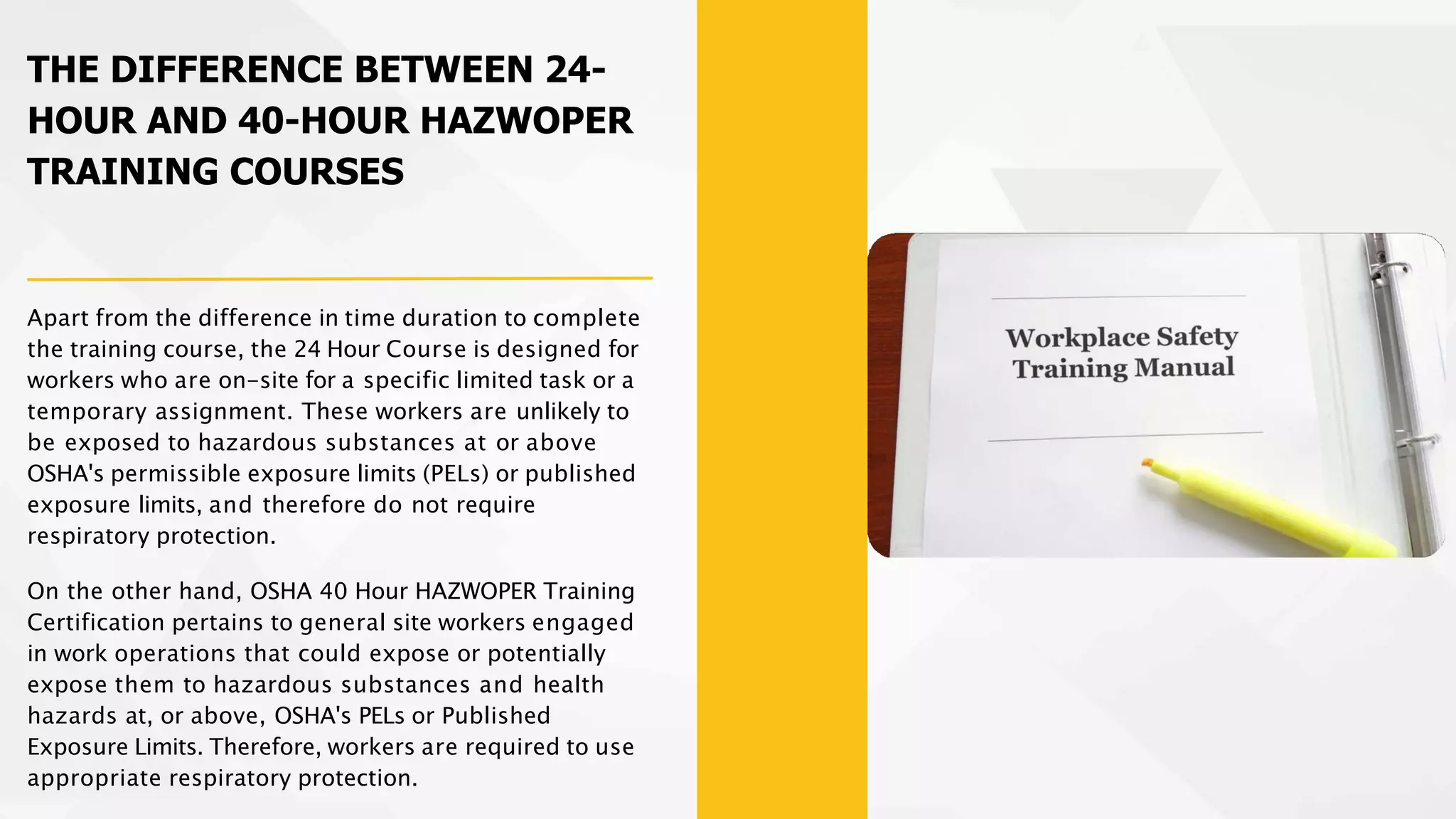
Choosing between the 24-hour and 40-hour HAZWOPER tracks depends entirely on the worker’s exposure profile and job description. The following table outlines the key differences in 2026 standards.
| Feature | 24-Hour HAZWOPER | 40-Hour HAZWOPER |
|---|---|---|
| Primary Audience | Occasional site workers, surveyors, monitors. | General site workers, remediation crews, equipment operators. |
| Exposure Risk | Unlikely to exceed PELs; no respirators typically required. | Likely to exceed PELs; requires respiratory protection. |
| Classroom Hours | 24 hours of initial instruction. | 40 hours of initial instruction. |
| Field Experience | Minimum 1 day of supervised field work. | Minimum 3 days of supervised field work. |
| Level of PPE | Primarily Levels C and D. | Levels A, B, C, and D. |
| Refresher Req. | 8 hours annually. | 8 hours annually. |
| Regulatory Basis | 29 CFR 1910.120(e)(3)(iii). | 29 CFR 1910.120(e)(3)(i). |
Delivery Methods: Online, In-Person, and Hybrid Options
As of 2026, the delivery of 24-hour training has evolved to accommodate various learning styles and professional schedules. However, OSHA’s stance on "hands-on" training remains strict.
Fully Online Training
Many providers offer 100% online courses. These are highly convenient but must be supplemented by a qualified instructor available for questions. OSHA has historically issued letters of interpretation stating that training solely through computer-based programs is generally not sufficient for the "hands-on" portions of the requirement (such as PPE donning). Therefore, reputable online programs in 2026 often include a "proctored" virtual component or require a secondary sign-off from a supervisor.
In-Person Classroom Instruction
Traditional classroom training provides the highest level of engagement. It allows for physical practice with air monitoring equipment (like Photoionization Detectors or PIDs) and real-time feedback on PPE fit-testing. This remains the preferred method for organizations dealing with high-liability environments.
The Hybrid Model
The hybrid approach is currently the industry standard. Students complete the theoretical portions (toxicology, law, and hazard communication) via an asynchronous online platform and then attend a one-day intensive workshop for practical exercises. This maximizes efficiency while ensuring that the "hands-on" requirement of 29 CFR 1910.120 is met.
Maintenance and Renewal: The 8-Hour Annual Refresher
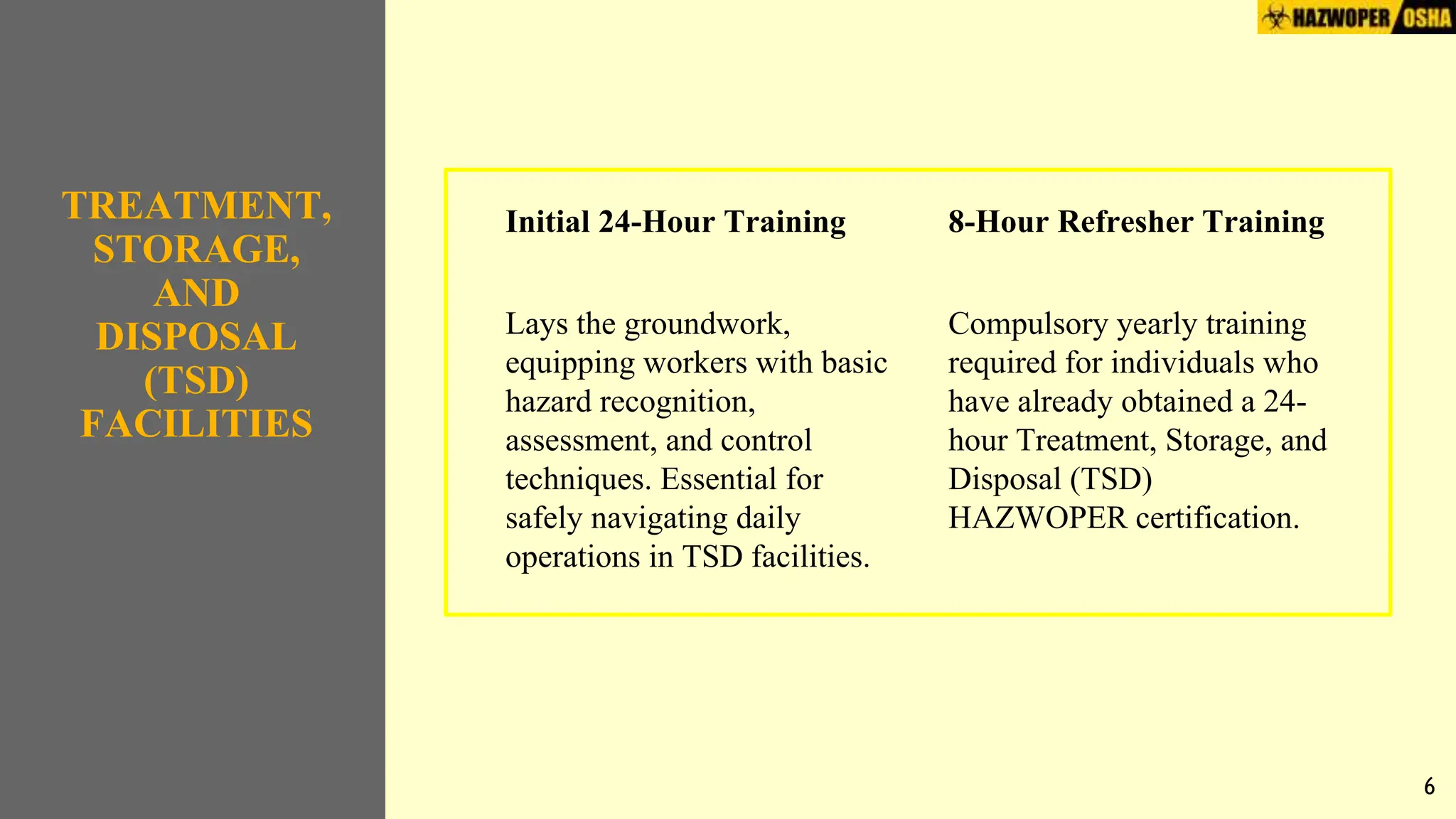
Certification for 24-hour training is not permanent. To maintain compliance, workers must complete an 8-hour HAZWOPER Refresher course every 12 months. This refresher is designed to update workers on changes in regulations, review core safety concepts, and discuss any recent industry incidents that provide learning opportunities.
If a worker misses their annual deadline, there is technically no "grace period" provided by OSHA. While missing the deadline by a short margin (e.g., a few weeks) usually allows the worker to simply take the 8-hour refresher to regain compliance, a long lapse may require the worker to retake the full 24-hour course. The determination often depends on the employer's risk assessment and the complexity of the site operations.
Certification Requirements and 2026 Compliance Standards
To be fully certified, a worker must do more than just sit through 24 hours of lectures. There is a multi-step verification process required to meet federal and state safety standards.
- Instructional Hours: Completion of the 24 hours of curriculum from an OSHA-compliant provider.
- Examination: Passing a comprehensive exam, typically requiring a score of 70% or higher.
- Field Experience: OSHA requires at least one day of actual field experience under the direct supervision of a trained, experienced supervisor. This must happen after the classroom training.
- Employer Certification: The employer must certify that the worker has been trained and is competent to perform their assigned duties. This is a crucial point: the training certificate from a school is only one piece of the legal "competency" puzzle.
- Medical Surveillance: Depending on the site, workers may need to be enrolled in a medical surveillance program to ensure they are physically fit to wear PPE and to establish a baseline for health monitoring.
Is My Training Valid?
In 2026, workers should verify that their training provider is accredited or widely recognized in the industry. Training should include a certificate that lists the instructor’s name, the dates of training, and the specific citation (29 CFR 1910.120) it covers.
FAQ: Common Questions About 24-Hour Training
Can I use my 24-hour training to work on an active remediation site?
No. If you are involved in active cleanup operations where you are likely to be exposed to hazardous substances above the PEL, you must have the 40-hour certification. The 24-hour course is strictly for those whose exposure risk is minimal and whose tasks are specific and limited.
Does the 24-hour HAZWOPER certificate expire?
Yes. The certification is valid for exactly 12 months from the date of completion. To keep it active, you must complete an 8-hour refresher course annually. If you go several years without a refresher, you may be required to retake the initial 24-hour course.
Is the 24-hour training the same as the 24-hour NYC SST?
No. These are two different certifications. The HAZWOPER training deals with hazardous waste and chemical safety under federal OSHA rules. The NYC SST (Site Safety Training) is a requirement under New York City Local Law 196, focusing primarily on construction fall protection and general site safety for workers in the five boroughs.
Can online training satisfy the 24-hour HAZWOPER requirement?
Partially. OSHA requires that some components, such as PPE donning and doffing, involve hands-on practice. A fully online course that lacks any interactive or practical component may not be considered compliant during an inspection. Most professionals recommend a hybrid approach.
What happens if I move from a 24-hour role to a 40-hour role?
You do not need to take a brand new 40-hour course. You can take a "16-hour upgrade" course that bridges the gap between the two certifications. This upgrade must be documented and supplemented by the required three days of supervised field experience.
Next Steps for Compliance and Safety
If you have determined that 24-hour training is the correct level for your professional needs, your next action should be to select a reputable training provider. Ensure the course covers the specific requirements of 29 CFR 1910.120 and offers a path for the hands-on component.
Once the classroom portion is complete, coordinate with your employer to schedule your one day of supervised field experience. This is not just a formality; it is a legal requirement to validate your certification. Finally, set a calendar reminder for 11 months from your completion date to schedule your 8-hour refresher. Maintaining this cycle is the only way to ensure you remain legally eligible to work on hazardous waste sites throughout 2026 and beyond.