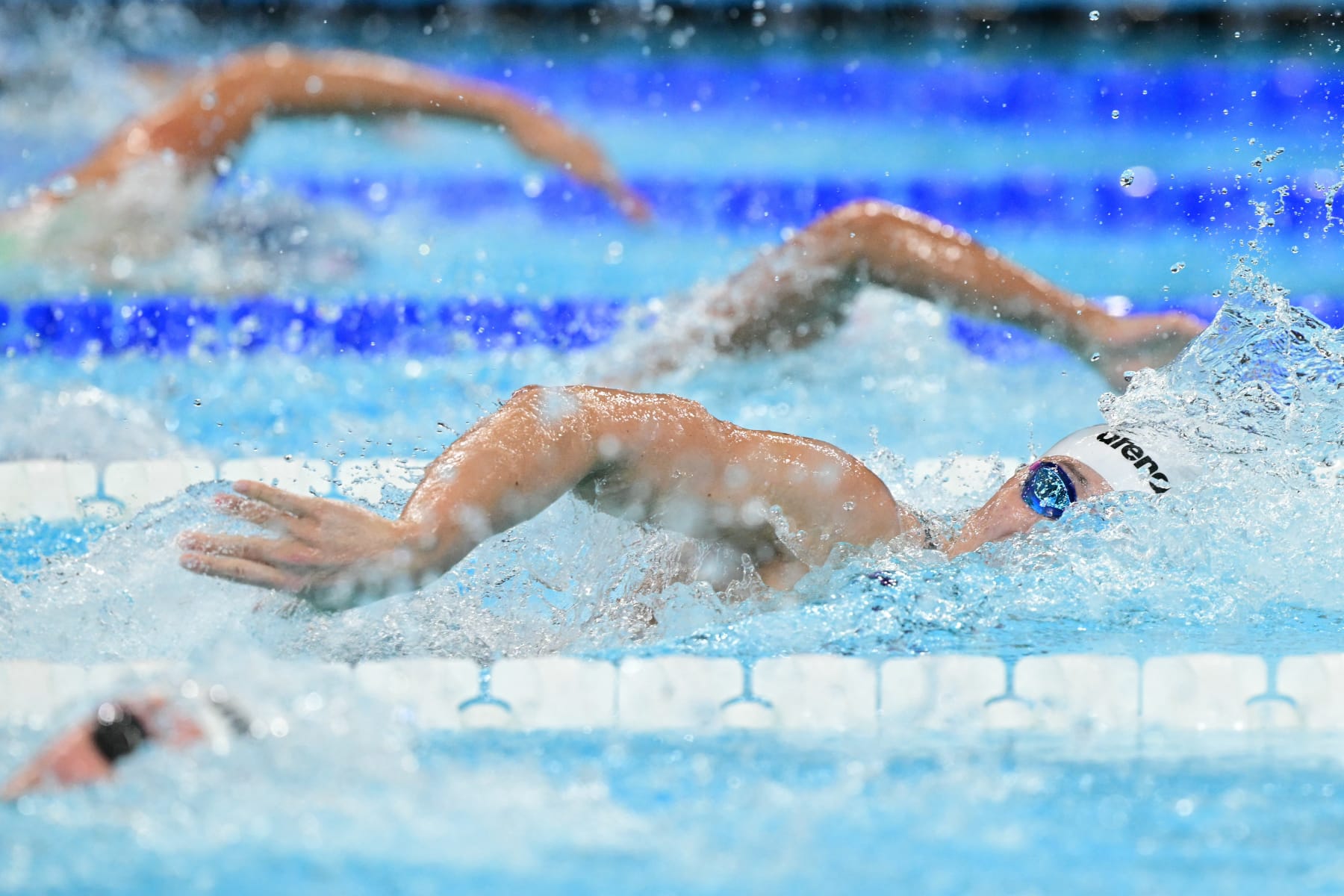
The 2024 Paris Olympic swimming competition concluded with the United States topping the medal table with 28 total medals (8 gold), closely followed by Australia with 18 total medals (7 gold), and host nation France securing 7 medals (4 gold). Four world records and 20 Olympic records were broken across 37 pool and open-water events at Paris La Défense Arena and the Seine River.
Overview of the Paris 2024 Olympic Swimming Competition
The swimming program at the Paris 2024 Olympic Games delivered nine days of high-intensity competition in the pool from July 27 to August 4, 2024, followed by two days of marathon open-water swimming in the Seine River on August 8 and 9. Held inside the temporarily transformed Paris La Défense Arena in Nanterre, the pool events featured 35 separate gold-medal races spanning freestyle, backstroke, breaststroke, butterfly, individual medley, and team relays.
The competition was defined by historic individual achievements, tactical relay showdowns, and an intense head-to-head battle for national supremacy between traditional swimming powers. While early commentary focused on the custom pool's 2.2-meter depth—slightly shallower than the 3-meter depth seen in Tokyo and Rio—the fast water ultimately produced four new world records and dozens of Olympic records.
Host nation France experienced a historic resurgence behind individual phenomenon Léon Marchand, while Team USA sustained its long-standing status atop the cumulative medal count. Meanwhile, emerging global stars from China, Canada, Ireland, and Romania reshaped the international hierarchy across sprint, middle-distance, and endurance events.
Official 2024 Olympic Swimming Medal Standings
The final medal standings for the Paris 2024 swimming events incorporate all 35 pool events and the 2 open-water marathon events (10km men and women). The United States earned the highest total medal count, driven by deep podium representation across relay and individual events, while Australia maintained exceptional gold-medal efficiency.
| Rank | Nation | Gold | Silver | Bronze | Total Medals |
|---|---|---|---|---|---|
| 1 | United States (USA) | 8 | 13 | 7 | 28 |
| 2 | Australia (AUS) | 7 | 8 | 3 | 18 |
| 3 | France (FRA) | 4 | 1 | 2 | 7 |
| 4 | Canada (CAN) | 3 | 2 | 3 | 8 |
| 5 | Hungary (HUN) | 3 | 1 | 1 | 5 |
| 6 | China (CHN) | 2 | 3 | 7 | 12 |
| 7 | Italy (ITA) | 2 | 1 | 2 | 5 |
| 8 | Sweden (SWE) | 2 | 0 | 0 | 2 |
| 9 | Netherlands (NED) | 2 | 0 | 2 | 4 |
| 10 | Great Britain (GBR) | 1 | 4 | 0 | 5 |
| 11 | South Africa (RSA) | 1 | 1 | 0 | 2 |
| 12 | Ireland (IRL) | 1 | 0 | 2 | 3 |
| 13 | Germany (GER) | 1 | 1 | 1 | 3 |
| 14 | Romania (ROU) | 1 | 0 | 1 | 2 |
| 15 | Greece (GRE) | 0 | 1 | 0 | 1 |
| 15 | Japan (JPN) | 0 | 1 | 0 | 1 |
| 17 | Hong Kong (HKG) | 0 | 0 | 2 | 2 |
| 18 | Switzerland (SUI) | 0 | 0 | 1 | 1 |
Note: Medal totals include both pool swimming (35 events) and 10km open-water marathon events (2 events). Official results are published by the International Olympic Committee and World Aquatics.
Historic World Records Broken at Paris 2024
Despite initial technical discussions surrounding the pool architecture, four world records fell during the nine days of pool action in Paris. These performances highlighted advancements in pacing execution, underwater kick mechanics, and relay exchange precision.
| Event | Swimmer / Team | Nation | Time |
|---|---|---|---|
| Men's 100m Freestyle | Pan Zhanle | China | 46.40 |
| Men's 1500m Freestyle | Robert Finke | United States | 14:30.67 |
| Mixed 4x100m Medley Relay | Team USA | United States | 3:37.43 |
| Women's 4x100m Medley Relay | Team USA | United States | 3:49.63 |
Men's 100m Freestyle: Pan Zhanle (46.40)
China's Pan Zhanle delivered one of the most dominant sprint performances in Olympic history by winning the men's 100m freestyle in 46.40 seconds. Pan shattered his own previous world record of 46.80 seconds—set earlier in 2024 at the World Championships in Doha—by a massive margin of 0.40 seconds. Finishing over a second ahead of silver medalist Kyle Chalmers of Australia (47.48), Pan's split times of 22.28 at the 50-meter turn and 24.12 on the return leg established a new benchmark for high-velocity front-end speed combined with late-race endurance.
Men's 1500m Freestyle: Robert Finke (14:30.67)
American distance specialist Robert Finke defended his Tokyo Olympic title by winning the 1500m freestyle in a world-record time of 14:30.67. Finke broke the 12-year-old mark of 14:31.02 set by China's Sun Yang at the London 2012 Games. Taking the race out aggressively from the opening 100 meters, Finke held off a relentless charge from Italy's Gregorio Paltrinieri (14:34.55), maintaining sub-29.3-second splits per 50-meter lap before touching the wall to claim gold and lower the world standard.
Mixed 4x100m Medley Relay: Team USA (3:37.43)
The United States relay quartet of Ryan Murphy (backstroke: 52.08), Nic Fink (breaststroke: 58.29), Gretchen Walsh (butterfly: 55.18), and Torri Huske (freestyle: 51.88) set a world record of 3:37.43 in the mixed 4x100m medley relay. The Americans narrowly out-touched Great Britain and Australia, shaving 0.15 seconds off the previous record set by Great Britain at the Tokyo 2020 Games (3:37.58). The performance relied on precise leg selection, optimal stroke transitions, and Huske’s clutch freestyle anchor leg.
Women's 4x100m Medley Relay: Team USA (3:49.63)
On the final night of pool action, the American women's 4x100m medley relay team composed of Regan Smith (57.28 backstroke lead-off), Lilly King (1:04.90 breaststroke), Gretchen Walsh (55.03 butterfly split), and Torri Huske (52.42 freestyle split) achieved a world-record time of 3:49.63. They lowered Team USA's previous record of 3:50.40 set in 2019, finishing nearly three and a half seconds ahead of second-place Australia (3:53.11).
Standout Performers and Olympic Records
Beyond the four world records, the Paris Games produced 20 Olympic record performances, marked by individual multiple-gold campaigns that captured global attention.
Léon Marchand’s Historic Four-Gold Campaign
France's Léon Marchand emerged as the marquee athlete of the swimming competition, winning four individual gold medals, all in Olympic record times, plus a bronze medal in the men's 4x100m medley relay:
- Men's 400m Individual Medley: 4:02.95 (broke Michael Phelps' 2008 Olympic record)
- Men's 200m Butterfly: 1:51.21 (broke Kristóf Milák's 2020 Olympic record)
- Men's 200m Breaststroke: 2:05.85 (broke Zak Stubblety-Cook's 2020 Olympic record)
- Men's 200m Individual Medley: 1:54.06 (broke Michael Phelps' 2008 Olympic record)
Marchand accomplished an unprecedented feat on July 31 by winning gold in both the 200m butterfly and the 200m breaststroke within a single two-hour evening session, defeating reigning Olympic champions Kristóf Milák and Zak Stubblety-Cook in their respective signature events.
Summer McIntosh’s Triple-Gold Breakthrough
17-year-old Canadian phenom Summer McIntosh established herself as one of the world's elite multi-stroke swimmers, claiming three individual gold medals and one silver medal:
- Gold: Women's 400m Individual Medley (4:27.71)
- Gold: Women's 200m Butterfly (2:03.03 – Olympic Record)
- Gold: Women's 200m Individual Medley (2:06.56 – Olympic Record)
- Silver: Women's 400m Freestyle (3:58.37)
McIntosh's tactical maturity in the medley and butterfly events provided Canada with its most successful Olympic pool campaign in national history.
Kaylee McKeown’s Backstroke Double-Double
Australia's Kaylee McKeown became the first female swimmer in Olympic history to successfully defend both the 100m and 200m backstroke titles across consecutive Olympic Games. McKeown swept the backstroke events in Paris, setting Olympic records in both finals:
- Women's 100m Backstroke: 57.33 (Olympic Record)
- Women's 200m Backstroke: 2:04.25 (Olympic Record)
McKeown added a gold medal in the women's 4x100m freestyle relay, a silver in the women's 4x100m medley relay, and a bronze in the mixed 4x100m medley relay to finish with five total medals.
Katie Ledecky’s Historic Longevity
American distance legend Katie Ledecky extended her historic career by winning gold in the 1500m freestyle (15:30.02 – Olympic Record) and the 800m freestyle (8:11.04), while earning silver in the 4x200m freestyle relay and bronze in the 400m freestyle.
Ledecky's victory in the 800m freestyle marked her fourth consecutive Olympic title in the event (2012, 2016, 2020, 2024), joining Michael Phelps as the only swimmers to win the same individual event at four separate Olympic Games. Her performance elevated her total career Olympic gold medal count to 9, tying Soviet gymnast Larisa Latynina for the most gold medals won by any female athlete in Olympic history.
Sarah Sjöström’s Sprint Double
Sweden’s Sarah Sjöström delivered a masterclass in modern sprint freestyle. After initially planning to focus primarily on the 50m freestyle, Sjöström entered the 100m freestyle and won gold in 52.16 seconds. She followed up by winning gold in the 50m freestyle (23.71), after setting an Olympic record of 23.66 seconds in the semi-finals, completing a rare sprint double at age 30.
Detailed Discipline Breakdown: Stroke by Stroke
Freestyle Disciplines
The freestyle events presented intense competitive depth across all distances:
- Sprint (50m/100m): Cameron McEvoy of Australia claimed his first individual Olympic gold in the men's 50m freestyle (21.25), while Sarah Sjöström swept the women's 50m and 100m titles. Pan Zhanle dominated the men's 100m with his 46.40 world record.
- Middle Distance (200m/400m): David Popovici of Romania won gold in the men's 200m freestyle (1:44.72) by 0.02 seconds ahead of Great Britain's Matthew Richards. In the women's 200m freestyle, Mollie O'Callaghan led an Australian 1-2 finish over Ariarne Titmus, setting an Olympic record of 1:53.27. Lukas Märtens of Germany took the men's 400m freestyle (3:41.78), while Ariarne Titmus defended her women's 400m freestyle title (3:57.49).
- Distance (800m/1500m): Ireland's Daniel Wiffen won gold in the men's 800m freestyle with an Olympic record of 7:38.19, and secured bronze in the 1500m freestyle. Katie Ledecky swept the women's 800m and 1500m events.
Stroke Disciplines (Backstroke, Breaststroke, Butterfly)
- Backstroke: Hubert Kós of Hungary took gold in the men's 200m backstroke (1:54.26), while Italy's Thomas Ceccon won the men's 100m backstroke (52.00). Kaylee McKeown dominated both women's backstroke distances.
- Breaststroke: Nicolò Martinenghi of Italy earned gold in the men's 100m breaststroke (59.03) in a tight finish ahead of Adam Peaty and Nic Fink. Léon Marchand won the men's 200m breaststroke (2:05.85 OR). South Africa's Tatjana Smith won gold in the women's 100m breaststroke (1:05.28) and silver in the 200m breaststroke, which was won by Kate Douglass of the USA (2:19.24).
- Butterfly: Kristóf Milák of Hungary bounced back to win the men's 100m butterfly (49.90), while Marchand claimed the 200m butterfly. In the women's butterfly, Torri Huske won gold in the 100m butterfly (55.59), narrowly beating teammate Gretchen Walsh (who set an Olympic record of 55.38 in the semi-finals). Summer McIntosh dominated the women's 200m butterfly.
Marathon Open Water Swimming
The 10km open-water marathon events took place in the Seine River, challenging swimmers with strong currents:
- Women's 10km: Sharon van Rouwendaal of the Netherlands won her second Olympic gold medal in the event (1:56:34.2), following her 2016 victory.
- Men's 10km: Kristóf Rasovszky of Hungary secured gold (1:50:52.7), holding off Oliver Klemet of Germany and fellow Hungarian Dávid Betlehem.
Technical Insights and Competitive Trends
Analyzing the Paris 2024 swimming data reveals critical strategic developments that are shaping elite aquatic competition heading into the Los Angeles 2028 Olympic cycle:
- Underwater Kicking and Breakout Distance: Winners in Paris consistently maximized underwater under-surface distance off every wall. Swimmers like Léon Marchand routinely utilized 14-to-15-meter underwater dolphin kicking off turns, effectively reducing surface drag and gaining up to half a body length per turn over competitors who surfaced earlier.
- Relay Depth Over Top-End Speed: Team USA’s victory in the overall medal table relied heavily on relay performances. The American team captured medals in all seven relay events (3 gold, 4 silver), benefiting from deep roster selections during morning preliminaries to rest key stars for evening finals.
- Closing Split Parity: In distance events, traditional negative-splitting strategies evolved toward even-pace splits. Bobby Finke's 1500m world record was built on consistent 29.1-to-29.3 second 50-meter intervals rather than relying exclusively on a final 50-meter sprint, forcing competitors to adapt to higher early tempos.
Accessing Official Results Archives and Timing Data
Coaches, performance analysts, and sports enthusiasts seeking detailed race metrics can access verified primary timing data through several official channels:
- Official Olympic Results Information System (ORIS): Complete race PDF books containing lap-by-lap split times, reaction times off the blocks, stroke rates, and distance-per-stroke metrics are archived via the International Olympic Committee Official Results Hub.
- World Aquatics Official Database: Biometric data, national records, world ranking progressions, and head-to-head historical comparison tools are available on the World Aquatics Competition Archive.
- National Governing Bodies: For domestic split breakdowns, trial qualifications, and selection standards, consult USA Swimming and Swimming Australia.
Frequently Asked Questions
Which nation won the most medals in swimming at the 2024 Paris Olympics?
The United States won the most overall swimming medals at the 2024 Paris Games with 28 total medals (8 gold, 13 silver, 7 bronze). Australia ranked second in total medals with 18 (7 gold, 8 silver, 3 bronze), while France finished third in gold medals with 4 gold (7 total medals).
How many world records were set in swimming at the 2024 Paris Olympics?
Four world records were set during the 2024 Paris Olympic swimming competition: Pan Zhanle in the men's 100m freestyle (46.40), Robert Finke in the men's 1500m freestyle (14:30.67), Team USA in the mixed 4x100m medley relay (3:37.43), and Team USA in the women's 4x100m medley relay (3:49.63).
Who was the most successful individual swimmer at Paris 2024?
France's Léon Marchand was the most decorated individual swimmer at Paris 2024, winning 4 individual gold medals (400m IM, 200m IM, 200m butterfly, 200m breaststroke) and 1 relay bronze medal. Summer McIntosh of Canada was the most successful female swimmer, winning 3 individual gold medals and 1 silver medal.
Did Katie Ledecky break any records at the 2024 Paris Olympics?
Katie Ledecky broke the Olympic record in the women's 1500m freestyle with a time of 15:30.02. By winning the 800m freestyle, she won her fourth consecutive gold medal in that event and earned her ninth career Olympic gold medal, tying the record for the most gold medals won by any female Olympic athlete in history.
Where were the swimming events held during the Paris 2024 Olympic Games?
Pool swimming events were held at the Paris La Défense Arena in Nanterre, a modular indoor stadium fitted with temporary competition and warmup pools. The open-water marathon 10km swimming events took place in the Seine River, starting and finishing near the Pont Alexandre III bridge.
Recommended Next Steps for Analysts and Enthusiasts
To utilize Paris 2024 timing data effectively for athletic training, performance modeling, or research, follow these steps:
- Download Official Split Books: Access the complete ORIS PDF reports from World Aquatics or the IOC to examine turn-by-turn velocity data, reaction times, and stroke counts.
- Analyze Race Pacing Models: Compare lap splits between gold medalists and field averages—particularly in 200m and 400m events—to understand modern tempo distribution strategies.
- Track World Aquatics Rankings: Monitor post-Olympic World Aquatics Series events and national championships to track how 2024 Olympic standards influence qualification times for upcoming World Championships and the 2028 Los Angeles Games cycle.