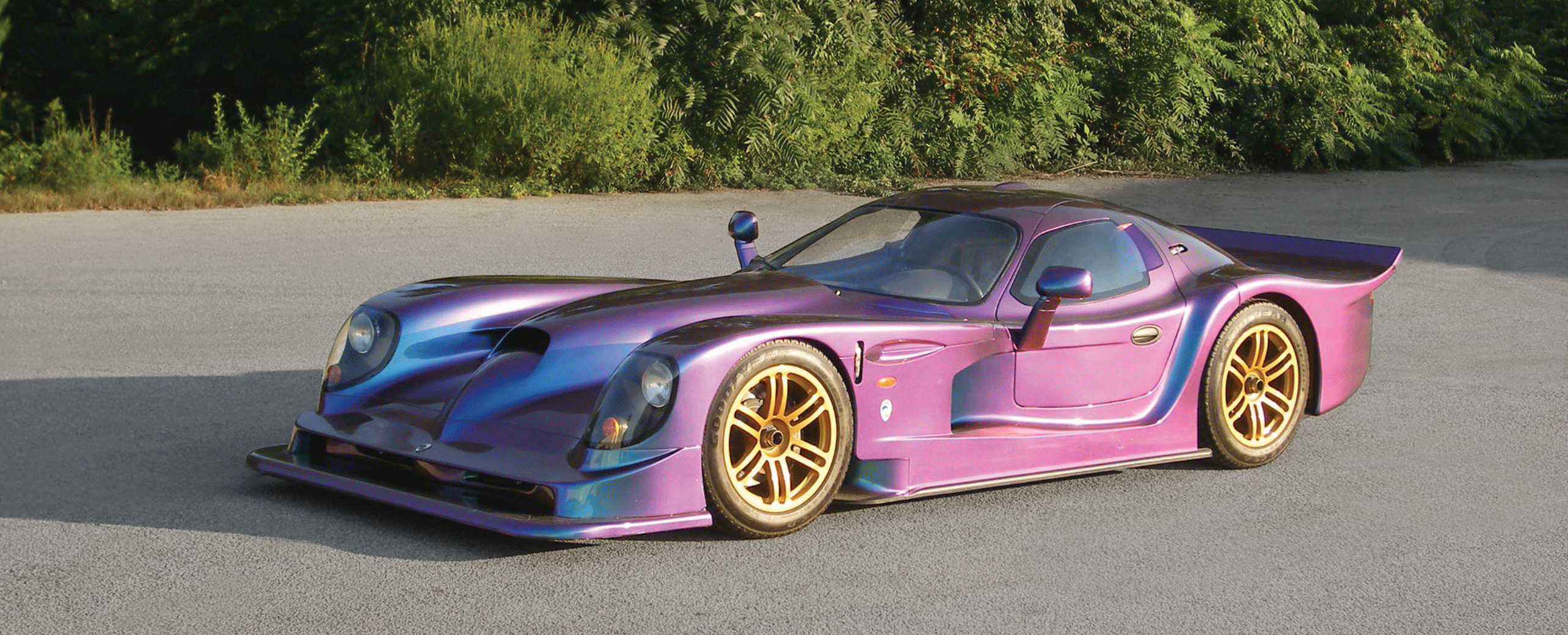
Owning a 2024 Esperante GTR-1 represents the pinnacle of boutique automotive collection, offering a raw, front-mid-engined Le Mans pedigree that few modern hypercars can match. As a continuation of the 1997 GT1 legend, the GTR-1 requires specialized sourcing through Panoz directly or high-end auction houses, demanding a rigorous maintenance schedule handled by technicians familiar with Ford-Roush racing powerplants and carbon-fiber chassis restoration.
The Panoz Esperante GTR-1 is not merely a car; it is a historical anomaly that challenged the mid-engine dominance of the late 1990s GT1 racing era. While competitors like the Porsche 911 GT1 and the Mercedes-Benz CLK GTR adhered to a mid-engine layout, Don Panoz famously doubled down on the front-engine configuration. This "Batmobile-esque" machine became a fan favorite at Le Mans and Sebring. In 2026, the 2024-spec GTR-1—a continuation and restoration project authorized by the Panoz estate—stands as a bridge between analog racing history and modern bespoke manufacturing.
The Heritage and Evolution of a GT1 Icon
To understand the 2024 Esperante GTR-1, one must look back to 1997. The GTR-1 was designed by Reynard Motorsport and Panoz to compete in the FIA GT Championship and the 24 Hours of Le Mans. To meet homologation requirements, Panoz was required to build a street-legal version. Unlike its peers, which were often purpose-built race cars with minimal interior concessions, the Panoz street car attempted to blend extreme aerodynamics with a surprisingly usable cabin.
The 2024 iteration of the GTR-1 is part of a "continuation" series. These are not mass-produced vehicles but are built or restored using the original molds and chassis designs, often incorporating modern materials and engine management systems. For the collector in 2026, this means the vehicle possesses the soul of a 90s racer with the reliability of contemporary engineering.
Ownership of a GTR-1 puts you in a very small circle. With only one original 1997 street car (the "Silver Car") and a handful of continuation models produced since 2015, the GTR-1 is significantly rarer than a Ferrari Enzo or a McLaren P1. It remains a statement of "American Might" on the global stage, utilizing a massive V8 heart to compete with the sophisticated V12s of Europe.
Technical Specifications and Performance Architecture
The heart of the 2024 Esperante GTR-1 is its unconventional layout. By placing the engine behind the front axle but in front of the driver, Panoz achieved a 50/50 weight distribution while maintaining the aggressive long-nose aesthetic of a classic GT.
Engine and Drivetrain
The 2024 models typically utilize a 6.0-liter naturally aspirated V8 based on the Ford-Roush Yates racing block. This engine is capable of producing over 600 horsepower and 500 lb-ft of torque. Unlike modern turbocharged hypercars, the GTR-1 provides linear power delivery and a visceral acoustic experience that is increasingly rare in 2026. Power is sent to the rear wheels via a 6-speed sequential gearbox or a heavily reinforced manual, depending on the specific build commission.
Chassis and Aerodynamics
The car features a carbon-fiber monocoque, which was revolutionary for its time. The bodywork is entirely carbon fiber, designed for maximum downforce. The 2024 specifications often include updated Brembo carbon-ceramic braking systems and bespoke Penske adjustable dampers, allowing the car to be "tuned" for either aggressive track use or high-speed touring.
| Specification | 2024 Panoz Esperante GTR-1 (Continuation) |
|---|---|
| Engine Type | 6.0L Ford-Roush V8 |
| Horsepower | 600+ HP |
| Torque | 500+ lb-ft |
| Chassis Material | Carbon Fiber Monocoque |
| Transmission | 6-Speed Sequential or Manual |
| 0-60 MPH | ~3.3 Seconds |
| Top Speed | 205+ MPH |
| Weight | ~2,600 lbs (approx. 1,179 kg) |
Acquisition Paths: How to Buy a GTR-1 in 2026
Purchasing a Panoz Esperante GTR-1 is not as simple as visiting a local dealership. As of 2026, there are three primary paths to ownership, each requiring a high degree of patience and financial liquidity.
1. Direct Commission via Panoz
The Panoz company, located in Braselton, Georgia, has historically offered a "continuation" service. This involves building a new GTR-1 from the ground up using the original tooling. This is the most desirable path for many, as it allows for modern personalization—upgraded leather interiors, air conditioning systems that actually work, and contemporary infotainment.
2. High-End Specialty Auctions
Occasionally, an original 1990s race chassis that has been converted for street use or a 2015-era continuation model appears at prestigious auctions like RM Sotheby’s or Gooding & Company. These sales are rare and often see prices exceeding $2 million depending on the car’s racing provenance or original condition.
3. Private Collector Networks
Many GTR-1s never reach the open market. They are traded between collectors in private transactions. Engaging a specialized automotive broker who focuses on "Homologation Specials" is often the most effective way to source a GTR-1. Due to the car's rarity, the verification of the VIN and chassis history is paramount. Buyers should demand a full "Certificate of Authenticity" from the Panoz factory to ensure the vehicle is a genuine build and not a kit-based recreation.
Maintenance and Ownership Reality
Owning a GTR-1 is an exercise in stewardship. Unlike a Porsche or a Ferrari, there is no global network of service centers.
Engine and Mechanical Maintenance: Because the engine is rooted in Ford racing technology, finding a mechanic who can work on the internal components is manageable, particularly in North America. Parts for the Roush-Yates block are generally available through specialty racing suppliers. However, the custom cooling systems, unique exhaust manifolds, and specialized dry-sump oiling systems require custom fabrication if they fail.
Bodywork and Structural Care: The carbon-fiber body panels are the most significant "risk" factor in ownership. If a GTR-1 is damaged in a collision, the panels cannot simply be ordered. They must be repaired by carbon-fiber specialists or recreated using the original Panoz molds. For this reason, many owners apply a comprehensive Paint Protection Film (PPF) or even a temporary wrap if the car is driven on the track.
Storage Requirements: The GTR-1 is a low-clearance vehicle with sensitive electronics and cooling systems. It should be kept in a climate-controlled environment with a battery tender. In 2026, many owners utilize specialized storage facilities that offer "start-and-run" services, ensuring that the fluids circulate and seals remain lubricated during periods of inactivity.
Comparative Value: Panoz vs. The GT1 Giants
To appreciate the GTR-1, one must compare it to its contemporaries. The late 90s saw a brief, glorious window where manufacturers built "road-going race cars" to satisfy the FIA's top-tier GT1 class.
The McLaren F1 remains the gold standard, but with prices now reaching $20 million and above, it is in a different financial stratosphere. The Porsche 911 GT1 Straßversion and the Mercedes-Benz CLK GTR typically sell for $10 million to $15 million.
The 2024 Esperante GTR-1 offers a similar level of rarity and performance for a fraction of that cost—typically ranging from $1.5 million to $3 million. For the investor, the Panoz represents a "value" entry into the ultra-exclusive world of GT1 homologation specials. It provides the same visceral thrill and "poster-car" presence at a price point that, while high, is more accessible to the high-net-worth collector.
Common Pitfalls and Troubleshooting
Prospective owners should be aware of specific challenges associated with the GTR-1’s race-bred design:
- Heat Management: The front-mid engine layout generates immense heat. In the original 1997 street car, cabin temperatures could become uncomfortable. The 2024 continuation models have improved heat shielding, but buyers should verify that the AC system has been upgraded to modern standards.
- Visibility and Ergonomics: The GTR-1 has significant blind spots due to its massive rear haunches and long nose. Driving it in modern traffic requires a high degree of situational awareness.
- Sequential Gearbox Maintenance: If the car is equipped with a racing-style sequential gearbox, it will require more frequent fluid changes and inspections than a standard manual or dual-clutch transmission. Owners should listen for excessive "whining" which may indicate gear wear.
- Legal Compliance: Ensure the car is registered as a "Continuation" or "Replica" vehicle depending on local jurisdictional laws. Some regions have strict emissions requirements for cars built after 2020, even if they use an older engine design.
FAQ
Is the 2024 Panoz Esperante GTR-1 street legal?
Yes, the continuation models are built to be street legal, though they must comply with the specific registration laws of the country or state in which they are kept. In the US, they are often registered under "Show or Display" rules or as low-volume manufactured vehicles. They include necessary lighting, mirrors, and safety equipment for road use.
How many Esperante GTR-1s were produced?
Originally, only two street-legal versions were intended, but only one (the "Silver Car") was widely recognized as the official 1997 homologation car. Since then, Panoz has produced a small number of continuation cars. The total number of street-legal GTR-1s in existence is estimated to be fewer than 10 globally as of 2026.
What is the difference between a 1997 and a 2024 GTR-1?
The 1997 car is the original homologation prototype. The 2024 GTR-1 is a continuation build that uses the same molds but often features updated interior materials, modern engine management, better cooling systems, and improved braking technology to make the car more drivable on modern roads.
Where can I get a Panoz GTR-1 serviced?
Service is best performed at the Panoz headquarters in Georgia, USA. For international owners, it is recommended to employ a race-specialized garage that has experience with Ford racing engines and carbon-fiber chassis. Routine maintenance like oil changes can be done by high-end exotic mechanics, but structural or complex electronic work usually requires Panoz factory support.
What engine is in the 2024 Esperante GTR-1?
Most 2024 builds utilize a 6.0-liter V8 engine prepared by Roush Yates. This is a high-performance, naturally aspirated engine based on the Ford small-block architecture, delivering the classic American V8 soundtrack and linear power that the Panoz brand is known for.
Final Recommendations for Potential Owners
If you are considering the acquisition of a 2024 Esperante GTR-1, the first step is to establish a direct line of communication with the Panoz Auto Development team or a verified broker specializing in rare GT1 vehicles. Due to the complexity of the carbon-fiber monocoque, it is essential to perform a pre-purchase inspection (PPI) that includes a full scan of the chassis for stress fractures or previous repair work.
Furthermore, potential owners should define their primary use case. If you intend to drive the car on the street, prioritize a continuation model with the "comfort" package (modern AC and sound deadening). If you are a track enthusiast, look for a chassis with the full racing-spec sequential gearbox. Regardless of the choice, owning a GTR-1 is a commitment to preserving one of the most daring chapters in American motorsport history.