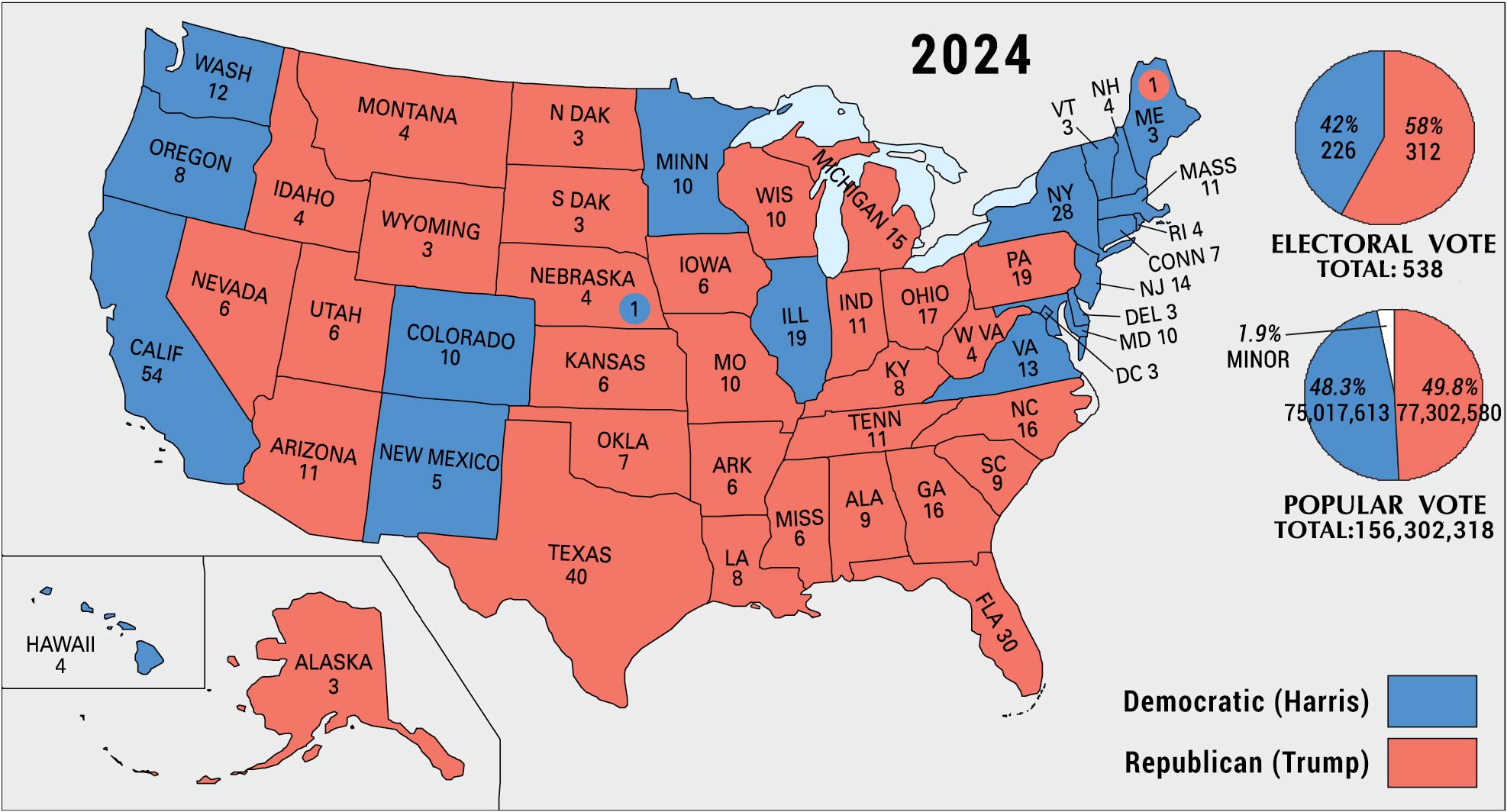
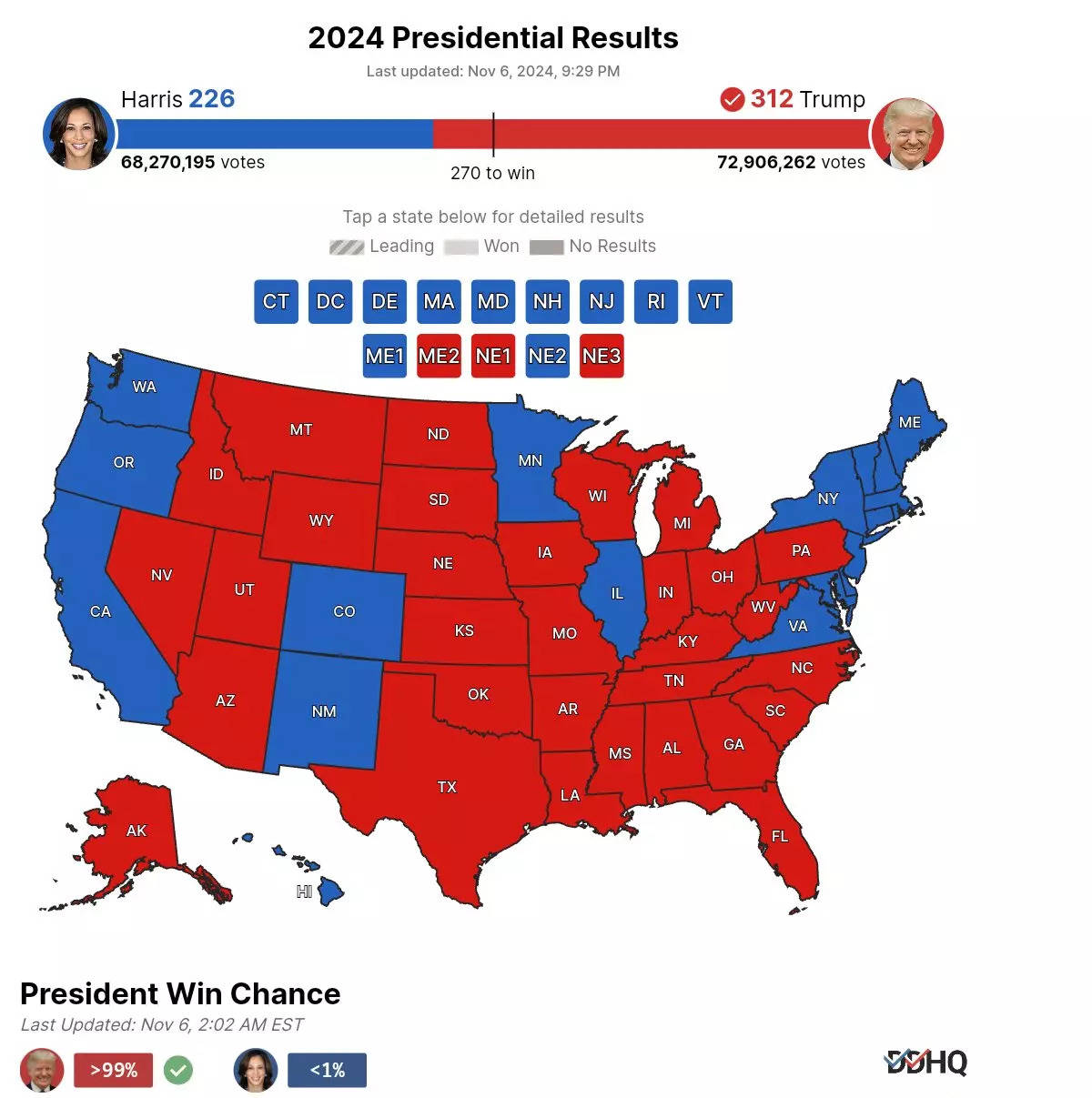
The 2024 United States Presidential Election concluded with Donald Trump being elected as the 47th President of the United States. Defeating the incumbent Vice President Kamala Harris, Trump secured 312 Electoral College votes and became the first Republican candidate to win the popular vote in twenty years, marking a significant political realignment.
The Unprecedented Path to November 2024
The 2024 election cycle is remembered as one of the most volatile in American history. It began with an anticipated rematch between President Joe Biden and former President Donald Trump. However, the trajectory of the race shifted dramatically following the first televised presidential debate on June 27, 2024. Concerns regarding President Biden’s age and performance led to intense intra-party pressure, culminating in his historic decision to withdraw from the race on July 21, 2024.
Vice President Kamala Harris quickly consolidated Democratic support, securing the nomination within weeks and selecting Minnesota Governor Tim Walz as her running mate. This transition energized the Democratic base but also required the Harris campaign to redefine its platform in a very short timeframe. Meanwhile, the Republican primary process saw Donald Trump maintain a commanding lead, eventually selecting Senator JD Vance of Ohio as his vice-presidential nominee.
The campaign was also defined by extraordinary external events, including two assassination attempts against Donald Trump—the first occurring at a rally in Butler, Pennsylvania, on July 13, 2024. These events, combined with ongoing legal proceedings involving the former president, created a high-stakes environment that dominated national discourse until the polls closed on November 5.
Candidate Platforms and Policy Pillars
The 2024 election was fundamentally a referendum on the direction of the national economy and social policy. Both campaigns focused on distinct sets of priorities designed to mobilize their core supporters while appealing to a dwindling number of undecided voters in swing states.
The Trump-Vance Platform Donald Trump’s campaign, anchored by the "Make America Great Again" slogan, focused heavily on economic protectionism, border security, and deregulation. Key proposals included:
- Massive Tariff Implementation: A plan to impose baseline tariffs on all imported goods, particularly those from China, to encourage domestic manufacturing.
- Border Enforcement: A commitment to completing the border wall and initiating the largest mass deportation operation in U.S. history.
- Energy Independence: Promoting "drill, baby, drill" policies to increase domestic oil and gas production to lower energy costs.
- Tax Policy: Making the 2017 Tax Cuts and Jobs Act permanent and further reducing corporate tax rates.
The Harris-Walz Platform Kamala Harris ran on a platform of "An Opportunity Economy," aiming to build on the Biden-Harris administration’s legislative achievements while addressing the high cost of living. Key proposals included:
- Middle-Class Tax Credits: Expanding the Child Tax Credit and providing assistance for first-time homebuyers.
- Reproductive Rights: Codifying federal protections for abortion access following the 2022 overturning of Roe v. Wade.
- Healthcare Costs: Continuing to lower the cost of prescription drugs through Medicare negotiations and capping insulin prices for all Americans.
- Climate Action: Investing in the green energy transition through the frameworks established by the Inflation Reduction Act.
Dissecting the 2024 Electoral Map and Shifts
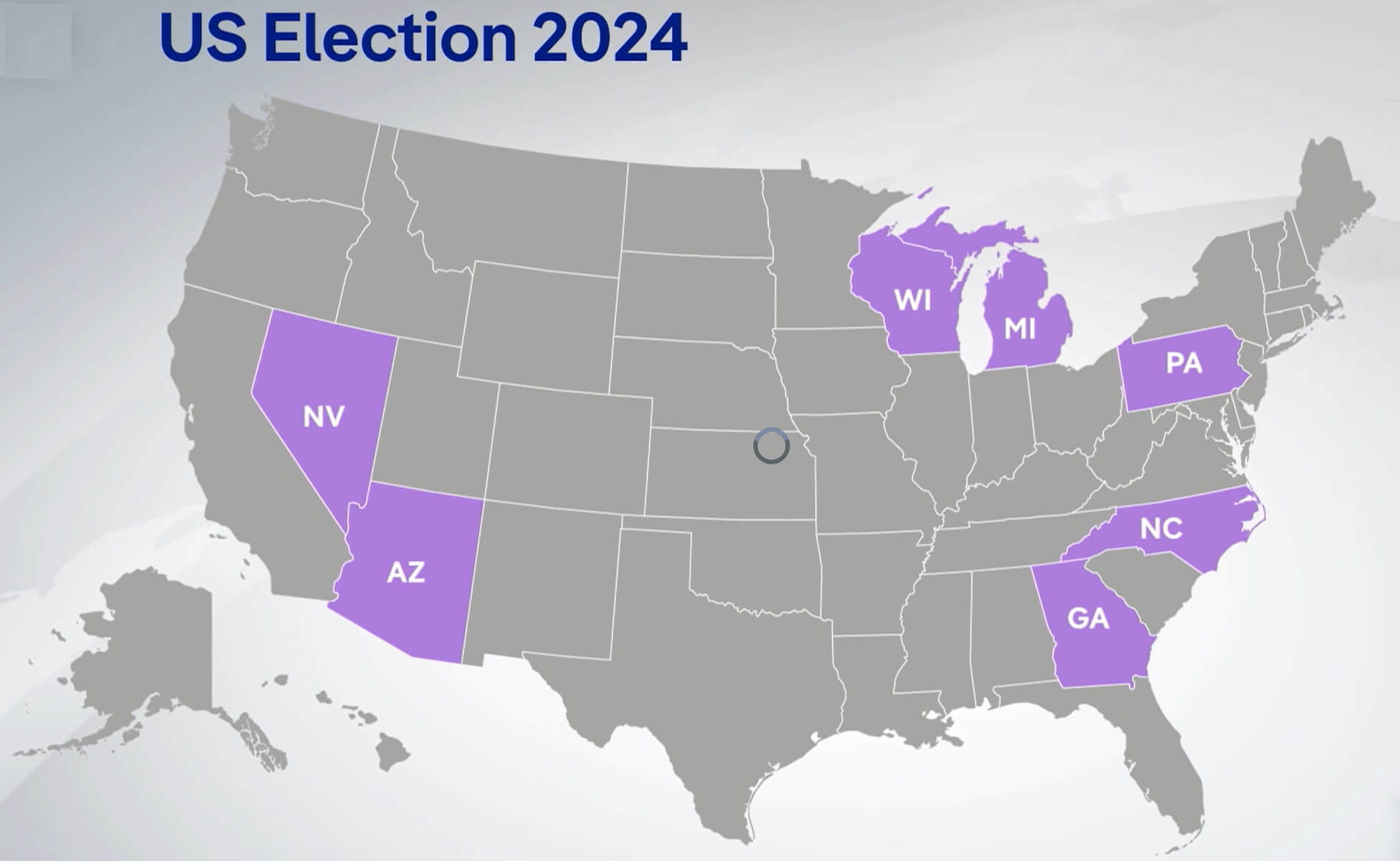
The outcome of the 2024 election was determined by a decisive sweep of the seven major battleground states. While the 2020 election saw narrow margins in the "Blue Wall" states (Pennsylvania, Michigan, and Wisconsin), 2024 saw these states flip back to the Republican column.
The following table illustrates the shift in the seven most critical states that decided the 2024 contest:
| State | 2020 Winner | 2024 Winner | Electoral Votes | Margin Shift (approx.) |
|---|---|---|---|---|
| Pennsylvania | Biden | Trump | 19 | R +3.2% |
| Georgia | Biden | Trump | 16 | R +2.1% |
| North Carolina | Trump | Trump | 16 | R +1.5% |
| Michigan | Biden | Trump | 15 | R +2.8% |
| Arizona | Biden | Trump | 11 | R +5.9% |
| Wisconsin | Biden | Trump | 10 | R +1.6% |
| Nevada | Biden | Trump | 6 | R +4.5% |
The most notable trend in the 2024 map was the "red shift" in non-traditional Republican strongholds. Donald Trump saw improved performance in urban centers and among minority voters, particularly Latino men and Black men, which eroded the traditional Democratic margins in states like New Jersey, New York, and Florida.
Legislative Control: The Republican Sweep of Congress
The 2024 election resulted in a unified government, as Republicans secured control of both the U.S. Senate and the House of Representatives. This outcome provided President Trump with a significant mandate to pursue his legislative agenda starting in early 2025.
In the Senate, Republicans gained four seats, ending with a 53-47 majority. Key flips occurred in West Virginia, where Jim Justice won the seat vacated by Joe Manchin; in Montana, where Tim Sheehy defeated incumbent Jon Tester; and in Ohio, where Bernie Moreno unseated Sherrod Brown. This shift gave Republicans control over judicial confirmations and cabinet appointments, which are critical for the administration’s functional control of the executive branch.
In the House of Representatives, the margin remained narrow but firm. Republicans successfully defended most of their vulnerable incumbents while picking up key seats in rural and suburban districts. This "trifecta"—control of the White House, Senate, and House—has streamlined the budgetary reconciliation process, allowing for major tax and spending changes that do not require a 60-vote threshold in the Senate.
Voter Demographics and the Realignment of 2024
The 2024 results suggest a fundamental realignment of the American electorate along educational and cultural lines rather than purely ethnic or regional ones. The Trump campaign’s focus on the "working class" regardless of race proved effective.
According to exit polling and precinct data, the Republican Party saw double-digit gains among Hispanic voters, particularly in South Texas and Florida. The "gender gap" remained prominent, with women largely favoring Harris—driven by the issue of reproductive rights—while men, particularly younger men under 30, shifted toward Trump in record numbers. This shift among young voters is often attributed to a changing media landscape, where the Trump campaign heavily utilized podcasts and non-traditional digital platforms to reach voters who are less engaged with legacy news media.
Educational attainment continued to be a primary predictor of voting behavior. College-educated voters in suburban areas largely remained with the Democratic Party, but their gains were not enough to offset the massive turnout among non-college-educated voters in rural and exurban areas.
Security, Integrity, and the Peaceful Transfer of Power
Despite the high tensions leading up to November 5, the 2024 election was noted for its administrative efficiency and the relative lack of legal challenges compared to 2020. The Cybersecurity and Infrastructure Security Agency (CISA) and local election officials reported that the election was "the most secure in history," with no evidence of significant foreign interference or systemic fraud.
The 2022 updates to the Electoral Count Reform Act played a vital role in clarifying the Vice President's ceremonial role and raising the threshold for objecting to state results. On January 6, 2025, the certification process proceeded without major incident. On January 20, 2025, Donald Trump was inaugurated as the 47th President, marking only the second time in history a president has served non-consecutive terms (the first being Grover Cleveland in 1892).
The 2026 Perspective: Long-term Impacts on American Governance
As we look back from 2026, the 2024 election is viewed as a turning point in federal policy. The first two years of the second Trump administration have been characterized by significant shifts in trade policy and a major overhaul of the federal bureaucracy. The "Schedule F" executive order, which sought to reclassify thousands of civil service roles as political appointments, has been a central point of legislative and legal debate throughout 2025 and 2026.
For the Democratic Party, the 2024 defeat triggered a period of intense soul-searching and a debate over "identity politics" versus "economic populism." As the 2026 midterm elections approach, both parties are testing whether the demographic shifts seen in 2024 are permanent features of the new American political landscape or a temporary reaction to the post-pandemic economic environment.
Frequently Asked Questions
Who won the 2024 U.S. Presidential Election?
Donald Trump won the 2024 election, defeating Kamala Harris. Trump secured 312 Electoral College votes and won the popular vote, making him the 47th President of the United States. His victory included winning all seven key battleground states: Pennsylvania, Michigan, Wisconsin, Georgia, Arizona, Nevada, and North Carolina.
What were the main issues that decided the 2024 election?
The primary issues were the economy (specifically inflation and the cost of living), immigration, and reproductive rights. While Democrats focused on the protection of democracy and abortion access, the Trump campaign successfully centered the race on economic dissatisfaction and border security, which resonated with a majority of voters in swing states.
How did the 2024 election affect the composition of Congress?
The election resulted in a Republican sweep. The Republican Party gained control of the Senate with a 53-47 majority and maintained a narrow majority in the House of Representatives. This unified government has allowed the Trump administration to pass significant legislation through the budget reconciliation process.
Why did Joe Biden drop out of the 2024 race?
President Joe Biden withdrew from the race on July 21, 2024, following a poor debate performance in June and subsequent concerns regarding his age and ability to win a second term. He immediately endorsed Vice President Kamala Harris, who became the Democratic nominee shortly thereafter at the Democratic National Convention in Chicago.
What was the final Electoral College vote count in 2024?
The final count was 312 votes for Donald Trump and 226 votes for Kamala Harris. A candidate needs 270 Electoral College votes to win the presidency. Trump’s victory was confirmed when he surpassed the threshold in the early morning hours of November 6, 2024, after Pennsylvania was called in his favor.
Participating in the Post-2024 Political Process
For citizens looking to engage with the current political environment in 2026, the most immediate step is preparing for the 2026 Midterm Elections. These elections will determine whether the current Republican "trifecta" remains in place or if the Democratic Party can regain control of one or both houses of Congress to serve as a check on the executive branch. Voters should verify their registration status through their Secretary of State’s office and stay informed on local redistricting changes that may have occurred following legal challenges to the 2020 census maps.