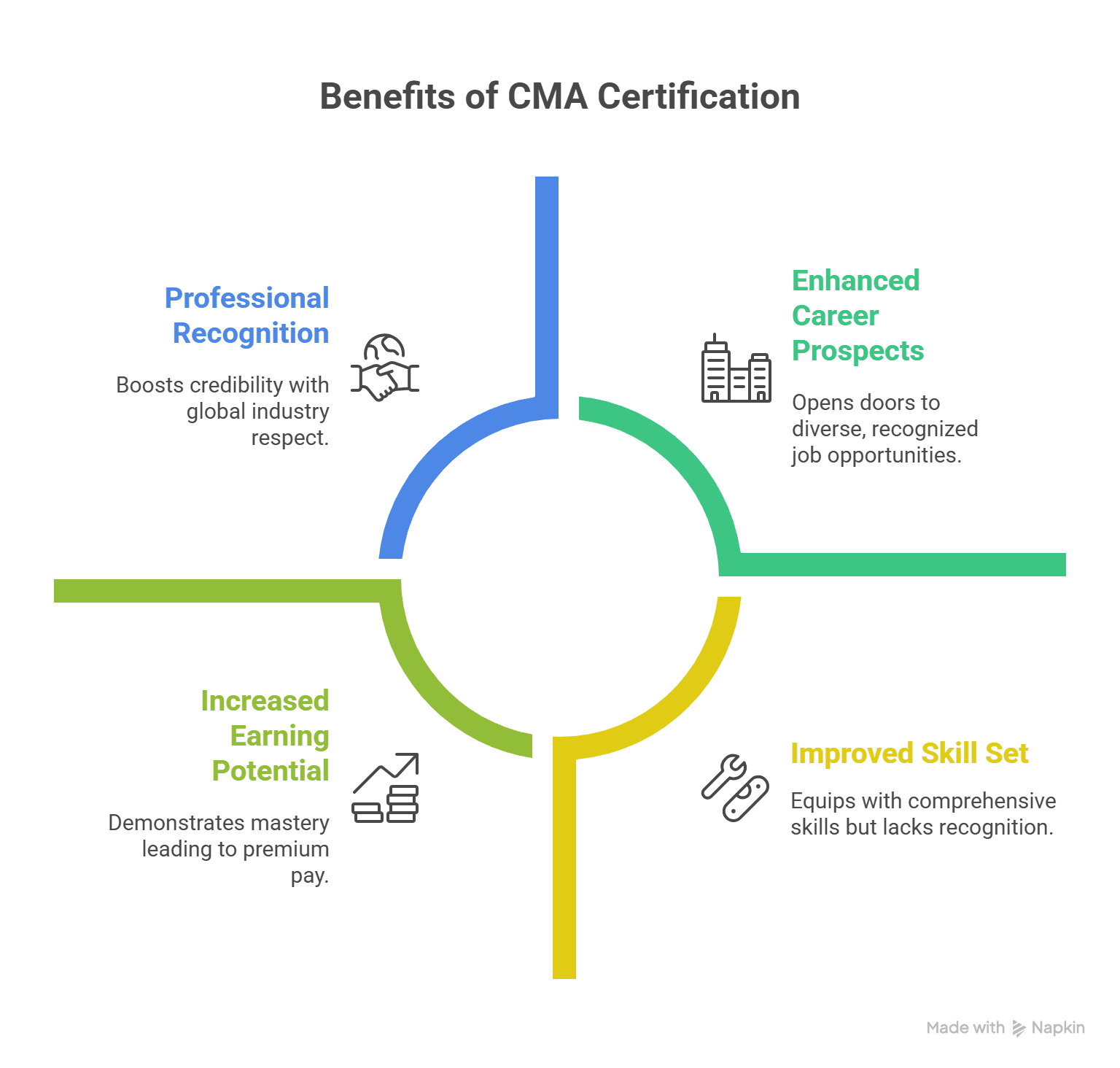
The Certified Management Accountant (CMA) certification remains the global benchmark for management accountants and financial professionals. Achieving the CMA, particularly following the pivotal curriculum updates of 2024, demonstrates a mastery of financial planning, analysis, control, and decision support. In 2026, this credential serves as a vital differentiator for professionals aiming to transition from back-office accounting to strategic leadership roles within multinational corporations.
The Evolution of the CMA Certification
The landscape of corporate finance underwent a significant transformation leading up to 2024, prompting the Institute of Management Accountants (IMA) to refine the CMA curriculum. As we navigate 2026, the importance of these changes—specifically the increased emphasis on data analytics, cybersecurity, and strategic decision-making—is more apparent than ever. The CMA is not merely a test of accounting rules; it is a rigorous assessment of a professional's ability to interpret data and provide actionable insights to executive leadership.
Management accounting differs fundamentally from public accounting (CPA). While the latter focuses heavily on compliance, auditing, and taxation, the CMA focuses on the "inside" of the business. It equips professionals to answer the "Why" and "What’s Next" of financial performance. By earning this certification, candidates signal to employers that they possess the technical proficiency and the ethical framework required to manage the complex financial health of an organization.
The designation is granted by the Institute of Certified Management Accountants (ICMA), the certifying body of the Institute of Management Accountants (IMA). Since its inception, the program has maintained a high barrier to entry, ensuring that those who carry the letters "CMA" are truly prepared for the rigors of modern financial management.
Strategic Prerequisites for CMA Candidates
Before embarking on the journey to unlock success through the CMA, candidates must meet specific foundational requirements. These prerequisites ensure that the candidate has the academic and professional maturity to handle the advanced concepts presented in the exam.
Educational Requirements
To be eligible for the CMA certification, a candidate must hold a bachelor's degree from an accredited college or university. While many candidates hold degrees in accounting or finance, the IMA accepts degrees in various disciplines, provided the institution is recognized by the ICMA. For those who graduated from non-accredited institutions, an evaluation by an independent agency is typically required.
Professional Experience
Candidates must complete two continuous years of professional experience in management accounting or financial management. This requirement can be fulfilled before, during, or within seven years of passing the exam. Qualifying experience involves tasks that require the regular application of management accounting and financial management principles, such as financial analysis, budgeting, forecasting, and risk management. Routine clerical or non-technical tasks do not satisfy this requirement.
IMA Membership and Ethics
Active membership in the IMA is a mandatory prerequisite. Beyond the administrative requirement, membership provides access to a global network of professionals, continuing education resources, and the IMA’s Statement of Ethical Professional Practice. Adherence to these ethical standards is the bedrock of the certification, as management accountants are often the primary guardians of corporate integrity.
Detailed Breakdown of the CMA Exam Parts
The CMA exam is divided into two distinct parts, each four hours long, consisting of 100 multiple-choice questions and two 30-minute essay scenarios. A candidate must score at least 360 out of 500 on each part to pass.
Part 1: Financial Planning, Performance, and Analytics
Part 1 focuses on the internal technical skills required to manage an organization's operations. Following the 2024 updates, there is a heightened focus on technology and data analytics, reflecting the digital-first nature of finance in 2026.
- External Financial Reporting Decisions (15%): Covers the preparation and valuation of financial statements.
- Planning, Budgeting, and Forecasting (20%): Focuses on the strategic planning process and the development of comprehensive budgets.
- Performance Management (20%): Explores how organizations measure results against goals using variances and Key Performance Indicators (KPIs).
- Cost Management (15%): Delves into various costing systems, such as activity-based costing and standard costing.
- Internal Controls (15%): Emphasizes risk assessment and the implementation of controls to safeguard assets.
- Technology and Analytics (15%): Examines data governance, business intelligence, and the use of data analytics in decision support.
Part 2: Strategic Financial Management
Part 2 shifts the focus toward higher-level strategic decisions and corporate finance. This section tests the candidate’s ability to act as a strategic partner to the CEO and Board of Directors.
- Financial Statement Analysis (20%): Uses ratios and profitability analysis to evaluate organizational health.
- Corporate Finance (20%): Covers capital structure, dividend policy, and working capital management.
- Decision Analysis (25%): Focuses on CVP analysis, marginal analysis, and pricing strategies.
- Risk Management (10%): Identifies and mitigates enterprise-wide risks.
- Investment Decisions (10%): Covers capital budgeting and discounted cash flow analysis.
- Professional Ethics (15%): Evaluates the application of ethical standards in complex business scenarios.
| Exam Component | Weighting | Key Focus Areas |
|---|---|---|
| Part 1: Tech & Performance | 100% Total | Budgeting, Internal Controls, Data Analytics |
| Part 2: Strategy & Finance | 100% Total | Decision Analysis, Corporate Finance, Ethics |
| Multiple Choice Section | 75% of Score | Knowledge and Application of Concepts |
| Essay Section | 25% of Score | Analysis and Written Communication |
Navigating the Registration Process and Costs
Entering the CMA program requires a strategic financial commitment. In 2026, the fee structure remains tiered to accommodate students, academic professionals, and working professionals. Understanding these costs is essential for planning your certification timeline.
CMA Entrance Fee
The entrance fee must be paid before a candidate can sit for the exams. This fee covers the credentialing process and provides access to the CMA Support Package, which includes sample questions and the ICMA Retirement Board’s guidelines. Note that the entrance fee is generally non-refundable and valid for a three-year period. If a candidate does not complete both parts within three years, they must re-enter the program.
Exam Fees
Each part of the exam requires a separate fee. Professional members typically pay higher fees than students or academics. It is highly recommended to schedule exams during one of the three testing windows: January/February, May/June, or September/October. Early registration often provides a wider selection of dates at Prometric testing centers, which facilitate the computerized exam.
Total Investment Estimates
When accounting for IMA membership ($150–$295 annually), the CMA entrance fee ($210–$300), and exam fees ($370–$495 per part), the total direct cost often ranges between $1,200 and $1,600. However, this does not include study materials or review courses, which can add another $500 to $2,000 to the total investment. Despite these costs, surveys consistently show that CMAs earn significantly more than their non-certified peers, often recouping the investment within the first two years of certification.
Proven Study Strategies for 2026
Passing the CMA exam requires a disciplined approach, as the global pass rate historically fluctuates between 45% and 55%. Most successful candidates dedicate 150 to 300 hours of study per part.
Selecting a Review Provider
While some candidates attempt to self-study using official textbooks, the vast majority utilize a review provider such as Gleim, Becker, Hock, or UWorld. These providers offer adaptive learning platforms that identify a candidate's weaknesses and focus study time on those areas. In 2026, these platforms have become highly sophisticated, integrating AI-driven mock exams that simulate the actual Prometric environment.
The Power of Practice Questions
Mastering the multiple-choice section requires exposure to thousands of practice questions. Candidates should aim for a "correct" rate of at least 80% during practice sessions. It is crucial not just to memorize answers but to understand the underlying logic of why an answer is correct or incorrect.
Mastering the Essay Section
The essay section is often where candidates struggle. To succeed, one must be able to communicate technical financial information clearly and concisely. The exam software does not have a spell-checker, so practice in a raw-text environment is essential. Focus on answering every part of the prompt; partial credit is awarded, so even an incomplete analysis is better than a blank response.
Why the 2024 Milestone Matters for Future Success
The transition of the CMA curriculum in 2024 was a response to the "Fourth Industrial Revolution" in finance. By 2026, these skills—once considered "advanced"—are now the baseline for employment in mid-to-senior level finance roles.
- Data-Driven Leadership: The 2024 updates integrated data visualization and structured query language (SQL) concepts into the exam. Professionals who understand these tools can bridge the gap between IT and Finance.
- Global Portability: The CMA is recognized in over 150 countries. As global supply chains and multinational operations become more complex, having a standardized credential ensures your skills are understood from New York to Shanghai.
- Future-Proofing Your Career: Traditional bookkeeping is increasingly automated. The CMA focuses on the human element of finance: judgment, strategy, and ethics—skills that AI cannot easily replicate.
Common Pitfalls to Avoid
Many candidates fail because they underestimate the depth of the "Decision Analysis" and "Internal Controls" sections. Another common mistake is poor time management during the exam. With only 2.4 minutes per multiple-choice question, candidates must learn to "mark and move" when they encounter a particularly difficult calculation.
Frequently Asked Questions
Is the CMA worth it in 2026?
Yes. The CMA remains one of the most cost-effective ways to increase salary potential and career mobility in management accounting. In 2026, as companies look for leaders who can navigate economic volatility and digital transformation, the strategic focus of the CMA is more relevant than it was a decade ago. It provides a specialized skillset that complements an MBA or a CPA.
How long does it take to get the CMA certification?
On average, candidates complete both parts of the exam within 12 to 18 months. However, the IMA allows up to three years from the date of entry into the program to pass both parts. The timeline depends largely on the candidate's prior knowledge and the amount of time they can dedicate to studying each week.
Can I take the CMA exam if I am still a student?
Yes, students are encouraged to take the exam while they are still in an academic mindset. Students receive significant discounts on IMA membership and exam fees. While you can pass the exams as a student, you will not be officially "certified" until you complete the required two years of professional work experience.
What happens if I fail one part of the exam?
If you fail a part, you can retake it in a future testing window. There is no limit to the number of times you can retake a part, but you must pay the exam fee for each attempt. Candidates are encouraged to review their "Performance Report," which the ICMA provides to those who do not pass, highlighting areas of weakness.
How many CPE credits are required for CMAs?
To maintain the certification, CMAs must complete 30 hours of Continuing Professional Education (CPE) each year, including at least two hours of ethics. This ensures that CMAs stay current with the latest developments in the field and maintain the high standards of the designation.
Next Steps: Launching Your CMA Journey
To unlock success with the CMA certification, your first step should be to conduct a "gap analysis" of your current qualifications against the IMA requirements. If you meet the educational standards, join the IMA and register for the CMA program. Choose a review provider that matches your learning style—whether that is video-heavy instruction or text-based drill sessions.
Success in the CMA program is a marathon, not a sprint. By focusing on the strategic updates established in 2024 and maintained through 2026, you are not just passing a test; you are preparing for a seat at the executive table. Begin by scheduling your first exam part today to create a hard deadline for your goals.