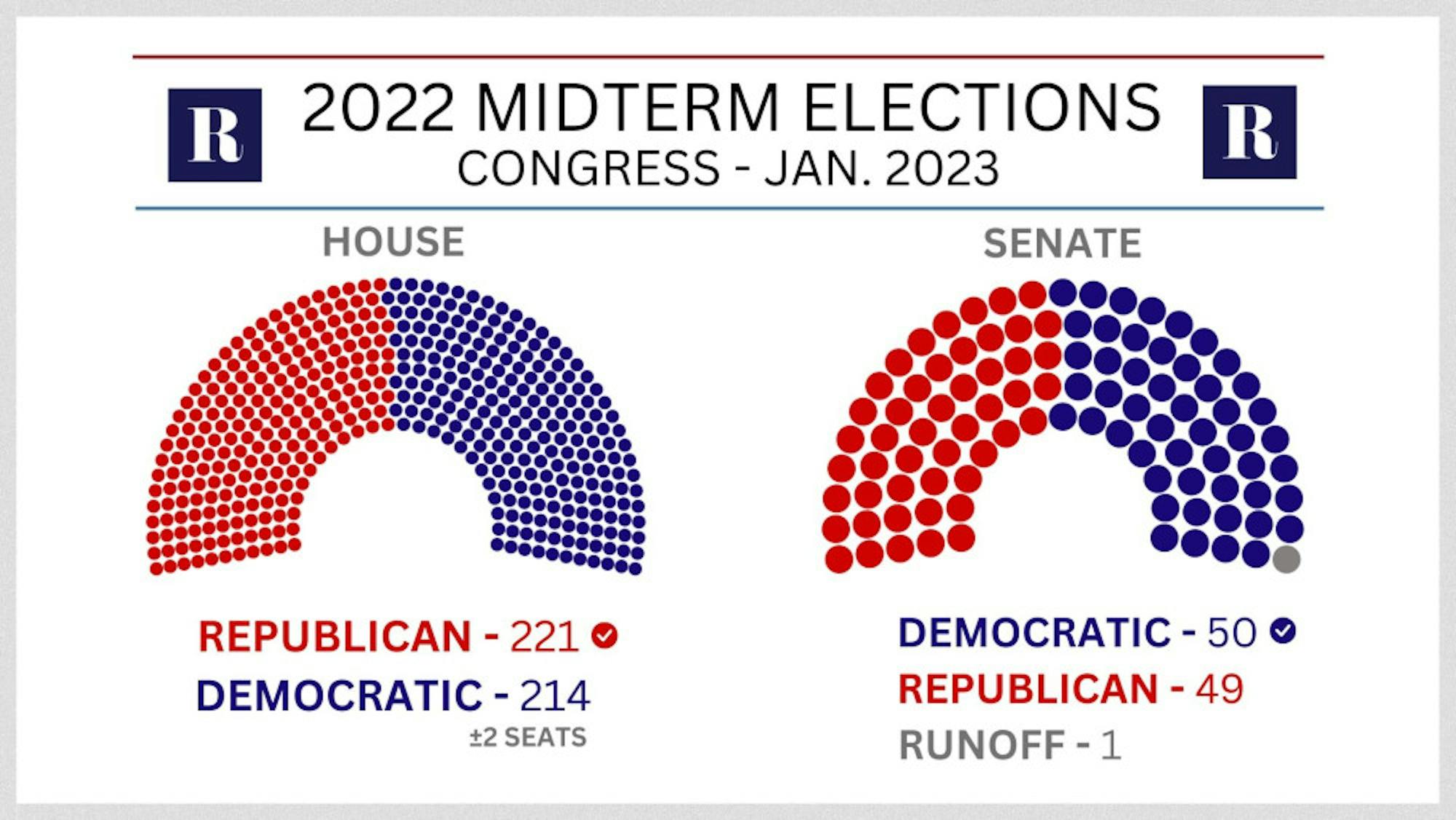
The 2022 United States midterm elections, held on November 8, 2022, resulted in a divided government that significantly altered the American legislative trajectory. Republicans secured a narrow majority in the House of Representatives with 222 seats, while Democrats defied historical trends by retaining and slightly expanding their control of the Senate to a 51–49 margin.
The Political Landscape of the 2022 Midterm Cycle
The 2022 election took place during a period of intense economic and social flux. Historically, the party in control of the White House typically suffers significant losses during the first midterm election of a presidency. However, several unique variables prevented the widely anticipated "red wave" from materializing. This cycle was the first to utilize the newly drawn congressional districts following the 2020 U.S. Census, a technical shift that fundamentally altered the competitive map across several states.
The redistricting process, while varying by state, generally led to fewer "swing" districts and a more polarized electoral map. In states like New York and Florida, redistricting battles in the courts played a decisive role in the final House composition. Beyond the map itself, the political climate was defined by high inflation, lingering pandemic recovery concerns, and the landmark Supreme Court decision in Dobbs v. Jackson Women's Health Organization, which overturned Roe v. Wade just months before the polls opened. These factors created a dual-track election: one focused on economic grievances and another on reproductive rights and democratic institutional integrity.
Composition of the 118th Congress: House and Senate Outcomes
The final results of the 2022 election determined the makeup of the 118th Congress, which served from January 2023 to January 2025. This transition shifted the power of subpoena and legislative priority-setting in the House of Representatives, while the Senate remained a firewall for the executive branch’s judicial appointments.
The House of Representatives
Republicans gained nine seats to reach a 222-seat majority, surpassing the 218-seat threshold required for control. While this victory granted the GOP the Speakership—initially held by Kevin McCarthy after a historic 15-round vote in early 2023—the thin margin created significant internal caucus friction. This narrow majority meant that small factions of the party could exert outsized influence on budgetary negotiations and leadership stability, a theme that dominated the legislative years following the 2022 vote.
The Senate
In the Senate, the "blue wall" remained largely intact. The most critical race occurred in Pennsylvania, where John Fetterman flipped a Republican-held seat. Other incumbent Democrats in high-stakes battlegrounds, such as Catherine Cortez Masto in Nevada and Mark Kelly in Arizona, successfully defended their positions. The cycle concluded with a December runoff in Georgia, where incumbent Raphael Warnock defeated Herschel Walker, moving the Senate from a 50-50 tie (with the Vice President as the tiebreaker) to a true 51-49 Democratic majority. This 51st seat was functionally significant as it allowed Democrats to hold outright majorities on committees, streamlining the confirmation process for federal judges.
Core Influences: Economic Data and Social Mobilization
To understand the 2022 election results, one must analyze the competing priorities of the American electorate. According to exit polling data from the 2022 midterms, voters were split between concerns regarding "pocketbook issues" and "fundamental rights."
- Inflation and the Economy: Throughout 2022, the Consumer Price Index (CPI) remained at 40-year highs. Republican campaigns focused heavily on the cost of gas, groceries, and housing, attributing these rises to the American Rescue Plan and federal spending. For many voters, this was the primary motivator for supporting a change in House leadership.
- Reproductive Rights: The June 2022 Dobbs decision served as a massive catalyst for voter registration, particularly among women and younger voters. In states where abortion access was directly or indirectly on the ballot, Democratic turnout exceeded traditional midterm expectations.
- Candidate Quality: Post-election post-mortems by several political institutes noted that in many high-profile Senate races, Republican candidates who were perceived as too far outside the political mainstream struggled to capture independent voters, despite the favorable economic environment for the GOP.
State-Level Impact: Governors and Secretary of State Races
While federal races dominate the headlines, the 2022 election was a watershed moment for state-level executive power. Thirty-six gubernatorial seats were up for election, along with numerous Secretary of State positions, which had gained newfound prominence due to debates over election administration and security.
In Michigan, Pennsylvania, and Wisconsin, Democratic governors won re-election or maintained control of the executive branch, which proved pivotal for the 2024 presidential cycle's administration. Conversely, in Florida, Governor Ron DeSantis won a decisive re-election by nearly 20 percentage points, signaling a significant shift in the state’s political alignment toward the Republican party.
The 2022 cycle also saw a rejection of candidates who explicitly questioned the validity of the 2020 election in several key Secretary of State races. Voters in Nevada, Arizona, and Michigan opted for candidates who campaigned on traditional election certification processes, stabilizing the technical infrastructure of the democratic process heading into the mid-2020s.
Comparative Data: Seat Changes and Historical Context
The following table outlines the net changes in the 2022 election compared to the previous 2018 midterm cycle, highlighting the relative stability of the 2022 results compared to historical "wave" years.
| Chamber | 2018 Net Change (Party in Power) | 2022 Net Change (Party in Power) | Final 2022 Seat Count | Control Established |
|---|---|---|---|---|
| U.S. House | -40 (Republican Loss) | -9 (Democratic Loss) | 222 GOP / 213 DEM | Republican |
| U.S. Senate | +2 (Republican Gain) | +1 (Democratic Gain) | 51 DEM / 49 GOP | Democratic |
| Governorships | +7 (Democratic Gain) | +2 (Democratic Gain) | 26 DEM / 24 GOP | Mixed |
Note: Senate counts include Independents who caucus with the Democratic Party.
Technical Logistics: Voter Turnout and Demographics
Voter turnout in 2022 was remarkably high for a midterm year, continuing a trend of increased civic engagement seen since 2018. The U.S. Census Bureau reported that 52.2% of the voting-age population participated in the 2022 election.
Technically, the 2022 election saw an expansion of "early voting" and "no-excuse mail-in" ballots in many jurisdictions, though some states had begun to tighten these rules following the 2020 cycle. The demographic breakdown showed a significant "age gap" in voting behavior: voters under 30 leaned heavily toward Democratic candidates, while voters over 65 remained the most reliable Republican voting bloc. The narrowing of the GOP's expected margins was largely attributed to the high turnout among younger cohorts, specifically motivated by climate policy and student loan discussions.
FAQs about the 2022 Election
Why was there no "Red Wave" in the 2022 election?
While Republicans did win the House, the "wave" failed to materialize due to a combination of high voter mobilization regarding the Dobbs decision, the relative unpopularity of several high-profile GOP candidates in swing states, and a stronger-than-expected performance by Democrats among independent voters concerned about democratic stability.
Which state's runoff determined the final Senate margin?
The final seat in the Senate was determined by the Georgia runoff election on December 6, 2022. Senator Raphael Warnock defeated challenger Herschel Walker, securing a 51st seat for the Democratic caucus. This prevented a repeat of the 50-50 power-sharing agreement that existed during the 2021-2022 term.
How did redistricting affect the 2022 House results?
Following the 2020 Census, states redrew their congressional maps. In some states, like Florida, the new maps significantly favored Republicans. In others, like New York, court-ordered maps led to more competitive districts that ultimately helped Republicans flip several seats. Overall, redistricting made the path to a Republican majority easier but also reduced the number of truly competitive seats nationwide.
What were the most expensive races in the 2022 cycle?
The Senate races in Pennsylvania, Georgia, and Arizona were among the most expensive in U.S. history. According to OpenSecrets, total spending for the 2022 federal elections exceeded $8.9 billion, driven by massive contributions to Super PACs and intense fundraising by individual candidates in battleground states.
Did the 2022 election change voting laws?
The 2022 election was the first major test for several new state-level voting laws passed in 2021. Some states, such as Georgia, saw record-breaking early voting turnout despite concerns that new regulations would restrict access. The results suggested that while administrative rules changed, voter motivation remained the primary driver of participation.
Accessing Historical Election Records and Data
For researchers, students, or citizens looking to verify specific precinct-level results or campaign finance disclosures from the 2022 cycle, the following official resources provide the most accurate data:
- Federal Election Commission (FEC): The primary source for all campaign finance data, including individual donations and PAC spending for House and Senate races.
- The U.S. Election Assistance Commission (EAC): Provides technical data on voting methods, ballot rejection rates, and election administration.
- State Secretary of State Offices: These are the final authorities on certified election results. Most states maintain digital archives where users can download CSV or PDF versions of the 2022 canvass reports.
By analyzing the 2022 results through both a legislative and demographic lens, it becomes clear that the election was not merely a referendum on the sitting president, but a complex interaction of economic dissatisfaction and a robust defense of social liberties. These results set the stage for the legislative gridlock and specialized committee investigations that defined the years leading into 2026.