The 2020 Democratic presidential primary featured the largest and most diverse field of major-party candidates in modern American history, with 29 major candidates declaring candidacies alongside several high-profile figures who explored potential runs. The primary contest was shaped by ideological divides, strategic lanes, strict Democratic National Committee debate criteria, and early-state consolidation.
- 2020 Democratic Primary Field Structure
- Moderate Lane
- Biden
- Buttigieg
- Klobuchar
- Bloomberg
- Progressive Lane
- Sanders
- Warren
- Diverse / Governors
- Harris
- Booker
- Castro
- O'Rourke
- Outsider / Single-Issue
- Yang
- Steyer
- Inslee
- Williamson
- Moderate Lane
Field Overview: Scale, Diversity, and Structural Dynamics
The potential and eventual declared field for the 2020 Democratic presidential nomination reflected a party recovering from the 2016 general election outcome while attempting to coalition-build across vastly different demographic and geographic bases. The field encompassed sitting United States Senators, members of the House of Representatives, current and former state governors, municipal leaders, cabinet secretaries, and non-traditional outsider entrepreneurs.
Unlike previous election cycles characterized by a single clear front-runner, the early potential field in 2018 and 2019 was defined by its fluidity. Prospective candidates evaluated their paths to the nomination based on early fundraising capacity, name recognition, staff recruitment, and unique ideological positioning. The scale of the field created distinct mechanical challenges for party leadership, media organizations, and primary voters trying to differentiate between overlapping platforms.
The structural dynamics of the race forced candidates into distinct campaign lanes. Rather than running purely against the incumbent Republican president, contenders spent early 2019 attempting to carve out exclusive ownership over specific ideological segments, demographic coalitions, and policy priorities before the first votes were cast in early 2020.
Major Political Lanes and Candidate Groupings
Understanding the potential and declared 2020 field requires categorizing candidates into ideological and strategic lanes. While candidate platforms occasionally overlapped, voter preferences were strongly influenced by these primary groupings.
| Lane Category | Core Strategic Goal | Prominent Candidates |
|---|---|---|
| Moderate / Establishment | Pragmatic electability, bipartisan appeals | Joe Biden, Pete Buttigieg, Amy Klobuchar, M. Bloomberg |
| Progressive / Left | Structural reform, economic redistribution | Bernie Sanders, Elizabeth Warren |
| Reform & Next-Generation | Generational change, civil rights focus | Kamala Harris, Cory Booker, Julián Castro, B. O'Rourke |
| Outsider / Single-Issue | Disruption, unique policy focus (UBI, Climate) | Andrew Yang, Tom Steyer, Jay Inslee |
The Moderate and Establishment Lane
The moderate lane centered on traditional political experience, incremental policy progress, and broad electability appeals aimed at reclaiming working-class voters in Midwestern swing states.
- Joe Biden: The former Vice President entered the race with high national name recognition and strong support among African American voters, labor unions, and older Democrats. His strategy relied on showcasing governing competence, restoring institutional norms, and leveraging his long legislative tenure.
- Pete Buttigieg: As the Mayor of South Bend, Indiana, Buttigieg presented a generational contrast as a Young Millennial veteran. He combined articulate, moderate policy messaging with strong performance in early-voting states like Iowa and New Hampshire.
- Amy Klobuchar: The Minnesota Senator emphasized her track record of winning red and rural counties, pitching pragmatism, legislative productivity, and Midwestern credibility.
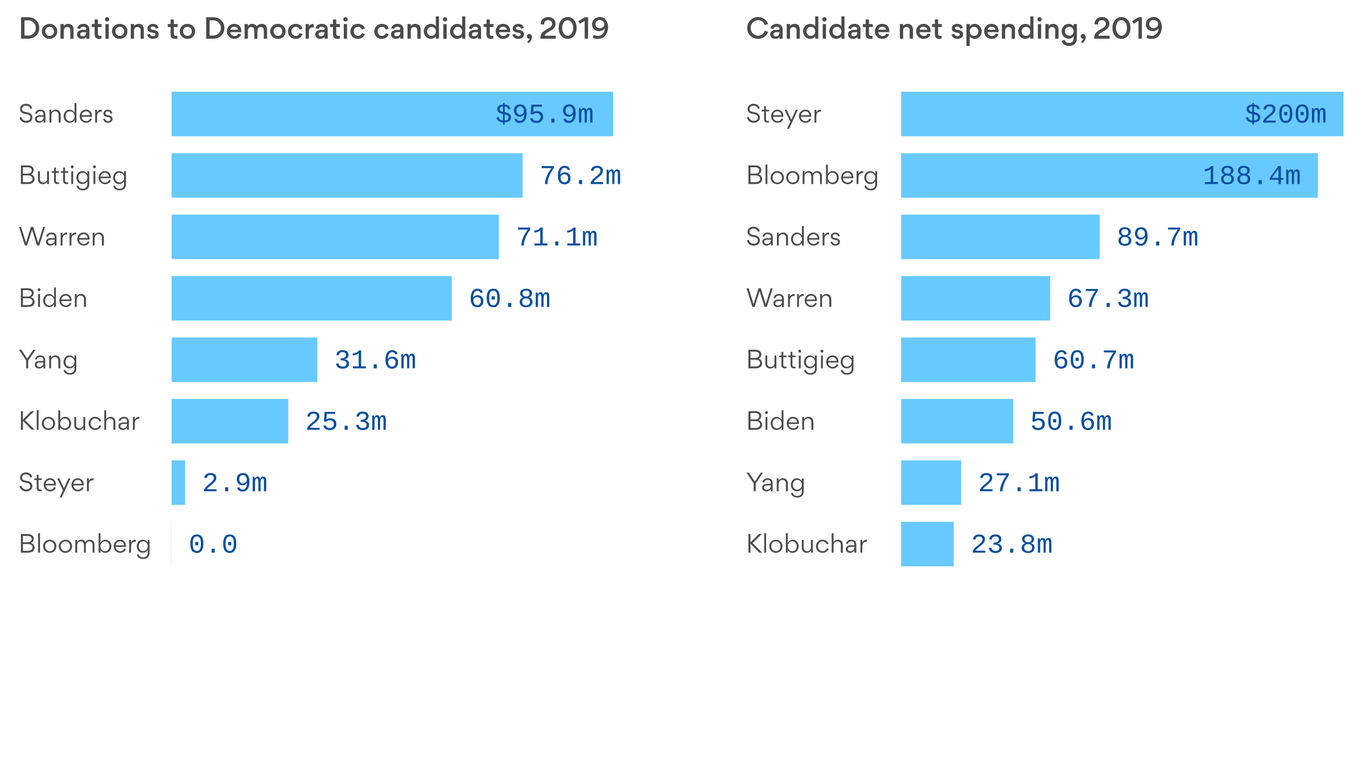
- Michael Bloomberg: Entering late in November 2019, the former New York City Mayor skipped the early primary states entirely. He financed a self-funded ad blitz worth hundreds of millions of dollars targeted directly at Super Tuesday states.
- Other Centrist Contenders: Former Maryland Congressman John Delaney, Colorado Senator Michael Bennet, former Colorado Governor John Hickenlooper, Montana Governor Steve Bullock, and Ohio Representative Tim Ryan focused their messages on economic pragmatic appeals to rural and moderate suburban voters.
The Progressive Lane
The progressive lane advocated for transformative economic and structural reforms, challenging corporate influence and wealth disparity in American politics.
- Bernie Sanders: Building on his 2016 campaign apparatus, the Vermont Senator championed grassroots small-dollar fundraising, universal government programs like Medicare for All, tuition-free public college, and a Green New Deal.
- Elizabeth Warren: The Massachusetts Senator built her campaign around detailed policy plans, consumer protection, and structural economic reform. Her slogan "I have a plan for that" targeted college-educated progressives seeking policy depth and systemic anti-corruption measures.
The Reformers, Next-Generation Leaders, and Diverse Field
A broad group of candidates focused on civil rights, justice reform, demographic inclusion, and generational transition within the party structure.
- Kamala Harris: The California Senator and former prosecutor positioned herself as a versatile contender capable of bridging moderate and progressive factions, placing early emphasis on criminal justice reform and voting rights.
- Cory Booker: The New Jersey Senator advocated for moral leadership, justice reform, and economic empowerment, building strong grassroots organizations in key primary states.
- Julián Castro: The former Housing and Urban Development (HUD) Secretary and Mayor of San Antonio ran an issue-focused campaign emphasizing immigration reform, police accountability, and social equity.
- Beto O'Rourke: Following a high-profile 2018 Texas Senate campaign, O'Rourke entered with national attention, focusing on gun control reform and grassroots engagement before dropping out prior to primary voting.
- Kirsten Gillibrand: The New York Senator prioritized gender equity, paid family leave, and military justice reform.
Outsiders and Single-Issue Campaigns
Several non-traditional candidates entered the 2020 contest to bring specific topics to the forefront of national political discourse.
- Andrew Yang: The entrepreneur mobilized a passionate online movement (the "Yang Gang") around Universal Basic Income (UBI), proposing a $1,000 per month "Freedom Dividend" funded by a Value-Added Tax (VAT) to combat automation-driven job loss.
- Tom Steyer: The billionaire activist spent heavily on national advertising focused on presidential impeachment, climate action, and direct democracy.
- Jay Inslee: The Washington Governor tailored his entire campaign around confronting climate change, serving as a policy baseline for other candidates' environmental plans.
- Marianne Williamson: The author and activist focused on spiritual healing, holistic wellness, and systemic reparations.
Comparative Analysis of Major Contenders
The table below summarizes key declared candidates, their primary elected or professional roles, strategic lane alignment, core policy focus, and final outcome within the 2020 Democratic primary process.
| Candidate | Primary Prior Role | Ideological Lane | Core Policy Platform Focus | Primary Outcome / Exit Timing |
|---|---|---|---|---|
| Joe Biden | Former U.S. Vice President | Moderate / Establishment | Public Option, Bipartisanship, Electability | Secured Nomination (August 2020) |
| Bernie Sanders | U.S. Senator (VT) | Progressive | Medicare for All, Green New Deal, Wealth Tax | Withdrew April 2020 (Runner-up) |
| Elizabeth Warren | U.S. Senator (MA) | Progressive | Anti-Corruption, Wealth Tax, Policy Plans | Withdrew March 2020 |
| Pete Buttigieg | Mayor of South Bend (IN) | Moderate / Reform | Generational Transition, Democratic Reform | Withdrew March 2020 |
| Amy Klobuchar | U.S. Senator (MN) | Moderate | Practical Infrastructure, Midwestern Appeal | Withdrew March 2020 |
| Michael Bloomberg | Former Mayor of New York City | Moderate / Centrist | Public Safety, Infrastructure, Economy | Withdrew March 2020 |
| Kamala Harris | U.S. Senator (CA) | Diverse / Reform | Middle-Class Tax Cuts, Voting Rights | Withdrew December 2019 (Selected VP) |
| Andrew Yang | Entrepreneur / Author | Outsider | Universal Basic Income, Technology Regulation | Withdrew February 2020 |
| Tom Steyer | Business Executive / Activist | Outsider | Climate Emergency, Structural Democracy | Withdrew February 2020 |
| Cory Booker | U.S. Senator (NJ) | Diverse / Reform | Criminal Justice Reform, Housing Equality | Withdrew January 2020 |
| Beto O'Rourke | Former U.S. Representative (TX) | Reform / Generational | Gun Control, Civil Rights, Immigration | Withdrew November 2019 |
| Julián Castro | Former HUD Secretary | Diverse / Policy | Progressive Immigration Reform, Equity | Withdrew January 2020 |
| Jay Inslee | Governor of Washington | Single-Issue / Executive | Climate Crisis Mitigation Plan | Withdrew August 2019 |
Key Policy Debates Defining the Primary
The potential and actual candidate field sparred over several policy debates that highlighted tactical and ideological choices for the Democratic party.
- Primary Policy Divides
- Healthcare
- Single-Payer vs. Public Option
- Climate Policy
- Green New Deal vs. Transition
- Economy
- Wealth Tax vs. Targeted Tax
- Healthcare
Healthcare: Medicare for All vs. Healthcare Choice
Healthcare stood as the sharpest wedge issue of the debates. Bernie Sanders and Elizabeth Warren backed a single-payer "Medicare for All" system that would replace private insurance with a universal, public health network.
Conversely, moderate candidates led by Joe Biden, Pete Buttigieg, and Amy Klobuchar advocated for building upon the Affordable Care Act (ACA). Buttigieg framed his proposal as "Medicare for All Who Want It," introducing a public option to compete alongside private health insurance plans. Moderates argued this approach preserved choice and minimized political vulnerability in swing-state general election contests.
Climate Action and Economic Transformation
While all major candidates acknowledged the urgency of addressing global climate change, their execution strategies differed significantly.
Jay Inslee introduced comprehensive policy frameworks aimed at eliminating carbon emissions from electricity generation and new buildings by specified target dates. Sanders and Warren embraced the Green New Deal framework, linking rapid decarbonization with federal job guarantees and economic restructuring. Centrist candidates advocated for re-entering the Paris Climate Agreement, ending fossil-fuel subsidies, and deploying targeted carbon pricing mechanisms.
Taxation, Wealth Inequality, and Financial Regulation
Addressing wealth inequality produced divergent economic frameworks across the potential field:
- Ultra-Wealth Taxes: Elizabeth Warren and Bernie Sanders proposed annual direct taxes on net worth above specific financial thresholds (e.g., 2% on assets over $50 million) to fund universal childcare, higher education, and healthcare initiatives.
- Targeted Capital Reform: Moderates, including Joe Biden and Amy Klobuchar, rejected direct wealth taxes over implementation and constitutional concerns, arguing instead for raising the top income tax bracket, rolling back 2017 corporate tax reductions, and eliminating capital gains step-up provisions.
- Universal Basic Income: Andrew Yang proposed a flat dividend to all adult citizens regardless of income, asserting that traditional safety nets failed to protect workers displaced by technological advances.
Campaign Strategies and Democratic National Committee (DNC) Rules
To manage the unprecedentedly large field, the Democratic National Committee established strict dual-threshold qualification criteria for officially sanctioned primary debates. Candidates were required to meet both polling benchmarks in approved national and early-state surveys, as well as unique donor count requirements.
- DNC Debate Qualification Engine
- Polling Threshold: Registered % in National or Early-State Surveys
- Donor Threshold: Unique Grassroots Donors across Multiple States
- Qualified for Stage Discourse
These rules exerted structural pressure on campaigns:
- Grassroots Fundraising Demand: Campaigns were forced to invest heavy capital into digital advertising to recruit low-dollar individual donors to qualify for early debate stages.
- Early Field Attrition: Lower-polling candidates who failed to reach escalating debate thresholds faced reduced media coverage, diminishing donor contributions, and early withdrawal before the Iowa Caucuses.
- Debate Stage Formats: The early debates required two-night broadcasts featuring 20 total candidates, creating chaotic debate environments where lower-tier candidates sought breakout moments by directly challenging front-runners.
Primary Timeline and the Path to Consolidation
The primary progression unfolded across distinct strategic phases, culminating in a rapid consolidation around Joe Biden during early spring 2020.
- Feb 3: Iowa Caucuses - Buttigieg/Sanders Lead Early Delegates
- Feb 11: New Hampshire - Sanders Wins; Klobuchar Surges
- Feb 22: Nevada Caucuses - Sanders Secures Decisive Victory
- Feb 29: South Carolina - Biden Scores Convincing Blowout Victory
- Mar 3: Super Tuesday - Moderate Consolidation Propels Biden Win
- Apr 8: Sanders Exits - Biden Becomes Presumptive Nominee
Early State Votes: Iowa, New Hampshire, and Nevada
The opening votes yielded a fragmented field:
- Iowa Caucuses (February 3): Pete Buttigieg and Bernie Sanders emerged at the top of the delegate count, while early front-runner Joe Biden finished fourth, raising doubts about his campaign's organizational strength.
- New Hampshire Primary (February 11): Bernie Sanders edged out Pete Buttigieg for first place, with Amy Klobuchar achieving a strong third-place finish based on late debate momentum.
- Nevada Caucuses (February 22): Bernie Sanders won a decisive victory supported by strong Latino voter turnout, establishing himself as the national front-runner heading into late February.
South Carolina and Super Tuesday Consolidation
The trajectory shifted rapidly during the South Carolina primary on February 29, 2020. Powered by an endorsement from Congressman James Clyburn and overwhelming support among Black voters, Joe Biden scored a decisive victory.
In the 48 hours following South Carolina, Pete Buttigieg and Amy Klobuchar ended their campaigns and endorsed Biden. On Super Tuesday (March 3), Biden won 10 out of 14 voting states, demonstrating broad appeal across Southern, Midwestern, and suburban voters. Bloomberg withdrew immediately after Super Tuesday and pledged his financial infrastructure to the party ticket.
By early April 2020, Bernie Sanders suspended his campaign, allowing Joe Biden to secure the nomination and select former primary rival Kamala Harris as his vice-presidential running mate ahead of the Democratic National Convention.
Long-Term Impact on Party Infrastructure and Political Strategy
The dynamics of the 2020 Democratic primary left lasting operational and policy marks on national political campaigns:
- Validation of Small-Dollar Fundraising Engines: The success of grassroots digital fundraising demonstrated that non-establishment candidates could build multi-million-dollar war chests without reliance on traditional party bundlers.
- Policy Integration: While moderate candidates prevailed electorally, progressive policies regarding federal minimum wage hikes, renewable energy investments, student loan relief, and prescription drug price negotiations were integrated into subsequent party platforms and legislative initiatives.
- Early State Calendar Debates: The logistical and political challenges of the 2020 Iowa Caucuses accelerated subsequent DNC reforms to revamp the presidential primary calendar, elevating states with greater demographic diversity.
Frequently Asked Questions
Who were the top contenders in the 2020 Democratic primary field?
The main contenders included former Vice President Joe Biden, Senator Bernie Sanders, Senator Elizabeth Warren, former Mayor Pete Buttigieg, Senator Amy Klobuchar, Senator Kamala Harris, and former Mayor Michael Bloomberg. Biden ultimately secured the presidential nomination.
Why was the 2020 Democratic primary field so large compared to previous cycles?
The field expanded to 29 declared candidates because the party lacked a singular heir apparent following the 2016 election. Furthermore, dynamic small-dollar digital fundraising models lowered barriers to entry, allowing lesser-known candidates to fund national operations.
How did the DNC debate qualification rules affect candidate survival?
The DNC required candidates to meet increasing polling percentages and unique donor counts. These rules forced candidates to spend money on digital donor acquisition. Those who missed debate thresholds lost national media exposure and were forced to exit early.
Which prominent Democrats declined to run despite potential field speculation?
High-profile figures who explored or were widely speculated to consider a 2020 run but ultimately declined included U.S. Senator Sherrod Brown, former Attorney General Eric Holder, former Virginia Governor Terry McAuliffe, and voting rights advocate Stacey Abrams.
What key policy shifts emerged from the 2020 Democratic primary field?
The contest expanded the party's policy agenda around climate change mitigation, wealth taxation, student loan relief, industrial manufacturing investments, and healthcare expansion. Many of these elements were integrated into federal policy proposals and legislative agendas in subsequent years.
Methodological Retrospective for Analyzing Primary Fields
When evaluating complex presidential primary fields, researchers and analysts should assess three distinct factors rather than relying solely on early national polling:
- Coalition Breadth: Analyze whether a candidate relies on a single geographic or demographic group, or demonstrates cross-demographic appeal capable of surviving diverse primary states.
- Cash-on-Hand and Burn Rate: Evaluate a campaign's financial efficiency by tracking digital acquisition costs relative to net recurring small-dollar contributions.
- Ideological Lane Dominance: Monitor whether multiple candidates are competing within the same ideological segment, which often splits votes and enables a candidate from an opposing lane to win early plurality victories.