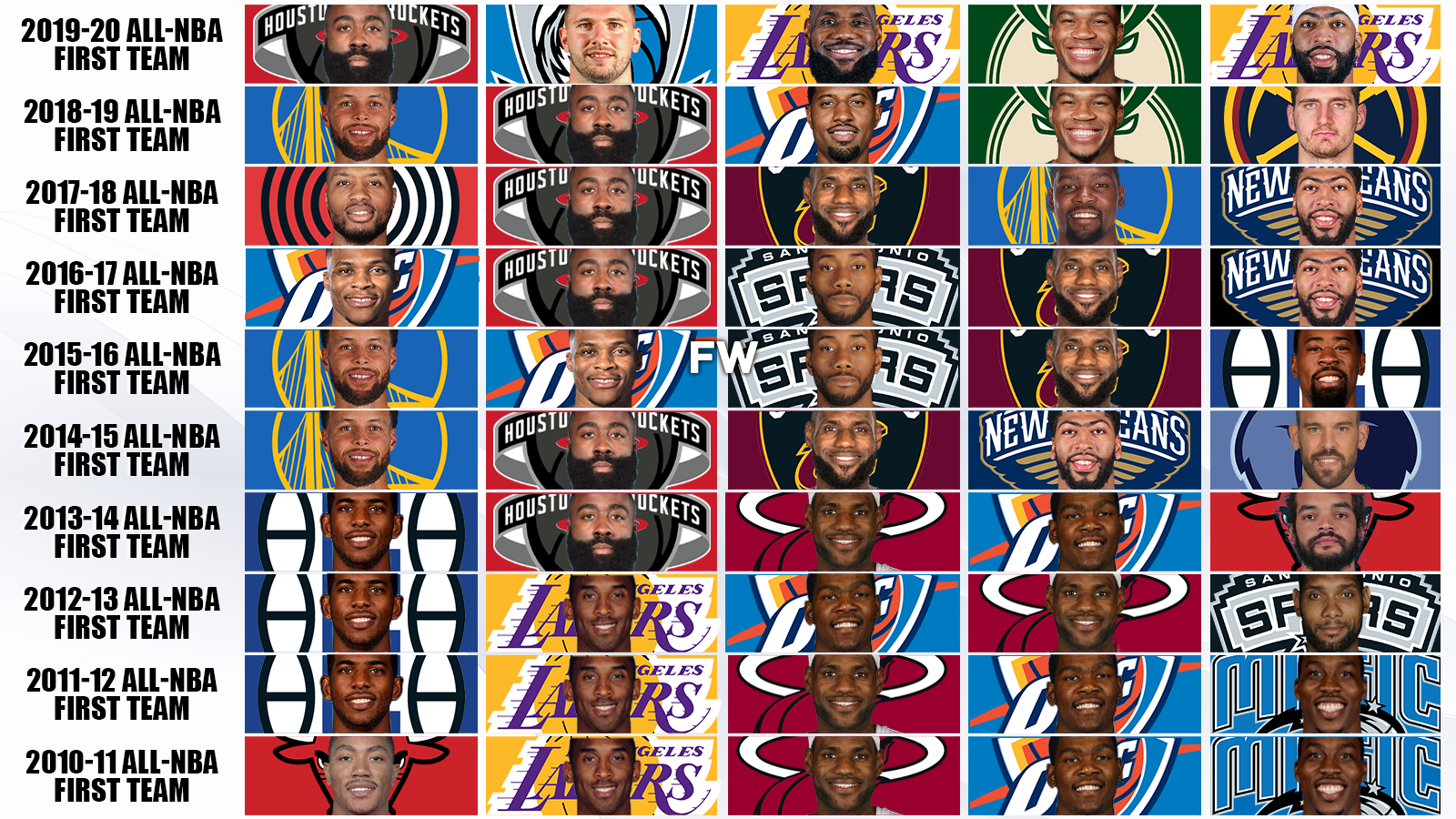
The 2010-11 All-NBA Teams featured a generational shift in talent, headlined by the youngest MVP in league history, Derrick Rose, alongside established icons like Kobe Bryant and LeBron James. These selections highlighted a season defined by the rise of the "Heatles" in Miami and the defensive dominance of Dwight Howard.
The All-NBA Team is an annual honor bestowed upon the best players in the league following the conclusion of the regular season. In 2011, the voting panel consisted of 119 media members across the United States and Canada. Players were awarded five points for a First Team vote, three for a Second Team vote, and one for a Third Team vote. The 2010-11 season was particularly noteworthy because it captured the league in a state of transition—between the post-Jordan era stalwarts and the burgeoning "pace and space" era that would soon redefine professional basketball.
The All-NBA First Team: A Historic Five
The 2011 All-NBA First Team represented the pinnacle of individual performance, combining raw athleticism with veteran mastery. This group included three players who would go on to be considered among the greatest of all time at their respective positions.
Derrick Rose (Chicago Bulls)
At just 22 years old, Derrick Rose became the youngest player to win the NBA Most Valuable Player award. Leading the Chicago Bulls to a league-best 62-20 record, Rose averaged 25.0 points, 7.7 assists, and 4.1 rebounds per game. His selection to the First Team was unanimous in spirit, as he revitalized a franchise that had struggled to find its identity since the retirement of Michael Jordan. Rose’s 2011 campaign was characterized by explosive drives to the rim and an improved perimeter game that made him nearly impossible to guard in pick-and-roll situations.
Kobe Bryant (Los Angeles Lakers)
Kobe Bryant earned his ninth First Team selection in 2011, tying him at the time with legends like Magic Johnson and Oscar Robertson. Despite the Lakers' eventual exit in the second round of the playoffs, Bryant’s regular season was masterclass in efficiency and leadership. He averaged 25.3 points, 5.1 rebounds, and 4.7 assists. In 2011, Bryant was still the "Black Mamba," a feared closer who maintained elite production despite the cumulative wear and tear of 15 seasons in the league.
LeBron James (Miami Heat)
The 2010-11 season was LeBron James' first in Miami following "The Decision." While he faced unprecedented scrutiny, his on-court production remained undeniable. James averaged 26.7 points, 7.5 rebounds, and 7.0 assists while shooting a highly efficient 51% from the field. His ability to facilitate the offense while acting as a primary scoring threat allowed the Heat to finish second in the Eastern Conference. This selection marked his fifth First Team honor, solidifying his status as the best small forward in the world.
Kevin Durant (Oklahoma City Thunder)
In only his fourth season, Kevin Durant secured his second consecutive scoring title and his second First Team selection. Averaging 27.7 points per game, Durant’s length and shooting touch allowed him to score over any defender. He led a young Oklahoma City Thunder squad to 55 wins, signaling the arrival of a new powerhouse in the Western Conference. His 2011 performance proved that his previous year's breakout was no fluke, but rather the beginning of a legendary career.
Dwight Howard (Orlando Magic)
Dwight Howard was the undisputed best center in the league in 2011. He won his third consecutive Defensive Player of the Year award while averaging 22.9 points, 14.1 rebounds, and 2.4 blocks per game. Howard’s presence in the paint was the foundation of the Orlando Magic's system. He was the only player in the league to finish in the top five for both scoring and rebounding that season, earning 118 out of 119 possible First Team votes.
The All-NBA Second Team: The Elite Contenders
The Second Team in 2011 featured players who were often the primary or secondary engines of championship-contending teams. This group showcased the depth of the power forward position during this era.
Russell Westbrook (Oklahoma City Thunder)
Westbrook made his first All-NBA appearance in 2011, signaling his rise as an elite point guard. Averaging 21.9 points and 8.2 assists, he provided the aggressive secondary scoring punch alongside Kevin Durant. His inclusion made the Thunder the only team with two players on the top two All-NBA rosters that year.
Dwyane Wade (Miami Heat)
While LeBron James took much of the spotlight in Miami, Dwyane Wade remained a top-five player in the league. Averaging 25.5 points, 6.4 rebounds, and 4.6 assists, Wade’s defensive contributions and transition scoring were vital to Miami's success. Many argued he had a First Team-caliber season, but the guard spots were exceptionally competitive.
Dirk Nowitzki (Dallas Mavericks)
The 2010-11 season would eventually culminate in Dirk Nowitzki’s greatest achievement—an NBA Championship and Finals MVP. However, his regular season was equally impressive. He averaged 23.0 points per game on nearly 50/40/90 shooting splits (49.7% FG, 39.3% 3PT, 88.9% FT). Dirk’s ability to stretch the floor redefined the power forward position for the next generation.
Pau Gasol (Los Angeles Lakers)
Pau Gasol continued to be the perfect complement to Kobe Bryant. Averaging 18.8 points and 10.2 rebounds, Gasol’s basketball IQ and interior passing were essential to the Lakers' triangle offense. His consistency earned him his second consecutive Second Team selection.
Amar'e Stoudemire (New York Knicks)
Stoudemire’s first season in New York was a massive success. He brought relevance back to Madison Square Garden, averaging 25.3 points and 8.2 rebounds. His streak of nine consecutive games with 30 or more points earlier in the season captivated the league and earned him his fifth and final All-NBA selection.
The All-NBA Third Team: High-Impact Specialists
The Third Team represented players who were either the cornerstone of their franchises or vital veterans leading winning cultures.
- Chris Paul (New Orleans Hornets): Despite battling injuries, Paul remained the "Point God," averaging 15.8 points and 9.8 assists while leading a limited Hornets roster to the playoffs.
- Manu Ginóbili (San Antonio Spurs): Ginóbili was the heartbeat of a Spurs team that won 61 games. His creativity and clutch scoring (17.4 ppg) earned him his second All-NBA nod.
- LaMarcus Aldridge (Portland Trail Blazers): With Brandon Roy sidelined by injuries, Aldridge stepped up as the face of the Blazers, averaging 21.8 points and 8.8 rebounds.
- Zach Randolph (Memphis Grizzlies): "Z-Bo" led the "Grit and Grind" Grizzlies with 20.1 points and 12.2 rebounds per game, punishing opponents in the low post.
- Al Horford (Atlanta Hawks): Horford’s versatility and defensive anchoring for the Hawks earned him his first All-NBA selection, averaging 15.3 points and 9.3 rebounds.
2010-11 All-NBA Statistical Comparison
The following table summarizes the regular-season performance of the 15 players selected for the 2011 All-NBA Teams.
| Player | Team | PPG | RPG | APG | BPG/SPG | Team Record |
|---|---|---|---|---|---|---|
| First Team | ||||||
| Derrick Rose | CHI | 25.0 | 4.1 | 7.7 | 1.0 SPG | 62-20 |
| Kobe Bryant | LAL | 25.3 | 5.1 | 4.7 | 1.2 SPG | 57-25 |
| LeBron James | MIA | 26.7 | 7.5 | 7.0 | 1.6 SPG | 58-24 |
| Kevin Durant | OKC | 27.7 | 6.8 | 2.7 | 1.1 BPG | 55-27 |
| Dwight Howard | ORL | 22.9 | 14.1 | 1.4 | 2.4 BPG | 52-30 |
| Second Team | ||||||
| Russell Westbrook | OKC | 21.9 | 4.6 | 8.2 | 1.9 SPG | 55-27 |
| Dwyane Wade | MIA | 25.5 | 6.4 | 4.6 | 1.5 SPG | 58-24 |
| Dirk Nowitzki | DAL | 23.0 | 7.0 | 2.6 | 0.6 BPG | 57-25 |
| Pau Gasol | LAL | 18.8 | 10.2 | 3.3 | 1.6 BPG | 57-25 |
| Amar'e Stoudemire | NYK | 25.3 | 8.2 | 2.6 | 1.9 BPG | 42-40 |
| Third Team | ||||||
| Chris Paul | NOH | 15.8 | 4.1 | 9.8 | 2.4 SPG | 46-36 |
| Manu Ginóbili | SAS | 17.4 | 3.7 | 4.9 | 1.5 SPG | 61-21 |
| LaMarcus Aldridge | POR | 21.8 | 8.8 | 2.1 | 1.2 BPG | 48-34 |
| Zach Randolph | MEM | 20.1 | 12.2 | 2.2 | 0.8 SPG | 46-36 |
| Al Horford | ATL | 15.3 | 9.3 | 3.5 | 1.0 BPG | 44-38 |
Voting Trends and Position Requirements
In 2011, the All-NBA voting process was strictly bound by positions: two guards, two forwards, and one center per team. This often led to difficult decisions, particularly in the forward category. For instance, Kevin Love (Minnesota Timberwolves) averaged 20.2 points and a league-leading 15.2 rebounds but failed to make an All-NBA team due to his team’s poor record (17-65).
The center position was also top-heavy. While Dwight Howard was the unanimous choice for the First Team, the gap between him and the other centers was significant. This era was the tail end of the "traditional center" dominance before the league transitioned toward smaller, more mobile lineups. Players like Al Horford and Pau Gasol were often utilized as centers in All-NBA voting despite playing significant minutes at power forward, a trend that eventually forced the NBA to move toward "positionless" voting years later.
For more information on historical voting and official records, you can visit the NBA’s Official History Page.
Historical Significance from the 2026 Perspective
Looking back from the year 2026, the 2011 All-NBA roster serves as a time capsule for a league on the precipice of a revolution. Many of these players have since been inducted into the Naismith Memorial Basketball Hall of Fame.
The 2011 season was the last year before the 2011 lockout, which changed the collective bargaining agreement and financial landscape of the league. Furthermore, the 2011 All-NBA selections were made before the "three-point revolution" fully took hold. In 2011, the league average for three-point attempts per game was 18.0; by 2026, that number has nearly doubled in some contexts.
The inclusion of Dirk Nowitzki and Zach Randolph on these teams highlights the "mid-range and post-up" era, which is now viewed as a specialized art form rather than the standard offensive approach. Meanwhile, the emergence of Rose and Westbrook marked the beginning of the "uber-athletic point guard" archetype that dominated the 2010s.
Frequently Asked Questions
Who won the NBA MVP in 2011?
Derrick Rose won the MVP award for the 2010-11 season. He received 113 out of 121 first-place votes, finishing ahead of Dwight Howard, LeBron James, and Kobe Bryant. He remains the youngest player in NBA history to receive the honor, achieving it at the age of 22.
Which team had the most All-NBA selections in 2011?
Three teams had two players selected to the All-NBA rosters in 2011: the Miami Heat (LeBron James and Dwyane Wade), the Los Angeles Lakers (Kobe Bryant and Pau Gasol), and the Oklahoma City Thunder (Kevin Durant and Russell Westbrook). No team had three players selected that year.
Did any rookies make the All-NBA Team in 2011?
No rookies were selected for the All-NBA Teams in 2011. The 2011 Rookie of the Year was Blake Griffin, who had an outstanding statistical season (22.5 ppg, 12.1 rpg), but he did not receive enough voting points to displace the established forwards like Dirk Nowitzki or LaMarcus Aldridge.
How many First Team selections did Kobe Bryant have by 2011?
By the end of the 2011 season, Kobe Bryant had 9 All-NBA First Team selections. He would go on to finish his career with 11 First Team selections, tied for the second-most in NBA history with LeBron James and Karl Malone (at the time of his retirement).
Why was Dwight Howard so dominant in 2011?
Dwight Howard’s dominance was rooted in his defensive impact. In 2011, he became the first player to win Defensive Player of the Year three years in a row. He led the league in defensive win shares (7.7) and was the primary reason the Orlando Magic maintained a top-tier defense despite a roster focused on perimeter shooters.
Navigating Historical NBA Statistics
For fans and researchers looking to verify individual game logs or advanced metrics from the 2010-11 season, several databases provide comprehensive archives. Official statistics are maintained by NBA Stats, while historical context and career trajectories are best viewed through the Basketball Reference 2011 Summary. When analyzing these stats, it is important to consider the "pace" of the game at the time, as the 2011 season had significantly fewer possessions per game compared to the modern 2026 era.