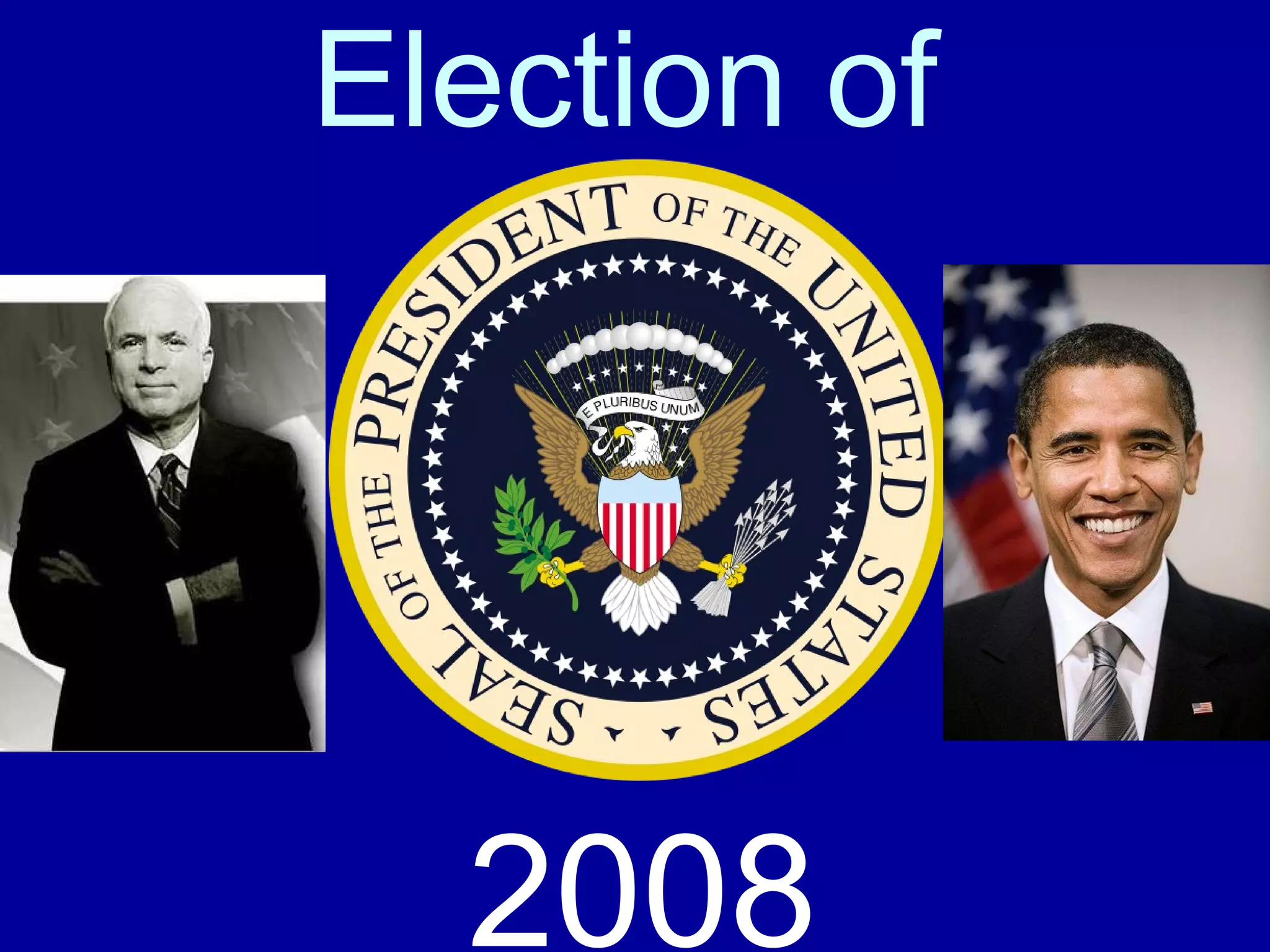
The 2008 United States presidential election was a landmark contest in which Democrat Barack Obama defeated Republican John McCain. Held on November 4, 2008, it resulted in Obama becoming the first African American president in U.S. history. The election was primarily shaped by the global financial crisis and the ongoing wars in Iraq and Afghanistan.
As of 2026, the 2008 election remains a cornerstone of political analysis, representing a fundamental shift in how campaigns utilize technology and how demographic changes influence the American electoral map. It was the 56th quadrennial presidential election and occurred at a time of immense national anxiety, as the "Great Recession" began to take hold of the global economy. For the first time since 1952, neither the sitting president nor the sitting vice president was on the ballot, creating a wide-open race that captured the world's attention.
The Economic and Geopolitical Climate of 2008
To understand the 2008 election, one must first recognize the volatile environment in which it took place. By late 2007, the United States was entering a period of significant instability. The presidency of George W. Bush was drawing to a close under a cloud of low approval ratings, driven largely by the protracted conflict in Iraq and a deepening economic downturn.
The defining moment of the campaign occurred in September 2008, when the collapse of Lehman Brothers signaled the onset of a global financial crisis. This "October Surprise" happened a month early, forcing both candidates to pivot their messaging toward economic stability. While John McCain initially struggled with his response—famously declaring that "the fundamentals of our economy are strong" before suspending his campaign to address the crisis in Washington—Barack Obama projected a sense of "calm under pressure." This period saw a decisive shift in polling data, as voters began to favor the Democratic platform on economic issues.
Furthermore, the fatigue of the "War on Terror" played a significant role. Obama’s early opposition to the Iraq War provided him with a distinct advantage during the Democratic primaries, allowing him to contrast his judgment with that of both Hillary Clinton and John McCain, who had supported the initial invasion.
The Historic Democratic Primary: Obama vs. Clinton
The 2008 Democratic primary was one of the most competitive and closely watched in history. It pitted Senator Hillary Clinton, who began the race as the heavy favorite with deep institutional support, against Senator Barack Obama, a relative newcomer who had gained national prominence following his keynote speech at the 2004 Democratic National Convention.
Obama’s strategy focused on a grassroots movement and the "caucus" system. By winning smaller caucus states that Clinton’s team had largely overlooked, Obama was able to build a delegate lead that became mathematically difficult for Clinton to overcome. The campaign also revolutionized the use of the internet for small-dollar fundraising, allowing Obama to outspend his opponents without relying solely on large corporate donors.
The primary battle lasted until June 2008, when Clinton eventually conceded and threw her support behind Obama. This prolonged contest was significant because it tested Obama’s organization and helped him build a massive database of volunteers and donors that would prove invaluable during the general election.
The Republican Nomination and the Choice of Sarah Palin
On the Republican side, Senator John McCain emerged as the nominee after a primary season that saw several frontrunners rise and fall. McCain, a Vietnam War veteran and a "maverick" known for occasionally bucking his own party, faced the challenge of distancing himself from the unpopular Bush administration while maintaining the support of the conservative base.
In a move to energize the Republican base and appeal to female voters, McCain selected Alaska Governor Sarah Palin as his running mate. Palin was the first woman on a Republican national ticket. While her initial introduction at the Republican National Convention was met with immense enthusiasm, subsequent media interviews and her lack of experience on the national stage became a point of contention for many moderate and independent voters.
The "Palin Effect" was a double-edged sword: she drew massive crowds and solidified support among social conservatives, but she also contributed to a narrative that McCain’s decision-making was erratic, particularly as the economic crisis demanded a steady hand.
Comparing the Platforms: Key Issues of 2008
The general election was fought on three primary fronts: the economy, foreign policy, and the future of healthcare in America. Both candidates recognized the need for reform but offered starkly different paths forward.
| Feature/Issue | Barack Obama (Democrat) | John McCain (Republican) |
|---|---|---|
| Economic Policy | Focused on middle-class tax cuts and increased regulation of Wall Street. | Emphasized corporate tax cuts and deregulation to stimulate growth. |
| Healthcare | Proposed a universal system including a public option and mandates for coverage. | Favored a market-based approach using tax credits to buy private insurance. |
| Iraq War | Advocated for a phased withdrawal and a renewed focus on Afghanistan. | Supported the "Surge" strategy and a continued presence until stability was achieved. |
| Energy | Pushed for heavy investment in green energy and reduced oil dependency. | Promoted "Drill, Baby, Drill"—increasing domestic oil production and nuclear energy. |
| Campaign Slogan | "Change We Can Believe In" / "Yes We Can" | "Country First" |
The Role of Digital Technology and Social Media
The 2008 election is often cited by historians as the first "internet election." The Obama campaign utilized social media platforms like Facebook, MySpace, and a dedicated site called My.BarackObama.com to organize supporters at a local level. This digital infrastructure allowed the campaign to:
- Micro-target Voters: By analyzing data, the campaign could send specific messages to different demographics.
- Facilitate Peer-to-Peer Organizing: Supporters could organize their own phone banks and canvassing events without direct oversight from the national headquarters.
- Bypass Traditional Media: The campaign used YouTube to host long-form speeches and direct-to-voter messaging, avoiding the "soundbite" culture of cable news.
John McCain’s campaign, while attempting to modernize, struggled to match the digital sophistication and engagement levels of the Obama operation. This technological gap contributed significantly to the difference in youth voter turnout, which reached historic highs in 2008.
Election Night Results and Demographic Shifts
On November 4, 2008, Barack Obama won a decisive victory in both the Electoral College and the popular vote. He secured 365 electoral votes to McCain's 173. Obama also won approximately 52.9% of the popular vote, the highest percentage for a Democratic candidate since Lyndon B. Johnson in 1964.
The results revealed a shifting American electorate. Obama successfully flipped several traditionally "red" states, including Virginia, Indiana, North Carolina, and Florida. His victory was built on a coalition of young voters, African Americans, Latinos, and college-educated suburbanites. According to the Federal Election Commission (FEC), voter turnout was exceptionally high, reflecting the high stakes of the era.
McCain’s support was largely concentrated in the South and the Great Plains. Despite his loss, McCain’s concession speech was widely praised as a moment of national unity, as he acknowledged the historic significance of Obama’s election and called on his supporters to offer the new president their full cooperation.
The Long-Term Impact and Legacy of 2008
Looking back from 2026, the 2008 election did more than just change the occupant of the White House; it changed the trajectory of American politics. The election of the first Black president was a symbolic milestone that suggested a "post-racial" America to some, though subsequent years would show that deep divisions remained.
The policy shifts that followed the election were profound. The American Recovery and Reinvestment Act of 2009 was a direct response to the economic crisis discussed during the campaign. Similarly, the Patient Protection and Affordable Care Act (ACA), signed in 2010, was the realization of the healthcare platform Obama campaigned on in 2008.
Furthermore, the 2008 election catalyzed the rise of the Tea Party movement within the Republican Party, a populist reaction to government spending and the ACA. This movement would eventually reshape the GOP, moving it toward a more nationalist and populist stance that would define the party in the 2010s and 2020s.
Frequently Asked Questions
Who were the vice presidential candidates in 2008?
Barack Obama chose Joe Biden, a veteran Senator from Delaware with extensive foreign policy experience. John McCain chose Sarah Palin, the Governor of Alaska. Biden’s role was to provide a steady, experienced hand to complement Obama’s message of change, while Palin was intended to energize the Republican base.
What was the significance of the "Iowa Caucus" in this election?
The Iowa Caucus was the turning point for Barack Obama’s campaign. By winning Iowa, a predominantly white state, Obama proved he could appeal to a broad demographic beyond African American voters. This victory gave him the momentum needed to challenge Hillary Clinton’s status as the inevitable nominee.
How did the 2008 financial crisis affect the polls?
Before the financial crisis hit its peak in September 2008, the race was relatively neck-and-neck. After the collapse of Lehman Brothers, voters’ primary concern shifted almost exclusively to the economy. Polls showed that voters trusted Obama more than McCain to handle the crisis, leading to a significant and sustained lead for Obama in the final two months of the campaign.
What was the "Hope and Change" theme?
"Hope and Change" was the central messaging pillar of the Obama campaign. It focused on the idea that the political system was broken and that a new generation of leadership could move past the partisanship of the 1990s and the Bush years. The simplicity and optimism of the message resonated with an electorate exhausted by war and economic instability.
Which states did Obama flip from the 2004 election?
Obama flipped nine states that had voted for George W. Bush in 2004: Colorado, Florida, Indiana, Iowa, Nevada, New Mexico, North Carolina, Ohio, and Virginia. This geographic expansion was a result of heavy investment in state-level organizing and a shift in suburban voting patterns.
Analyzing the 2008 Election for Future Lessons
The 2008 election serves as a blueprint for how a well-organized grassroots campaign can overcome an established political machine. For students of political science and modern history, the primary lesson is the power of a clear, consistent message—in this case, "change"—tailored to the specific anxieties of the time.
As we evaluate this period from the perspective of 2026, it is clear that the 2008 election was the bridge between the old-school retail politics of the 20th century and the data-driven, digital-first campaigns of the 21st. It established the importance of the youth vote and social media as non-negotiable components of a winning strategy. To understand today’s political landscape, one must first understand the tectonic shifts that occurred in 2008.