20/20 vision is a clinical term used to describe normal visual acuity—the clarity or sharpness of vision—measured at a distance of 20 feet. If you have 20/20 vision, you can see clearly at 20 feet what a person with normal vision should see at that distance. It serves as the baseline for refractive health but does not account for peripheral vision, depth perception, or color awareness.
What Does 20/20 Vision Actually Mean?
To understand 20/20 vision, one must first understand the fraction itself. The first number refers to the distance at which the test is conducted, which is traditionally 20 feet. The second number indicates the distance at which a person with "normal" eyesight can read the same line of letters. Therefore, if you are tested at 20 feet and can read the line that a normal eye sees at 20 feet, your vision is 20/20.
Visual acuity is a static measurement, meaning it is taken while the subject is seated and the target is stationary. While 20/20 is often described as "perfect" vision by the general public, eye care professionals in 2026 emphasize that it is merely the "standard" or "average" for human clarity. Many individuals, particularly younger people with healthy eyes, possess 20/15 or even 20/10 vision, meaning they can see objects at 20 feet that the average person can only see clearly from 15 or 10 feet away.
Conversely, if a person has 20/40 vision, it means that when they stand 20 feet away from a chart, they can only see what a person with normal vision could see from 40 feet away. This indicates that their vision is half as sharp as the standard. Visual acuity is a vital metric for determining the need for corrective lenses, eligibility for certain professions (such as aviation), and legal standing for activities like driving.
The Science and History of the Snellen Chart
The ubiquitous chart featuring a large "E" at the top is known as the Snellen chart, developed by Dutch ophthalmologist Herman Snellen in 1862. Before this standardization, eye care providers had no consistent way to measure vision across different patients or locations. Snellen’s breakthrough was the creation of "optotypes"—letters specifically designed on a 5x5 grid.
Each optotype is structured so that the thickness of the lines and the spaces between them are uniform. For a person to have 20/20 vision, their eye must be able to resolve a spatial pattern separated by a visual angle of one minute of arc. The Snellen chart remains the gold standard in 2026 because of its simplicity and effectiveness, though it has been supplemented by digital versions that prevent patients from memorizing the letters.
In clinical settings, the Snellen chart is usually placed 20 feet away because this distance is considered "optical infinity." At 20 feet, the light rays entering the eye are essentially parallel, meaning the ciliary muscles inside the eye are relaxed. This allows the optometrist to measure the eye's natural refractive state without the interference of "accommodation"—the eye’s ability to change focus for near objects.
Is 20/20 Vision "Perfect" Sight?
It is a common misconception that 20/20 vision represents the pinnacle of ocular health. In reality, visual acuity is only one component of how we process the world. A person can have 20/20 vision on a Snellen chart but still struggle with functional vision due to deficiencies in other areas.
Peripheral Vision and Field of View
A standard acuity test only measures central vision. Peripheral vision allows you to detect motion and objects outside your direct line of sight. Conditions like glaucoma can leave a patient with 20/20 central vision while their side vision is severely restricted, often referred to as "tunnel vision."
Contrast Sensitivity
This is the ability to distinguish between an object and its background. For example, a person with poor contrast sensitivity might struggle to see a grey car on a foggy day or read light-colored text on a white background, even if they can technically see the 20/20 line on a high-contrast black-and-white eye chart.
Depth Perception and Binocularity
Depth perception requires both eyes to work together (binocular vision) to perceive the world in three dimensions. If the eyes are misaligned or if one eye is significantly weaker than the other, a person may have 20/20 vision in each eye individually but lack the ability to judge distances accurately.
Color Vision
The Snellen chart does not test for color blindness. Approximately 8% of men and 0.5% of women have some form of color vision deficiency. While this does not impact the "sharpness" of their vision, it significantly affects their visual experience and ability to perform certain tasks.
Comparison of Visual Acuity Levels
The following table outlines how different visual acuity measurements impact daily life and legal requirements as of 2026.
| Visual Acuity | Interpretation | Practical Implications |
|---|---|---|
| 20/10 to 20/15 | Above Average | Exceptional clarity; common in athletes and young adults. |
| 20/20 | Normal / Standard | The baseline for healthy human vision; required for most pilots. |
| 20/40 | Fair | Minimum standard for obtaining an unrestricted driver’s license in most jurisdictions. |
| 20/70 | Visual Impairment | "Low vision"; may require specialized aids or magnification for reading. |
| 20/200 | Legally Blind | The level at which a person is considered legally blind in the U.S. (with best correction). |
| 20/400+ | Severe Impairment | Significant difficulty performing daily tasks without non-visual assistance. |
Common Factors That Prevent 20/20 Vision
Most people who do not have 20/20 vision naturally suffer from refractive errors. These occur when the shape of the eye prevents light from focusing directly on the retina.
- Myopia (Nearsightedness): The eyeball is too long or the cornea is too curved. Light focuses in front of the retina, making distant objects blurry while close objects remain clear.
- Hyperopia (Farsightedness): The eyeball is too short or the cornea is too flat. Light focuses behind the retina. While young people can often compensate for this, it typically causes eye strain and blurry near vision.
- Astigmatism: The cornea or lens has an irregular, oblong shape (like a football). This causes light to focus at multiple points, leading to blurred or distorted vision at all distances.
- Presbyopia: This is an age-related condition that typically begins in the mid-40s. The lens inside the eye becomes less flexible, making it difficult to focus on close-up tasks like reading. A person may still have 20/20 distance vision but require "reading glasses" for near work.
Modern Diagnostic Tools and Treatments in 2026
By 2026, the technology used to measure and achieve 20/20 vision has advanced significantly beyond the simple wall chart.
Digital Refraction and Wavefront Technology
Modern eye exams now frequently use wavefront aberrometry. Originally developed for high-powered telescopes, this technology maps how light travels through the eye. It identifies "higher-order aberrations"—subtle distortions that glasses cannot always fix—allowing for highly customized prescriptions.
Advanced Refractive Surgery
Procedures like LASIK, PRK, and SMILE (Small Incision Lenticule Extraction) have become more refined. Topography-guided LASIK now allows surgeons to map the unique contours of a patient's cornea, often resulting in vision that is better than 20/20. Additionally, ICL (Implantable Collamer Lenses) provide a permanent solution for those with high degrees of myopia who are not candidates for laser surgery.
Pharmaceutical Solutions for Presbyopia
In 2026, several FDA-approved eye drops are widely used to treat presbyopia. These drops work by constricting the pupil, creating a "pinhole effect" that increases the depth of field and allows patients to see clearly at close range without losing their 20/20 distance vision.
Maintaining Visual Health in a Digital Age
Achieving and maintaining 20/20 vision requires proactive care, especially given the prevalence of digital eye strain (Computer Vision Syndrome). As we spend more time looking at screens, the eyes' focusing muscles are under constant tension.
The 20-20-20 Rule
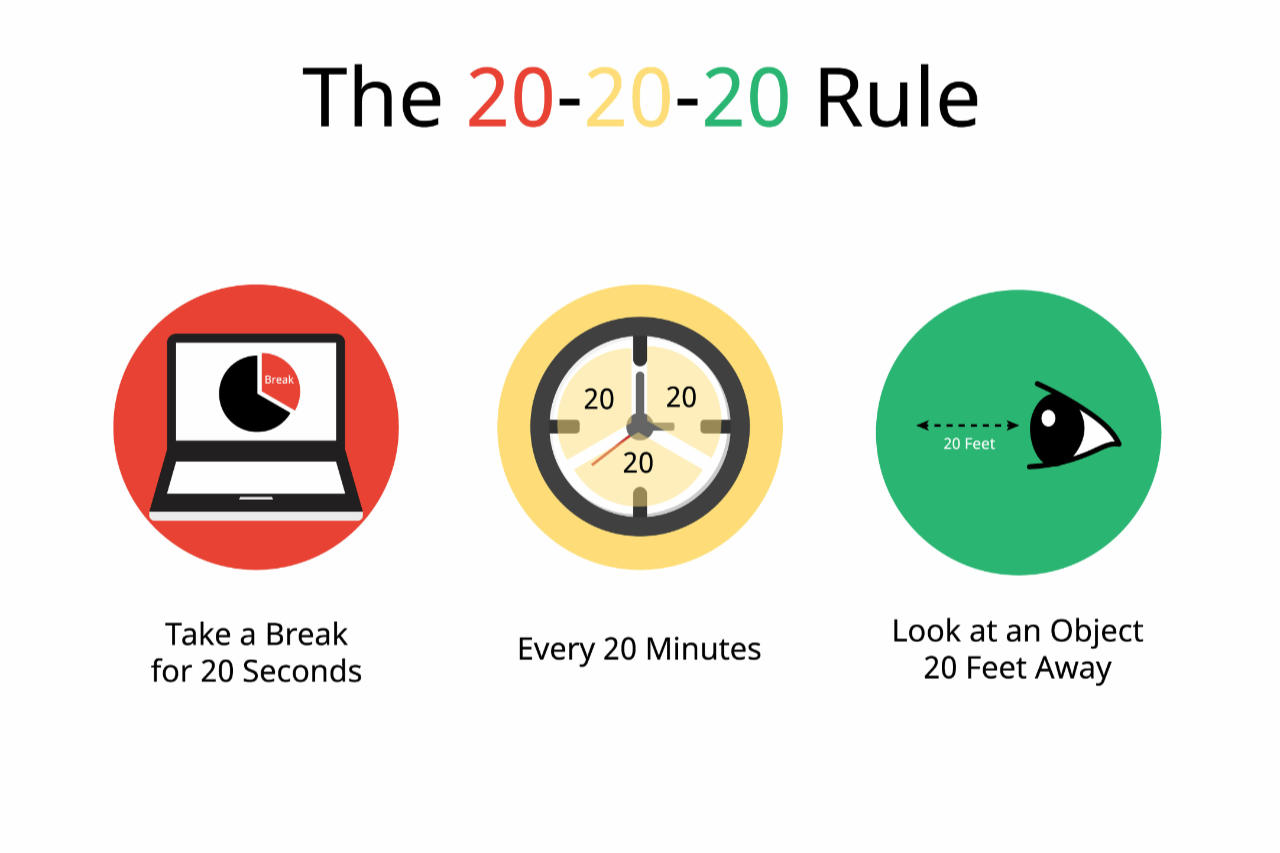
To mitigate digital eye strain, eye care professionals recommend the 20-20-20 rule: Every 20 minutes, look at something 20 feet away for at least 20 seconds. This allows the ciliary muscles to relax and reduces the risk of accommodative spasms and dry eye symptoms.
Nutrition and Lifestyle
The retina is one of the most metabolically active tissues in the body. Diets rich in Lutein, Zeaxanthin, Omega-3 fatty acids, and Vitamin C are linked to a lower risk of macular degeneration and cataracts. Furthermore, protecting the eyes from ultraviolet (UV) radiation by wearing sunglasses is essential for preventing long-term damage to the lens and retina.
Regular Comprehensive Exams
A visual acuity test is not a substitute for a comprehensive eye exam. A standard 20/20 test can miss early signs of glaucoma, retinal detachment, or systemic issues like hypertension and diabetes, which often manifest in the eyes before symptoms appear elsewhere in the body.
FAQ: Common Questions About 20/20 Vision
Can you have better than 20/20 vision?
Yes. Many people have 20/15 vision, which means they can see at 20 feet what a "normal" person must be at 15 feet to see. Some humans even reach 20/10. This is often the result of an exceptionally smooth cornea and a high density of photoreceptor cells in the retina.
Does 20/20 vision decline with age?
While 20/20 distance vision can remain stable for many years, the ability to focus on near objects almost always declines after age 40 due to presbyopia. Additionally, age-related conditions like cataracts or macular degeneration can eventually degrade distance acuity if left untreated.
Is 20/20 vision required for a driver’s license?
Not usually. In most U.S. states and many other countries, the minimum requirement for an unrestricted driver’s license is 20/40 vision in at least one eye. If your vision is worse than this without correction, you will be required to wear glasses or contacts while driving.
Can eye exercises restore 20/20 vision?
Generally, no. Most vision problems are structural (the shape of the eye). While "vision therapy" can help with coordination, tracking, and certain binocular vision disorders, it cannot change the axial length of the eyeball or the curvature of the cornea to "cure" nearsightedness or farsightedness.
What is the difference between an optometrist and an ophthalmologist?
An optometrist (OD) is a primary care provider for the eyes who conducts exams, prescribes lenses, and manages most eye diseases. An ophthalmologist (MD or DO) is a medical doctor who specializes in eye surgery and the treatment of complex ocular pathologies. Both can perform 20/20 acuity testing.
Next Steps for Visual Optimization
If you have not had a comprehensive eye exam in the last two years, scheduling one is the most effective way to ensure your vision remains at the 20/20 standard. Even if you believe your sight is clear, a professional evaluation can detect subtle refractive errors that cause headaches or fatigue.
For those already wearing correction, ask your provider about the latest lens technologies available in 2026, such as high-index materials or advanced anti-reflective coatings designed for heavy digital device usage. If you are interested in permanent correction, a refractive surgery consultation can determine if your eyes are structurally capable of achieving 20/20 vision—or better—without the need for external aids.