The year 1986 stands as a monumental turning point in cinema history, marking a dramatic transformation in how feature-length animation was produced, marketed, and perceived globally. From Don Bluth’s record-breaking box office triumph An American Tail and Walt Disney’s crucial turnaround with The Great Mouse Detective to the official cinematic debut of Studio Ghibli with Castle in the Sky, 1986 reshaped the commercial and artistic trajectory of the medium.
The Historical Context: Why 1986 Transformed Feature Animation
To understand the impact of the animated films released in 1986, one must look at the uncertain landscape of the early-to-mid 1980s. Feature animation in Western cinema had hit a critical period of stagnation. The Walt Disney Studio, long considered the undisputed standard-bearer of the medium, was reeling from the commercial failure of The Black Cauldron in 1985. The costly fantasy epic had lost money at the box office, leading corporate executives to question whether the studio’s traditional animation division had a viable future.
Concurrently, independent animation studios were rising to challenge Disney's dominance. Animator Don Bluth, who led a high-profile walkout from Disney in 1979, proved that theatrical animation could thrive outside the studio system. Partnering with executive producer Steven Spielberg, Bluth set out to build a competitive powerhouse that prioritized classic hand-drawn aesthetics combined with ambitious narrative scale.
Meanwhile, Japanese animation (anime) was experiencing an unprecedented golden era of technical artistry and theatrical ambition. Studios in Japan were pushing boundaries in narrative complexity, adult-oriented storytelling, and mechanical design. The year 1986 proved to be the exact nexus where traditional hand-drawn techniques, early computer-generated imagery (CGI), independent production models, and cross-cultural distribution collided, creating a benchmark year whose legacy remains influential today.
Key Western Releases and Box Office Breakthroughs
The North American box office in 1986 hosted an unprecedented battle for family audiences, driven by two distinct productions that defined the future of Western animation.
1986 Animated Feature Dynamics:
- Commercial & Critical Hits
- An American Tail (Bluth/Spielberg - Highest Non-Disney Gross at Time)
- The Great Mouse Detective (Disney - Early CGI & Studio Revival)
- Japanese Masterpieces & Cult Hits
- Castle in the Sky (Studio Ghibli - Official Debut Feature)
- The Transformers: The Movie (Hasbro/Sunbow - Narrative & Aesthetic Shift)
- Fist of the North Star (Toei - Mature Animated Cinema)
- Experimental & Mature Adaptations
- When the Wind Blows (TVC London - Anti-Nuclear Graphic Novel Film)
An American Tail (Sullivan Bluth Studios / Amblin Entertainment)
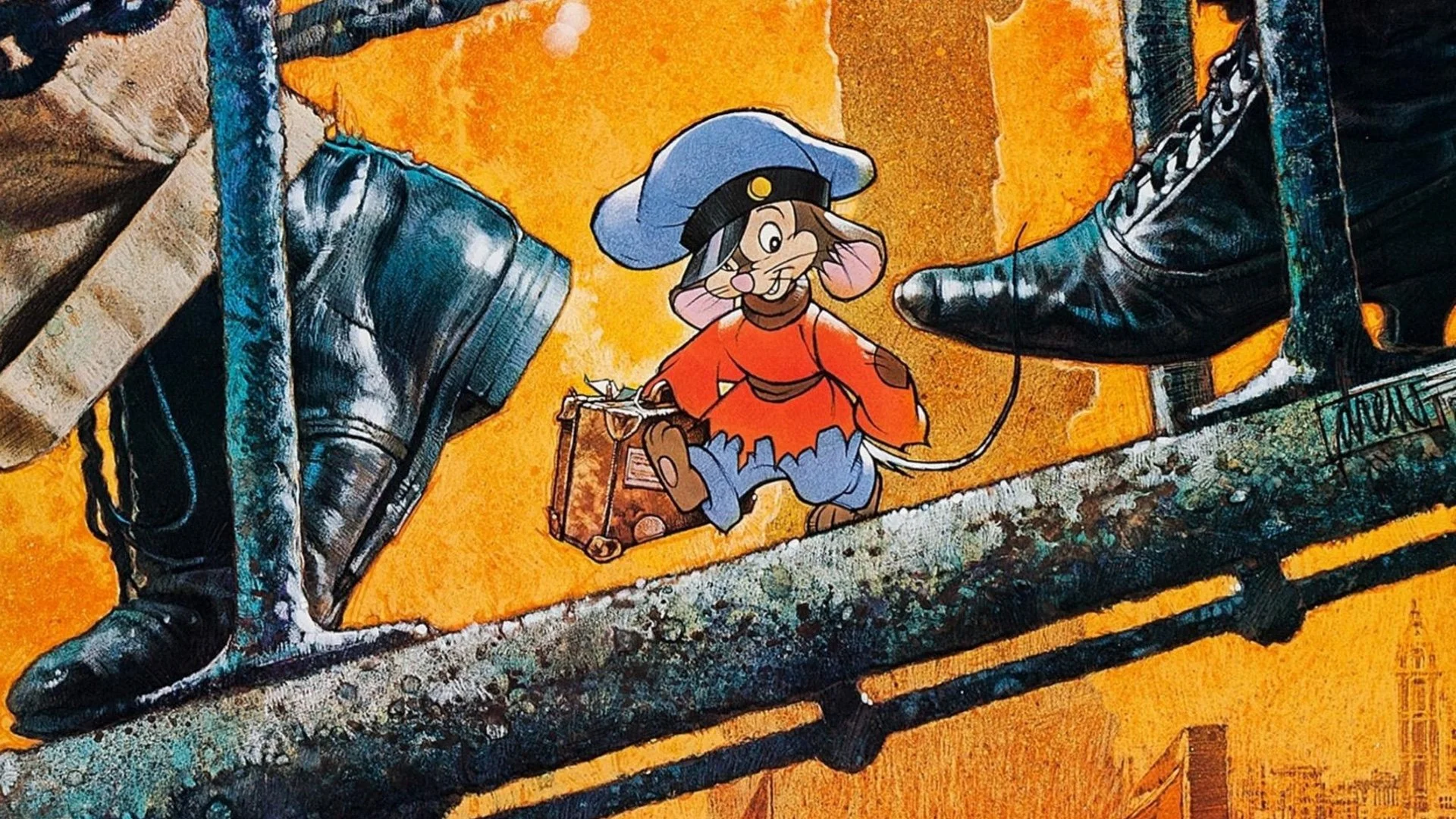
Directed by Don Bluth and produced by Steven Spielberg’s Amblin Entertainment, An American Tail tells the emotional story of Fievel Mousekewitz, a young Jewish-Russian mouse who becomes separated from his family while emigrating to New York City in the late 19th century.
An American Tail became a massive financial success, grossing over $47 million domestically during its initial theatrical run and more than $84 million worldwide. At the time of its release, it became the highest-grossing non-Disney animated film in history. The movie demonstrated to Hollywood financiers that non-Disney animated feature films could achieve blockbuster returns, laying the operational groundwork for the modern animation boom of the 1990s. Its centerpiece song, "Somewhere Out There," composed by James Horner, Barry Mann, and Cynthia Weil, earned Academy Award and Golden Globe nominations and won two Grammy Awards.
The Great Mouse Detective (Walt Disney Feature Animation)
Directed by Ron Clements, Burny Mattinson, Dave Michener, and John Musker, The Great Mouse Detective was greenlit on a strict budget and tight deadline following the internal turmoil of The Black Cauldron. Set in Victorian London, the film reimagines Sherlock Holmes through mouse protagonist Basil of Baker Street as he combats the villainous Professor Ratigan (voiced by Vincent Price).
The film earned over $38 million domestically on a modest $14 million budget, proving to Disney's new management team—led by Michael Eisner and Jeffrey Katzenberg—that hand-drawn animation remained profitable. Crucially, directors Musker and Clements demonstrated key leadership capabilities during production, positioning them to direct The Little Mermaid (1989) and launch the historical era known as the Disney Renaissance.
Anime Revolutions: Studio Ghibli and Cult Hits
While Western studios battled for box office dominance, Japanese animators delivered groundbreaking cinematic works in 1986 that broadened the thematic and artistic boundaries of the medium.
Castle in the Sky (Tenkū no Shiro Rapyuta)
Directed by Hayao Miyazaki, Castle in the Sky was the very first official feature film produced and released by Studio Ghibli following its founding in 1985. The steampunk adventure follows Pazu, an orphan machinist, and Sheeta, a girl carrying a mysterious crystal pendant, as they race air pirates and government agents to discover Laputa, a legendary floating city.
Castle in the Sky established Studio Ghibli's signature aesthetic: expansive world-building, detailed mechanical design, anti-war themes, and nuanced character development. Miyazaki combined European industrial visual motifs with traditional Japanese cell animation techniques, setting artistic standards that transformed global animation aesthetics over the following decades.
The Transformers: The Movie (Hasbro / Sunbow / Toei Animation)
Directed by Nelson Shin, The Transformers: The Movie served as a theatrical bridge between the second and third seasons of the popular animated television series. Funded to launch a new line of toy products, the film shocked audiences by permanently killing off several established core characters, including Autobot leader Optimus Prime.
Featuring an all-star voice cast that included Orson Welles (in his final film role), Leonard Nimoy, Judd Nelson, and Robert Stack, driven by a synth-rock soundtrack, the film was initially met with mixed reviews and grief-stricken reactions from young viewers. However, its sophisticated hand-drawn mechanical animation—produced by Japanese studio Toei Animation—and dark narrative trajectory have earned it an enduring cult classic status worldwide.
Mature and Experimental Animation: When the Wind Blows
Beyond family entertainment and commercial franchises, 1986 offered profound artistic experimentation in mature animated cinema. When the Wind Blows, directed by Jimmy T. Murakami and adapted from Raymond Briggs’ graphic novel, remains one of the most haunting animated films ever produced.
The film chronicles an elderly British couple, Jim and Hilda Bloggs, attempting to survive a nuclear attack using outdated government pamphlets. When the Wind Blows used a rare hybrid animation technique, combining hand-drawn 2D character animation on acetate cells with three-dimensional physical miniature sets for background environments.
Backed by an original soundtrack featuring music from Roger Waters, David Bowie, and Genesis, the film offered a devastating commentary on Cold War politics. It remains a crucial case study in how animation can address deeply serious, real-world political anxieties.
Comparative Overview of Landmark 1986 Animated Films
The table below contrasts the major animated feature films released in 1986 across box office performance, primary artistic styles, and historical legacy.
| Film Title | Studio / Production Entity | Key Directors | Primary Technical & Narrative Distinction | Historical Impact & Box Office Legacy |
|---|---|---|---|---|
| An American Tail | Sullivan Bluth Studios / Amblin | Don Bluth | Traditional 2D cell animation; orchestral-driven musical score | Grossed $84M+ worldwide; established Don Bluth as Disney's main rival |
| The Great Mouse Detective | Walt Disney Feature Animation | Ron Clements, John Musker, et al. | Early integration of 3D computer graphics (Big Ben clock tower) | Restored financial confidence in Disney Animation; paved way for Disney Renaissance |
| Castle in the Sky | Studio Ghibli / Tokuma Shoten | Hayao Miyazaki | Detailed hand-drawn world-building; original score by Joe Hisaishi | Studio Ghibli’s maiden feature release; established global anime design benchmark |
| The Transformers: The Movie | Sunbow Productions / Marvel / Toei | Nelson Shin | High-frame-rate mechanical animation; synth-rock soundtrack | Pivotal cultural landmark; bold narrative decisions shifted franchise filmmaking |
| When the Wind Blows | Meltdown Productions / TVC London | Jimmy T. Murakami | Hybrid technique (2D cells over 3D miniature sets) | Acclaimed anti-nuclear mature drama; pushed boundaries of adult feature animation |
| Care Bears Movie II: A New Generation | Nelvana / Columbia Pictures | Dale Schott | Standard broadcast-style 2D character animation | Commercial hit for independent Canadian studio Nelvana; demonstrated toy-line viability |
Technological and Aesthetic Innovations Introduced in 1986
The animated films of 1986 served as an important bridge between traditional mid-century hand-crafted cell techniques and the digital workflows that would emerge in the 1990s.
Early Computer Graphics (CGI) Integration
One of the most consequential technical breakthroughs occurred during the climax of Disney’s The Great Mouse Detective. The confrontation between Basil and Professor Ratigan takes place inside the complex gear mechanisms of London’s Big Ben.
Rather than drawing the mechanical clockwork entirely by hand, Disney animators built wireframe 3D digital models of the gears using early computer graphics software. These 3D models were plotted onto paper, transferred onto animation cells using photo-stat cameras, and painted traditionally. This pioneer use of CGI lay the foundation for Disney’s Computer Animation Production System (CAPS), which would fully revolutionize the studio a few years later.
1986 Early CGI Workflow (The Great Mouse Detective):
- 3D Digital Wireframe Model
- Plotting to Paper & Plot Lines
- Photostat Transfer to Acetate Cells
- Hand-Painted 2D Cell Layering
Innovative Hybrid Media Techniques
Films like When the Wind Blows bypassed standard flat hand-drawn backgrounds. Filmmakers built fully realized physical scale models of the protagonists' cottage home.
The camera was moved through physical miniature rooms frame-by-frame, and traditional hand-drawn 2D character frames were optically composited onto the physical set photography. This yielded an unsettling sense of tactile realism and spatial depth that enhanced the story's emotional weight.
Musical Cross-Pollination
The year 1986 also fundamentally reshaped how soundtracks were integrated into animated features. Rather than relying exclusively on classic broadway-style scores, producers began incorporating mainstream pop, hard rock, and synth-wave compositions:
- An American Tail launched top-40 pop hits onto international music charts.
- The Transformers: The Movie utilized heavy metal and synth-rock tracks (such as Stan Bush's "The Touch") to match the intensity of its action sequences.
- When the Wind Blows enlisted mainstream rock icons like David Bowie and Roger Waters to craft thematic tone poems.
How to Screen and Experience 1986 Animated Classics Today
For film scholars, animation enthusiasts, and collectors reviewing these classics today, accessing high-quality restorations requires understanding format transfers and aspect ratio preservation.
Audio and Visual Restoration Quality
- 4K UHD and High-Definition Remasters: Major studio releases such as Castle in the Sky, An American Tail, and The Transformers: The Movie have received extensive digital restorations. When selecting media, look for transfers made directly from original 35mm camera negatives to preserve natural film grain and hand-painted cell textures without excessive digital noise reduction (DNR).
- Soundtrack Mixes: Original theatrical releases of 1986 films featured stereo or Dolby Surround audio. Modern Blu-ray and digital releases frequently provide upgraded 5.1 or Dolby Atmos remixes alongside original theatrical tracks. Film purists often prefer lossless original stereo tracks for an authentic historical experience.
Technical Checklist for Retrospective Viewing
- Aspect Ratio Verification: Confirm whether the source video preserves the original theatrical aspect ratio (typically 1.85:1 for Western theatrical releases or 1.37:1 Academy ratio for certain Japanese releases) rather than cropped "fullscreen" formats.
- Color Palette Accuracy: Restored releases of hand-drawn cell animation can sometimes suffer from over-saturation during digital color grading. Look for editions approved by original directors or animation supervisors (such as Studio Ghibli's supervised video masters).
- Audio Language Tracks: For Japanese releases like Castle in the Sky, compare original Japanese voice tracks featuring Joe Hisaishi's original score against English dub options, which occasionally feature altered orchestral arrangements.
Frequently Asked Questions About 1986 Animated Films
Which 1986 animated film was the highest-grossing at the box office?
Don Bluth’s An American Tail was the highest-grossing animated film released in 1986. It grossed over $47 million in North America during its original run and over $84 million globally, setting a record at the time for the highest-grossing non-Disney animated feature film.
What was Studio Ghibli's first official feature film released in 1986?
Castle in the Sky (Tenkū no Shiro Rapyuta), directed by Hayao Miyazaki, was the first official feature film produced and released by Studio Ghibli following its founding in 1985. (Although Miyazaki's 1984 film Nausicaä of the Valley of the Wind is often grouped with Ghibli works, it was produced prior to the studio's formal establishment).
How did The Great Mouse Detective save Disney Animation?
Following the box office failure of The Black Cauldron in 1985, Disney executives considered closing the feature animation division. The Great Mouse Detective was produced on a modest budget, became a commercial success, and proved that animated feature films remained financially viable. Its success convinced new management to keep the animation department open, directly leading to the Disney Renaissance.
Why was The Transformers: The Movie controversial upon its 1986 release?
The Transformers: The Movie sparked controversy among young viewers and parents because the filmmakers permanently killed off major franchise characters—most notably Optimus Prime—within the first thirty minutes. This decision was driven by Hasbro's commercial desire to clear out older toy lines to introduce new product lines, but it shocked audiences unaccustomed to such dramatic plot twists in children's entertainment.
What technical innovation did The Great Mouse Detective introduce to feature animation?
The Great Mouse Detective featured one of the earliest major uses of 3D computer graphics (CGI) integrated into a 2D hand-drawn animated film. The climax inside the gears of Big Ben used computer-generated wireframes of clock mechanisms, which were printed out, transferred to traditional cells, and painted by hand.
Building Your 1986 Animated Film Retrospective
To fully appreciate the breadth and artistic diversity of 1986's animated cinema, design a curated viewing list that spans mainstream studio efforts, international anime, and experimental cinema.
Start your retrospective by pairing An American Tail and The Great Mouse Detective to observe how rival Western studios tackled high-stakes narrative storytelling, character design, and emerging CGI technologies. Follow this with Studio Ghibli’s Castle in the Sky to examine how Japanese studios approached environmental themes and expansive world-building through traditional cell animation. Conclude your study with When the Wind Blows to experience how animation was leveraged as a powerful medium for political commentary and adult-oriented storytelling. Exploring these landmark titles offers a comprehensive look at one of the single most transformative years in global animation history.