The year 1954 stands as a monumental transitional phase in cinematic history, defined by the aggressive rise of widescreen formats, changing studio economics following the Paramount Decree, and masterpieces that redefined global art house and Hollywood genres alike. This era marked a profound shift in how stories were told on screen, balancing grand technological experiments with deeply psychological narratives.
Historical Context and Industrial Shifts in 1954
The motion picture industry in 1954 was undergoing radical structural reformation. The United States Supreme Court's 1948 Paramount Decree, which forced major Hollywood studios to divest themselves of their theater chains, continued to reverberate throughout the early 1950s. Studios could no longer rely on guaranteed block booking and captive theater audiences to ensure profitability for every production. Instead, each film had to fight for its own exhibition space, leading to higher-budget spectacles, greater differentiation in storytelling, and an increased reliance on independent production units.
Compounding this economic realignment was the existential threat of home television ownership, which skyrocketed during the post-World War II suburban boom. To lure audiences away from their living rooms, Hollywood heavily invested in sensory innovations. Color filmmaking, though still expensive, became far more widespread. More importantly, widescreen technologies such as CinemaScope—introduced by 20th Century Fox in 1953 with The Robe—dominated production slates throughout 1954, forcing filmmakers to completely rethink spatial composition, blocking, and editing rhythms.
Technological Innovations: Widescreen and Color Dynamics
The widespread adoption of anamorphic and widescreen projection systems fundamentally altered the visual grammar of the 1954 film. Standard Academy ratio (1.37:1) was rapidly ceding ground to wide formats that offered panoramic vistas, reshaping genres like the Western and the historical epic.
Technicolor, while still utilizing its complex and vibrant three-strip dye-transfer process, began facing increased competition from alternative color processes like Eastman Color, which used a single-strip negative. This lowered production costs and made color accessible to a wider array of low- and mid-tier films. Directors and cinematographers faced steep learning curves in mastering these wider canvases and divergent color palettes. Maintaining sharp focus across deep focal planes in CinemaScope required new lenses and intense lighting setups, while composition demanded that directors fill the horizontal frame effectively without sacrificing character intimacy.
Landmark Hollywood Productions of 1954
Hollywood's output in 1954 featured an extraordinary concentration of enduring classics across multiple genres, establishing new benchmarks for suspense, adventure, and social commentary.
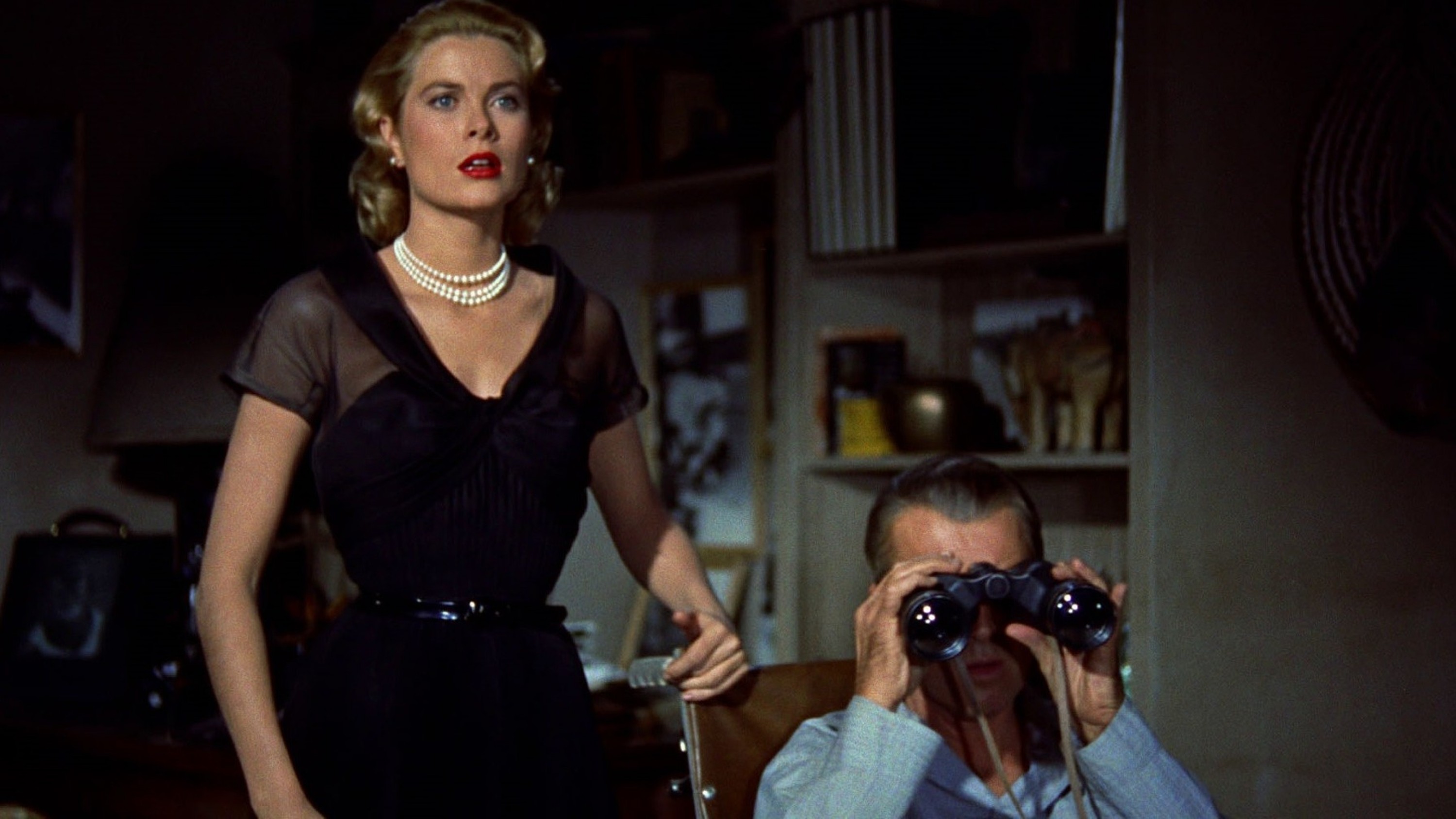
Alfred Hitchcock released two defining works of his career during this period: Rear Window and Dial M for Murder. Rear Window, starring James Stewart and Grace Kelly, transformed a single apartment courtyard set into a masterclass in cinematic voyeurism and spatial tension, exploring the psychology of the audience itself. Meanwhile, Dial M for Murder showcased Hitchcock's early mastery of 3D technology, though the film proved equally effective when projected in standard flat formats due to its rigorous theatrical plotting and precise framing.
The Western genre also achieved towering heights. John Sturges directed Bad Day at Black Rock, a taut, socially conscious thriller starring Spencer Tracy that dealt with xenophobia and wartime guilt in a desolate desert town. Concurrently, traditional epic filmmaking reached a pinnacle with productions like 20,000 Leagues Under the Sea, Disney's lavish, live-action adaptation of the Jules Verne classic that combined pioneering underwater photography with state-of-the-art special effects and stellar performances from James Mason and Kirk Douglas.
| Film Title | Director | Primary Genre | Key Technological or Artistic Innovation |
|---|---|---|---|
| Rear Window | Alfred Hitchcock | Suspense / Mystery | Masterclass in single-set spatial tension and subjective camera angles. |
| Seven Samurai | Akira Kurosawa | Action / Epic | Pioneered modern action editing, motion pacing, and deep-focus choreography. |
| On the Waterfront | Elia Kazan | Drama | Groundbreaking naturalistic acting style and gritty location realism. |
| 20,000 Leagues Under the Sea | Richard Fleischer | Adventure / Sci-Fi | Advanced CinemaScope deployment and pioneering visual/underwater effects. |
International Masterpieces and Global Cinema
Beyond Hollywood, 1954 was an extraordinary year for international cinema, particularly in Japan and post-war Europe, where national film industries were producing works that would permanently alter global film culture.
Akira Kurosawa released Seven Samurai (Shichinin no Samurai) in 1954. This epic action-drama set new standards for narrative pacing, character ensemble work, and action choreography. Kurosawa’s use of telephoto lenses, multiple cameras simultaneously capturing scenes, and innovative slow-motion techniques transformed the grammar of action cinema. The film's structural influence can be traced across decades of global filmmaking, inspiring countless remakes and genre adaptations.
In Europe, Italian Neorealism was evolving into more polished dramatic forms, while French and British studios maintained strong regional identities. The international film festival circuit—particularly Cannes and Venice—grew in influence, acting as vital conduits for cross-cultural cinematic appreciation and helping foreign-language films secure distribution in Western markets.
Critical Triumphs and Industry Recognition
The cultural impact of the 1954 film slate was immediately reflected in major awards ceremonies, most notably the 27th Academy Awards held in early 1955.
Elia Kazan’s On the Waterfront dominated the competition, winning eight Academy Awards, including Best Picture, Best Director for Kazan, Best Actor for Marlon Brando, and Best Supporting Actress for Eva Marie Saint. The film's raw depiction of labor corruption on the Hoboken docks married Method acting techniques with gritty location cinematography, setting a new standard for socially engaged American drama.
Similarly, foreign-language cinema gained formal institutional recognition. Though the Academy Award for Best Foreign Language Film was not established as a competitive category until 1956, international masterpieces from 1954 routinely toured global markets, proving that artistic excellence transcended linguistic and geographic barriers.
Common Misconceptions About 1954 Cinema
When examining the cinema of this era, modern audiences frequently encounter several historical misconceptions:
- Assumption that widescreen completely replaced standard formats overnight: While CinemaScope and other widescreen systems generated massive publicity, hundreds of films—particularly B-movies, film noirs, and melodramas—continued to be shot in the traditional Academy ratio throughout the mid-1950s due to budgetary constraints.
- Belief that 3D was a short-lived 21st-century gimmick: The 1950s actually experienced the first major craze for stereoscopic 3D filmmaking, with 1954 seeing numerous releases experiment with polarized dual-strip projection before the novelty briefly waned due to projection alignment difficulties.
- Overlooking the financial instability of studios: The commercial success of blockbuster hits often masks the severe financial turbulence smaller independent studios faced as they navigated the post-studio-era distribution landscape.
Frequently Asked Questions
What were the most critically acclaimed films released in 1954?
Some of the most celebrated films from this year include Rear Window and Dial M for Murder by Alfred Hitchcock, Seven Samurai by Akira Kurosawa, On the Waterfront by Elia Kazan, and 20,000 Leagues Under the Sea by Richard Fleischer. These works remain staples of film studies and continue to top critical polls worldwide.
How did the Paramount Decree impact film production in 1954?
The Paramount Decree, which forced major studios to divest their theater ownership, decentralized the American film industry. By 1954, studios relied less on routine block booking and more on individualized prestige projects, independent producer partnerships, and technological spectacles designed to compete directly with television.
Why was widescreen technology so dominant in 1954?
Widescreen technology was rapidly adopted to combat declining box office revenues driven by the rise of home television sets. Studios used expansive horizontal frames, vibrant color processes, and stereoscopic sound to offer a theatrical experience that small cathode-ray tube televisions could not replicate.
Did international films receive major recognition during this period?
Yes. International masterpieces released in 1954, such as Akira Kurosawa’s Seven Samurai, achieved massive global critical acclaim and commercial success, paving the way for greater cross-cultural distribution and influencing generations of Western filmmakers.
Assessing and Experiencing 1954 Cinema Today
For film historians, students, and modern cinephiles, exploring the cinema of 1954 requires access to well-restored physical media or curated streaming archives. Many major studio releases have received 4K digital restorations from original nitrate and safety film elements, revealing rich color grading and intricate sound design previously lost to generations of television syndication. When examining these works, viewers should consider the industrial pressures of the era—such as the transition to widescreen and the rise of independent production—to fully appreciate the artistic risks taken by filmmakers during this watershed year.