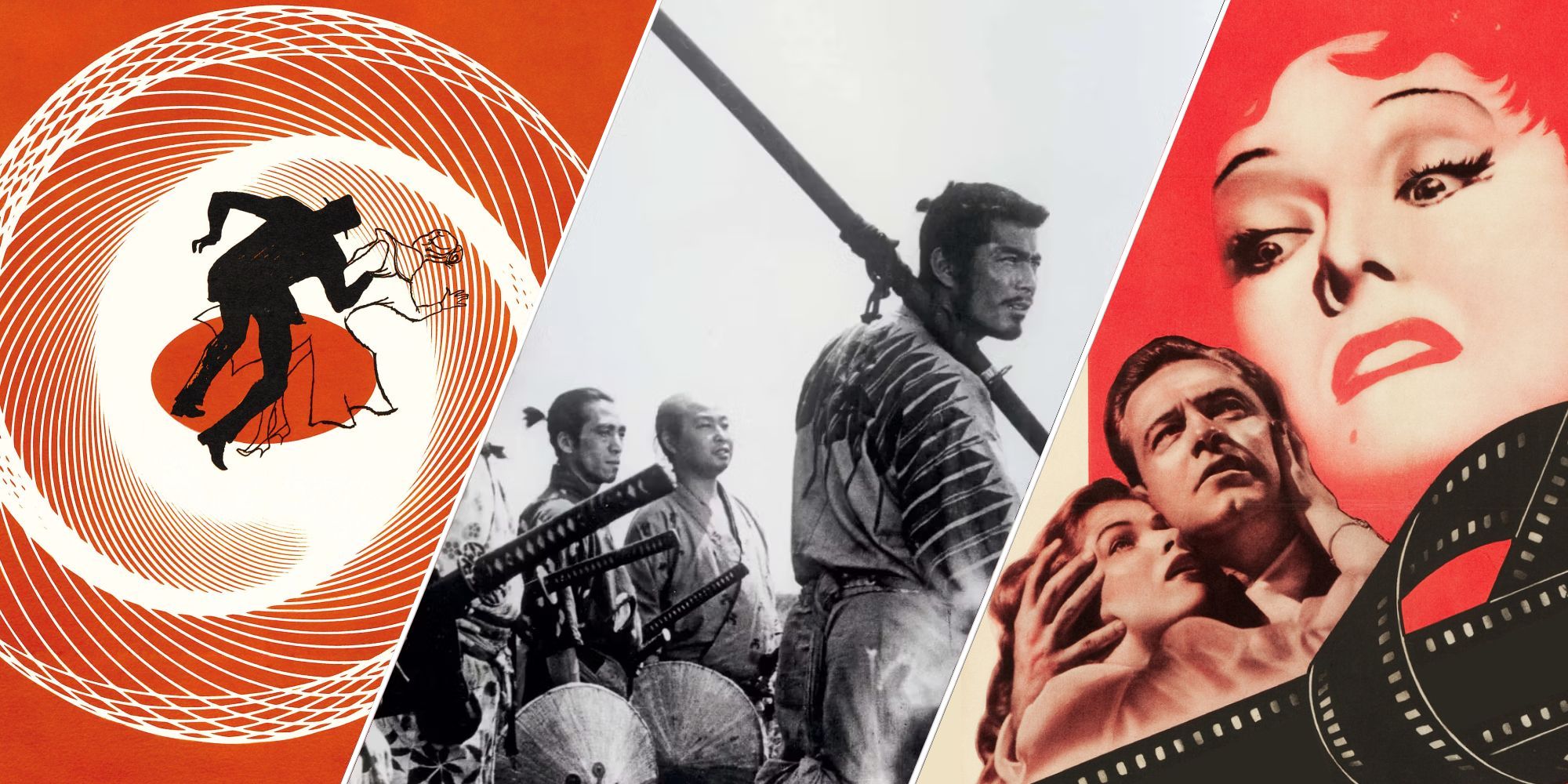
The cinema of the 1950s was a transformative decade defined by the rise of widescreen formats, the erosion of strict studio censorship codes, and an explosion of international art-house movements. Amidst the suburban migration and the competitive threat of television, the global film industry reinvented its visual and narrative language to recapture mass audiences.
The Technological Shift: Widescreen, 3D, and Color
Faced with declining ticket sales due to the widespread adoption of home television sets, Hollywood studios in the early 1950s invested heavily in technological spectacles that the small screen could not replicate. The introduction of wide-aspect-ratio systems fundamentally altered composition, moving away from the boxy Academy ratio (1.37:1) toward expansive horizontal frames.
Twentieth Century Fox launched the era in 1953 with The Robe, utilizing the anamorphic process known as CinemaScope. This system compressed a wide image onto standard 35mm film during shooting and expanded it via a matching lens on the projector. Other studios developed competing formats, such as Paramount's VistaVision, which used standard film running horizontally through the camera for a sharper negative, and the massive three-strip Cinerama process, which required a curved screen and three synchronized projectors to immerse viewers in travelogues and narrative features.
Simultaneously, a brief but intense craze for stereoscopic 3D swept theaters, beginning in earnest with Arch Oboler's Bwana Devil (1952). While 3D required polarized glasses and frequently suffered from synchronization issues, it briefly boosted box office revenues before fading by mid-decade due to audience eye strain and technical fatigue.
Color cinematography also shifted dramatically. The near-monopoly held by Technicolor—with its cumbersome, three-strip cameras and intense light requirements—weakened following anti-trust rulings and the introduction of Eastman Color in 1950. Eastman Color allowed single-strip, monopack shooting, making color accessible to lower-budget productions and independent studios, paving the way for the vibrant visual palettes of the late 1950s.
Challenging the Hays Code: The Decline of Studio Censorship
Throughout the 1930s and 1940s, the Production Code Administration (PCA), headed by Joseph Breen, strictly regulated American film content under a moral framework known as the Hays Code. By the 1950s, however, the monolithic authority of the studio system and its internal censorship apparatus began to fracture due to legal challenges, economic pressures, and imported foreign films.
The turning point arrived with the 1952 Supreme Court case Joseph Burstyn, Inc. v. Wilson (commonly known as the "Miracle Decision"). The Court ruled that motion pictures were a form of expression protected by the First Amendment, overturning a New York state ban on Roberto Rossellini’s film The Miracle on the grounds of "sacrilege." This ruling effectively dismantled state-level film censorship boards and signaled that the federal government would protect controversial artistic expression.
Independent producers and major studios increasingly tested the boundaries of the Production Code by tackling taboo subjects. Otto Preminger’s The Moon is Blue (1953) was released without a PCA seal of approval because it utilized words like "virgin" and "mistress," yet it proved a commercial success that weakened the studios' fear of unapproved releases. Preminger again challenged the code with The Man with the Golden Arm (1955), which addressed narcotic addiction, and Anatomy of a Murder (1959), which featured explicit dialogue regarding rape and murder.
By the end of the decade, the Code had become largely unenforceable for daring productions, paving the way for the eventual adoption of the MPAA rating system in 1968.
| Film Title | Release Year | Technological Innovation / Censorship Milestone | Primary Genre / Movement |
|---|---|---|---|
| Bwana Devil | 1952 | Sparked the early 1950s stereoscopic 3D craze. | Action / Adventure |
| The Robe | 1953 | Debuted CinemaScope anamorphic widescreen process. | Biblical Epic |
| The Moon is Blue | 1953 | Released without the Production Code seal; challenged moral norms. | Romantic Comedy |
| Seven Samurai | 1954 | Pioneered deep-focus staging and rapid action editing. | Jidaigeki / Action |
| The Searchers | 1956 | Utilized VistaVision and location shooting to redefine cinematic landscape. | Western |
| The 400 Blows | 1959 | Early landmark of the French New Wave; location hand-held shooting. | Art House / Drama |
The Global Renaissance: International Art Cinema
While Hollywood focused on widescreen spectacles and genre revisions, international cinema experienced a profound golden age. Film festivals in Cannes, Venice, and Berlin established global platforms that championed national cinemas operating outside the traditional studio framework.
In Japan, the international breakthrough of Akira Kurosawa’s Rashomon at the 1951 Venice Film Festival opened Western markets to Japanese masters such as Kenji Mizoguchi (Ugetsu, 1953) and Yasujiro Ozu (Tokyo Story, 1953). These films showcased distinct narrative structures, deeply rooted cultural perspectives, and formal rigor that challenged classical Hollywood continuity. Rashomon specifically introduced Western audiences to the concept of subjective truth through conflicting eyewitness accounts.
In Europe, Italian Neorealism evolved from its immediate post-war urgency into more lyrical and psychological investigations. Directors like Federico Fellini bridged neorealism and surrealism with La Strada (1954) and Nights of Cabiria (1957), while Michelangelo Antonioni began exploring modern alienation and bourgeois ennui.
Simultaneously, the Swedish master Ingmar Bergman achieved international acclaim with philosophical explorations of mortality and faith in The Seventh Seal (1957) and Wild Strawberries (1957). These works proved that cinema could function as high art, prompting the creation of specialized "art-house" cinema circuits in major metropolitan areas across the United States and Europe.
The Evolution of Hollywood Genres: Westerns and Melodramas
American genre filmmaking underwent significant maturation during the 1950s. The Western, long considered a straightforward morality play of heroes versus villains, evolved into the "Psychological Western." Films such as High Noon (1952), directed by Fred Zinnemann, and The Searchers (1956), directed by John Ford, examined existential dread, systemic racism, social ostracization, and the psychological toll of violence on the frontier.
Concurrently, the domestic melodrama flourished under the direction of masters like Douglas Sirk at Universal Studios. Working within strict studio budgets and vibrant technicolor palettes, Sirk directed films such as All That Heaven Allows (1955) and Imitation of Life (1959). These features used mise-en-scène, heavy symbolism, and artificial studio lighting to critique the hypocrisy, rigid class structures, and racial tensions of Eisenhower-era American suburban life.
Film noir also shifted from the gritty, urban black-and-white crime thrillers of the 1940s to cynical, widescreen post-war critiques. Orson Welles’s Touch of Evil (1958) is frequently cited as the twilight masterpiece of classical noir, featuring extreme wide-angle lenses, deep focus, and an atmosphere of institutional corruption along the United States-Mexico border.
The Foundations of Modern Independent Distribution
The decentralization of the American film industry in the 1950s created vital pathways for independent production outside the major studio lots. Following the 1948 Supreme Court antitrust ruling in United States v. Paramount Pictures, Inc., major studios were forced to divest their theater chains. This vertical integration breakup eliminated guaranteed distribution for studio product and opened screen time to independent producers and foreign imports.
Producers like Stanley Kramer and independent production companies bypassed traditional studio financing by securing independent backing and distributing through major studios on a picture-by-picture basis. This structural shift allowed filmmakers to retain creative control over controversial social issues, as seen in Kramer's handling of civil rights and nuclear anxiety in films like The Defiant Ones (1958) and On the Beach (1959).
Furthermore, the rise of low-budget exploitation cinema, typified by producer Roger Corman at American International Pictures (AIP), proved that profitability could be achieved outside the studio system by targeting teenage demographics. AIP capitalized on drive-in theaters and double features, producing science fiction and horror features that addressed juvenile delinquency, atomic monsters, and space exploration.
Frequently Asked Questions
What caused the shift toward widescreen formats in the 1950s?
The primary driver was the rapid rise of home television ownership, which caused cinema box office revenues to plummet. Studios needed to offer a visual spectacle that could not be replicated on a small cathode-ray tube, leading to the adoption of widescreen systems like CinemaScope, VistaVision, and Cinerama.
How did the Supreme Court "Miracle Decision" impact film censorship?
The 1952 Burstyn v. Wilson ruling established that motion pictures were protected speech under the First Amendment. This decision invalidated state and local censorship boards that had previously banned foreign and domestic films on vague grounds of sacrilege or morality, paving the way for the eventual collapse of the Hays Code.
What distinguishes a "Psychological Western" from traditional Westerns?
Traditional Westerns generally relied on clear-cut moral binaries between heroes and villains. Psychological Westerns of the 1950s, such as High Noon and The Searchers, focused on internal conflicts, moral ambiguity, societal cowardice, trauma, and the complex psychological motivations of frontier characters.
Why was the 1948 Paramount antitrust ruling significant for 1950s cinema?
The Supreme Court ruling forced the major studios to sell their theater chains, ending studio monopolies on exhibition. This breakup opened screens to independent producers, foreign art-house imports, and lower-budget exploitation films, fundamentally restructuring the business model of the American film industry.
How did 1950s science fiction cinema reflect Cold War anxieties?
Science fiction films of the decade frequently used alien invasions, giant mutant insects created by radiation, and pod-people takeovers as allegories for contemporary fears regarding communist infiltration, nuclear testing, McCarthyism, and the loss of individual identity in a conformist society.
Navigating and Studying 1950s Film History
To fully appreciate the cinematic achievements of the 1950s, researchers and enthusiasts should approach the era through a dual lens: the commercial pressures of the collapsing studio system and the artistic innovations of the global art-house movement. When exploring this period, prioritize viewing films in their original aspect ratios where possible, and examine contemporary trade publications alongside modern critical analyses to understand how technical specifications and censorship battles shaped the final frames seen on screen.