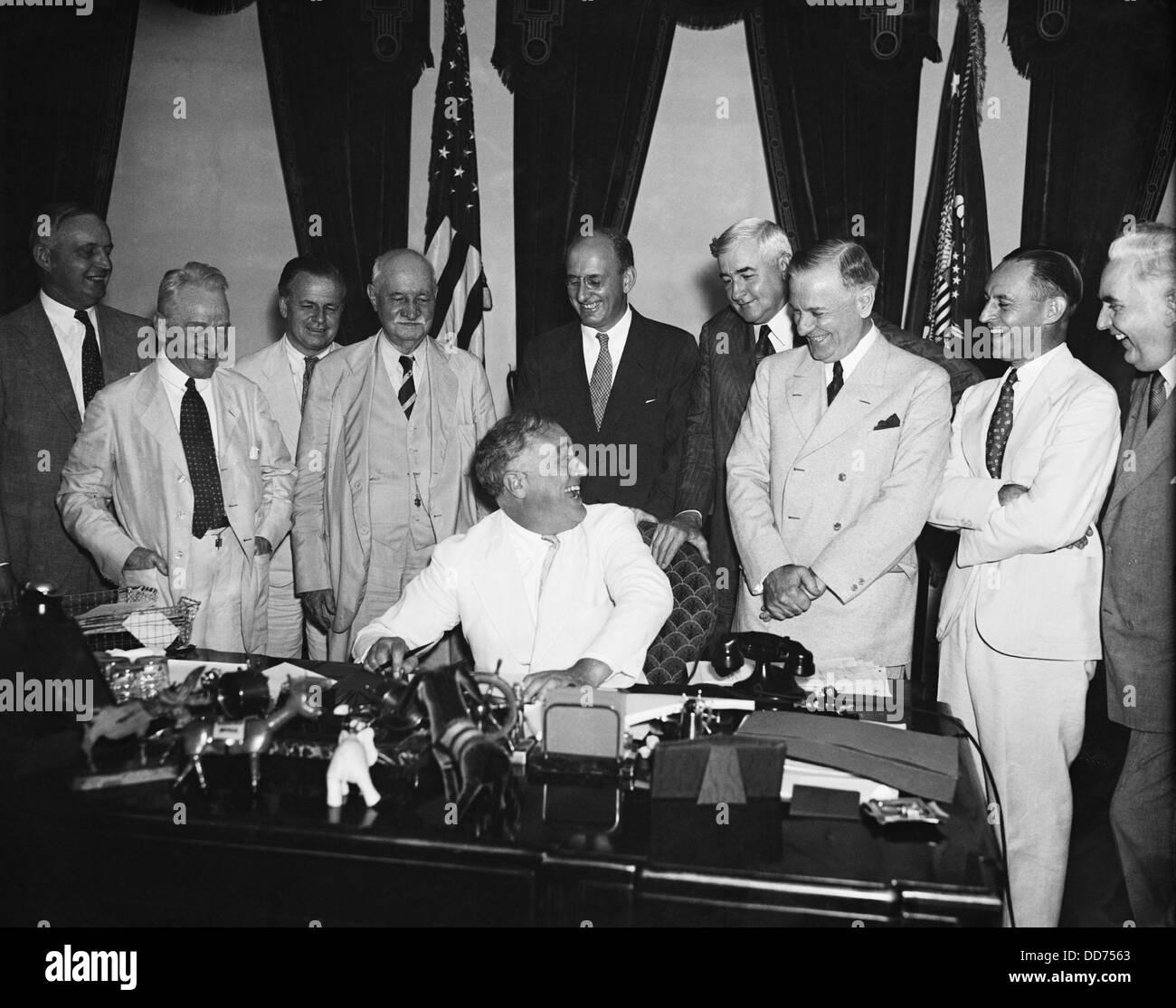
The legislation of 1935 represents a transformative turning point in modern statutory law, primarily marked by Franklin D. Roosevelt’s Second New Deal in the United States and global constitutional milestones like the Government of India Act 1935. These acts established foundational social safety nets, structured modern labor relations, reorganized central banking, and expanded federal administrative authority.
The Historical Context of the 1935 Legislative Wave
By 1935, the global economy remained deeply entrenched in the Great Depression. In the United States, economic distress was compounded by mounting political pressure on the Roosevelt administration from both progressive activists demanding bolder wealth redistribution and conservative groups challenging the constitutionality of early emergency programs.
The first phase of the New Deal (1933–1934) had focused largely on emergency economic relief, agricultural subsidies, and temporary price-stabilization measures under bodies like the National Recovery Administration (NRA). However, in May 1935, the U.S. Supreme Court struck down key elements of early New Deal programs in A.L.A. Schechter Poultry Corp. v. United States, ruling that Congress had unconstitutionally delegated legislative power to the executive branch and exceeded its authority under the Commerce Clause.
This judicial setback accelerated a pivot toward permanent economic structural reforms, initiating what historians designate as the "Second New Deal." Operating during the 74th United States Congress, lawmakers drafted and passed a series of unprecedented statutes designed to institutionalize social protection, guarantee collective bargaining rights, stabilize banking architecture, and regulate public utility holding companies. Simultaneously, internationally, major colonial reform statutes like the Government of India Act 1935 were enacted by the British Parliament, altering governance frameworks across South Asia.
Core U.S. New Deal Acts of 1935
The 74th U.S. Congress produced some of the most influential federal statutes in American statutory history between April and August 1935. These legal frameworks established administrative mechanisms that continue to govern public social insurance, industrial labor disputes, financial regulation, and energy infrastructure today.
1. Social Security Act of 1935
Enacted on August 14, 1935 (Pub. L. 74-271, 49 Stat. 620), the Social Security Act statutory record established a federal system of old-age benefits and social welfare protections. The statute addressed economic insecurity among the elderly, unemployed, disabled, and dependent children.
Key structural provisions included:
- Old-Age Insurance: A contributory social insurance program funded through dedicated payroll taxes on employees and employers, administered directly by the federal government under Title II.
- Unemployment Compensation: A federal-state cooperative framework under Title III and Title IX, where federal tax credits incentivized individual states to create standardized unemployment insurance programs.
- Public Assistance Programs: Federal grants-in-aid to states to assist needy elderly individuals (Old-Age Assistance), the blind, and dependent children (Aid to Dependent Children, which later evolved into AFDC and TANF).
The act created the Social Security Board to manage program implementation, an entity later restructured into the modern Social Security Administration. Comprehensive historical records preserved by the Social Security Administration legislative archive document how this framework established the legal precedent for federal entitlement programs in the United States.
2. National Labor Relations Act (Wagner Act)
Signed into law on July 5, 1935 (Pub. L. 74-198, 49 Stat. 449), the National Labor Relations Act (NLRA)—commonly known as the Wagner Act after its primary author, Senator Robert F. Wagner—fundamentally restructured private-sector labor relations.
Prior to 1935, employers routinely utilized injunctions, blacklists, and company-dominated worker organizations to suppress independent union formation. The NLRA explicitly recognized the statutory right of private-sector employees to organize, form trade unions, engage in collective bargaining through representatives of their own choosing, and take concerted action such as strikes.
The statute prohibited five core unfair labor practices by employers:
- Interfering with, restraining, or coercing employees in the exercise of their rights under Section 7.
- Dominating or interfering with the formation or administration of any labor organization.
- Discriminating in hiring, tenure, or terms of employment to encourage or discourage union membership.
- Discharging or discriminating against an employee for filing charges or giving testimony under the act.
- Refusing to bargain collectively with the accredited representative of the employees.
To enforce these protections, the act created the National Labor Relations Board (NLRB) as an independent administrative agency with quasi-judicial authority to investigate labor charges and conduct workplace representation elections, as documented in the NLRB Wagner Act history.
3. Banking Act of 1935
Enacted on August 23, 1935 (Pub. L. 74-305, 49 Stat. 684), the Banking Act of 1935 finalized major administrative adjustments initiated by the Glass-Steagall Act of 1933. According to historical records in the Federal Reserve Bank of St. Louis FRASER repository, this legislation altered the governing structure of the Federal Reserve System.
The statute replaced the original Federal Reserve Board with a seven-member Board of Governors based in Washington, D.C., removing the Secretary of the Treasury and the Comptroller of the Currency to insulate central banking policy from direct executive branch influence. Crucially, the Banking Act of 1935 formally created the Federal Open Market Committee (FOMC), centralizing control over national monetary supply and open-market bond operations within the Board of Governors and select regional Reserve Bank presidents. It also permanently established deposit insurance under the Federal Deposit Insurance Corporation (FDIC).
4. Public Utility Holding Company Act (PUHCA)
Enacted on August 26, 1935 (Pub. L. 74-333, 49 Stat. 803), Title I of the Public Utility Holding Company Act targeted complex corporate pyramiding in the electric and gas utility industries. During the 1920s, holding companies acquired operating utilities across state lines, utilizing multi-tiered corporate ownership structures that evaded state-level rate regulation and concealed financial risk.
PUHCA empowered the Securities and Exchange Commission (SEC) to dismantle holding company structures that extended beyond integrated public utility systems. It mandated that holding companies simplify their financial arrangements and limit operations to geographically connected regions, significantly curtailing speculative financial maneuvers in public infrastructure.
5. Emergency Relief Appropriation Act of 1935
Enacted on April 8, 1935 (Pub. Res. 74-11, 49 Stat. 115), this statute authorized large-scale federal public works spending to alleviate unemployment. It empowered President Roosevelt to establish executive agencies by executive order, leading directly to the creation of the Works Progress Administration (WPA), which employed millions of Americans in infrastructure, arts, and conservation projects.
International Legislative Milestones of 1935
While New Deal statutes reshaped American law, significant legal frameworks were enacted elsewhere in 1935 that influenced global constitutional evolution.
Government of India Act 1935
Passed by the British Parliament in August 1935 (25 & 26 Geo. 5 c. 42), the Government of India Act 1935 was the longest statute enacted by the Imperial Parliament up to that point. Designed as a constitutional framework for governing British India, it introduced three structural reforms:
- Provincial Autonomy: It abolished the dual-governance system ("dyarchy") in the provinces, transferring executive departments to elected Indian ministers responsible to provincial legislatures.
- Federal Structure: It provided for a proposed "Federation of India" combining British provinces and princely states, governed by a bicameral federal legislature.
- Establishment of Institutional Bodies: It provided the statutory mandate for establishing the Federal Court of India (the direct predecessor to the Supreme Court of India) and the Reserve Bank of India.
Although the full federal provisions were never fully implemented due to political disagreements and the outbreak of World War II, the administrative details, division of legislative powers (Union, Provincial, and Concurrent lists), and emergency authority provisions were directly incorporated into the 1950 Constitution of India and influenced the 1956 Constitution of Pakistan.
United States Neutrality Act of 1935
Enacted on August 31, 1935 (Pub. Res. 74-67, 49 Stat. 1081), the first of a series of Neutrality Acts reflected deep isolationist sentiment within the United States. The law required the President to impose an embargo on the export of arms, ammunition, and implements of war to any belligerent nations upon the declaration of a state of war, and established the National Munitions Control Board.
Comparative Summary of Major 1935 Statutes
The following table summarizes the primary statutory objectives, governing administrative bodies, and long-term regulatory legal impacts of key 1935 legislation:
| Statute Name | Primary Jurisdiction | Main Regulatory Objective | Governing Authority / Agency | Long-Term Legal Legacy |
|---|---|---|---|---|
| Social Security Act | United States (Federal) | Establish old-age pensions, unemployment insurance, and child welfare aid | Social Security Board (now SSA) | Created modern federal social entitlement safety net framework |
| National Labor Relations Act (Wagner Act) | United States (Federal) | Protect collective bargaining and prohibit unfair labor practices | National Labor Relations Board (NLRB) | Standardized private-sector labor law and union organization procedures |
| Banking Act of 1935 | United States (Federal) | Centralize monetary policy and formalize deposit insurance | Federal Reserve Board of Governors / FOMC / FDIC | Established modern Federal Reserve organizational structure and FOMC authority |
| Public Utility Holding Company Act (PUHCA) | United States (Federal) | Eliminate multi-tiered utility monopolies and reform holding structures | Securities and Exchange Commission (SEC) | Precedent for structural federal regulation of corporate conglomerates |
| Government of India Act 1935 | British Empire / India | Grant provincial autonomy and lay groundwork for federal system | Federal Court of India / Governor-General | Provided direct constitutional architecture for independent India (1950) |
Judicial Challenges and Constitutional Interpretation
The enactment of 1935 legislation sparked major constitutional clashes in American legal history, testing the limits of federal legislative power.
Initial Judicial Resistance
Opponents of the Second New Deal argued that statutes like the NLRA and the Social Security Act exceeded Congress's enumerated powers under Article I of the U.S. Constitution. Critics contended that labor relations in local manufacturing plants were purely local activities outside the scope of the Commerce Clause, and that federal payroll taxes unconstitutionally infringed upon police powers reserved to the states under the Tenth Amendment.
Throughout 1935 and 1936, conservative majorities on the U.S. Supreme Court struck down related federal laws, including the Agricultural Adjustment Act (United States v. Butler, 1936) and the Bituminous Coal Conservation Act (Carter v. Carter Coal Co., 1936).
The 1937 Jurisprudential Shift
The constitutional impasse culminated in early 1937 when President Roosevelt introduced the Judicial Procedures Reform Bill of 1937 (the "court-packing" plan). Shortly thereafter, the Supreme Court issued decisions that upheld key 1935 statutes:
- NLRB v. Jones & Laughlin Steel Corp. (301 U.S. 1, 1937): The Supreme Court upheld the constitutionality of the National Labor Relations Act. The Court held that labor disputes in industrial manufacturing plants had a direct, substantial relation to interstate commerce, dramatically expanding the scope of Congressional power under the Commerce Clause.
- Steward Machine Co. v. Davis (301 U.S. 548, 1937): The Court sustained the tax provisions of the Social Security Act, ruling that Congress’s spending power under the General Welfare Clause permitted federal tax-and-credit incentives to encourage state participation in unemployment programs.
- Helvering v. Davis (301 U.S. 619, 1937): The Court affirmed the old-age benefit provisions of the Social Security Act, confirming that Congress possesses broad discretion to expend tax revenues for the general welfare of the elderly.
These decisions validated the expanded administrative state created by 1935 statutes and established modern standards for federal economic regulation under the U.S. Constitution.
Verifying Official 1935 Statutory Records
Legal researchers, historians, and compliance professionals analyzing statutes from the 1935 legislative session rely on official legislative history sources to trace statutory language and intent.
- 74th U.S. Congress (1935)
- Public Law Enrolled Bills (U.S. Statutes at Large, Vol. 49)
- Pub. L. 74-198 (NLRA / Wagner Act) 49 Stat. 449
- Pub. L. 74-271 (Social Security Act) 49 Stat. 620
- Pub. L. 74-305 (Banking Act of 1935) 49 Stat. 684
- Administrative Codification Frameworks
- Federal Register Act of 1935 (Pub. L. 74-220)
- Code of Federal Regulations (CFR - established 1938)
- Public Law Enrolled Bills (U.S. Statutes at Large, Vol. 49)
To examine original text, amendments, or legislative history for 1935 acts:
- United States Statutes at Large: Enrolled statutes passed during the 74th Congress are published in Volume 49 of the U.S. Statutes at Large. Citations follow the format
[Volume] Stat. [Page Number](e.g., 49 Stat. 620). - Public Law Numbers: Statutory records from this period use the congress-sequential numbering format, written as
Pub. L. [Congress]-[Act Number](e.g., Public Law 74-271). - The Federal Register Act of 1935: Recognizing the rapid expansion of administrative rulemaking stemming from 1935 statutes, Congress passed the Federal Register Act (Pub. L. 74-220, 49 Stat. 500) on July 26, 1935. This act established the Federal Register to publish executive orders, administrative regulations, and agency notices, laying the groundwork for the Code of Federal Regulations (CFR) in 1938.
- Official Repositories: Primary legislative documents can be accessed via the Library of Congress (Congress.gov), the U.S. National Archives and Records Administration (NARA), and official agency digital archives.
Frequently Asked Questions
What was the most historically significant U.S. law passed in 1935?
The Social Security Act of 1935 is widely regarded as the most historically significant U.S. statutory framework enacted that year. It introduced permanent federal old-age pensions, established joint federal-state unemployment insurance, and created public assistance grants for vulnerable populations, forming the basis of the modern American welfare state.
How did the National Labor Relations Act (Wagner Act) impact organized labor?
The Wagner Act protected private-sector employees' rights to unionize and engage in collective bargaining. By creating the National Labor Relations Board (NLRB) and outlawing employer practices such as company unions and union-based firing, the act led to rapid growth in union membership throughout the late 1930s and 1940s.
Why was the Federal Register Act of 1935 enacted?
The Federal Register Act was enacted to create a standardized, centralized system for publishing executive branch regulations, proclamations, and agency rules. Before its passage, federal agencies issued rules without a uniform public reporting system, making compliance difficult for businesses and the public.
How did the Supreme Court rulings of 1937 change federal legislative power?
In 1937 rulings such as NLRB v. Jones & Laughlin Steel Corp. and Steward Machine Co. v. Davis, the Supreme Court broadly interpreted the Commerce Clause and General Welfare Clause. These decisions affirmed Congress's statutory authority to regulate workplace conditions, industrial production, and social welfare programs nationwide.
What was the historical significance of the Government of India Act 1935?
The Government of India Act 1935 granted provincial autonomy to British Indian provinces and laid out a blueprint for a federal structure. Although enacted under British rule, its legal definitions, administrative structures, and distribution of powers served as the foundational draft for the 1950 Constitution of India.
Statutory Research Guidance and Legal Verification
When conducting legal history research or statutory interpretation on acts originating in 1935, analysts should follow a structured verification procedure:
- Step 1: Locate the Original Enrolled Text: Access Volume 49 of the Statutes at Large to review the original statutory language as enacted by the 74th Congress prior to subsequent legislative revisions.
- Step 2: Trace Subsequent Statutory Amendments: Major 1935 acts have undergone extensive modification over time. For example, the Wagner Act was significantly modified by the Taft-Hartley Act of 1947 (Labor Management Relations Act) and the Landrum-Griffin Act of 1959. Similarly, the Social Security Act underwent key structural changes in 1939, 1965 (Medicare/Medicaid), and 1983.
- Step 3: Review Current Codification: Verify how statutory provisions are currently codified within the United States Code (U.S.C.). For instance, Title 29 of the U.S.C. governs Labor (NLRA provisions under 29 U.S.C. §§ 151–169), while Title 42 governs Public Health and Welfare (Social Security provisions under 42 U.S.C. Chapter 7).
- Step 4: Consult Administrative Regulations: Cross-reference current statutory provisions against executive branch regulations published in the Code of Federal Regulations (CFR) and agency administrative decisions available through the NLRB, SSA, or Federal Reserve Board.
Disclaimer: This article is intended strictly for educational, historical, and legal research reference purposes. It does not constitute formal legal, administrative, or statutory compliance advice. For legal counsel concerning current statutory interpretations or labor compliance matters, consult a qualified attorney in your jurisdiction.