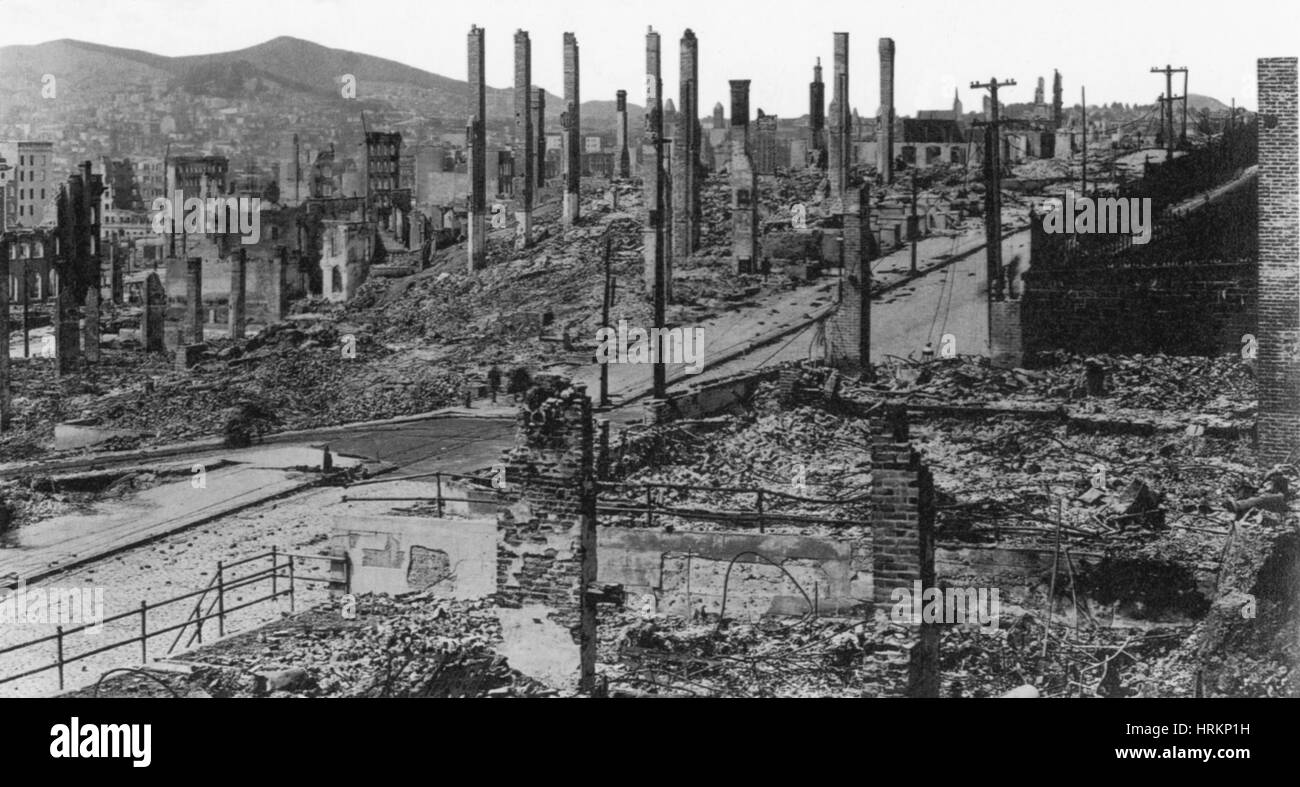
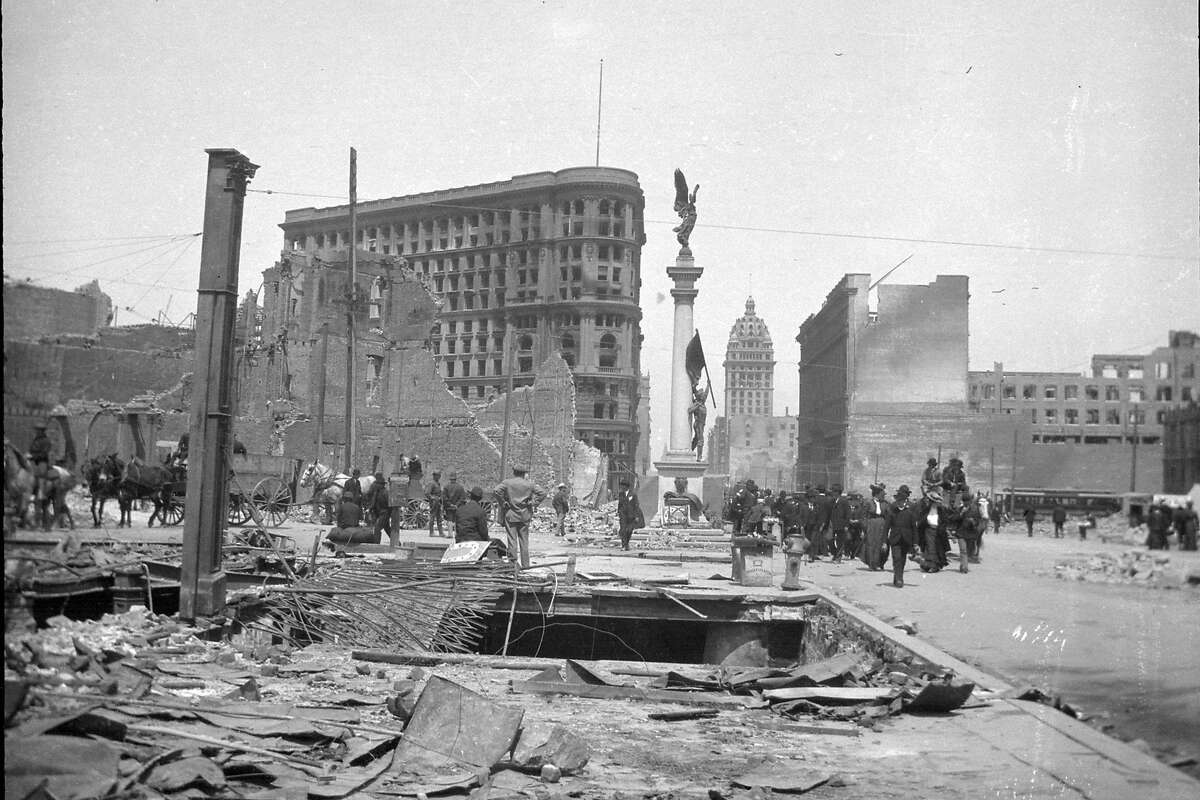
On April 18, 1906, at 5:12 AM, a catastrophic moment magnitude 7.9 earthquake struck San Francisco, rupturing nearly 300 miles of the San Andreas Fault. The initial shaking and subsequent three-day firestorm destroyed over 80 percent of the city, claiming an estimated 3,000 lives and reshaping global seismology, dynamic structural engineering, and urban fire prevention.
Geotechnical Origins and Seismic Mechanics of the 1906 Rupture
The 1906 San Francisco earthquake remains the benchmark seismic event for the San Andreas Fault system in Northern California. The quake was caused by a sudden slip along the transform boundary separating the Pacific Plate and the North American Plate. This strike-slip faulting mechanism displaced land horizontally, moving the Pacific Plate northwestward relative to the North American continent.
Modern seismological re-evaluations place the epicenter offshore near Mussel Rock, just west of Daly City, approximately eight miles south of downtown San Francisco. The fault rupture propagated unilaterally and bilaterally across a total length of approximately 296 miles (477 kilometers)—stretching from Shelter Cove in Humboldt County south to San Juan Bautista in San Benito County. This massive spatial extent represents one of the longest surface ruptures recorded on a continental strike-slip fault.
- Pacific Plate (Northwest Motion)
- San Andreas Fault Line
- North American Plate (Southeast Motion)
The slip velocity and horizontal displacement observed during the event were unprecedented in early twentieth-century geology. Offsets averaged 8 to 12 feet across much of the rupture zone, with maximum horizontal displacements reaching 20 to 28 feet (6 to 8.5 meters) near Olema in Marin County. The main rupture propagated at speeds estimated between 2.7 and 3.3 kilometers per second.
Strong ground motion lasted approximately 45 to 60 seconds, characterized by severe violent shaking. Geotechnical analysis indicates that peak ground acceleration (PGA) surpassed 0.6g across many filled lowlands and alluvial zones in San Francisco. The long duration and high-frequency content of the seismic waves generated catastrophic forces on unreinforced structures unequipped for lateral loads.
From Shaking to Conflagration: The Three-Day Firestorm
While the physical shaking caused immense physical damage, post-earthquake fire was responsible for roughly 80 to 90 percent of the total destruction in San Francisco. The violent shaking fractured gas mains throughout the urban core, creating hundreds of immediate ignition points. Simultaneously, stove pipes ruptured inside residential homes, turning morning meal preparations into localized blazes.
The primary factor transforming scattered ignitions into an uncontrollable urban firestorm was the total collapse of the city's water delivery infrastructure. The Spring Valley Water Company’s principal supply conduits—large-diameter steel and wood-stave pipelines running along the fault line from San Andreas Lake and Crystal Springs Reservoir—were sheared by ground displacement. Water mains inside city limits severed where soft fill met rigid soils, rapidly draining municipal reservoirs and leaving fire hydrants dry.
- Earthquake Shaking
- Ruptured Gas Mains & Overturned Stoves
- 100+ Initial Fire Ignitions
- Sheared Trunk Water Mains
- Zero Water Pressure
- Uncontrollable Firestorm (Consumed 490 Blocks)
- Ruptured Gas Mains & Overturned Stoves
Compounding the water loss was the fatal injury of Fire Chief Dennis T. Sullivan. When the earthquake struck, the brick bell tower of the neighboring California Engine Co. No. 3 collapsed through the roof of Chief Sullivan’s quarters, inflicting injuries from which he died days later. Lacking centralized command and operational water pressure, firefighters were reduced to fighting blazes with cisterns, sewage lines, and improvised bucket brigades.
Military intervention further escalated the disaster. Acting on his own authority, Brigadier General Frederick Funston deployed troops from the Presidio to enforce martial law and establish firebreaks. Lacking demolition expertise, troops utilized black powder and unstable dynamite to destroy standing buildings in the path of the flames. In many instances, black powder charges ignited surrounding rubble, creating new fire fronts that merged into a sweeping conflagration. The firestorm burned unchecked for three days and three nights across 490 city blocks, consuming over 28,000 structures before light rain and the wide expanse of Van Ness Avenue helped firefighters contain the blaze.
Ground Failure and Soil Behavior: Liquefaction on Filled Lands
The spatial distribution of damage in 1906 provided early empirical proof of how local geology modifies earthquake shaking. The most catastrophic structural failures occurred on artificial fill, reclaimed tidal marshes, and filled stream beds, whereas structures anchored to solid bedrock experienced significantly lower levels of shaking damage.
- BEDROCK (Telegraph Hill, Russian Hill)
- Ground Motion: Low Amplification
- Structural Survival: High
- ARTIFICIAL FILL / RECLAIMED MARSH (SoMa, Mission District, Foot of Market)
- Ground Motion: High Amplification + Liquefaction
- Structural Survival: Severe Failure
Areas such as the South of Market (SoMa) district, the lower Mission District, and the waterfront along Market Street had been built upon loose sand, mud, and rubble fill to expand available real estate. When intense seismic waves passed through these saturated, poorly consolidated soils, cyclic shear stresses increased pore water pressure, turning solid soil into a fluid-like suspension—a phenomenon known as soil liquefaction.
- Lateral Spreading: Liquefied soils moved laterally toward free faces such as bay shorelines and creek channels, tearing apart surface pavements and shearing underground utility lines.
- Differential Settlement: Buildings lost uniform bearing capacity. Heavy masonry structures sank unevenly, leading to tilting, structural cracking, and instant foundation collapse.
- Amplification of Seismic Waves: Deep alluvial deposits amplified ground motion energy, subjecting over-lying structures to prolonged, high-amplitude vibrations compared to nearby sites situated on sandstone or serpentine bedrock.
Neighborhoods like Telegraph Hill, Russian Hill, and Pacific Heights, which rested directly on Franciscan bedrock, recorded far less ground motion damage. Houses on these outcrops often lost chimneys and plaster but remained structurally sound, demonstrating the controlling influence of site-specific soil conditions on seismic risk.
The Lawson Report and the Birth of Modern Seismology
The 1906 disaster catalyzed a fundamental shift in geosciences. Recognizing the extraordinary scientific opportunity presented by the event, California Governor George Pardee established the State Earthquake Investigation Commission. Led by Andrew C. Lawson, chairman of the geology department at the University of California, Berkeley, the commission compiled a multi-volume document published in 1908, known globally as the Lawson Report.
- Tectonic Strain Accumulation
- Friction Holds Fault Surface
- Elastic Strain Energy Stored
- Rupture Initiates
- Severe Friction Overcome
- Rupture Point Reached
- Elastic Rebound (Sudden Horizontal Displacement & Earthquake Waves)
The Lawson Report stands as a foundational text in modern geology and seismology. It comprehensively mapped the full surface trace of the San Andreas Fault for the first time, detailed ground displacement patterns across hundreds of miles, and analyzed the relationship between underlying geology and structural damage intensity.
A pivotal theoretical contribution came from team member Harry Fielding Reid, a professor of geological physics at Johns Hopkins University. By analyzing geodetic survey data collected by the U.S. Coast and Geodetic Survey before and after the 1906 rupture, Reid formulated the Elastic-Rebound Theory:
- Strain Accumulation: Adjacent blocks of the Earth's crust move slowly in opposite directions, but friction locks the fault plane, preventing immediate movement.
- Elastic Deformation: Crustal rocks adjacent to the fault warp and deform elastically over decades or centuries, storing potential strain energy.
- Rupture and Rebound: When accumulated stress exceeds the frictional resistance of the rock, the fault breaks suddenly. The distorted rock snaps back into an undeformed state, releasing stored elastic energy as seismic waves.
This theory transformed seismology from a descriptive field into a quantitative dynamic science, establishing the baseline framework for modern fault mechanics, strain monitoring, and seismic hazard assessments conducted by agencies like the U.S. Geological Survey (USGS).
Structural Engineering and the Evolution of Building Codes
Prior to 1906, American building codes largely ignored lateral dynamic forces generated by earthquakes. Buildings were designed primarily to sustain gravity loads (dead and live loads) alongside minimal static wind pressures. The destruction of San Francisco forced structural engineers to overhaul structural design criteria.
Performance of Historical Structural Systems
Unreinforced masonry (URM) structures performed poorest during the main shock. Brick walls lacked tensile strength and ductile ties to floors and roofs. Severe lateral shaking caused unreinforced brick walls to delaminate, burst outward, and collapse onto street fronts, leaving interior floors unsupported.
Conversely, early steel skeleton high-rises demonstrated remarkable structural performance during the initial shaking. The 18-story Call Building (Claus Spreckels Building) at 3rd and Market Streets sustained violent lateral forces without structural collapse. Its structural steel frame flexed elastically under lateral loads, keeping the structural frame intact, though its interior was subsequently gutted by the firestorm. Steel frames proved that ductile materials capable of absorbing and dissipating kinetic energy could survive major earthquakes.
| UNREINFORCED MASONRY (URM) | STRUCTURAL STEEL FRAMES |
|---|---|
| • Zero tensile strength | • Ductile material response |
| • Out-of-plane wall failure | • Absorbed lateral forces |
| • Total structural collapse | • Frame intact (Fire gutted) |
Engineering and Code Innovations
The reconstruction of San Francisco drove major evolutions in municipal regulations and civil engineering standards:
- Lateral Force Design Requirements: Initial post-1906 building regulations introduced mandatory lateral force resistance, initially specified as a wind load design equivalent of 30 pounds per square foot. This developed into modern equivalent lateral force procedures and dynamic response spectrum analysis.
- Unreinforced Masonry Ordinances: Municipalities across seismic zones systematically banned new URM construction. Late twentieth-century codes mandated structural retrofits, requiring steel ties to bind walls, floors, and roof diaphragms.
- Soft-Story Retrofits: The failure of multi-story timber-frame structures with open ground-floor garages or retail fronts led to modern mandatory retrofitting programs, such as San Francisco's Mandatory Soft Story Retrofit Program, which enforces steel moment frames or shear walls on vulnerable structures.
- Auxiliary Water Supply System (AWSS): To ensure water infrastructure survival in future events, San Francisco constructed an independent high-pressure water system designed by City Engineer C.E. Grunsky. Completed in 1913, the AWSS features a dedicated 10-million-gallon reservoir at Twin Peaks, hundreds of underground static water cisterns, dual saltwater pumping stations, and high-pressure fireboats.
Seismic Performance Comparison Across Structural Systems
The following table summarizes the structural performance, primary failure modes, and modern engineering mitigations derived from the 1906 earthquake empirical evidence:
| Structural / Infrastructure Class | 1906 Failure Modes | Primary Physical Cause | Modern Engineering & Retrofit Mitigation |
|---|---|---|---|
| Unreinforced Masonry (URM) | Out-of-plane wall collapse, diagonal shear cracking, floor collapse. | Absence of tensile capacity, lack of positive anchors between walls and diaphragms. | Complete phase-out; installation of through-wall tension bolts, shotcrete reinforcement, or total replacement. |
| Wood-Frame Structures | Shifting off unanchored post foundations; soft-story collapse at street level. | Inadequate foundation anchorage, insufficient lateral shear resistance on open ground floors. | Foundation anchor bolting, installation of structural plywood shear walls, and ground-floor steel moment frames. |
| Structural Steel Frames | Structural frame survived shaking intact; interior gutted by thermal fire expansion. | High structural ductility; absence of fire-proofing insulation on steel members. | Modern spray-applied fireproofing, buckling-restrained braced frames (BRBF), seismic moment-resisting connections. |
| Artificial Fill Foundations | Severe differential settlement, foundation cracking, lateral ground displacement. | Soil liquefaction, pore water pressure buildup, loss of shear strength in saturated soils. | Deep foundation piles driven to bedrock, ground improvement (vibro-replacement, compaction grouting), structural mat foundations. |
| Water Supply Pipelines | Shearing at fault crossings, complete system depressurization across city blocks. | Cast-iron pipes lacked flexibility; rigid joints sheared under lateral offset and liquefaction. | Flexible pipe joints, earthquake-resistant ductile iron pipe (ERDIP), redundant loop architectures, AWSS underground cisterns. |
Frequently Asked Questions
What was the precise magnitude of the 1906 San Francisco earthquake?
Modern seismologists estimate the magnitude of the 1906 earthquake at moment magnitude ($M_w$) 7.9, with acceptable uncertainty ranges between 7.7 and 7.9. Because the Richter scale and moment magnitude scale were developed decades after 1906, this value was calculated retroactively by analyzing historical seismograms recorded around the globe combined with measured surface displacement along the fault line.
Why did fires cause significantly more destruction than the initial seismic shock?
Fires caused approximately 80 to 90 percent of the total destruction because the shaking simultaneously severed underground municipal water supply trunks and broken hundreds of natural gas lines. Firefighters were left without water pressure, and ill-advised military deployments of black powder to blast firebreaks inadvertently ignited new fire fronts that destroyed over 28,000 structures.
How did the 1906 event revolutionize the scientific understanding of earthquakes?
The earthquake led directly to the publication of the 1908 Lawson Report, which provided the first comprehensive geological mapping of a major fault zone. Team researcher Harry Fielding Reid used post-quake geodetic data to formulate the Elastic-Rebound Theory, which proved that earthquakes are caused by the sudden release of elastically accumulated tectonic strain along fault planes.
What building designs demonstrated the highest survival rates during the disaster?
Multi-story steel skeleton buildings, such as the 18-story Call Building, demonstrated the highest survival rates against shaking. Their flexible structural frames absorbed dynamic lateral forces without collapsing. Similarly, buildings anchored directly into deep sandstone or serpentine bedrock suffered vastly less structural damage than those built upon loose artificial fill.
How does the 1906 San Andreas rupture compare to present-day seismic hazards in Northern California?
The 1906 rupture involved a massive 296-mile section of the Northern San Andreas Fault. Present-day hazard assessments indicate that while full-length ruptures occur infrequently (recurrence intervals estimated at 200 to 300 years), adjacent regional faults—such as the Hayward Fault and Rodgers Creek Fault—pose immediate high-probability risks for localized, highly damaging events ($M_w$ 6.7 to 7.2) within dense urban corridors.
Seismic Risk Management and Property Mitigation Actions
Understanding the mechanics and structural lessons of the 1906 San Francisco earthquake is vital for property owners, structural engineers, and public policy makers operating in active seismic zones. The 1906 disaster proved that structural failure is heavily dictated by soil conditions, framing material, and water infrastructure redundancy.
Structural Assessment and Retrofit Priorities
- Conduct Geotechnical Soil Evaluations: Verify whether structures sit on artificial fill, high water tables, or potential liquefaction zones. Projects on soft soils require deep foundation support (such as micro-piles or steel piers driven to bedrock) rather than shallow spread footings.
- Mitigate Soft-Story Vulnerabilities: Inspect multi-unit residential or commercial buildings built over ground-floor parking or retail openings. Retrofit these structures with engineered steel moment frames or plywood shear walls to prevent first-story sideway collapse during lateral shaking.
- Abate Unreinforced Masonry (URM): Eliminate non-ductile load-bearing brick components. Structural walls must be positively tethered to floor and roof diaphragms using engineered steel tension ties, supplemented by reinforced shotcrete linings where necessary.
Utility and Fire-Prevention Infrastructure Safeguards
- Install Automated Seismic Shutoff Valves: Equip primary natural gas supply lines with motion-activated seismic shutoff valves calibrated to trigger during strong ground motion ($M_w \ge 5.4$ or acceleration $\ge 0.3g$), preventing gas-fed post-earthquake ignitions.
- Establish Flexible Utility Entrances: Structural connections for incoming municipal gas, water, and waste lines must utilize flexible, high-deflection couplings to absorb differential ground displacement between the building foundation and surrounding soil.
- Deploy On-Site Redundant Water Reserves: Commercial facilities and critical infrastructure should maintain static, gravity-fed water storage tanks integrated with independent diesel-powered fire pumps to ensure fire suppression capabilities if municipal trunk lines suffer systemic failure.