The 1901 Nobel Laureates were the inaugural recipients of the world’s most prestigious international award, established through the last will and testament of Swedish industrialist and dynamite inventor Alfred Nobel. Five prizes were awarded across Physics, Chemistry, Physiology or Medicine, Literature, and Peace, establishing a global benchmark for extraordinary achievements in science, letters, and international humanitarianism.
The Historical Context of the Inaugural 1901 Nobel Prizes
When Alfred Nobel passed away in San Remo, Italy, in 1896, his final will revealed a surprising bequest: the bulk of his vast estate—exceeding 31 million Swedish kronor—was to be invested in a fund. The annual interest would be distributed as prizes to individuals who conferred the greatest benefit on humanity during the preceding year.
Executing Nobel's vision was a complex administrative and political task. It required five years of legal negotiations, corporate structuring, and institutional coordination. The Nobel Foundation was formally established in 1900 to manage the capital, while four designated awarding institutions created specialized committees to oversee nominations and evaluations:
- The Royal Swedish Academy of Sciences (Physics and Chemistry)
- The Karolinska Institute (Physiology or Medicine)
- The Swedish Academy (Literature)
- The Norwegian Nobel Committee appointed by the Norwegian Storting (Peace)
On December 10, 1901—the fifth anniversary of Alfred Nobel’s death—the first Nobel Prize ceremonies were conducted simultaneously in Stockholm, Sweden (at the Old Royal Academy of Music) and Christiania (now Oslo), Norway. This dual-city presentation reflected the political union between Sweden and Norway at the time and set a ceremonial tradition that continues into the modern era.
- ALFRED NOBEL'S WILL (1895)
- NOBEL FOUNDATION ESTABLISHED (1900)
- Ceremonies:
- STOCKHOLM CEREMONY (Physics, Chemistry, Medicine, Literature)
- CHRISTIANIA (OSLO) CEREMONY (Peace)
Complete Overview of the 1901 Nobel Prize Winners
Each of the inaugural categories recognized individuals whose contributions significantly transformed their respective disciplines. The table below details the 1901 Nobel Laureates, their home countries, their primary contributions, and the awarding bodies responsible for their selection.
| Category | Laureate(s) | Country of Origin | Award Citation / Key Contribution | Awarding Institution |
|---|---|---|---|---|
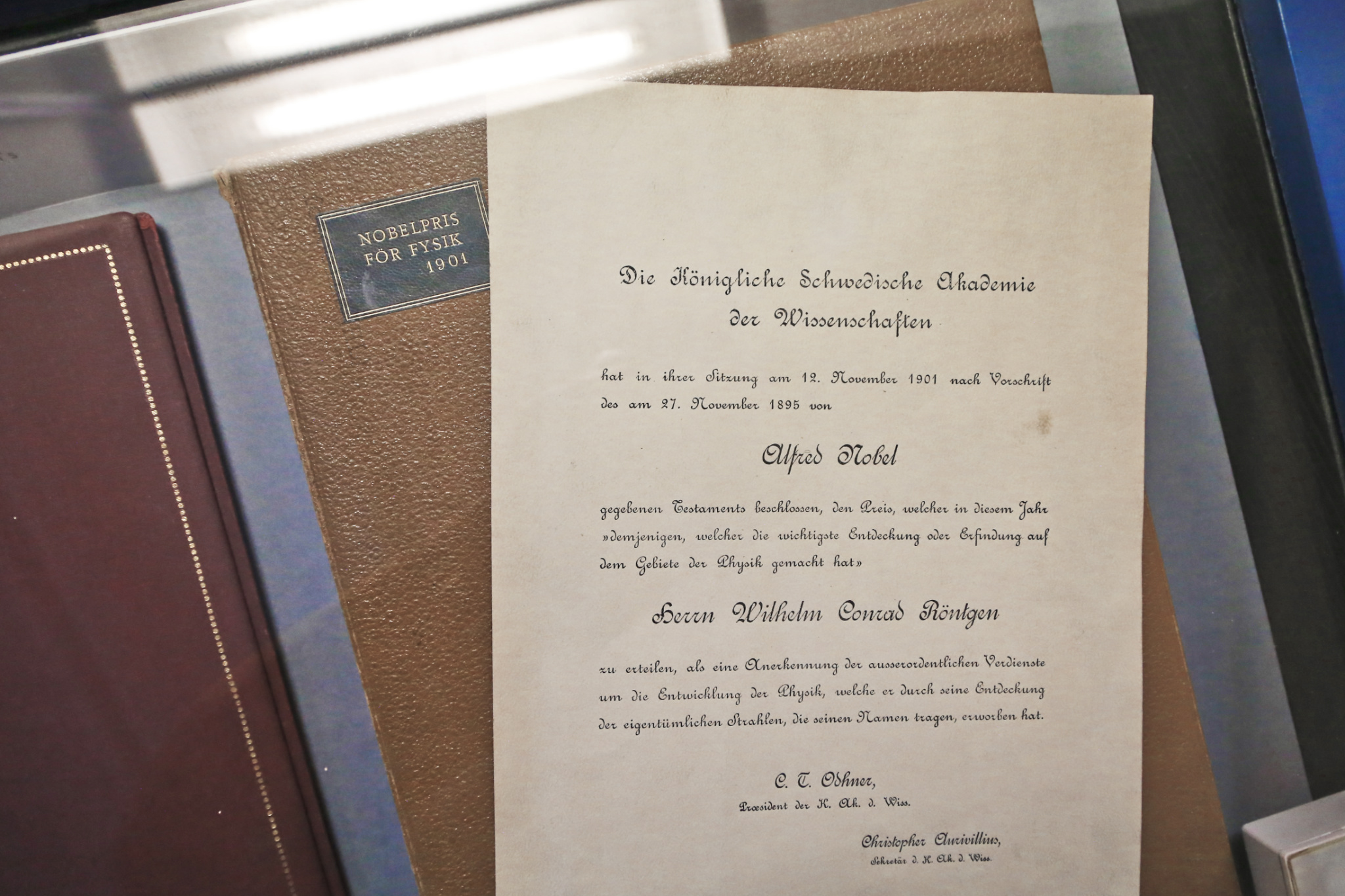
| Physics | Wilhelm Conrad Röntgen | German Empire | Discovery of X-rays (Röntgen rays) | Royal Swedish Academy of Sciences |
| Chemistry | Jacobus Henricus van 't Hoff | Netherlands | Laws of chemical dynamics and osmotic pressure in solutions | Royal Swedish Academy of Sciences |
| Physiology or Medicine | Emil Adolf von Behring | German Empire | Serum therapy against diphtheria | Karolinska Institute |
| Literature | Sully Prudhomme | France | Poetic composition demonstrating lofty idealism and artistic perfection | Swedish Academy |
| Peace | Jean Henry DunantFrédéric Passy | SwitzerlandFrance | Dunant: Founding the International Red CrossPassy: Founding the Inter-Parliamentary Union and Ligue internationale | Norwegian Nobel Committee |
Physics: Wilhelm Conrad Röntgen and the Discovery of X-Rays
The inaugural Nobel Prize in Physics was conferred upon German physicist Wilhelm Conrad Röntgen for his late-1895 discovery of electromagnetic radiation in a wavelength range today known as X-rays (or Röntgen rays).
The Discovery and Scientific Breakthrough
Working at the University of Würzburg, Röntgen was investigating electrical discharges in evacuated glass vacuum tubes (Crookes tubes). On November 8, 1895, he observed that a cardboard screen coated with barium platinocyanide, placed near a darkened tube, began to fluoresce—even though the tube was covered with black cardboard that blocked visible light. He deduced that an invisible, highly penetrating ray was passing through opaque matter.
Röntgen spent weeks systematically documenting the properties of these new rays. He demonstrated that they could penetrate thick layers of wood, paper, and aluminum, but were stopped by dense materials like lead and bone. The first human X-ray photograph—a capture of his wife Anna Bertha Ludwig's hand showing her skeletal bones and wedding ring—rapidly captured global public and scientific imagination.
- Crookes Vacuum Tube
- Invisible X-Rays
- Barium Screen / Photographic Plate
- Internal Structures / Skeletal Imaging
Medical and Scientific Impact
Röntgen’s breakthrough revolutionized medical diagnostics almost overnight. Physicians could visualize internal bone fractures, joint dislocations, foreign objects, and organ pathology without invasive surgery. Beyond medicine, X-ray discovery catalyzed the birth of modern atomic physics, laying the groundwork for subsequent breakthroughs in radioactivity, crystallography, and structural biology.
Demonstrating notable personal ethics, Röntgen refused to patent his discovery. He believed that scientific achievements belonged to all humanity and should be made freely available to researchers and physicians worldwide without commercial restrictions.
Chemistry: Jacobus Henricus van 't Hoff and Chemical Thermodynamics
The first Nobel Prize in Chemistry was awarded to Dutch physical chemist Jacobus Henricus van 't Hoff for his fundamental work in chemical dynamics and osmotic pressure.
Principles of Chemical Dynamics and Osmosis
Prior to van 't Hoff's research, chemistry was primarily a descriptive science focused on synthesizing compounds and characterizing elements. Van 't Hoff applied rigorous mathematical principles and thermodynamics to chemical behavior, effectively helping establish physical chemistry as a distinct discipline.
His award-winning work focused on two major areas:
- Chemical Dynamics: Formulating mathematical expressions for reaction rates, chemical equilibrium, and reaction kinetics.
- Dilute Solutions: Demonstrating that dissolved substances in dilute solutions exert an osmotic pressure equivalent to the gas pressure they would exert if they existed as a gas in the same volume.
Van 't Hoff introduced the van 't Hoff factor ($i$), which measures the extent to which a solute dissociates or associates in solution, bridging thermodynamic theory with experimental observations in electrochemistry.
Applications in Biological and Chemical Systems
Understanding osmotic pressure proved vital for biological and physiological sciences. It explained how plant roots absorb water from soil, how cellular membranes maintain homeostasis, and how metabolic nutrients transport across biological tissues. In industrial chemistry, his thermodynamic equations allowed engineers to optimize temperature and pressure conditions for large-scale chemical syntheses.
Physiology or Medicine: Emil von Behring and Diphtheria Serum Therapy
The inaugural Nobel Prize in Physiology or Medicine went to German physician and microbiologist Emil Adolf von Behring for his groundbreaking development of serum therapy against diphtheria and tetanus.
- Injected Inactivated Toxin
- Animal Model Produces Antitoxins
- Extract Serum containing Antitoxins
- Patient Injected with Blood Serum
The Crisis of Pediatric Diphtheria
In the late 19th century, diphtheria was among the leading causes of child mortality worldwide. Caused by the bacterium Corynebacterium diphtheriae, the disease produced a thick membrane in the respiratory tract that choked young patients, while toxic bacterial secretions damaged heart muscle and peripheral nerves. Treatments were largely palliative, and mortality rates routinely exceeded 50%.
Development of Antitoxin Serum Therapy
Working alongside Japanese bacteriologist Kitasato Shibasaburo at Robert Koch's Institute for Infectious Diseases in Berlin, Behring discovered that animals injected with sublethal doses of diphtheria or tetanus toxin produced counter-substances in their blood. Behring isolated blood serum containing these protective "antitoxins" (now recognized as antibodies) and demonstrated that injecting this serum into infected individuals conferred passive immunity.
Clinical trials conducted in the early 1890s demonstrated dramatic survival improvements. When diphtheria antitoxin was administered early in the course of infection, child mortality dropped dramatically, earning Behring the popular title "The Savior of Children." His work laid the theoretical and practical foundations for modern immunology and targeted immunotherapy.
Literature: Sully Prudhomme and Idealist Poetic Artistry
The first Nobel Prize in Literature was awarded to French poet and essayist René François Armand Prudhomme, known by his pen name Sully Prudhomme.
The Academy's Selection Criteria
The Swedish Academy chose Prudhomme "in special recognition of his poetic composition, which gives evidence of lofty idealism, artistic perfection and a rare combination of the qualities of both heart and intellect."
Prudhomme began his career associated with the Parnassian school of poetry, which emphasized formal precision, classical elegance, and philosophical detachment. Over time, his work evolved toward integrating scientific concepts, formal logic, and ethical inquiry into poetic forms, as seen in major works like La Justice (1878) and Le Bonheur (1888).
- SULLY PRUDHOMME'S POETIC TRAJECTORY
- Parnassian Movement: Classical formalism & aesthetic rigor
- Philosophical Expansion: Ethical inquiry & idealist poetry
- 1901 Nobel Recognition: Synthesis of heart, intellect, & form
The Early Literary Controversy
The decision to award Prudhomme proved controversial among international intellectuals. Many contemporary critics expected the inaugural literature prize to go to Russian novelist Leo Tolstoy, whose broad narrative canvas and moral influence dominated European literature.
A group of prominent Swedish writers and artists—including August Strindberg and Selma Lagerlöf—sent a public letter of protest to Tolstoy, distancing themselves from the Academy's decision. Tolstoy responded graciously, stating he was pleased not to receive the prize money, as managing wealth presented ethical challenges. Nevertheless, the decision highlighted early tension between the Nobel Committee's interpretation of Alfred Nobel's directive ("idealistic tendency") and broader literary prestige.
Peace: Henry Dunant and Frédéric Passy – International Humanitarianism and Arbitration
The 1901 Nobel Peace Prize was awarded jointly to Jean Henry Dunant of Switzerland and Frédéric Passy of France. This dual recognition established a balanced precedent by honoring two complementary paths to world peace: humanitarian assistance during war and diplomatic arbitration to prevent conflict.
Jean Henry Dunant: Founder of the Red Cross
In June 1859, Swiss businessman Henry Dunant witnessed the aftermath of the Battle of Solferino in northern Italy, where over 40,000 wounded and dying soldiers were left on the battlefield without adequate medical care. Horrified by the suffering, Dunant organized local villagers to render neutral assistance to wounded soldiers regardless of their military affiliation.
Upon returning to Geneva, Dunant published A Memory of Solferino (1862), in which he proposed two revolutionary concepts:
- Establishing permanent national voluntary relief organizations to care for wounded soldiers during wartime.
- Formulating an international treaty guaranteeing neutral status to medical staff and field hospitals.
His efforts led directly to the founding of the International Committee of the Red Cross (ICRC) in 1863 and the adoption of the First Geneva Convention in 1864. Although Dunant subsequently faced bankruptcy and spent years living in obscurity, his nomination for the inaugural Nobel Peace Prize restored his international recognition.
- Battle of Solferino (1859)
- A Memory of Solferino (1862)
- Red Cross Founded (1863)
- First Geneva Convention Adopted (1864)
- 1901 Nobel Peace Prize Awarded
Frédéric Passy: Pioneer of International Arbitration
Frédéric Passy spent over half a century advocating for international law, economic free trade, and diplomatic arbitration. In 1867, he founded the Ligue internationale et permanente de la paix (later known as the French Society for Arbitration between Nations).
Passy recognized that lasting peace required durable institutional structures. In 1889, alongside British parliamentarian William Randal Cremer, Passy co-founded the Inter-Parliamentary Union (IPU), an organization designed to bring lawmakers from different nations together to resolve disputes through legal mediation rather than military confrontation. Passy served as a prominent voice in the international peace movement, urging governments to reduce military expenditures in favor of judicial dispute resolution.
Historical Impact and Legacy of the 1901 Nobel Ceremonies
The success of the 1901 awards established the credibility, prestige, and administrative model of the Nobel Prizes. By selected established scholars and humanitarians across Western Europe, the awarding institutions demonstrated an intent to honor rigorous, peer-evaluated achievements.
Financial and Ceremonial Standards
In 1901, the monetary value of each Nobel Prize category was 150,782 Swedish kronor. This represented a massive financial sum—equivalent to decades of average academic salaries at the time—which immediately elevated the prize's status above existing national awards.
The split decision in the Peace Prize established the precedent that a single Nobel Prize category could be shared between co-laureates, a practice later applied to the scientific categories to recognize collaborative research across international boundaries.
Frequently Asked Questions About the 1901 Nobel Laureates
Why was there no Nobel Prize in Economic Sciences awarded in 1901?
The Prize in Economic Sciences was not created in Alfred Nobel's original 1895 will. The official Sveriges Riksbank Prize in Economic Sciences in Memory of Alfred Nobel was established much later, in 1968, by Sweden's central bank to celebrate its 300th anniversary, with the first award presented in 1969.
Where were the inaugural 1901 Nobel Ceremonies held?
The prizes for Physics, Chemistry, Physiology or Medicine, and Literature were presented at the Old Royal Academy of Music in Stockholm, Sweden. The Nobel Peace Prize ceremony took place in Christiania (now Oslo), Norway, at the Norwegian Parliament (Storting), following Alfred Nobel's specific directive separating the Peace Prize administration from Swedish institutions.
How much monetary award did each 1901 Nobel Laureate receive?
Each of the five award categories carried a prize value of 150,782.36 Swedish kronor in 1901. For the shared Nobel Peace Prize, co-laureates Jean Henry Dunant and Frédéric Passy split the award equally, each receiving approximately 75,391 kronor.
Why was Leo Tolstoy not awarded the 1901 Nobel Prize in Literature?
The Swedish Academy's literature committee, led by Carl David af Wirsén, prioritized works demonstrating "lofty idealism" and classical stylistic refinement. Committee members viewed Tolstoy's radical socio-religious philosophy, anti-institutional views, and non-traditional narrative structures as incompatible with the specific wording of Alfred Nobel's bequest.
Did Wilhelm Röntgen patent the X-ray after winning his Nobel Prize?
No. Wilhelm Conrad Röntgen explicitly refused to file patents on his discovery of X-rays. He rejected commercial opportunities and donated his 1901 Nobel Prize money to the University of Würzburg to support ongoing scientific research.
Researching Primary Sources on Early Nobel History
For historians, educators, and researchers investigating the 1901 Nobel Laureates, primary documentation provides valuable context regarding committee deliberations, public reactions, and early prize administration:
- Nobel Foundation Archives: Consult the official Nobel Prize Database to access historical nomination databases, committee reports, ceremonial acceptance speeches, and lecture transcripts preserved from 1901 onward.
- Medical & Scientific Repositories: Examine digitized original papers, such as Röntgen's Ueber eine neue Art von Strahlen (On a New Kind of Rays) and Behring's original serum therapy publications via the U.S. National Library of Medicine or German National Library archives.
- Humanitarian Archives: Review founding documents, correspondence, and Geneva Convention records maintained by the International Committee of the Red Cross Historical Archives to examine Henry Dunant’s contributions to international humanitarian law.