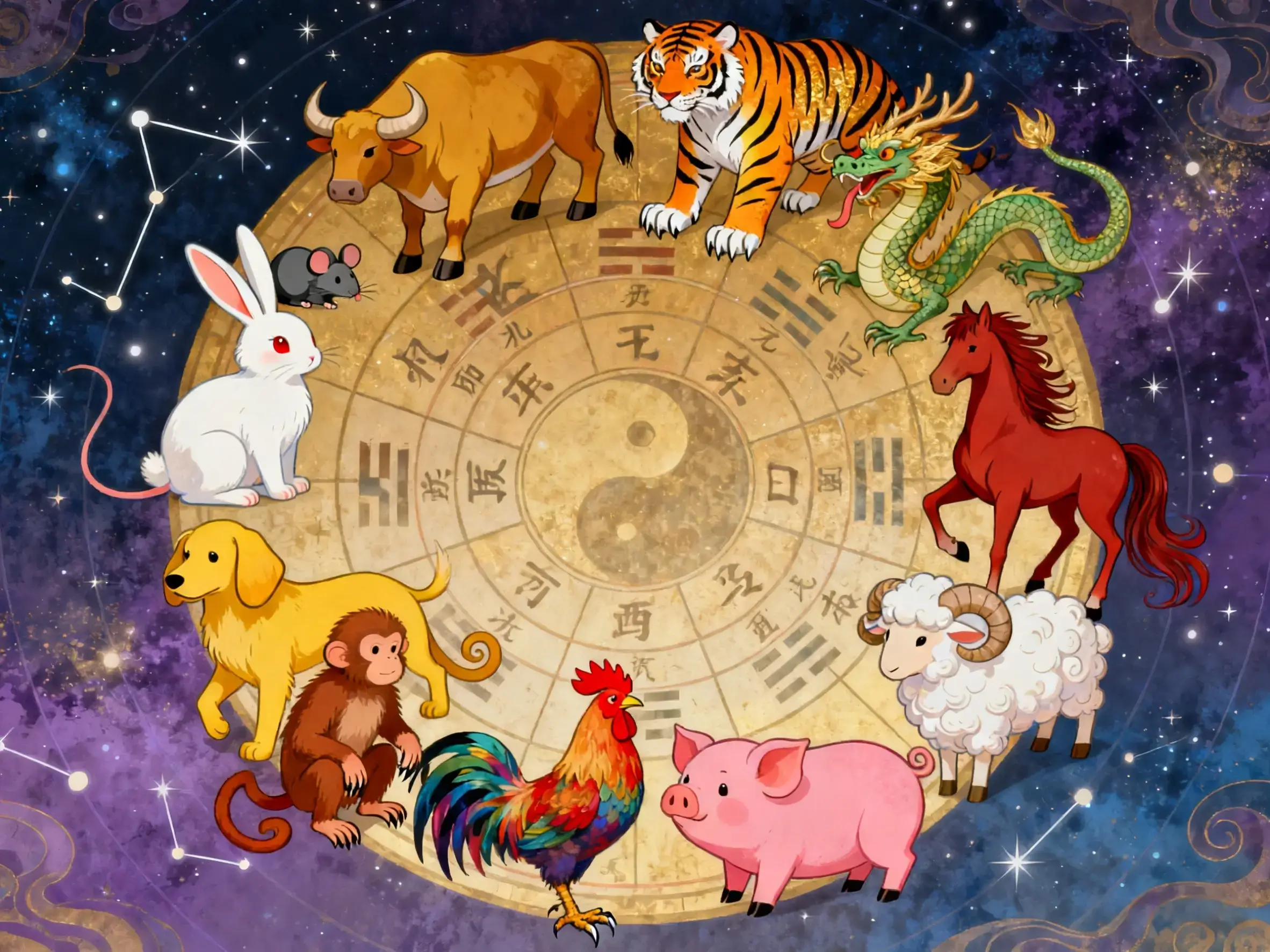
Anyone born during the 1630 lunar year falls under the Horse sign in the Chinese zodiac, specifically governed by the Metal element (Geng Wu 庚午). The 1630 Metal Horse combines the enthusiastic, independent drive of the Horse with the firmness, integrity, and decisive focus of Yang Metal, making it a powerful sign of decisive action and mobility.
Decoding 1630 in the Chinese Sexagenary Cycle (Ganzhi)
The traditional Chinese calendar operates on a 60-year sexagenary cycle known as Ganzhi (干支). This timekeeping system pairs ten Heavenly Stems (Tiangan) with twelve Earthly Branches (Dizhi). The year 1630 occupies the 7th position in this 60-year sequence, designated as Geng Wu (庚午).
To understand the astrological composition of 1630, it is essential to examine its two core components:
- Heavenly Stem (Geng 庚): Represents Yang Metal. Metal associated with Geng reflects unrefined iron, weapons, sword blades, and raw mineral strength. It symbolizes justice, firmness, direct action, discipline, and unwavering determination.
- Earthly Branch (Wu 午): Represents the Horse and corresponds to the peak of Yang Fire, aligned with mid-summer, the midday hours (11:00 AM to 1:00 PM), and the southern cardinal direction.
- 1630 GENG WU YEAR
- Heavenly Stem: Geng (庚): Yang Metal (Strength, Resolve)
- Earthly Branch: Wu (午): Horse (Mobility, Passion)
- Nayin Element: Roadside Earth (路傍土)
When Yang Metal (Geng) sits atop the Horse branch (Wu), an energetic dynamic emerges. Although the Earthly Branch of the Horse carries intrinsic Fire energy, the overarching governing element for the year's stem is Metal. In classical Chinese Five Element (Wuxing) theory, Fire melts Metal. This intrinsic tension between the inner Fire of the Horse and the outer Metal stem gives individuals born in a Geng Wu year a passionate yet disciplined nature, balancing rapid movement with sharp analytical focus.
Calculating the 1630 Chinese Lunar New Year Transition
Determining a birth sign in traditional Chinese astrology requires checking the exact date against the lunar calendar rather than the standard Western Gregorian calendar. Solar and lunar dates do not align perfectly because the Chinese calendar relies on lunisolar cycles governed by the moon's phases and solar terms (Jieqi).
In 1630, the Chinese Lunar New Year (Spring Festival) fell on February 12, 1630. The lunar year concluded on January 31, 1631.
1630 LUNAR YEAR DATES:
- January 1, 1630 – February 11, 1630: Ji Si Year (Earth Snake)
- February 12, 1630 – January 31, 1631: Geng Wu Year (Metal Horse)
Anyone born between January 1, 1630, and February 11, 1630, belongs to the preceding zodiac year: the Earth Snake (Ji Si 己巳). Individuals born from February 12, 1630, through January 31, 1631, belong to the Metal Horse (Geng Wu 庚午).
Astrologers utilizing the Solar Calendar system (Li Chun, which marks the official start of spring around February 4) calculate the zodiac boundary from the exact solar term transition point. In 1630, Li Chun occurred on February 4, 1630. While popular astrology uses the Lunar New Year date, professional Four Pillars of Destiny (Bazi) practitioners use Li Chun for precise natal chart construction.
Characteristics and Traits of the 1630 Metal Horse
The Horse is traditionally recognized in Chinese culture as a symbol of speed, freedom, nobility, and tireless endurance. Ancient military and agricultural societies valued the horse above almost all domestic animals for its vital role in transportation, warfare, and commerce.
Personality Strengths
Individuals associated with the Metal Horse exhibit a unique blend of spirit and self-control:
- Independence and Autonomy: Metal Horses resist rigid restriction and thrive when given room to chart their own course. They prefer leadership roles over subordinate positions.
- Decisive Leadership: The Geng Metal influence provides mental clarity and directness. Unlike signs that hesitate, the Metal Horse makes swift decisions under pressure.
- High Energy and Stamina: Governed by the midday Fire branch (Wu), these individuals possess abundant physical energy, enthusiasm, and an eagerness to take on ambitious projects.
- Strong Ethical Compass: Metal represents righteousness (Yi 義) in Five Element theory. People born under this sign typically exhibit strong loyalties, direct honesty, and an intolerance for hypocrisy.
Potential Challenges
The intense combination of Yang Metal and Horse energy can also generate specific personal challenges:
- Impatience and Restlessness: The speed of the Horse paired with Metal's sharp focus can result in frustration when dealing with slower team members or delayed bureaucratic processes.
- Stubbornness: Because Yang Metal signifies hardened iron, the Metal Horse can become unyielding once a course of action is chosen, occasionally resisting constructive advice.
- Temperamental Outbursts: The internal conflict between the Horse's intrinsic Fire and the Stem's Metal can manifest as sudden flare-ups of anger when progress is obstructed.
Comparative Analysis: 1630 and Adjacent Zodiac Years
Understanding where 1630 fits in relation to surrounding years helps clarify the shifting elemental dynamics across the 12-year animal cycle and 5-element rotations.
| Year | Gregorian Date Range | Sexagenary Stem-Branch | Animal Sign | Ruling Element | Personality / Astrological Focus |
|---|---|---|---|---|---|
| 1628 | Jan 6, 1628 – Jan 23, 1629 | Wu Chen (戊辰) | Dragon | Earth | Strategic, grounded, pragmatic ambition |
| 1629 | Jan 24, 1629 – Feb 11, 1630 | Ji Si (己巳) | Snake | Earth | Analytical, introspective, diplomatic |
| 1630 | Feb 12, 1630 – Jan 31, 1631 | Geng Wu (庚午) | Horse | Metal | Decisive, energetic, independent, direct |
| 1631 | Feb 1, 1631 – Jan 20, 1632 | Xin Wei (辛未) | Goat / Sheep | Metal | Artistic, meticulous, gentle, detail-oriented |
| 1632 | Jan 21, 1632 – Feb 8, 1633 | Ren Shen (壬申) | Monkey | Water | Adaptable, inventive, swift intellect |
| 1633 | Feb 9, 1633 – Jan 28, 1634 | Gui You (癸酉) | Rooster | Water | Observant, precise, communicative |
Elemental Dynamics: How Yang Metal Shapes the Horse Sign
In traditional Chinese metaphysics, every animal sign appears in five distinct elemental forms over a 60-year cycle: Wood, Fire, Earth, Metal, and Water. The Horse sign recurs every 12 years, but the Metal Horse occurs only once every six decades (e.g., 1570, 1630, 1690, 1750, 1810, 1870, 1930, 1990, and 2050).
THE FIVE ELEMENTAL VARIATIONS OF THE HORSE:
- Wood Horse (Jia Wu): Creative, expansive, cooperative
- Fire Horse (Bing Wu): Highly intense, fiery, revolutionary
- Earth Horse (Wu Wu): Steady, deliberate, practical
- Metal Horse (Geng Wu): Formidable, disciplined, decisive
- Water Horse (Ren Wu): Flexible, intuitive, communicative
The Unique Synthesis of Metal and Fire
The Metal Horse possesses a distinctive balance compared to other Horse variations:
- Refinement Through Heat: In Five Element interactions, Fire controls Metal by forging and refining it. Because the Horse's inner element is Fire, the Metal Horse undergoes continuous internal refinement. This process transforms raw potential into seasoned leadership and sharp skill.
- Structural Strength: Where a Fire Horse (Bing Wu) can be volatile and an Earth Horse (Wu Wu) cautious, the Metal Horse combines momentum with structural discipline. They establish clear rules and expectations before charging forward.
- Financial and Commercial Focus: Metal is historically linked with currency, trade, and mineral wealth. Consequently, individuals born in Geng Wu years often demonstrate a strong talent for commerce, logistics, and resource management.
Historical Context: Life and Fortunes During the 1630 Geng Wu Year
Placing the 1630 Geng Wu year within its historical context provides insight into how contemporaries viewed global events, societal governance, and astrological signs.
In East Asia, 1630 marked the third year of the reign of the Chongzhen Emperor (Zhu Youjian), the final ruling emperor of the Ming Dynasty. Globally, the year fell within the broader era of the Thirty Years' War in Europe and rapid expansion in maritime trade networks documented by historical bodies like the Royal Historical Society.
Astrological Interpretations of 1630
Historical court astrologers analyzed years like 1630 through the lens of national harmony and agricultural stability:
- Military Activity: The combination of Geng (Metal, weapons) and Wu (Horse, cavalry) frequently signified heightened military activity, border defenses, and cavalry mobilization. 1630 was characterized by military engagements between Ming forces and the rising Later Jin (later Qing) forces under Hong Taiji.
- Infrastructure and Transport: Years governed by the Horse emphasized communication networks, courier postal systems (Yizhan), and road transport efficiency across territories.
- Economic Shifts: The Metal element's association with silver and trade matched an era when foreign silver inflows through trade ports significantly impacted global monetary policy.
Fortunate Symbols and Harmonious Connections for the Horse
In Chinese astrological tradition, each sign is associated with specific directions, numbers, colors, and complementary signs that foster balance and success.
Astrological Compatibility
The Horse belongs to the Fire Trine in Chinese astrology, forming natural alliances with two specific signs:
- The Tiger (Yin): Shares the Horse's adventurous spirit, bold vision, and enthusiasm for action.
- The Dog (Xu): Provides loyalty, stability, and sensible judgment to balance the Horse's swift momentum.
Additionally, the Horse forms a powerful secret alliance (Liu He) with the Goat (Wei), combining dynamic energy with peaceful diplomacy. Conversely, the Horse experiences direct tension with the Rat (Zi), as Fire and Water stand in direct opposition across the zodiac wheel.
- HORSE ASTROLOGICAL ALLIANCES
- San He (Three Harmonies): Horse (午) + Tiger (寅) + Dog (戌)
- Liu He (Six Harmony Pair): Horse (午) + Goat (未)
- Zheng Chong (Direct Clash): Horse (午) vs. Rat (子)
Traditional Lucky Elements for the Metal Horse
- Favorable Colors: Yellow, beige, brown (Earth elements that generate Metal), as well as gold, white, and silver (Metal elements).
- Favorable Directions: South (associated with the Horse's home branch) and Southwest/Northeast (Earth directions that stabilize Metal).
- Favorable Numbers: 2, 5, and 8 (Earth numbers), along with 4 and 9 (Metal numbers).
How to Determine Your Lunar Zodiac Sign for Historical Birth Years
Calculating historical zodiac signs accurately requires a systematic method to avoid errors caused by calendar reforms, timezone differences, and solar-lunar discrepancies.
Step 1: Verify the Exact Gregorian Date
Identify the exact day, month, and year of birth. Ensure that dates recorded under old systems (such as the Julian calendar used in Western Europe prior to 1582 or later depending on the country) are properly converted to standard Gregorian dates if comparing historical records.
Step 2: Check the Lunar New Year Boundary
Consult a reliable lunisolar calendar converter or astronomical table. Identify whether the birth date fell before or after the Lunar New Year of that specific year.
- If the birth date is before Chinese New Year, the individual belongs to the animal sign and element of the previous year.
- If the birth date is on or after Chinese New Year, the individual belongs to the animal sign and element of that year.
Step 3: Determine the Heavenly Stem and Earthly Branch
Use the 60-year Ganzhi table to extract the Heavenly Stem (governing element) and Earthly Branch (zodiac animal). Remember that the 60-year cycle repeats continuously. For example, 1570, 1630, 1930, and 1990 all share the identical Geng Wu Metal Horse designation.
Frequently Asked Questions
What Chinese zodiac sign corresponds to the year 1630?
The year 1630 corresponds to the Horse sign, specifically the Metal Horse (Geng Wu 庚午). This applies to anyone born between February 12, 1630, and January 31, 1631.
Was 1630 a Fire Horse or a Metal Horse year?
1630 was a Metal Horse year. While the Horse as an Earthly Branch naturally carries internal Fire energy, the governing Heavenly Stem for 1630 was Geng (Yang Metal), making Metal the official ruling element for the year.
How do I know if someone born in early 1630 is a Horse or a Snake?
Check the exact birth date against the 1630 Chinese Lunar New Year (February 12, 1630). Anyone born from January 1 through February 11, 1630, belongs to the Earth Snake (Ji Si) year. Anyone born on or after February 12, 1630, belongs to the Metal Horse (Geng Wu) year.
What are the main personality traits of a Metal Horse?
The Metal Horse is known for independence, strong willpower, decisive leadership, and high energy. The Metal element adds structure, discipline, and directness to the naturally energetic and freedom-loving Horse.
How often does the Metal Horse year occur in the Chinese calendar?
The Metal Horse (Geng Wu) year occurs once every 60 years in the sexagenary cycle. Recent and historical Metal Horse years include 1570, 1630, 1690, 1750, 1810, 1870, 1930, 1990, and the upcoming year 2050.
Applying Historical Zodiac Calculation Principles Today
When analyzing historical dates or calculating natal signs for genealogy research, accuracy depends on using proper lunisolar transition data rather than relying solely on Western calendar years.
To conduct accurate historical astrology or genealogical research:
- Cross-Reference Lunar Dates: Always use verified historical Chinese calendar databases (such as those maintained by academia or astronomical observatories) to confirm the exact start of the lunar year.
- Account for Solar Terms (Jieqi): If practicing Four Pillars of Destiny (Bazi), remember to locate the exact date and hour of Li Chun (Spring Beginning) rather than relying exclusively on Lunar New Year's Day.
- Evaluate Stem and Branch Interactions: Assess both the Heavenly Stem (Geng) and Earthly Branch (Wu) together to understand the full balance of elements, rather than looking at the animal sign in isolation.
Understanding the 1630 Geng Wu year provides valuable insight into traditional timekeeping, structural astrology, and the enduring symbolism of the Metal Horse across history.