Establishing a productive day begins with a structured morning routine designed to optimize biological rhythms and cognitive focus. By prioritizing hydration, natural light exposure, and strategic deep work over digital distractions, you can regulate cortisol levels and stabilize dopamine baselines, ensuring sustained energy and mental clarity throughout 2026.
The Neurobiology of a Productive Morning
To understand why specific habits facilitate productivity, one must first look at the transition from sleep to wakefulness. During the first hour of the day, the brain moves from delta and theta waves into alpha and beta states. This transition is governed by the circadian rhythm, an internal clock regulated by the suprachiasmatic nucleus (SCN).
In 2026, productivity experts emphasize that "winning the morning" is not about waking up at 4:00 AM, but rather about aligning your actions with your endocrine system. Cortisol, often mislabeled as just a "stress hormone," naturally peaks in the morning (the Cortisol Awakening Response) to provide alertness. When we introduce high-dopamine triggers—like checking social media—too early, we disrupt this natural ramp-up, leading to "attention residue" and a mid-morning crash. Effective habits are those that support this biological transition rather than fighting against it.
1. Eliminate the Snooze Button
The habit of "snoozing" creates a physiological state known as sleep inertia. When you hit snooze and fall back asleep, your brain initiates a new sleep cycle that it cannot finish. Waking up mid-cycle leaves you feeling groggier than if you had simply risen at the first alarm. In 2026, sleep science continues to validate that consistency in wake times is more critical for cognitive performance than total sleep duration alone. By rising immediately, you signal to your nervous system that the day has begun, allowing the natural clearing of adenosine—the chemical responsible for sleep pressure—to occur more efficiently.
2. Rehydration Before Caffeine
After six to eight hours of sleep, the human body is in a state of mild dehydration. Dehydration is a primary, yet often overlooked, cause of morning fatigue and "brain fog." Before reaching for coffee, consuming at least 16 to 20 ounces of water is essential. Water facilitates the transport of oxygen to cells and supports metabolic processes that were slowed during sleep. Adding a pinch of sea salt or electrolytes can improve cellular absorption, ensuring that your neurological system is primed for the day's demands before you introduce stimulants like caffeine.
3. Early Sun Exposure
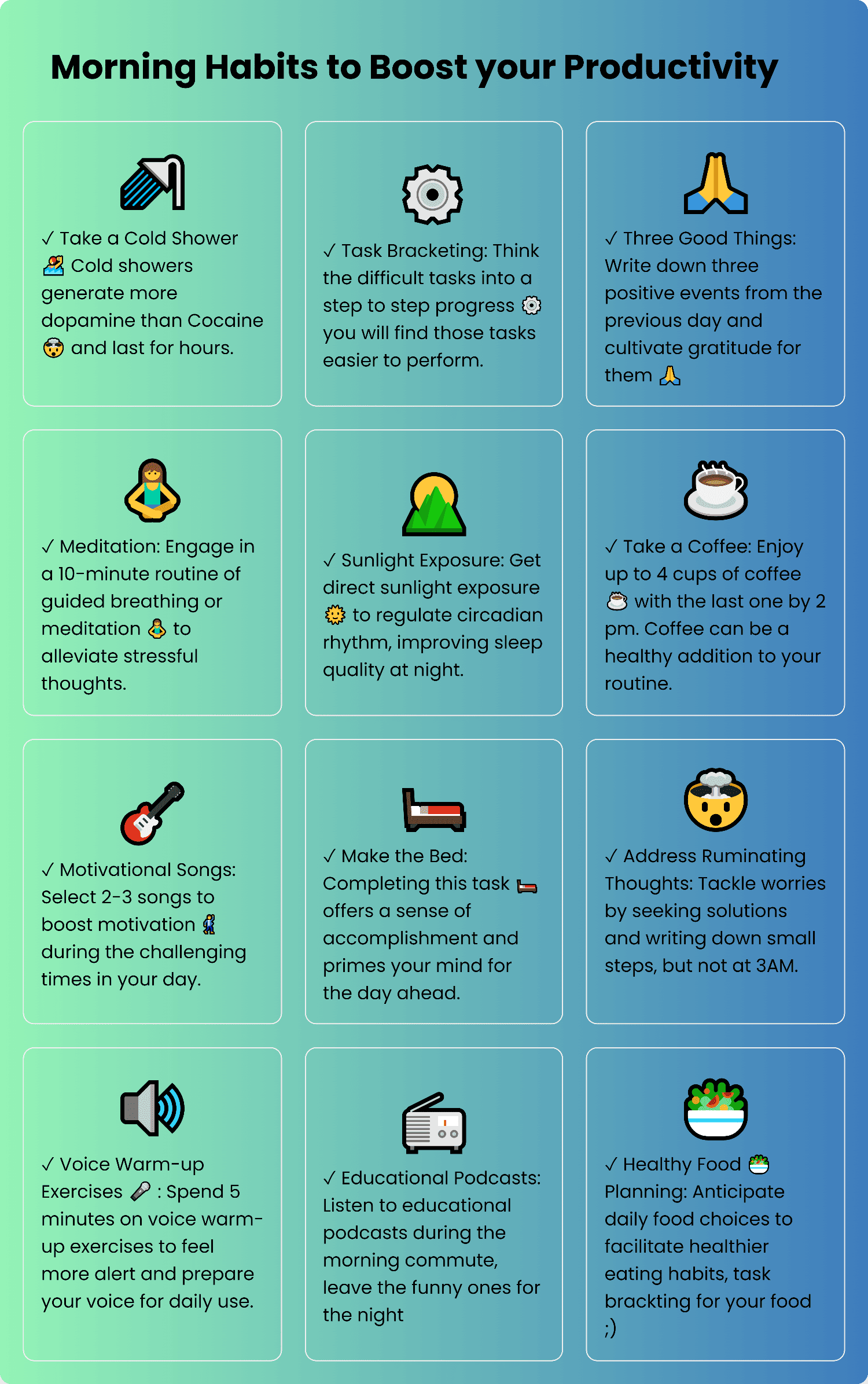
Viewing natural sunlight within the first 30 to 60 minutes of waking is perhaps the most powerful tool for regulating the circadian clock. Sunlight triggers the release of cortisol and sets a timer for the production of melatonin approximately 16 hours later. According to research from institutions like the National Institute of General Medical Sciences, blue light from the sun interacts with melanopsin-containing cells in the eyes, which communicates directly with the brain’s master clock. Even on cloudy days, the photon density outdoors is significantly higher than indoor lighting, making a short walk or time spent on a balcony a non-negotiable habit for peak productivity.
4. Delaying Caffeine Consumption
While it is tempting to drink coffee immediately upon waking, delaying intake by 60 to 90 minutes can prevent the dreaded afternoon crash. Upon waking, residual adenosine is still being cleared from your receptors. Caffeine works by blocking these receptors. If you block them before they have naturally cleared, the adenosine builds up and floods the system once the caffeine wears off. By waiting until your natural cortisol peak begins to subside, you use caffeine as a strategic tool rather than a biological crutch.
5. Cold Exposure (Hydrotherapy)
In 2026, the use of cold showers or deliberate cold exposure has moved from niche "biohacking" to a standard productivity practice. A 30-second to two-minute cold burst at the end of a shower triggers a significant release of epinephrine (adrenaline) and norepinephrine. These chemicals increase focus and alertness. More importantly, cold exposure has been shown to increase baseline dopamine levels by up to 250% for several hours, providing a steady state of motivation rather than the erratic spikes associated with digital consumption.
6. High-Protein Breakfast
Nutritional choices in the morning dictate blood sugar stability for the remainder of the day. A breakfast high in simple carbohydrates (like sugary cereals or white bread) leads to a rapid insulin spike followed by a crash, resulting in lethargy by 11:00 AM. Conversely, a meal containing 30 or more grams of protein—utilizing sources like eggs, Greek yogurt, or plant-based proteins—supports the production of neurotransmitters like dopamine and acetylcholine, which are essential for focus. This "slow-burn" energy keeps the prefrontal cortex functioning optimally for complex decision-making.
7. The "Digital Fast"
Checking email, news, or social media immediately upon waking forces the brain into a reactive state. Instead of pursuing your own goals, you are responding to the agendas of others. This "context switching" fractures your attention span before the workday even begins. Maintaining a digital fast for the first hour of the day allows you to maintain internal locus of control. By avoiding the dopamine loops of infinite scrolls, you preserve your cognitive "deep work" capacity for tasks that actually move the needle on your career or personal projects.
8. Mindfulness and Meditation
Productivity is not just about doing more; it is about having the presence of mind to do the right things. Five to ten minutes of mindfulness meditation helps lower the activity of the amygdala—the brain's fear center—and strengthens the pathways to the prefrontal cortex. This creates a "buffer" between a stimulus (like a stressful email) and your response, allowing you to remain calm and productive under pressure.
9. Physical Movement
You do not need an intense 90-minute gym session to reap the benefits of morning movement. A simple 10-minute routine of dynamic stretching, yoga, or a brisk walk increases blood flow to the brain and stimulates the lymphatic system. Movement also triggers the release of Brain-Derived Neurotrophic Factor (BDNF), a protein that supports the survival of existing neurons and encourages the growth of new ones, essentially "fertilizing" the brain for learning and problem-solving.
10. "Eating the Frog" (Deep Work)
Named after a Mark Twain quote, "eating the frog" refers to tackling your most difficult, important, or anxiety-inducing task first. Our willpower is a finite resource that depletes as the day progresses due to decision fatigue. By dedicating the first 60 to 90 minutes of your work sessions to your highest-priority task—before meetings or administrative "busy work"—you ensure that even if the rest of the day becomes chaotic, you have made meaningful progress on your most important objective.
11. Daily Prioritization (The Rule of 3)
Overwhelming "to-do" lists often lead to paralysis. A productive morning habit involves identifying exactly three tasks that, if completed, would make the day a success. This clarity reduces the cognitive load of constantly deciding what to do next. In 2026, many professionals use "time-blocking" to assign specific hours to these three tasks, ensuring that the schedule reflects their actual priorities rather than a reactionary list of chores.
12. Journaling and Brain Dumping
Mental clutter is a significant barrier to productivity. Using a journal to "dump" your thoughts, anxieties, or ideas onto paper clears the working memory. Whether you use the "Morning Pages" method of stream-of-consciousness writing or a structured gratitude journal, the act of externalizing thoughts reduces "open loops" in the brain. This creates a sense of psychological closure on the previous day and mental space for the new one.
13. Gratitude Practice
While often viewed as "soft," gratitude has profound neurological benefits. Actively identifying three specific things you are grateful for rewires the brain to look for opportunities and resources rather than threats and deficits. This optimistic bias is a key component of resilience. A productive individual is not someone who lacks problems, but someone who maintains the cognitive flexibility to navigate them—a trait reinforced by a consistent gratitude practice.
14. Structured Learning
The most productive individuals are often the most consistent learners. Spending 15 to 20 minutes in the morning reading a non-fiction book, listening to an educational podcast, or studying a new language primes the brain for growth. This habit ensures that your skills are constantly evolving, providing a long-term productivity advantage that compounds over months and years.
15. Reviewing the Environment
A cluttered workspace leads to a cluttered mind. Taking five minutes to clear your desk and organize your physical surroundings prepares your brain for "focus mode." Environmental cues are powerful; a clean desk signals to the brain that it is time to work, whereas a desk covered in old coffee cups and random papers signals chaos.
Morning Habit Comparison and Impact
The following table categorizes these habits by their primary benefit to help you prioritize which to implement first based on your specific needs.
| Habit | Primary Benefit | Implementation Effort | Physiological Driver |
|---|---|---|---|
| Sunlight Exposure | Circadian Regulation | Low | Cortisol/Melatonin |
| Hydration | Metabolic Activation | Low | Cellular Osmolality |
| Deep Work | High-Value Output | High | Prefrontal Cortex |
| Cold Exposure | Alertness/Mood | Medium | Epinephrine/Dopamine |
| Digital Fast | Focus Preservation | Medium | Dopamine Baseline |
| High-Protein Breakfast | Energy Stability | Medium | Blood Glucose |
| Mindfulness | Stress Reduction | Low | Amygdala Regulation |
FAQ
How many of these habits should I start at once?
You should ideally start with no more than two or three new habits at a time. The "habit stacking" method—anchoring a new habit to an existing one (e.g., drinking water while the coffee brews)—is the most effective way to ensure long-term adherence. Trying to overhaul your entire morning at once often leads to burnout within a week.
Does waking up early automatically make me more productive?
No, waking up early is not a panacea. Productivity is a result of what you do with your waking hours, not the specific time you start. If waking up at 5:00 AM leads to sleep deprivation (less than seven hours for most adults), the cognitive impairment will outweigh any benefits of an early start. Focus on sleep quality and consistency first.
Can I do my morning routine in a different order?
Yes, the order can be adjusted to fit your lifestyle, but some biological constraints apply. For instance, sunlight exposure and hydration should always occur as early as possible to align with your body’s natural wake-up signals. Deep work is best done when your house or office is quietest and your willpower is highest.
What if I work the night shift?
The principles of morning habits—hydration, light, and structured movement—still apply, but they must be shifted to your "subjective morning." If you wake up at 4:00 PM, that is when you should seek bright light (even if from a high-intensity light box) and hydrate to signal to your body that your "day" has begun.
Is it okay to check my phone if it’s for work?
Even work-related digital consumption in the first hour can trigger a reactive mindset. If your job requires you to be "on-call," try to handle only the urgent issues and then return to your routine. For most people, the "urgent" email can wait 60 minutes while they prioritize their own cognitive health.
Optimizing Your Implementation Strategy
To turn these 15 habits into a sustainable routine, begin by conducting a "morning audit" for one week. Document your current actions from the moment you wake up until you start work. Identify the "friction points"—such as scrolling through news for 20 minutes—and replace them with a high-impact habit like sunlight exposure or journaling.
Consistency is more important than perfection. If you miss a day, do not abandon the routine; simply return to it the following morning. By 2026, the integration of these biological and cognitive strategies is no longer just a "lifestyle choice" but a professional requirement for those operating in high-demand, high-complexity environments. Your morning routine is the foundation upon which the rest of your day is built; ensure it is a foundation of intention rather than reaction.