A measurement of 15 degrees represents an acute angle that is exactly 1/24th of a full 360-degree rotation. In practical terms, it is the fundamental unit for global time zones, the gold standard for high-performance cutlery edges, and a common structural slope in both architecture and mechanical engineering projects.
The Mathematical Foundation of 15 Degrees
In the realm of geometry and trigonometry, 15 degrees (expressed as 15°) is categorized as an acute angle, meaning it is less than 90 degrees. To understand its value in a broader mathematical context, we must look at its relationship to the circle and the radian system used in advanced calculus and physics. One full circle is $2\pi$ radians; therefore, 15 degrees is equal to $\pi/12$ radians (approximately 0.2618 radians).
Mathematically, 15 degrees is significant because it is the difference between two "standard" angles found on the unit circle: 45 degrees and 30 degrees. This relationship allows mathematicians to derive exact trigonometric values for 15 degrees without a calculator using subtraction formulas. For instance, the sine of 15 degrees is exactly $\frac{\sqrt{6}-\sqrt{2}}{4}$, and the cosine is $\frac{\sqrt{6}+\sqrt{2}}{4}$.
In 2026, these precise values remain foundational in computer-aided design (CAD) software and robotics, where incremental rotations of 15 degrees are frequently used as "snap" points. Because 15 is a factor of 30, 45, 60, and 90, it serves as a versatile building block for creating complex polygons, such as the dodecagon (a 12-sided figure), where each exterior angle is 30 degrees and interior angles are composed of 15-degree increments.
Geography and the Science of Time
Perhaps the most significant global application of 15 degrees is found in the way humanity measures time. The Earth rotates approximately 360 degrees every 24 hours. When you divide 360 by 24, the result is exactly 15. Consequently, each hour of the day corresponds to 15 degrees of longitude.
This 15-degree increment was the primary basis for the establishment of the International Time Zone system at the International Meridian Conference in 1884. In an ideal geographic model, every 15 degrees of travel east or west from the Prime Meridian in Greenwich, England, would result in a one-hour clock shift. While political boundaries and national interests have distorted these lines into "zigzag" patterns, the 15-degree rule remains the scientific anchor for Coordinated Universal Time (UTC).
Navigators and astronomers also utilize this relationship. In celestial navigation, the "hour angle" of a star or planet is often measured in 15-degree units to simplify calculations between the position of an object in the sky and the current time at the observer's location. Even in 2026, as satellite-based GPS dominates navigation, understanding the 15-degree longitudinal shift is a prerequisite for professional maritime and aviation certifications.
The 15-Degree Edge: Excellence in Sharpening
In the culinary and manufacturing worlds, "15 degrees" is a term synonymous with extreme sharpness. The angle at which a blade is ground determines the balance between its "bite" (how easily it enters a material) and its durability (how long the edge lasts before chipping or dulling).
Traditionally, Western kitchen knives (German and French styles) were ground to a 20-degree angle on each side, creating a 40-degree inclusive angle. However, by 2026, the industry has largely shifted toward the "15-degree standard." This trend originated with Japanese cutlery, which uses harder steel capable of supporting a thinner, more acute edge. A 15-degree edge provides significantly less resistance when slicing through delicate proteins or vegetables, though it requires more frequent maintenance and higher-quality steel (typically HRC 58 or higher on the Rockwell scale) to prevent the edge from folding.
For enthusiasts and professionals, maintaining this 15-degree angle is critical. Most modern electric sharpeners and guided honing systems now feature a 15-degree setting as the default for "high-performance" or "Asian-style" blades. Using a 20-degree sharpener on a 15-degree blade will quickly thicken the edge, destroying its slicing efficiency, while attempting to grind a 15-degree edge onto soft, cheap steel will result in a blade that dulls almost instantly.
Applications in Construction and Woodworking
In construction and carpentry, 15 degrees is a common "off-standard" angle used to create aesthetic transitions and structural slopes. While 45 and 90 degrees are the most frequent cuts, the 15-degree miter is essential for specific architectural features.
Miter and Bevel Cuts
When building a 12-sided structure (a dodecagon), such as a custom gazebo or a decorative planter, a carpenter must cut the joints at 15 degrees. Most modern miter saws include a "positive stop" or a detent at 15 degrees because it is a common requirement for crown molding and complex trim work.
Roof Pitch and Drainage
In roofing, angles are often expressed as "pitch" (rise over run), but they can be converted to degrees. A slope of approximately 15 degrees is considered a "low-slope" roof. This angle is steep enough to allow for effective water runoff in most climates but shallow enough that it requires specific roofing materials, such as standing-seam metal or modified bitumen, rather than standard asphalt shingles which typically require at least 18 to 20 degrees of slope to prevent water back-up under the tabs.
Ergonomics and Tool Design
Human factors engineering often cites 15 degrees as a "neutral" or "optimal" tilt for interface surfaces. For example, many ergonomic computer keyboards are designed with a 15-degree lateral tilt to align with the natural ulnar deviation of the human wrist. Similarly, solar panel mounting racks in temperate latitudes are often adjusted by 15-degree increments seasonally to optimize the "angle of incidence" between the sun's rays and the photovoltaic cells.
Technical Comparisons: 15 Degrees vs. Common Angles
The following table compares 15 degrees against other common angles to illustrate its unique properties in mathematics and practical application.
| Metric | 15 Degrees | 30 Degrees | 45 Degrees | 90 Degrees |
|---|---|---|---|---|
| Radians | $\pi/12$ (~0.26) | $\pi/6$ (~0.52) | $\pi/4$ (~0.78) | $\pi/2$ (~1.57) |
| Sine Value | 0.2588 | 0.5000 | 0.7071 | 1.0000 |
| Slope Percentage | 26.79% | 57.73% | 100% | $\infty$ |
| Time Equivalent | 1 Hour | 2 Hours | 3 Hours | 6 Hours |
| Common Use | Fine cutlery edge | Structural bracing | Miter joints | Square corners |
Thermal Context: 15 Degrees as Temperature
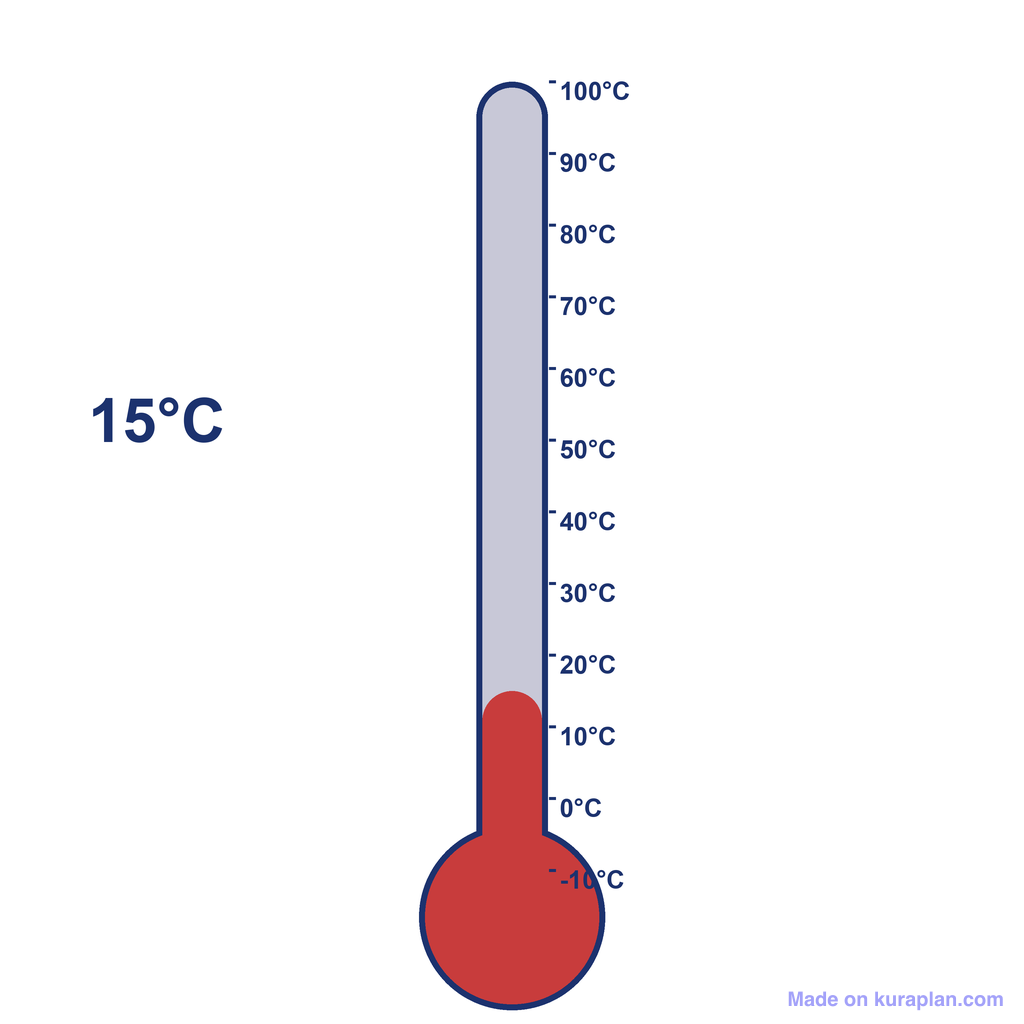
While the primary technical definition of "15 degrees" refers to an angle, it is frequently encountered as a temperature measurement in both Celsius (°C) and Fahrenheit (°F). In 2026, 15 degrees remains a significant threshold in environmental science and building management.
- 15° Celsius (59°F): This is often cited as the "room temperature" baseline for wine cellars and the ideal ambient temperature for high-intensity athletic performance (like marathons). It is also the global average surface temperature of the Earth, a key metric in climate change monitoring.
- 15° Fahrenheit (-9.4°C): This is a critical safety threshold. At 15°F, the risk of frostbite on exposed skin becomes significant within 30 minutes if wind chill is present. In plumbing, sustained temperatures at or below 15°F are the primary cause of uninsulated pipe bursts in residential attics and crawlspaces.
Common Mistakes When Working with 15 Degrees
One of the most frequent errors in technical fields involves the confusion between the angle of the cut and the angle of the joint. In woodworking, to create a 15-degree corner, one does not necessarily set the saw to 15 degrees. Because two pieces of wood meet to form the angle, each piece is typically cut at 7.5 degrees. This is known as the "bisected angle." Failing to account for this bisection is the leading cause of wasted material in custom carpentry.
In mechanical engineering, failing to account for "clearance angles" is another common pitfall. If a drill bit or cutting tool is ground to a 15-degree relief angle, it may perform beautifully on soft aluminum but fail catastrophically on hardened stainless steel. Professionals must always verify whether the "15 degrees" refers to the inclusive angle (the total wedge shape) or the angle per side.
FAQ
How do I measure 15 degrees without a protractor?
You can create a 15-degree angle by first constructing a 60-degree equilateral triangle using a compass and straightedge. Bisect the 60-degree angle to get 30 degrees, and then bisect that 30-degree angle again to achieve a precise 15-degree measurement. Alternatively, for rough work, 15 degrees is roughly the angle formed by the slope of a surface that rises 3.2 inches for every 12 inches of horizontal run.
Why is 15 degrees used for sharpening Japanese knives?
Japanese knives are typically made from harder, more brittle steel (such as VG-10 or Blue Super Steel). This hardness allows the edge to be ground very thin (15 degrees) without collapsing. The result is a blade that can sever cell walls in food cleanly rather than crushing them, which preserves flavor and texture in delicate dishes like sashimi.
Is 15 degrees a steep slope for a driveway or ramp?
Yes, 15 degrees is exceptionally steep for a driveway and is generally considered unsafe for standard residential use. For context, the Americans with Disabilities Act (ADA) requires a maximum slope of approximately 4.76 degrees (a 1:12 ratio) for ramps. A 15-degree slope is nearly a 27% grade, which most standard vehicles would struggle to climb in icy or wet conditions.
How does 15 degrees of longitude affect my local time?
Every 15 degrees you travel westward, the solar noon occurs one hour later. This is why time zones are spaced roughly 15 degrees apart. If you live on the eastern edge of a time zone, the sun rises and sets nearly an hour earlier than for someone living 15 degrees to your west in the same time zone.
Recommended Next Steps for Technical Accuracy
If you are planning a project involving a 15-degree angle—whether it is sharpening a premium chef's knife or designing a structural miter—your first step should be to verify your measurement tools. Digital angle finders should be calibrated against a known 90-degree square before attempting 15-degree increments. For culinary applications, ensure your knife’s steel is rated at least 58 HRC before attempting to re-profile it to 15 degrees, as softer steels will not hold this acute edge under standard use.