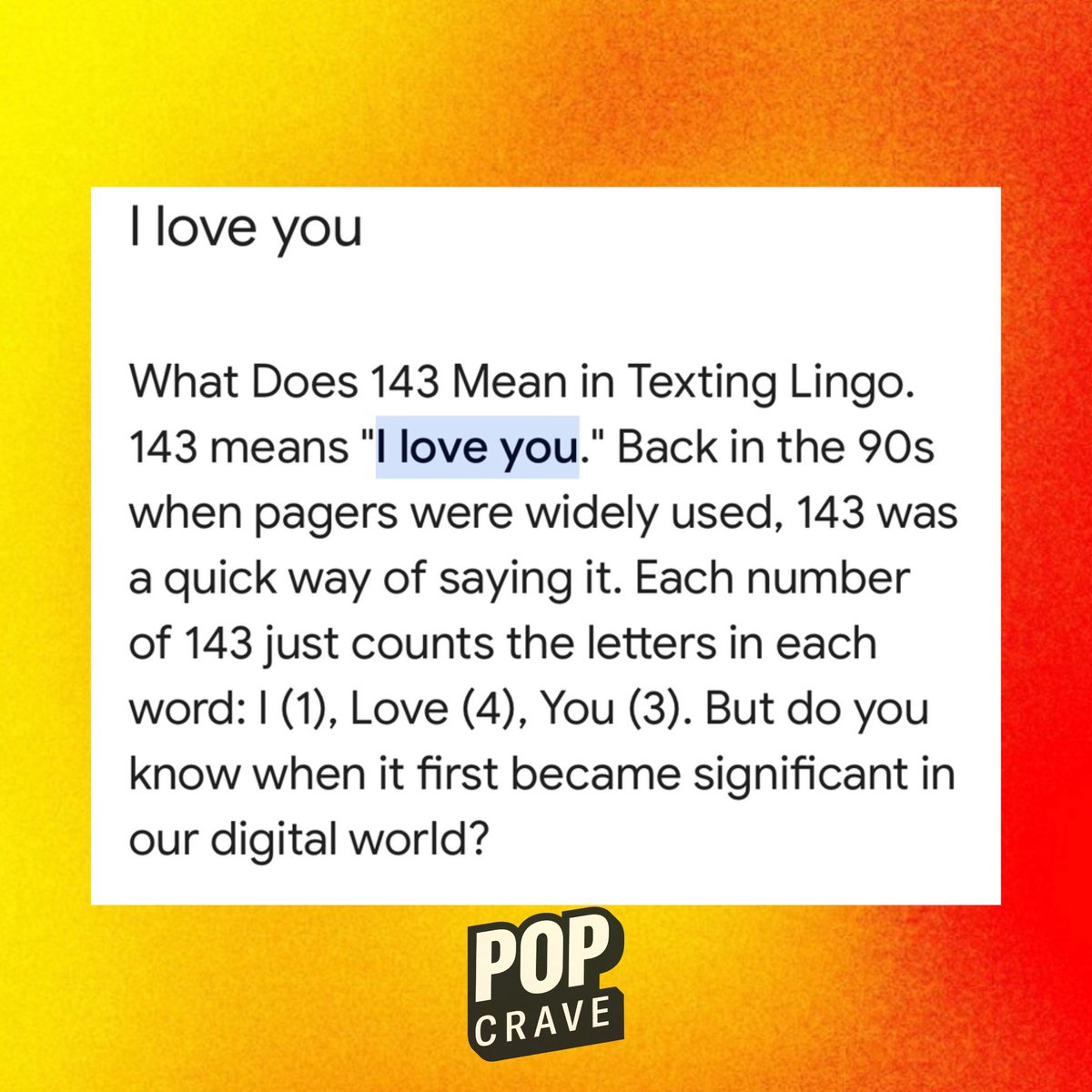
The numerical code 143 means "I love you." It is a shorthand expression where each digit represents the number of letters in the corresponding word: "I" has one letter, "love" has four letters, and "you" has three letters. While its roots trace back to early maritime signals and pager technology, it remains a popular digital slang term in 2026 for expressing affection quickly.
Decoding the 143 Meaning: The Mathematical Logic
The simplicity of 143 lies in its linguistic structure. It is a "count-based" code, a form of cipher where the length of the word is substituted with a digit. This method was particularly useful during eras of communication where character counts were limited or where typing was cumbersome.
In the phrase "I love you":
- 1 represents "I" (1 letter)
- 4 represents "love" (4 letters)
- 3 represents "you" (3 letters)
While the most common interpretation is romantic, the meaning has expanded over the decades to encompass platonic love between friends, familial affection, and even a general sense of appreciation within online communities. In 2026, it is often used as a "vintage" or "retro" expression of care, harkening back to the early days of digital culture while maintaining its core emotional weight.
The Historical Roots: From Pagers to Lighthouses
The history of 143 is surprisingly deep, involving more than just teenagers texting in the late 90s. Its origins are linked to physical safety and the constraints of early telecommunications.
The Pager Era (1990s)
Before the ubiquity of smartphones, the primary way to reach someone on the go was through a pager or "beeper." Early pagers were often numeric-only, meaning they could not display letters or emojis. If you wanted to send a message of affection, you had to get creative with numbers. 143 became the universal standard for "I love you" because it was easy to memorize and fast to type into a telephone keypad. During this time, 143 was more than just a cute code; it was a functional necessity for maintaining emotional connections in a pre-texting world.
The Minot’s Ledge Lighthouse
Long before pagers, 143 had a maritime significance. The Minot’s Ledge Light, located off the coast of Cohasset and Scituate, Massachusetts, is famously known as the "I Love You Light." In 1894, the lighthouse was fitted with a new flashing mechanism that flashed in a sequence of 1-4-3.
Local lore suggests that the families of the lighthouse keepers would look out at the sea and see the 1-4-3 flashes as a nightly message of love from the men stationed on the dangerous rock. According to the American Lighthouse Foundation, this sequence has made the lighthouse one of the most romantic landmarks in the United States, and the 143 sequence is still used today as a symbol of the region.
The Fred Rogers Connection: A Life Defined by 143
Perhaps the most famous proponent of the number 143 was Fred Rogers, the creator and host of Mister Rogers' Neighborhood. For Rogers, 143 was not just a code; it was a philosophy of life.
Rogers famously maintained a body weight of exactly 143 pounds for most of his adult life. He viewed this as a daily affirmation of his mission to spread love. He often pointed out the "143" connection, noting that it takes one letter to say "I," four letters to say "love," and three letters to say "you."
To Rogers, 143 represented a disciplined commitment to kindness. In the 2018 documentary Won't You Be My Neighbor?, his obsession with the number was highlighted as a testament to his consistent character. In 2026, fans of the show still use 143 to commemorate his legacy of emotional intelligence and compassion.
Modern Digital Context: Using 143 in 2026
In 2026, communication is dominated by high-speed messaging, AI-integrated chat, and immersive social platforms. Despite the availability of thousands of emojis and high-definition video calls, 143 has seen a resurgence. This is largely due to the "Y2K" and "90s nostalgia" trends that have influenced Gen Z and Gen Alpha.
Social Media and Bios
On platforms like TikTok and Instagram, users often place "143" in their bios or as a caption on photos of friends and partners. It serves as a subtle, low-profile way to signal affection without being overly sentimental. It is also frequently used in "Status" updates on messaging apps like WhatsApp or Signal to indicate a user’s current mood or a shout-out to their followers.
Aesthetics and Branding
143 has moved beyond text and into visual aesthetics. It is a common motif in streetwear, jewelry, and digital art (NFTs). Brands often use the number to evoke a sense of community and "insider" knowledge. Using 143 instead of the full phrase "I love you" creates a sense of belonging to a specific cultural history of the internet.
Variations and Numerical Relatives: Beyond 143
The success of 143 spawned several variations. As digital communication became more complex, users developed longer strings of numbers to convey more specific meanings.
- 1432: This means "I love you too." The "2" at the end represents "too."
- 1437: This means "I love you forever." The "7" comes from the seven letters in the word "forever."
- 14344: This is a more intense version, meaning "I love you very, very much" (though this is less standardized).
- 831: This is another common code for "I love you." 8 letters, 3 words, 1 meaning.
- 459: This is "I love you" based on the telephone keypad, where I is on the 4 key, L is on the 5 key, and Y is on the 9 key.
The Psychology of Using Shorthand Codes
Why do we continue to use 143 when typing "I love you" is just as easy on a modern smartphone? The answer lies in the psychology of "In-Group" communication.
- Emotional Safety: For some, saying "I love you" can feel vulnerable or "cringe." Using a code like 143 provides a layer of abstraction that makes the sentiment easier to share, especially in new relationships or among friends.
- Efficiency and Flow: In fast-paced gaming environments or live-stream chats, 143 is a quick way to show support for a creator or teammate without interrupting the flow of the game.
- Cultural Continuity: Using 143 is a way of acknowledging the history of the digital world. It is a linguistic artifact that connects the pager-carrying generation with the smartphone-carrying generation.
Numerical Communication Comparison Table
To understand where 143 fits in the broader landscape of numerical slang, consider the following comparison of common codes used in messaging today.
| Code | Primary Meaning | Logic/Origin | Usage Context |
|---|---|---|---|
| 143 | I Love You | Letter count per word | General affection, nostalgia |
| 1432 | I Love You Too | 143 + "2" (Too) | Response to a declaration |
| 1437 | I Love You Forever | 143 + "7" letters in "Forever" | Deep commitment |
| 831 | I Love You | 8 letters, 3 words, 1 meaning | Alternative shorthand |
| 459 | I Love You | Phone keypad (I-L-Y) | Old-school T9 texting |
| 637 | Always and Forever | 6, 3, 7 letter counts | Romantic emphasis |
| 224 | Today, Tomorrow, Forever | 2 (To-day), 2 (To-morrow), 4 (Forever) | Long-term promise |
FAQ: Common Questions About 143
Does 143 still mean "I love you" in 2026?
Yes, 143 remains a globally recognized code for "I love you." While it originated in the 1990s pager era, it has persisted through the decades as a classic piece of internet slang. It is particularly popular among those who enjoy retro digital culture or want to send a quick, coded message of affection.
What is the difference between 143 and 831?
Both 143 and 831 mean "I love you," but they use different logic. 143 is based on the number of letters in each word (I=1, Love=4, You=3). 831 stands for "8 letters, 3 words, 1 meaning." 143 is generally more common due to its historical association with Mr. Rogers and the Minot’s Ledge Lighthouse.
Is 143 used in professional settings?
Generally, no. 143 is considered informal slang. While it is appropriate for friends, family, and romantic partners, using it in a professional email or a business Slack channel might be seen as unprofessional or confusing, unless you are in a highly creative or informal industry where such shorthand is part of the team culture.
Why did Mr. Rogers like 143?
Fred Rogers liked 143 because it was a perfect mathematical representation of the phrase "I love you." He famously weighed 143 pounds for decades and saw it as a "gift" from the universe that reminded him of his life's work—telling children and adults alike that they are loved and special.
What does 143 mean in a breakup context?
In rare cases, if sent during a conflict, 143 can be used sarcastically, but this is uncommon. Usually, if someone sends 143 during a difficult time, it is intended as a "olive branch" or a reminder that despite the conflict, the core affection remains.
How to Use 143 in Your Daily Communication
If you want to incorporate 143 into your digital vocabulary, the best approach is to use it where a quick "thinking of you" or "I appreciate you" is needed. It is a versatile code that works well in text sign-offs, social media comments, or even as a small detail in a handwritten note.
In 2026, the use of 143 is a nod to a simpler time in tech history. Whether you are texting a partner or leaving a comment for a friend, 143 remains one of the most enduring and positive codes in the history of human communication.