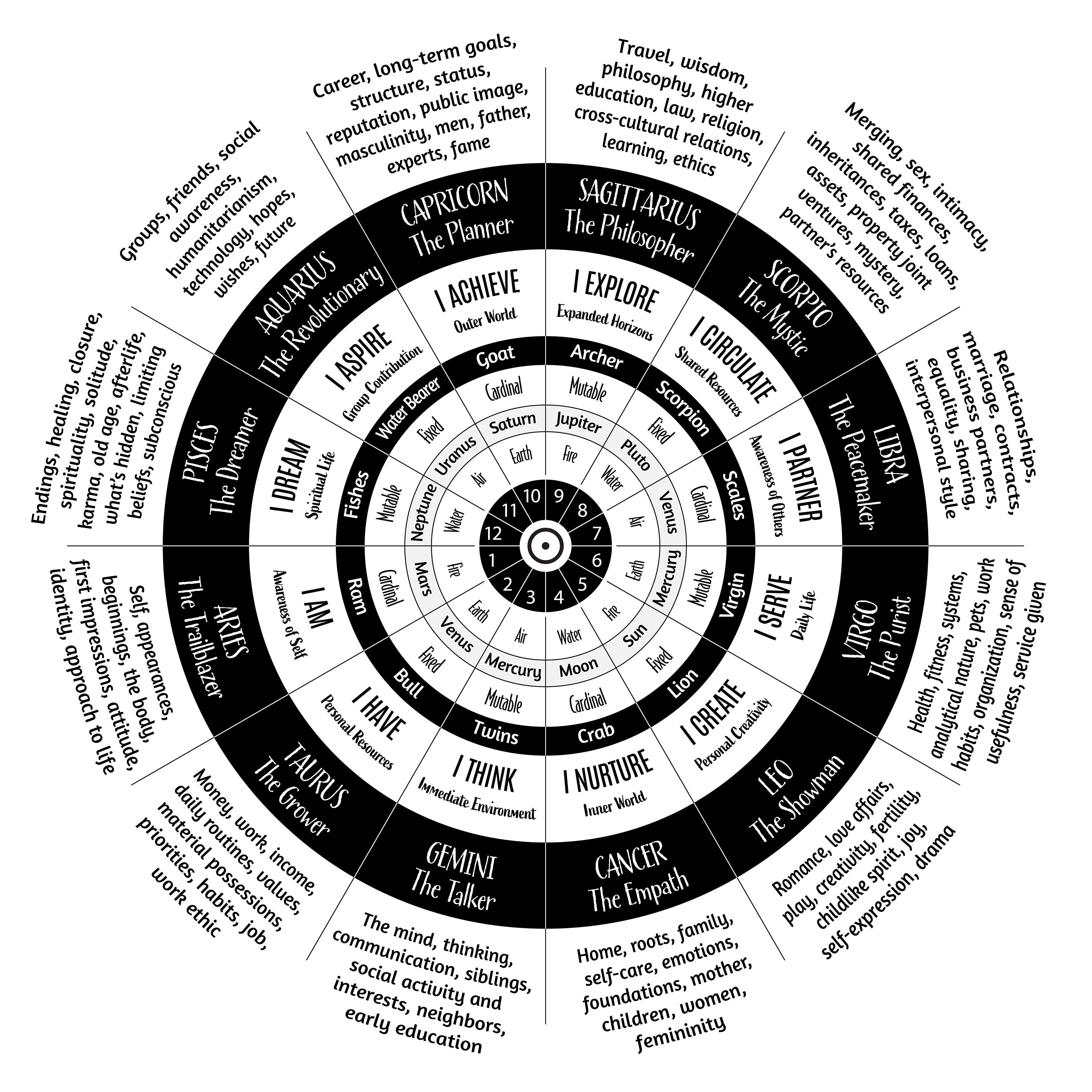
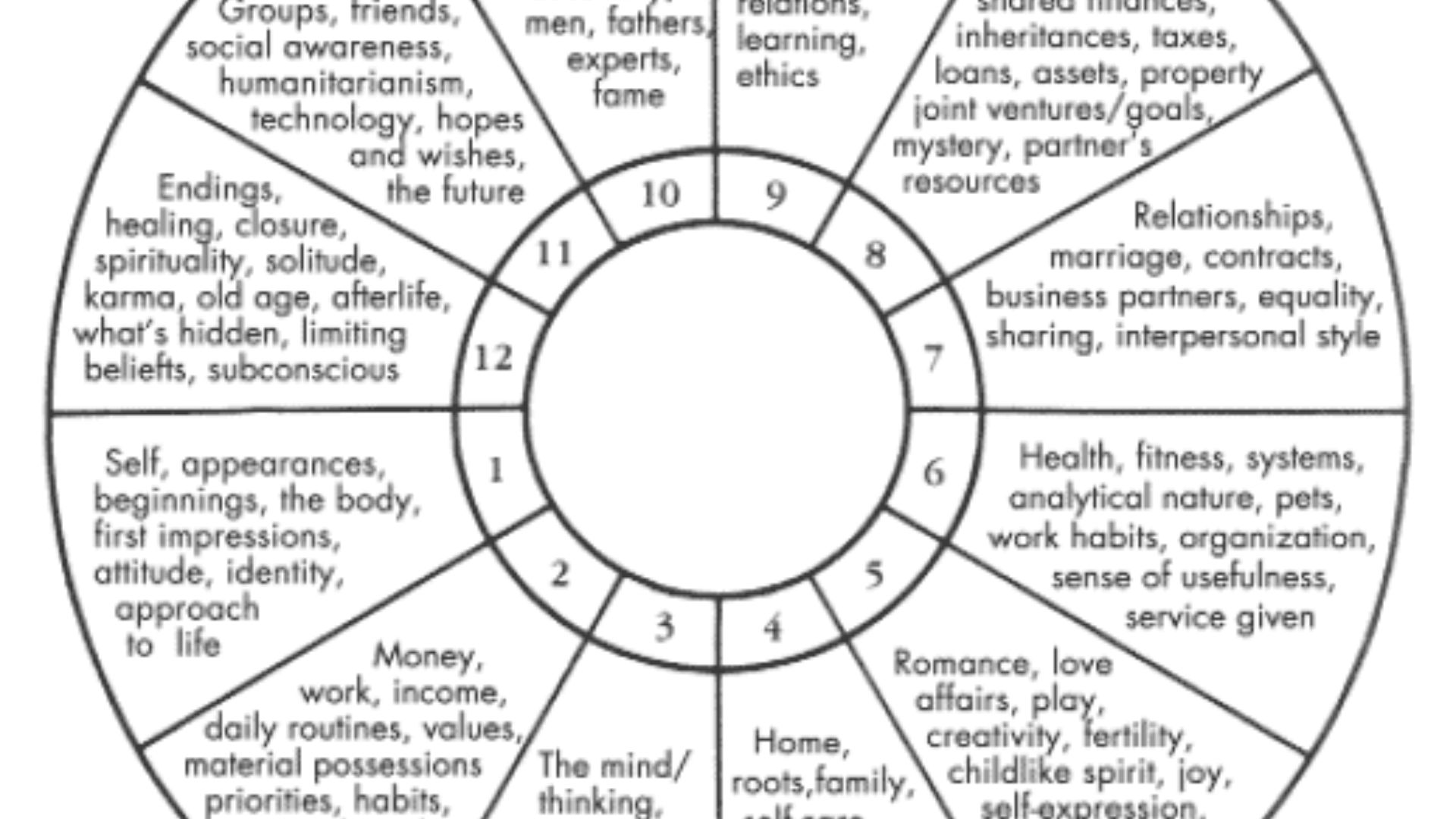
In astrology, the 12 houses represent the distinct spheres of human experience, mapped onto a chart based on the precise time and location of an event. Each house governs specific aspects of life—from personal identity and finances to career and social connections—acting as the stage upon which the planets play out their influences.
The Mechanics of the Natal Chart
To understand the 12 houses, one must first recognize that a natal (birth) chart is a 360-degree circle divided into twelve segments. Unlike the zodiac signs, which move through the sky relative to the equinoxes, the houses are determined by the Earth’s rotation on its axis over a 24-hour period. This means the house cusps—the lines that divide one house from the next—are highly dependent on the specific time and geographic coordinates of birth.
The starting point of the first house is known as the Ascendant or Rising Sign. This represents the eastern horizon at the moment of birth and is considered one of the most critical points in a chart, dictating the layout of all subsequent houses. Because the Earth completes a full rotation every day, the Ascendant changes roughly every two hours, highlighting why accurate birth data is essential for chart accuracy.
Categorizing the Houses
Astrologers often categorize houses by their "modality" or "triplicity," which helps define how the energies within those houses manifest. These categories—Angular, Succedent, and Cadent—provide insight into the momentum and focus of the areas of life they represent.
- Angular Houses (1, 4, 7, 10): These are the high-energy, action-oriented houses. They represent the "cardinal" points of the chart and are associated with immediate life changes, the self, home, partnerships, and career.
- Succedent Houses (2, 5, 8, 11): These follow the angular houses and are associated with stability, resources, and growth. They represent the maintenance of what was initiated in the angular houses.
- Cadent Houses (3, 6, 9, 12): These are considered houses of transition or "adjustment." They represent the integration of experiences, communication, service, philosophy, and subconscious processing.
The 12 Houses: A Functional Breakdown
Each house carries a primary theme that remains constant, though the presence of planets within these houses will modify how that theme expresses itself in an individual's life.
| House | Primary Focus | Life Domain |
|---|---|---|
| 1st | Identity | The Self, appearance, first impressions |
| 2nd | Resources | Money, personal values, material possessions |
| 3rd | Communication | Intellect, siblings, local environment, short trips |
| 4th | Foundations | Home, family, roots, emotional security |
| 5th | Creativity | Self-expression, romance, children, hobbies |
| 6th | Daily Life | Routines, health, service, workplace habits |
| 7th | Partnerships | Marriage, business contracts, open enemies |
| 8th | Transformation | Shared assets, intimacy, inheritance, rebirth |
| 9th | Expansion | Higher education, long travel, belief systems |
| 10th | Legacy | Career, reputation, public standing, ambition |
| 11th | Community | Friendships, social networks, aspirations |
| 12th | Subconscious | Secrets, intuition, solitude, closure |
Understanding the Progression of Experience
The sequence of the 12 houses mirrors the progression of a human life. It begins in the first house with the literal birth or realization of the "Self." As the individual grows, they move through the second house (learning to value what they possess), the third (learning to communicate with others), and the fourth (finding a place to call home).
By the time the chart reaches the later houses, the focus shifts from individual development to external engagement and eventual transcendence. The seventh house represents the first major commitment to another person, the tenth house addresses the individual’s contribution to society, and the final twelfth house deals with the dissolution of the ego and preparation for a new cycle.
Common Misinterpretations and Technical Nuance
A frequent error in interpreting house meanings is the assumption that an empty house—a house containing no planets—is "inactive." In practice, an empty house is still governed by the sign on its cusp and the planet that rules that sign. For example, if Aries sits on the cusp of the fifth house, the individual’s creative self-expression will take on the characteristics of Mars, the ruler of Aries, regardless of whether a planet is physically sitting inside the fifth house.
Furthermore, students of astrology should note that different house systems exist. While the Placidus system is the most commonly used in Western astrology, other systems such as Whole Sign or Equal House are used by practitioners to emphasize different nuances. The choice of system is a matter of professional preference and historical lineage rather than absolute right or wrong, but consistency is key when conducting an analysis.
Frequently Asked Questions
What happens if I have multiple planets in one house?
When multiple planets occupy a single house, it is called a "stellium." This creates an intense concentration of energy in that specific life domain. For example, a stellium in the tenth house often suggests an individual whose life path is heavily oriented toward career, public image, or professional legacy.
Do houses change throughout my life?
The houses in your natal chart remain fixed based on your birth coordinates. However, in a technique called "Profection," the houses are activated year by year. For instance, in your first year, the first house is activated; in your second year, the second house becomes the focal point. This is used to forecast thematic trends for specific solar years.
Is the 7th house only for marriage?
While the 7th house is the primary indicator of marriage, it represents all "one-on-one" committed partnerships. This includes business partnerships, legal contracts, and even the nature of one's interactions with known opponents or rivals. It is effectively the house of "the Other."
Can I have a house with two different zodiac signs in it?
Yes, this is known as an "intercepted" sign. In systems like Placidus, where the sizes of the houses can vary, one sign may be entirely contained within the boundaries of a single house. This suggests that the energy of that sign is "bottled up" and may require more conscious effort to express compared to a sign that sits clearly on a house cusp.
How do I use the houses to make decisions?
Astrologers typically look at the ruler of the house cusp in question to gain actionable insight. If you are questioning a career move, you look at the 10th house. Find the planet that rules the sign on the 10th house cusp and examine its position and aspects elsewhere in the chart. This provides a "map" of how that area of life is likely to unfold.
Aligning Your Intent with House Analysis
To utilize the 12 houses effectively, begin by identifying which houses in your own chart contain planets. Focus your study on these "occupied" houses first, as they represent the areas where your life experiences are most concentrated. Once you have a firm grasp of these active areas, branch out to examine the empty houses by looking at the planetary ruler of the cusp. Treat the houses not as a rigid set of instructions, but as a framework for understanding the internal and external pressures you face at any given time.