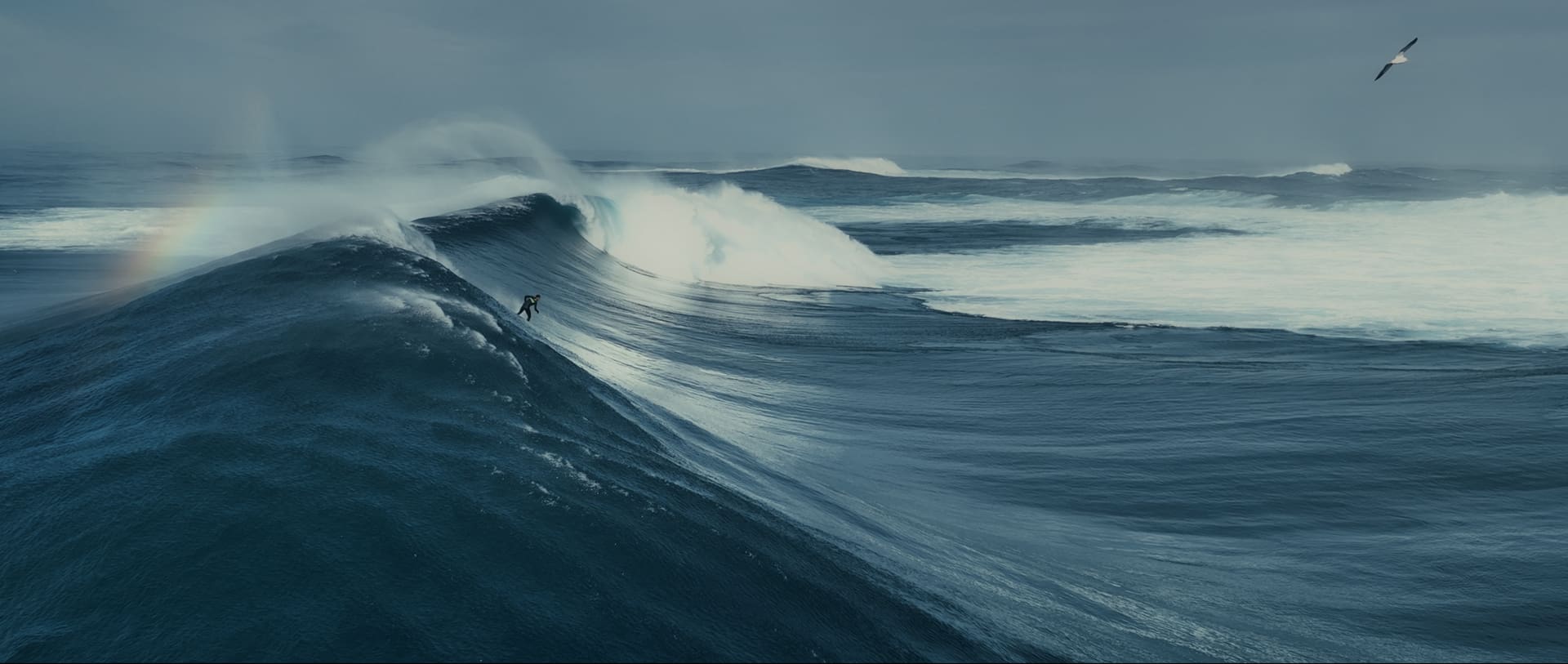
HBO’s 100 Foot Wave stands as a masterclass in sports documentary filmmaking, transforming the hazardous pursuit of big-wave surfing into a profound examination of human ambition, obsession, and mortality. Directed by Chris Smith, the Emmy-winning series captures the terrifying grandeur of Nazaré, Portugal, while delivering an intimate, emotionally grounded character study.
Cinematic Ambition: How Chris Smith Framed the Impossible
100 Foot Wave elevates extreme sports cinematography far beyond standard highlight reels. Director Chris Smith, known for his work on American Movie and FYRE, captures the sheer scale of oceanic violence through high-definition telephoto lenses, stabilized drone photography, and body-mounted cameras. Rather than relying solely on kinetic excitement, the production deliberate contrasts the chaotic power of the water with serene, slow-motion sequences that allow viewers to process the massive geometry of moving ocean swells.
The visual storytelling is anchored by an evocative musical score featuring work by legendary composer Philip Glass alongside Paul Leonard-Morgan. Glass’s signature minimalist arpeggios mirror the relentless, cyclical motion of the Atlantic tides, building atmospheric tension long before a wave breaks. This audio-visual harmony shifts the narrative tone from simple thrill-seeking to an almost mythic confrontation between man and nature.
Nazaré Canyon Dynamics:
- Deep-Sea Trench (16,000+ ft deep) to Shallow Continental Shelf
- Fast Ocean Swells (Unimpeded Speed) + Slowed Coastal Wave Crests
- Convergence at Praia do Norte
- Result: Massive Constructive Interference Produces 60- to 100-Foot Amplified Waves
The camera team frequently shoots from the cliffs of Sítio de Nazaré, looking down at surfers who appear as microscopic specks against walls of water five to eight stories tall. This vantage point emphasizes spatial perspective, making the physical danger immediate and comprehensible. Through rhythmic editing and restraint, Smith avoids cheap sensationalism, allowing the raw audio of crashing ocean foam and thunderous whitewash to communicate the real risks involved.
Garrett McNamara and the Transformation of Nazaré
At the emotional center of the documentary is Garrett McNamara, the Hawaiian big-wave pioneer whose obsessive quest to ride a 100-foot wave put a quiet Portuguese fishing village on the global sports map. The series documents how McNamara, alongside his supportive wife Nicole McNamara, traveled to Nazaré in 2010 after local bodyboarder Dino Casimiro invited him to investigate the region's legendary, unridden winter swells.
- 2010: McNamara Arrives
- Discovery of Nazaré Canyon Effect
- 2011: World Record 78ft Wave
- Shift from Fishing Village to Mecca
- Modern Era: Professional Tow-In Teams
The narrative explores how McNamara's arrival fundamentally altered the economic and cultural fabric of Nazaré. Historically dependent on traditional fishing, Praia do Norte was long considered by locals to be a treacherous, unusable coastline. 100 Foot Wave illustrates how McNamara's successful ride of a record-setting 78-foot wave in 2011 converted the region into a premier mecca for global surf tourism.
The documentary captures the personal cost of this crusade. McNamara is depicted not as an invincible adrenaline addict, but as an aging athlete grappling with chronic physical injuries, psychological trauma, and the complex responsibilities of fatherhood. Nicole McNamara’s grounded presence offers a vital counterbalance to Garrett’s unyielding drive, revealing the strain endured by families who sit on shore watching loved ones enter life-threatening conditions.
The Mechanics and Mortality of Big-Wave Surfing
One of the greatest strengths of 100 Foot Wave is its careful explanation of big-wave mechanics and safety infrastructure. The waves at Nazaré are uniquely destructive due to the Nazaré Canyon, an underwater geological trench over 16,000 feet deep that terminates abruptly near the shoreline. When ocean swells travel through this deep canyon and collide with waves moving across the shallow continental shelf, they merge through constructive interference, creating disproportionately massive, unpredictable peaks.
- Unconnected Swells (Canyon Trench / Shallow Shelf)
- Constructive Interference
- Ampliation at Shoreline
- Crashing Wall of Water
The series details the transition from traditional paddle surfing to tow-in surfing, a technique pioneered by Laird Hamilton and refined by McNamara's generation. Because waves moving faster than 30 miles per hour cannot be caught by human paddling alone, surfers are towed into position by personal watercraft (PWC) at high speeds using a tow rope.
The documentary highlights the life-saving role of PWC rescue drivers, spotters, and inflation vests:
- PWC Rescue Drivers: Maneuver through violent whitewash to retrieve downed surfers before the next wave in a set strikes.
- Cliffside Spotters: Use two-way radios from high vantage points to direct rescue craft through zero-visibility foam.
- High-Pressure Inflation Vests: Allow submerged, disoriented surfers to pull CO2 cartridges to surface rapidly after heavy wipeouts.
Despite these technological advancements, the series does not sanitize the catastrophic consequences of failure. Sequences detailing severe wipeouts—resulting in shattered limbs, broken vertebrae, severe concussions, and near-drownings—serve as sobering reminders that safety equipment merely narrow the margin of error rather than eliminating danger.
Narrative Evolution Across Seasons
Across its multi-season arc, 100 Foot Wave broadens its focus from Garrett McNamara’s singular journey to an ensemble portrait of international big-wave specialists. The documentary introduces a compelling lineup of athletes, each presenting a distinct philosophy toward risk and motivation:
- Andrew Cotton: A British former plumber whose relentless pursuit of heavy waves leads to dramatic victories and a horrifying spine fracture that tests his resolve.
- Justine Dupont: A world-class French surfer whose disciplined, methodical approach to safety and training sets new standards for performance in extreme conditions.
- Kai Lenny: The innovative Hawaiian waterman who brings modern hydrofoil technology and acrobatic aerial maneuvers to giant waves.
- Lucas "Chumbo" Chianca: A Brazilian athlete whose instinctual athleticism and high-energy style push the boundaries of tow-in surfing.
- C.J. Macias: An open-hearted American surfer whose spiritual connection to the ocean contrasts sharply with the hyper-competitive nature of professional sports.
This narrative expansion prevents the series from becoming repetitive. By contrasting Dupont’s scientific preparation with Cotton’s blue-collar resilience and Lenny’s modern technical innovation, the docuseries dissects the varied psychological profiles required to survive inside extreme marine environments.
Critical Breakdown: Features and Production Value
To understand how 100 Foot Wave achieves its high rating among documentary critics, it helps to evaluate its major components against standard sports documentary conventions.
| Evaluation Criterion | Implementation in 100 Foot Wave | Documentary Impact |
|---|---|---|
| Cinematography | Ultra-high-speed cameras, drone mapping, cliffside telephoto lenses | Renders ocean scale clear; makes wave geometry visually striking |
| Sound Design | Natural ocean audio mixed with Philip Glass’s score | Enhances psychological tension and highlights physical force |
| Character Depth | Long-form biographical focus including families and local residents | Avoids superficial athlete worship by highlighting fear and vulnerability |
| Technical Context | Explanations of canyon geology, swell charts, and rescue protocols | Educates casual viewers on oceanography and risk-mitigation tactics |
| Pacing & Editing | Alternates between quiet archival history and intense surf footage | Sustains narrative momentum across multi-episode story arcs |
Viewing Guidance and Streaming Access
100 Foot Wave is an official HBO Original documentary series available for streaming on Max. The series carries a TV-MA rating due to coarse language, intense depictions of physical injury, and high-stress operational environments.
Viewers sensitive to physical trauma should note that several episodes contain explicit footage of athletic injuries, emergency medical evacuations, and intense depictions of panic during underwater hold-downs. It is highly recommended for fans of cinema verité, oceanography, athletic biographies, and high-stakes survival stories.
Frequently Asked Questions
Is 100 Foot Wave based on a true story?
Yes, 100 Foot Wave is a non-fiction documentary series that chronicles real-world events, focusing on Garrett McNamara and an international community of big-wave surfers as they pioneer surfing at Praia do Norte in Nazaré, Portugal.
Who composed the music for 100 Foot Wave?
The series features a score by iconic minimalist composer Philip Glass, with additional original scoring and electronic arrangements contributed by composer Paul Leonard-Morgan.
Why are the waves at Nazaré, Portugal so unnaturally large?
The massive waves at Nazaré are caused by the underwater Nazaré Canyon, a deep-sea trench over 16,000 feet deep. When deep-water ocean swells travel down the canyon and abruptly hit the shallow waters near the shore, they combine with shallow-water swells to create massive constructive interference.
Who are the primary surfers featured in the docuseries?
While Garrett McNamara is the central figure, the series also prominently features Andrew Cotton, Justine Dupont, Kai Lenny, Lucas "Chumbo" Chianca, Nic von Rupp, and C.J. Macias.
How many seasons of 100 Foot Wave have been produced?
The series launched its first season on HBO in 2021, followed by a critically acclaimed second season in 2023, and subsequent continuations documenting ongoing swell seasons and safety advancements in Nazaré.
Verdict: Who Should Watch 100 Foot Wave?
100 Foot Wave succeeds because it treats the ocean not merely as a stadium for human achievement, but as an unpredictable, dangerous force of nature that demands absolute respect. Viewers seeking a high-octane sports recap will find plenty of breathtaking footage, but the true value of the series lies in its patient, empathetic exploration of human limits.
Whether you are an avid surfer or someone who has never stepped foot on a board, Chris Smith’s docuseries delivers a gripping, visually stunning, and emotionally resonant look at what happens when human ambition collides with the immense power of the sea. It remains one of the finest sports documentary achievements in modern television.