Improving your productivity today requires a shift from passive "busyness" to active energy management and prioritized execution. By implementing evidence-based strategies—such as the Eisenhower Matrix, time blocking, and digital minimalism—you can reduce cognitive load, eliminate distractions, and focus your efforts on the high-leverage tasks that generate the most significant results.
Categorizing Efforts with the Eisenhower Matrix
The foundation of immediate productivity improvement is the ability to distinguish between urgency and importance. Many professionals spend their day in a state of "reactive urgency," responding to notifications and minor requests while neglecting the tasks that drive long-term value. The Eisenhower Matrix, popularized by Dwight D. Eisenhower and later Stephen Covey, provides a robust framework for auditing your current task list.
To implement this today, divide your tasks into four quadrants. Quadrant I contains tasks that are both urgent and important (crises, deadlines). Quadrant II includes tasks that are important but not urgent (strategic planning, skill building, relationship management). Quadrant III covers urgent but unimportant tasks (most emails, some meetings), and Quadrant IV contains neither urgent nor important activities (mindless scrolling, busywork).
The goal is to maximize time spent in Quadrant II. This is the "Productivity Zone." When you focus on Quadrant II, you prevent many tasks from ever reaching the crisis state of Quadrant I. Today, look at your list and ruthlessly delegate or delete anything in Quadrant III and IV. By reclaiming even 30 minutes from these areas, you provide yourself the mental bandwidth required for high-level problem-solving.
Implementing Time Blocking and Task Batching
A primary enemy of productivity is "context switching," the cognitive cost incurred when moving from one unrelated task to another. Research suggests it can take up to 23 minutes to regain full focus after a distraction. Time blocking is the practice of scheduling specific "blocks" of time for specific tasks, effectively turning your calendar into a blueprint for your day.
Instead of a standard to-do list, which often lacks a temporal dimension, time blocking forces you to acknowledge the finite nature of your day. Start by blocking out non-negotiable commitments, then assign blocks for "Deep Work" (high-concentration tasks) and "Shallow Work" (administrative tasks).
Complementing this is task batching. This involves grouping similar activities—such as responding to all emails, making all phone calls, or performing all financial reconciliations—into a single time block. Because these tasks require similar mindsets and tools, your brain remains in the same "operating mode," significantly reducing the friction of switching. In the 2026 professional environment, where hybrid work is the standard, time blocking serves as a vital boundary-setting tool between professional obligations and personal recovery.
Aligning Tasks with Your Biological Prime Time
Productivity is not just about managing time; it is about managing energy. Every individual has a unique "chronotype" or biological prime time—the hours of the day when their cognitive function, alertness, and energy are at their peak. For some, this is early morning; for others, it is late afternoon or evening.
To improve your productivity today, identify your peak hours and protect them fiercely. Use these windows for your most demanding, creative, or complex work. Conversely, schedule routine or "low-energy" tasks—such as filing, data entry, or basic correspondence—during your natural energy troughs (often early afternoon).
Attempting to perform deep, analytical work when your biological energy is low is inefficient and leads to burnout. By 2026, many organizations have adopted "sync hours" to accommodate different chronotypes, but the individual responsibility remains: match the difficulty of the task to the level of your available energy. If you are unsure of your prime time, track your energy levels on a scale of 1-10 every hour for a few days to identify recurring patterns.
Cultivating Deep Work and Minimizing Context Switching
"Deep Work," a term coined by Cal Newport, refers to professional activities performed in a state of distraction-free concentration that push your cognitive capabilities to their limit. These efforts create new value, improve your skill, and are hard to replicate. In contrast, "Shallow Work" includes non-cognitively demanding, logistical-style tasks, often performed while distracted.
To engage in Deep Work today, you must create a "fortress of solitude." This means closing all unnecessary browser tabs, putting your phone in another room or on "Do Not Disturb," and notifying colleagues that you are unavailable. In an age of persistent connectivity, the ability to focus intensely is becoming an increasingly rare and valuable asset in the global economy.
The psychological benefit of Deep Work is the avoidance of "attention residue." When you switch from Task A to Task B, part of your attention remains stuck on Task A. By staying on one task for a prolonged period (usually 60 to 90 minutes), you allow your brain to reach a state of "flow," where output per hour increases exponentially.
Leveraging Tactical Breaks and the Pomodoro Technique
Productivity is a marathon, not a sprint. Sustained focus without rest leads to diminishing returns and mental fatigue. The Pomodoro Technique is a classic, proven method to maintain a high level of performance throughout the day. It involves working for 25 minutes (one "Pomodoro") followed by a 5-minute break. After four cycles, you take a longer break of 15–30 minutes.
The effectiveness of this method lies in the "urgency" created by the timer and the "recovery" provided by the breaks. During the 5-minute break, it is essential to step away from your screen. Stretching, hydrating, or briefly walking allows the brain’s "default mode network" to engage, which often leads to creative breakthroughs that don't occur during active focus.
For those who find 25 minutes too short, the "52/17" rule—52 minutes of work followed by 17 minutes of rest—is a popular alternative backed by data from time-tracking productivity apps. Regardless of the specific ratio, the principle remains: scheduled rest is not a waste of time; it is a prerequisite for high-quality output.
The Role of Digital Minimalism and Environmental Control
Your physical and digital environments either facilitate focus or actively sabotage it. Digital minimalism involves the intentional use of technology, rather than allowing apps and notifications to dictate your attention. Today, conduct a "notification audit." Disable all non-human notifications (alerts from social media, news apps, and promotional emails). Only allow notifications that require immediate action from actual people.
Physically, your workspace should be optimized for the task at hand. A cluttered desk often reflects—and contributes to—a cluttered mind. Ensure you have proper lighting, ergonomic support, and minimal visual distractions.
Furthermore, consider the "site-specific" nature of habits. If possible, use one location specifically for work and another for relaxation. By 2026, with the prevalence of remote work, creating these psychological boundaries is essential for preventing the "always-on" exhaustion that characterized the early 2020s.
Utilizing the "2-Minute Rule" and Small Wins
Procrastination often stems from the perceived "weight" of a task. The "2-Minute Rule," popularized by David Allen in Getting Things Done, states that if a task takes less than two minutes to complete, you should do it immediately rather than adding it to a list or filing it for later. This prevents the accumulation of small, nagging tasks that create mental clutter.
For larger projects that feel overwhelming, the key is "micro-productivity"—breaking a massive goal into the smallest possible actionable steps. Completing a single small step creates a dopamine response that builds momentum. Instead of "Write Annual Report," your task should be "Open document and write one paragraph of the introduction." Once the friction of starting is overcome, the brain is naturally inclined to continue the process (a phenomenon known as the Zeigarnik Effect).
Comparison of Productivity Frameworks
The following table compares several dominant productivity methodologies to help you determine which is best suited for your specific workflow.
| Methodology | Best For | Key Benefit | Difficulty to Implement |
|---|---|---|---|
| Eisenhower Matrix | Decision-making & Prioritization | Clarifies what truly matters; reduces busywork. | Low |
| Time Blocking | Schedule Control | Ensures dedicated time for high-value tasks. | Moderate |
| Pomodoro Technique | Combating Procrastination | Maintains high energy through structured breaks. | Low |
| Getting Things Done (GTD) | Complex Project Management | Clears mental clutter by externalizing all tasks. | High |
| Deep Work | Creative & Analytical Roles | Maximizes cognitive output and skill acquisition. | Moderate |
| Eat the Frog | Procrastinators | Tackles the hardest task first thing in the morning. | Moderate |
Refining the System through Reflection and Planning
The final way to improve productivity today is to prepare for tomorrow. Productivity is an iterative process. At the end of your workday, spend 10 to 15 minutes reviewing what you accomplished and identifying the top three "Must-Win" tasks for the following day. This is often called the "Ivy Lee Method."
By identifying your priorities the night before, you eliminate "decision fatigue" in the morning. Instead of wasting your peak energy hours wondering what to work on, you can dive straight into your most important task. This period of reflection also allows you to analyze where your time went and adjust your system accordingly. If you find you were consistently interrupted at 2:00 PM, you can proactively block that time as "unavailable" for the next day.
What is the single fastest way to increase productivity immediately?
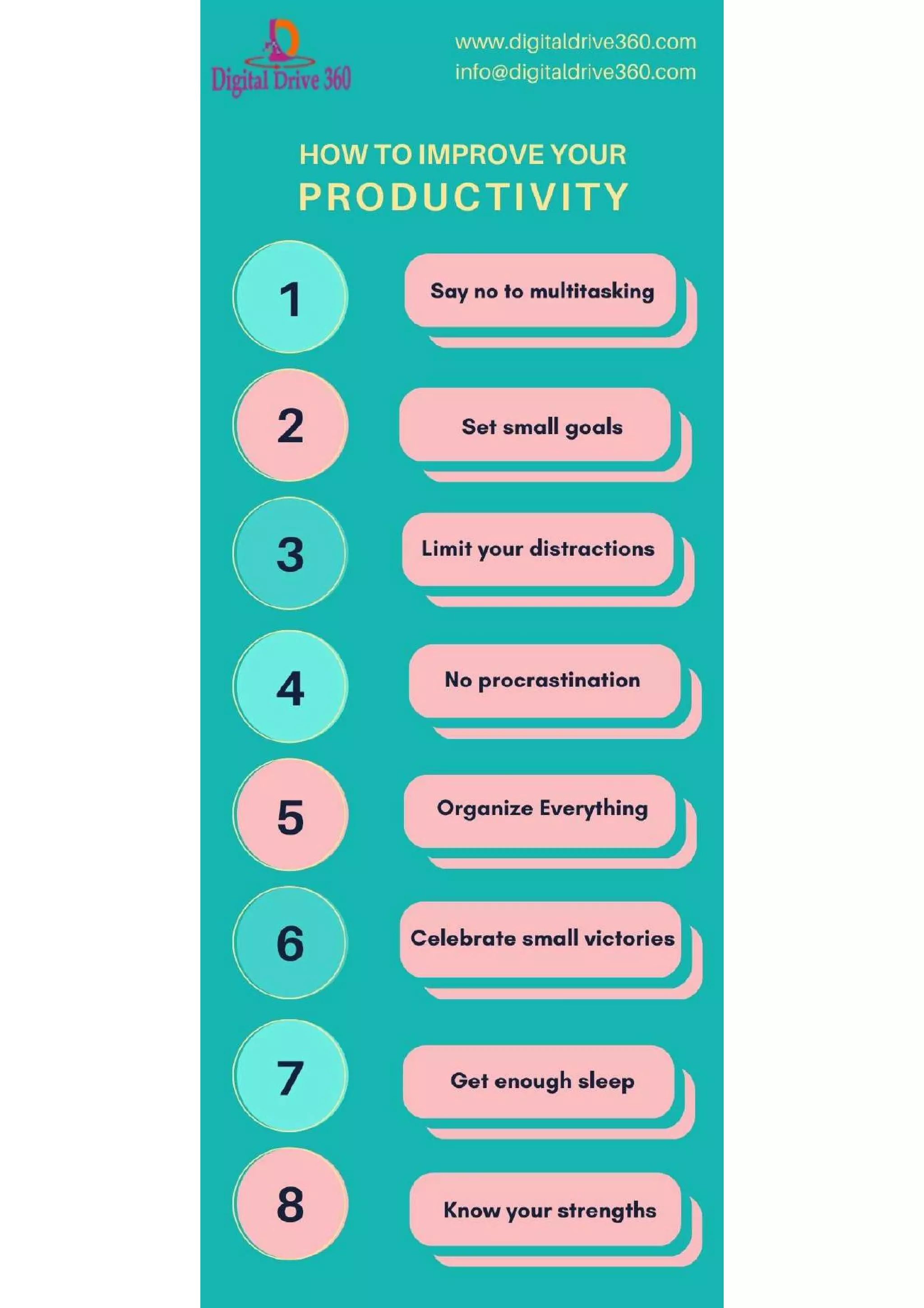
The fastest way to increase productivity is to eliminate multitasking and focus on one task at a time (monotasking). Research from organizations like the American Psychological Association (APA) has consistently shown that "multitasking" is actually rapid task-switching, which reduces IQ by 10 points and decreases productivity by up to 40%. By closing all distractions and finishing one task before moving to the next, you immediately increase your speed and accuracy.
How does physical health impact my output?
Productivity is a biological function. Sleep deprivation, dehydration, and poor nutrition directly impair the prefrontal cortex, the area of the brain responsible for executive function and focus. Ensuring seven to nine hours of sleep and maintaining steady blood sugar levels prevents the "brain fog" that makes tasks take twice as long as necessary.
Why is saying "no" considered a productivity strategy?
Every time you say "yes" to a non-essential request, you are indirectly saying "no" to your primary goals. Productivity isn't just about doing more; it's about doing the right things. High-performers use "strategic refusal" to protect their time for high-impact work, ensuring they don't become a bottleneck for their own priorities by over-committing to others' agendas.
Can AI tools help with productivity in 2026?
By 2026, AI tools have become standard for automating "Shallow Work" such as meeting transcription, initial drafting, and calendar optimization. However, AI cannot replace the "Deep Work" of strategic thinking and creative synthesis. Use AI to handle the logistical burdens, but do not let the ease of AI-generated content distract you from the high-level tasks that require human judgment and nuance.
Start with a Single Habit
To avoid the "planning fallacy," where we spend more time researching productivity than actually producing, choose exactly one strategy from this list to implement for the next four hours. Whether it is turning off your notifications, setting a 25-minute timer, or categorizing your tasks via the Eisenhower Matrix, the goal is to build momentum through immediate action. Small, consistent improvements in how you manage your attention will yield exponential gains in your professional and personal output over time.