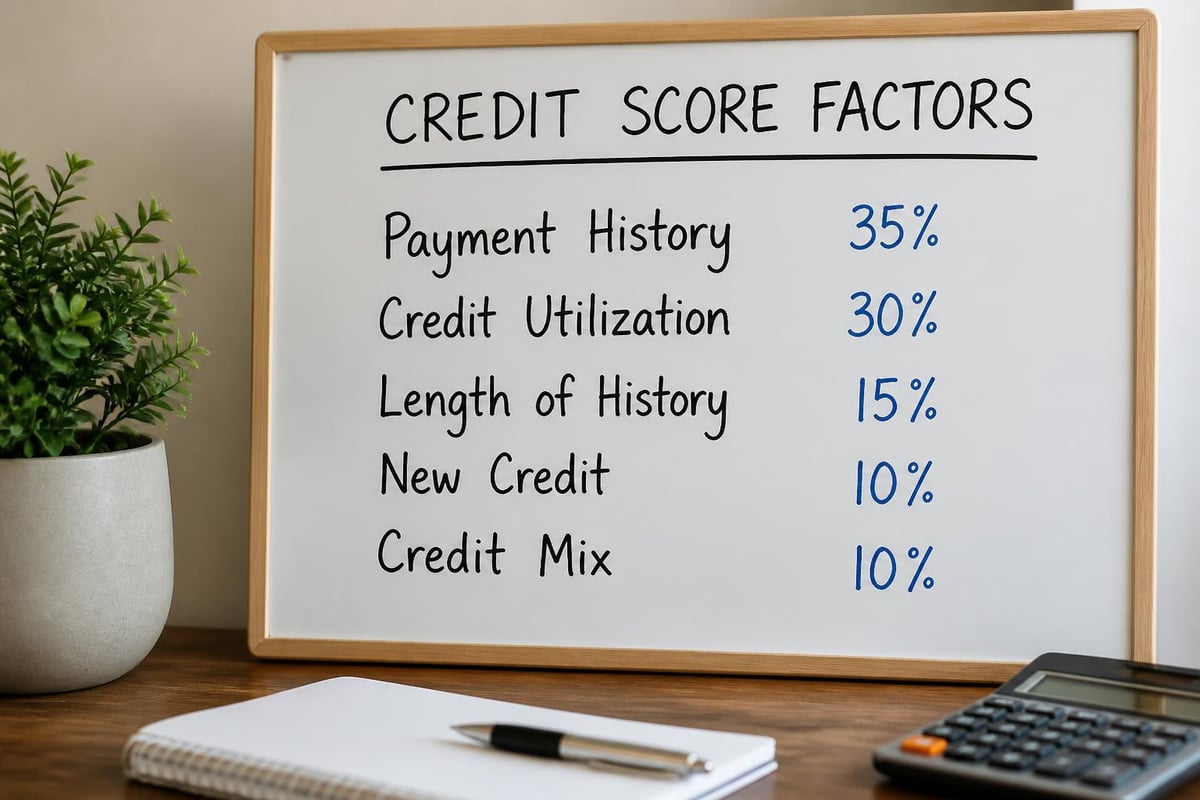
To improve your credit score fast, you must prioritize reducing your credit utilization ratio, correcting reporting errors through the formal dispute process, and ensuring all past-due accounts are brought current. These actions target the two most influential FICO scoring factors—payment history and amounts owed—often yielding measurable results within 30 to 45 days.
The landscape of personal finance in 2026 remains heavily dictated by credit scoring models, primarily FICO and VantageScore. While building a perfect credit history takes years, several "rapid-response" maneuvers can bypass long-term growth and force a quick upward adjustment. Achieving a higher score is not just about financial responsibility; it is about understanding the mathematical algorithms that credit bureaus use to calculate risk.
1. Reduce Credit Utilization Immediately
Credit utilization—the ratio of your outstanding balances to your total available credit limits—is the single fastest lever to move your score. It accounts for roughly 30% of your FICO score. In the current 2026 lending environment, keeping this ratio below 10% is the gold standard, though anything under 30% is considered acceptable.
To see an immediate jump, pay down high-balance credit cards before the statement closing date, not just the due date. The statement closing date is when the lender reports your balance to the credit bureaus. If you carry a $4,000 balance on a $5,000 limit, your utilization is 80%, which severely penalizes your score. Paying that down to $400 (8%) will typically result in a significant point increase the moment the new balance is reported in the next billing cycle.
2. Disputing Inaccuracies and Errors
Under the Fair Credit Reporting Act (FCRA), credit bureaus are legally required to investigate and remove any information that is inaccurate, incomplete, or unverifiable. A single mistakenly reported late payment or a "duplicate" collection account can suppress your score by 50 to 100 points.
By 2026, the dispute process has become highly automated, but manual oversight is still critical. Obtain your reports from Equifax, Experian, and TransUnion. Look for accounts that do not belong to you, incorrect credit limits, or negative marks that have aged past the seven-year reporting limit. When you submit a dispute, the bureau typically has 30 to 45 days to verify the data with the creditor. If the creditor fails to respond or cannot provide proof, the item must be deleted, leading to a rapid score recovery.
3. Become an Authorized User
Often called "credit piggybacking," becoming an authorized user on a family member's or partner's long-standing credit card account can instantly add years of positive history to your profile. When you are added, the primary cardholder's entire history for that specific account—including its age and payment record—is often imported into your credit report.
For this to work effectively, the primary account must have a perfect payment history and a very low utilization rate. It is important to confirm that the specific card issuer reports authorized user data to the bureaus for the secondary user. This strategy is particularly effective for those with "thin" credit files or young adults establishing credit for the first time in 2026.
4. Leverage Credit-Builder Tools and Rent Reporting
Historically, rent and utility payments were not included in credit scores. However, as of 2026, tools like Experian Boost and various third-party rent-reporting services (such as RentTrack or Rockerbox) allow consumers to opt-in to having these "alternative data" points counted.
By linking your bank account to these services, you can get credit for on-time payments to landlords, telecommunications providers, and streaming services. While these additions typically only affect certain versions of the FICO score (like FICO 8 or 9) and VantageScore, they can provide an immediate 10-to-20 point bump for users who have a consistent history of paying their monthly bills but few traditional credit accounts.
5. Request a Credit Limit Increase
If you cannot afford to pay down your balances immediately, you can achieve the same reduction in credit utilization by increasing your total available credit. Most major card issuers allow you to request a limit increase through their mobile app or website.
The key to doing this "fast" without hurting your score is to ensure the request does not trigger a "hard" credit inquiry. In 2026, many lenders use "soft" pulls for limit increase requests for existing customers. If you have a $2,000 balance on a $5,000 limit (40% utilization) and your limit is increased to $10,000, your utilization instantly drops to 20%, which provides an immediate positive signal to the scoring algorithm.
6. The "Azzero" Method (All Zero Except One)
The Azzero method is a highly technical strategy used by credit enthusiasts to squeeze the maximum possible points out of the "Amounts Owed" category. The logic is that credit scoring models penalize you if all your revolving accounts show a zero balance (as it looks like you aren't using credit) but also penalize you for high balances.
To execute this, you pay off all your credit cards to a zero balance except for one card. On that single card, you allow a small balance (typically $10 to $20) to report on the statement closing date. This demonstrates "active but responsible" credit usage. Many users see a 10-to-15 point jump over the "all zero" scenario.
7. Negotiate "Pay for Delete" for Collections
If you have accounts in collections, simply paying them off does not always improve your score. On older FICO models, a "paid" collection is still a negative mark. To see a fast improvement, you must negotiate a "Pay for Delete" agreement with the collection agency.
In this arrangement, you agree to pay the debt (often for a settled amount) in exchange for the agency completely removing the account from your credit report. While some agencies are hesitant to do this due to their contracts with credit bureaus, many will comply to secure payment. Once the account is deleted, the negative weight is lifted entirely, which can lead to a massive and rapid score increase.
8. Submit Goodwill Letters for Late Payments
A single 30-day late payment can stay on your report for seven years, but its impact is most severe in the first two years. If you have a long history of on-time payments and missed one due to a specific hardship or simple oversight, you can send a "goodwill letter" to the creditor.
Unlike a dispute, a goodwill letter asks the creditor for mercy. You explain the situation and ask them to remove the late payment record as a gesture of goodwill. While not guaranteed, creditors are often willing to help long-term customers, especially if the account is now current. Removing one recent late payment can boost a score by 60 points or more almost overnight.
9. Use a Credit Builder Loan
For individuals with no credit or very poor credit, a credit builder loan is a low-risk way to add a "secured installment loan" to your credit mix. Unlike a traditional loan, the money you borrow is held in a locked savings account while you make monthly payments.
Each payment is reported to the three bureaus as an on-time installment payment. This improves your "credit mix" (10% of your score) and "payment history" (35%). By 2026, many fintech platforms offer these loans with zero interest or very low fees, making them an accessible way to force-start credit repair.
10. Consolidate Revolving Debt into an Installment Loan
FICO scores view installment debt (like a personal loan) much more favorably than revolving debt (like a credit card). If you have $10,000 in credit card debt across four cards, your utilization is likely high, and your score is being suppressed.
By taking out a personal consolidation loan to pay off those cards, you "reset" your revolving utilization to 0%. Even though you still owe the $10,000, the scoring model treats the installment loan differently. This move can result in a dramatic score increase in the very next reporting cycle, provided you do not run the credit card balances back up.
Comparison of Rapid Credit Improvement Strategies
| Strategy | Speed of Impact | Difficulty | Potential Point Gain | Primary Factor Targeted |
|---|---|---|---|---|
| Utilization Reduction | 30 Days | Medium | 50 - 100+ | Amounts Owed |
| Disputing Errors | 30 - 45 Days | High | 20 - 100+ | Payment History |
| Authorized User | 30 Days | Low | 30 - 80 | Credit Age / History |
| Azzero Method | 30 Days | Medium | 10 - 20 | Amounts Owed |
| Pay for Delete | 30 - 60 Days | Very High | 50 - 100 | Payment History |
| Experian Boost | Instant | Very Low | 5 - 15 | Payment History |
Common Credit Repair Pitfalls
While the desire to improve a score fast is understandable, certain actions can inadvertently cause a drop. In 2026, the algorithms are more sensitive than ever to "credit-seeking behavior."
- Closing Old Accounts: Never close an old credit card to "clean up" your report. This shortens your average age of accounts and reduces your total available credit, both of which hurt your score.
- Applying for Too Many Cards: Each "hard" inquiry can shave 5 to 10 points off your score. Multiple applications in a short window suggest financial distress to lenders.
- Ignoring Small Collections: Even a $50 medical collection can have the same negative impact as a $5,000 collection. Treat all negative marks with equal urgency.
Frequently Asked Questions
Can I really increase my credit score in 24 hours?
No, a 24-hour turnaround is generally impossible because credit bureaus only update records when lenders report data, which usually happens once every 30 days. The only exception is tools like Experian Boost, which can show a change the moment you link your accounts, but this only affects your Experian report and specific score versions.
Does paying off a collection account always help my score?
Not necessarily. On older FICO versions (like FICO 8, which is still widely used in 2026), a collection account remains a negative factor even if the balance is zero. Only the newer FICO 9 and FICO 10 models ignore paid collections. This is why "Pay for Delete" is a much more effective strategy for a fast boost.
How much does a single late payment hurt?
A single 30-day late payment can cause a drop of 60 to 100 points for someone with an otherwise excellent credit score. The higher your starting score, the more points you lose. The impact fades over time, but the most significant damage occurs in the first 12 months.
Will checking my own credit score lower it?
No. Checking your own credit score is considered a "soft inquiry" and has zero impact on your credit rating. You should monitor your reports frequently to catch errors or identity theft early.
Can I remove a legitimate late payment?
Legally, a creditor is required to report accurate information. However, you can attempt to remove it via a "goodwill letter" or by looking for technical inaccuracies in how the late payment was reported (such as the wrong date or amount) and disputing those specific details.
What is the most important factor in a fast credit boost?
The most important factor is the Credit Utilization Ratio. Because it has no "memory" in older FICO models, your score is recalculated based only on the most recently reported balances. This means paying off a card today can result in a higher score as soon as the next statement is issued.
Next Steps for a Rapid Credit Score Increase
The first action you should take is to download your current credit reports and identify your current utilization rate. If your utilization is above 30%, focus every available dollar on paying those balances down to under 10%. Simultaneously, screen your reports for any inaccuracies—even minor ones—and initiate disputes through the bureau's online portals.
Financial Advice Disclaimer: Credit scoring is complex and results vary based on individual credit profiles. This information is for educational purposes and does not constitute professional financial or legal advice. Consult with a certified financial planner or credit counselor for personalized guidance.