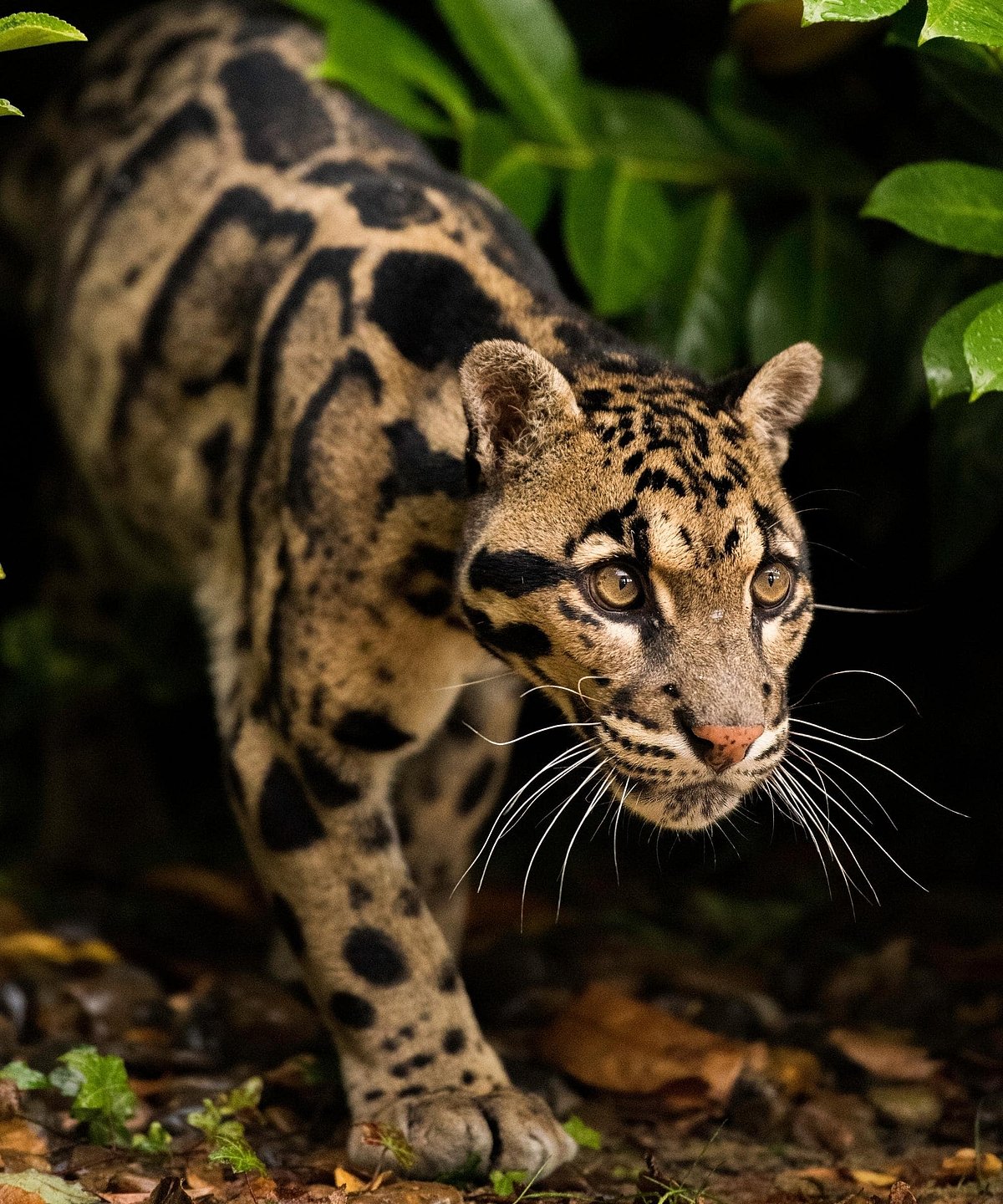
Clouded leopards are medium-sized wild cats native to the dense forests of Southeast Asia and the Himalayas, distinguished by their unique "cloud-like" coat patterns and extraordinary arboreal abilities. They are most famous for possessing the longest canine teeth relative to body size of any living feline, earning them the nickname "modern-day sabertooths."
Found lurking in the shadows of some of the world’s most impenetrable jungles, the clouded leopard (Neofelis nebulosa) and its cousin, the Sunda clouded leopard (Neofelis diardi), remain among the most mysterious creatures in the animal kingdom. For years, they were categorized as a single species, but genetic research has revealed a complex evolutionary history that sets them apart from both "big cats" like lions and "small cats" like lynxes. This guide explores the fascinating biological marvels and conservation challenges of these elusive "ghosts of the forest" as we understand them in 2026.
1. The Modern-Day Sabertooth
The most striking anatomical feature of the clouded leopard is its dentition. While a tiger’s canines are objectively larger, the clouded leopard’s upper canine teeth can reach up to two inches (5 cm) in length. When measured against the size of its skull, these teeth are the longest of any living cat species.
This adaptation mirrors the morphology of extinct machairodonts (saber-toothed cats). Because their jaw can open to an impressive 100-degree angle, they can utilize these massive teeth to deliver a lethal bite to prey much larger than themselves. Biologists believe this allows them to hunt primates and even small ungulates effectively within the vertical strata of the rainforest, where a firm, immediate grip is necessary to prevent prey from falling or escaping through the canopy.
2. Unrivaled Arboreal Gymnastics
Clouded leopards are widely considered the most talented climbers in the feline world. While many cats can climb trees, the clouded leopard possesses specialized physiological adaptations that allow it to perform maneuvers that would be impossible for a leopard or a cougar.
One of their most remarkable traits is their rotating ankles. Their rear ankle joints can turn nearly 180 degrees, allowing the cat to climb down a tree trunk head-first, much like a squirrel. Additionally, they are known to hang from branches using only their hind paws, leaving their front paws free to strike at prey or navigate complex branch systems. This extreme flexibility is supported by a low center of gravity and exceptionally powerful limb muscles.
3. The Tail as a Balancing Tool
In the world of arboreal predators, balance is survival. The clouded leopard possesses a tail that is nearly as long as its entire body. On average, a clouded leopard’s body measures between 24 and 43 inches, while its tail can extend up to 36 inches.
This massive, thick tail acts as a counterweight, similar to the balancing pole used by a tightrope walker. When the cat is leaping between branches or chasing a macaque through the canopy, the tail shifts dynamically to keep the leopard’s weight centered. This allows them to navigate narrow limbs at high speeds, even in wet, slippery conditions typical of tropical rainforests.
4. They Are Not Actually Leopards
Despite their name, clouded leopards are not a subspecies of leopard (Panthera pardus). They belong to a separate genus entirely, known as Neofelis. In the evolutionary tree, they occupy a unique middle ground between the "big cats" of the genus Panthera and the "small cats" of the subfamily Felinae.
The Neofelis lineage split from the ancestors of lions and tigers approximately six million years ago. This makes them one of the oldest distinct lineages within the feline family. Because of this separation, they possess a mix of traits: they have the specialized hyoid bone structure of small cats (which prevents them from roaring like a lion) but exhibit certain skull structures and behaviors associated with the Great Cats.
5. A Tale of Two Species
For centuries, scientists believed there was only one type of clouded leopard. However, in 2006, researchers using DNA analysis determined that the clouded leopards living on the islands of Borneo and Sumatra were a distinct species from those on the Asian mainland.
The two species are:
- Mainland Clouded Leopard (Neofelis nebulosa): Found from the Himalayas to Indochina. They generally have larger "clouds" on their coat and a lighter tawny background.
- Sunda Clouded Leopard (Neofelis diardi): Found in Borneo and Sumatra. They have smaller, darker cloud markings and a grayer coat.
The genetic distance between these two species is comparable to the distance between a lion and a leopard, proving that geographic isolation by rising sea levels millions of years ago led to a significant evolutionary divergence.
6. Unique Vocalizations and "Prusten"
Clouded leopards do not roar, but they also do not purr in the same way a domestic cat does. Instead, they utilize a range of vocalizations including growls, hisses, and snorts. One of their most interesting social signals is known as prusten, or "chuffing."
Prusten is a non-threatening, friendly sound made by blowing air through the nose with the mouth closed. It is a behavior shared with tigers and snow leopards, used primarily during courtship or between mothers and their cubs. This reinforces their status as an evolutionary bridge between the roaring big cats and the purring small cats.
7. The Mystery of the "Cloud" Pattern
The name "clouded leopard" comes from the large, irregular ellipses on their fur that resemble clouds. These markings are not just for aesthetics; they provide exceptional camouflage in the dappled light of the rainforest canopy.
Each "cloud" is outlined in black, with a darker center than the rest of the background fur. This pattern breaks up the cat's silhouette, making it nearly invisible against the mossy bark and shifting leaves of the forest. This "disruptive coloration" is so effective that even seasoned researchers often struggle to spot a clouded leopard sitting just a few yards away in the brush.
8. Oversized Paws for Stealth
Relative to their body size, clouded leopards have very large, broad paws. These paws function similarly to snowshoes, distributing the cat's weight more evenly across soft ground or narrow branches.
These large paws are equipped with sharp, retractable claws and thick padding that muffle the sound of their movement. In 2026, camera trap footage from high-altitude regions in Nepal has shown clouded leopards moving silently over rocky terrain that would cause other predators to stumble. This "stealth-first" anatomy allows them to get within striking distance of sensitive prey like deer and monkeys.
9. Oblong Pupils and Low-Light Vision
Unlike many small cats that have vertical slit pupils (like house cats) or big cats that have round pupils (like lions), the clouded leopard has pupils that never fully contract into a slit. Instead, they remain somewhat oblong or "squircle" shaped.
This eye structure is an adaptation for their crepuscular and nocturnal lifestyle. They are most active during dawn, dusk, and nighttime. Their eyes are exceptionally rich in rod cells, which are sensitive to low light, and they possess a tapetum lucidum—a reflective layer behind the retina that enhances night vision by reflecting light back through the eye.
10. The Ghost of the Forest
Clouded leopards are among the most difficult cats to study in the wild. They are naturally shy, solitary, and inhabit some of the most rugged terrains on Earth, from the foothills of the Himalayas to the swamps of Borneo.
Because they spend so much time in the trees and are primarily active when humans are not, many local communities within their range consider them "ghosts." Much of what we know about their lifespan and reproductive habits comes from conservation centers and zoos. In the wild, their population density is incredibly low, and they require large, undisturbed tracts of forest to survive.
Comparative Overview of Clouded Leopard Species
| Feature | Mainland Clouded Leopard (N. nebulosa) | Sunda Clouded Leopard (N. diardi) |
|---|---|---|
| Primary Habitat | SE Asia, Southern China, Himalayas | Borneo and Sumatra |
| Coat Color | Pale yellow to rich brown | Darker, grayish-yellow to charcoal |
| Pattern Size | Large, distinct "clouds" | Smaller, more frequent spots within clouds |
| Canine Length | Proportionally extreme | Proportionally extreme |
| Conservation Status | Vulnerable | Vulnerable |
| Weight Range | 25–50 lbs (11–23 kg) | 25–55 lbs (11–25 kg) |
Conservation Status and Challenges in 2026
Despite their beauty and biological significance, clouded leopards face a precarious future. As of 2026, both species are listed as Vulnerable on the IUCN Red List. Their primary threat is habitat loss driven by large-scale deforestation for palm oil plantations, logging, and infrastructure development.
Because these cats are highly dependent on closed-canopy forests, they do not transition well to fragmented landscapes. When forests are cut down, their prey disappears, and the cats become more vulnerable to poaching for the illegal wildlife trade. Their skins, bones, and teeth are highly valued on the black market, particularly in parts of East Asia.
Conservation efforts are currently focused on:
- Creating Wildlife Corridors: Connecting isolated patches of forest to allow for genetic exchange between populations.
- Anti-Poaching Patrols: Increasing boots-on-the-ground presence in protected areas like the Leuser Ecosystem in Sumatra.
- Community Education: Working with local populations to reduce human-wildlife conflict and provide alternative livelihoods to poaching.
Frequently Asked Questions
Can clouded leopards be kept as pets?
No, clouded leopards cannot and should not be kept as pets. They are highly specialized wild predators with complex social, dietary, and environmental needs that cannot be met in a domestic setting. Furthermore, they are protected under CITES Appendix I, making the international trade of these animals for the pet industry illegal.
What do clouded leopards eat?
Their diet is diverse and includes both arboreal and terrestrial prey. They commonly hunt macaques, gibbons, small deer (like muntjacs), wild pigs, squirrels, and birds. Their ability to hunt in the trees and on the ground gives them a wide range of options depending on seasonal availability.
How big do clouded leopards get?
They are considered medium-sized cats. Adult males typically weigh between 35 and 50 pounds, while females are significantly smaller, often weighing between 25 and 35 pounds. While they are much smaller than a lion, their muscular build and large teeth make them formidable predators.
Where is the best place to see a clouded leopard in the wild?
Seeing a clouded leopard in the wild is extremely rare and requires immense patience. However, conservation hubs like the Deramakot Forest Reserve in Sabah, Malaysian Borneo, are known for occasional sightings during night drives. Most people experience these animals through accredited zoological facilities that participate in the Species Survival Plan (SSP).
How long do they live?
In professional care, clouded leopards can live up to 15 to 17 years. In the wild, their lifespan is likely shorter—estimated between 10 and 12 years—due to the pressures of hunting, territorial disputes, and habitat loss.
Supporting Clouded Leopard Conservation
If you are inspired by these incredible "modern-day sabertooths," the most effective next action is to support organizations dedicated to their survival. You can contribute to the Clouded Leopard Working Group or the World Wildlife Fund (WWF), which focus on habitat preservation in Southeast Asia. Additionally, making informed consumer choices by purchasing products certified by the Roundtable on Sustainable Palm Oil (RSPO) helps reduce the deforestation that threatens their home. Every step taken toward forest preservation is a step toward ensuring these elusive cats don't become true ghosts of the past.