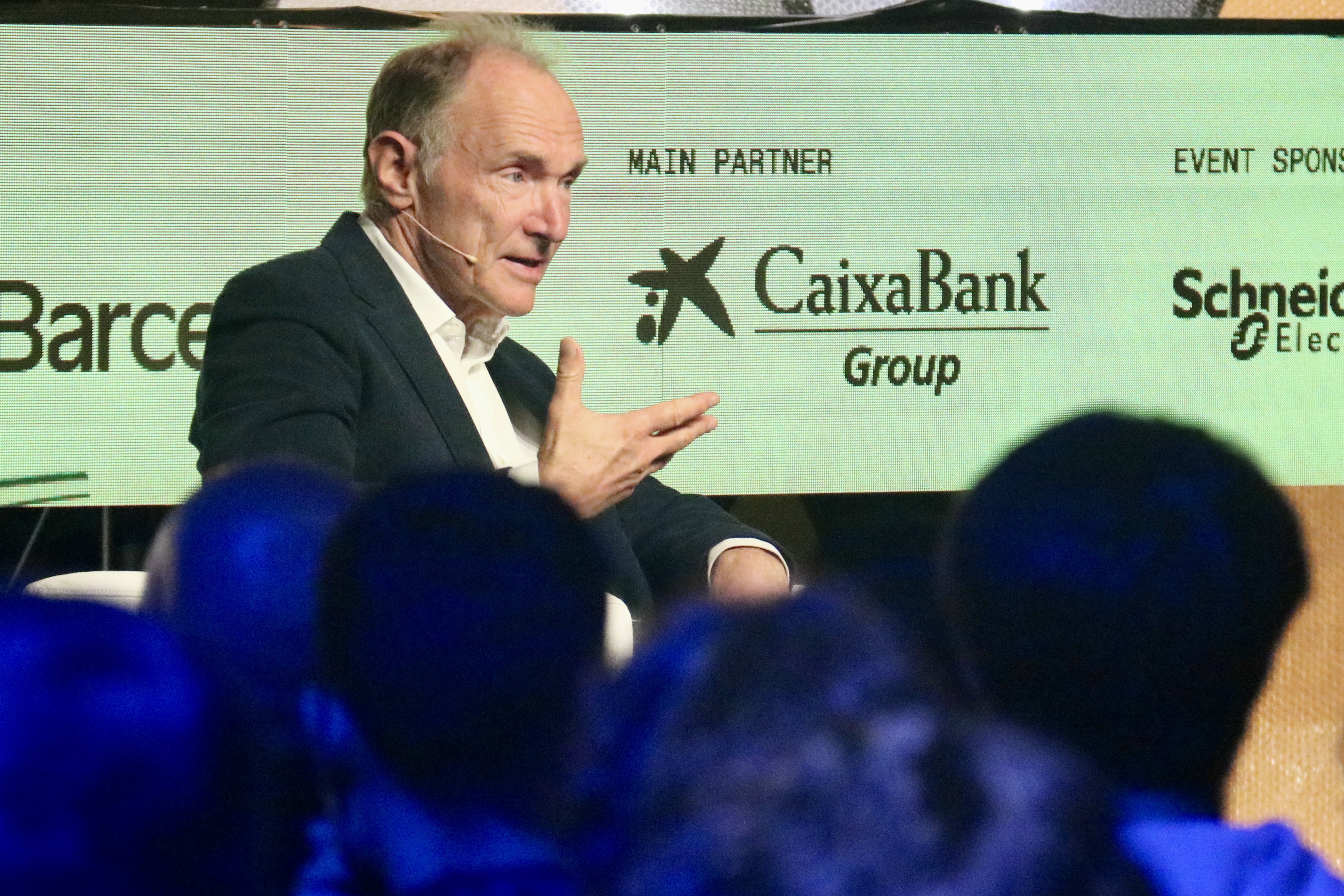
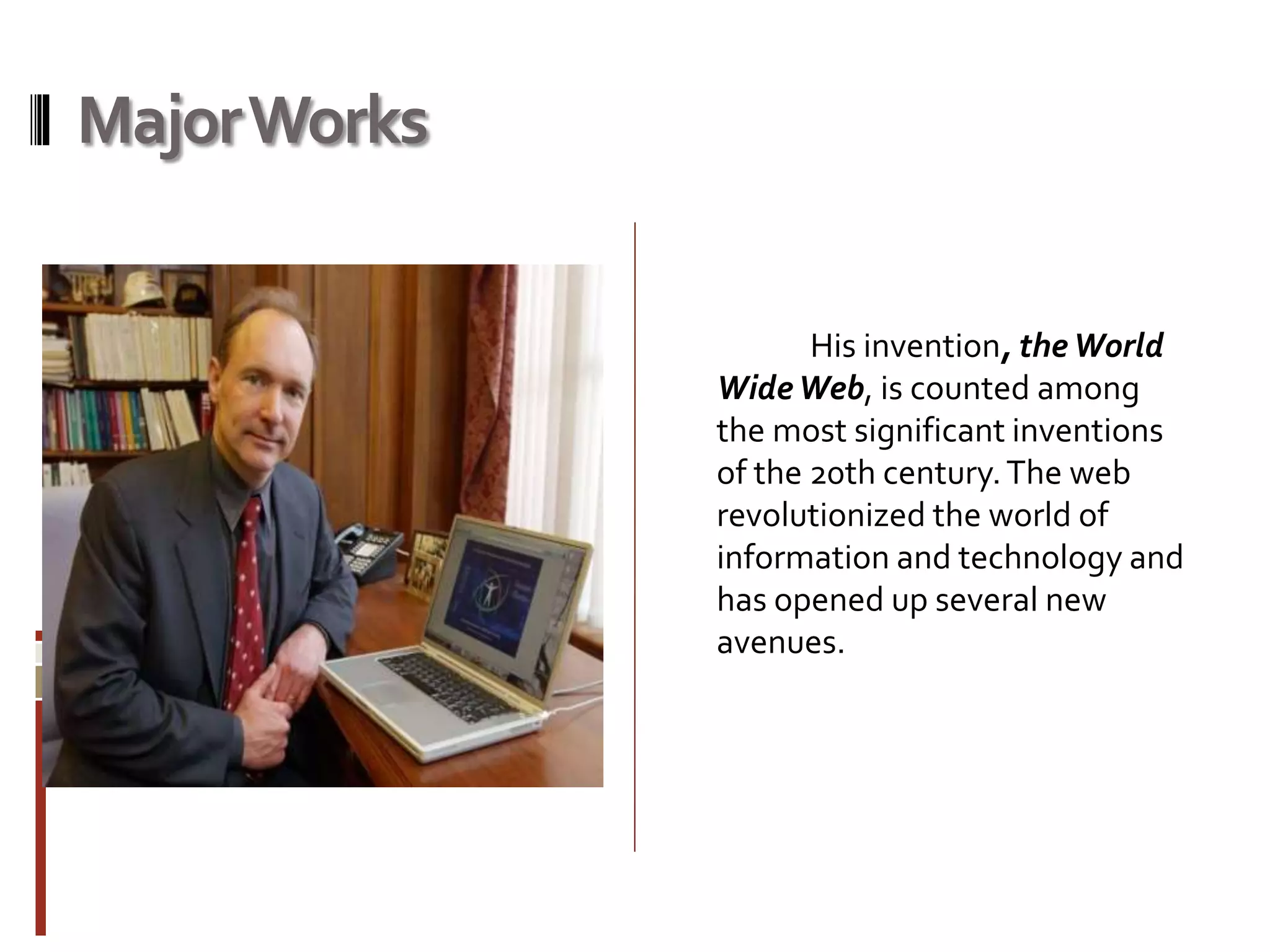
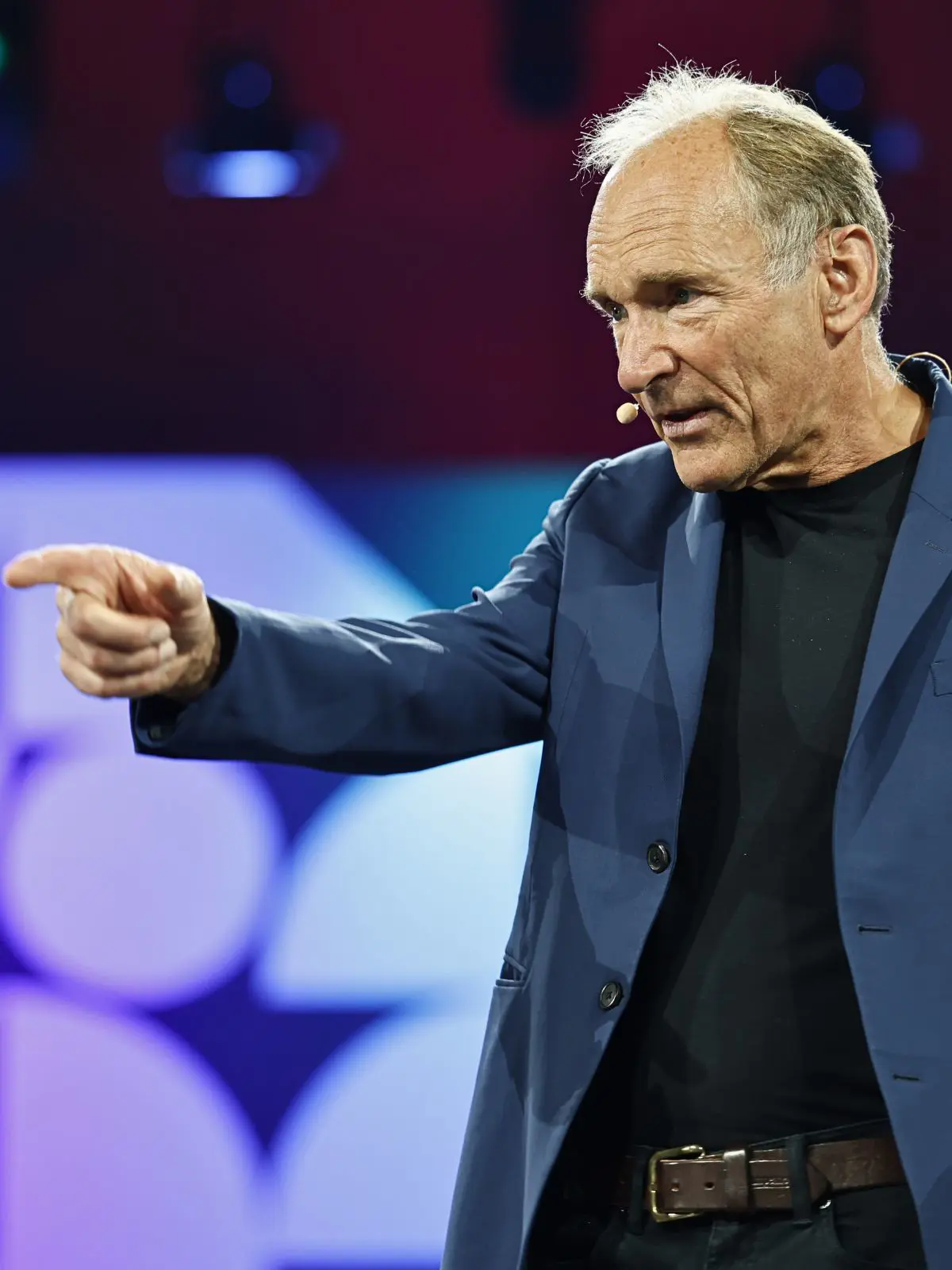
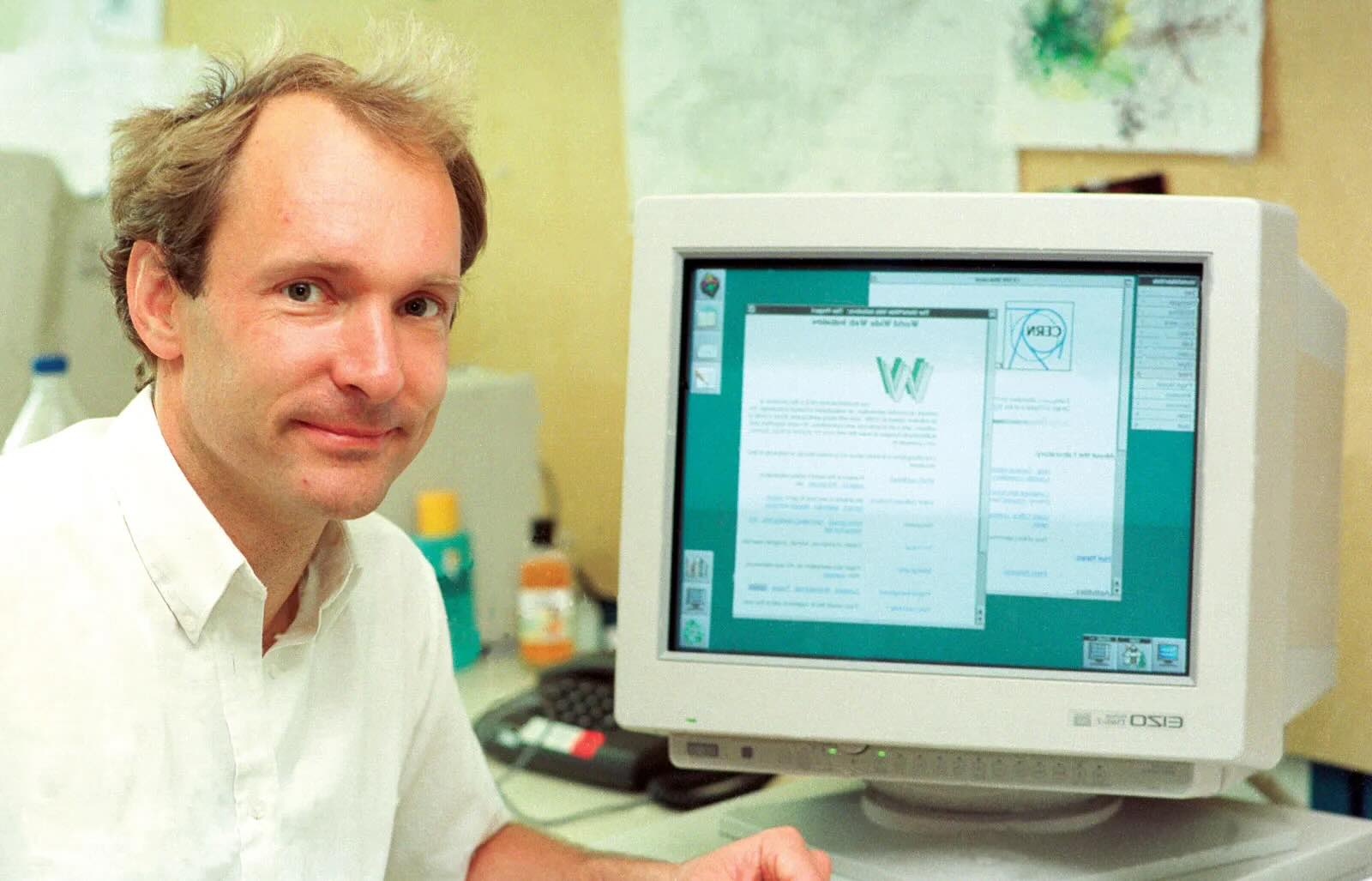
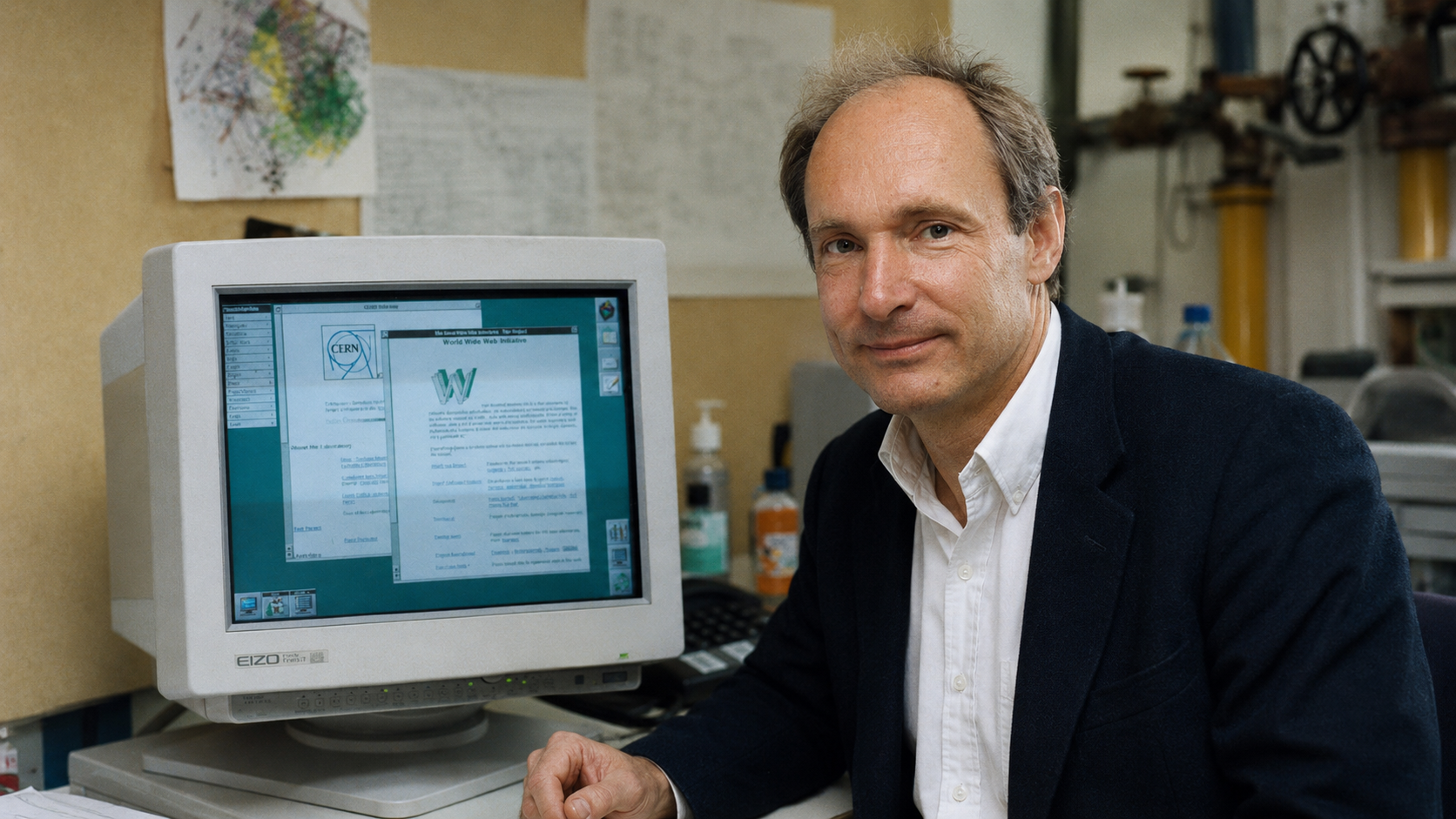
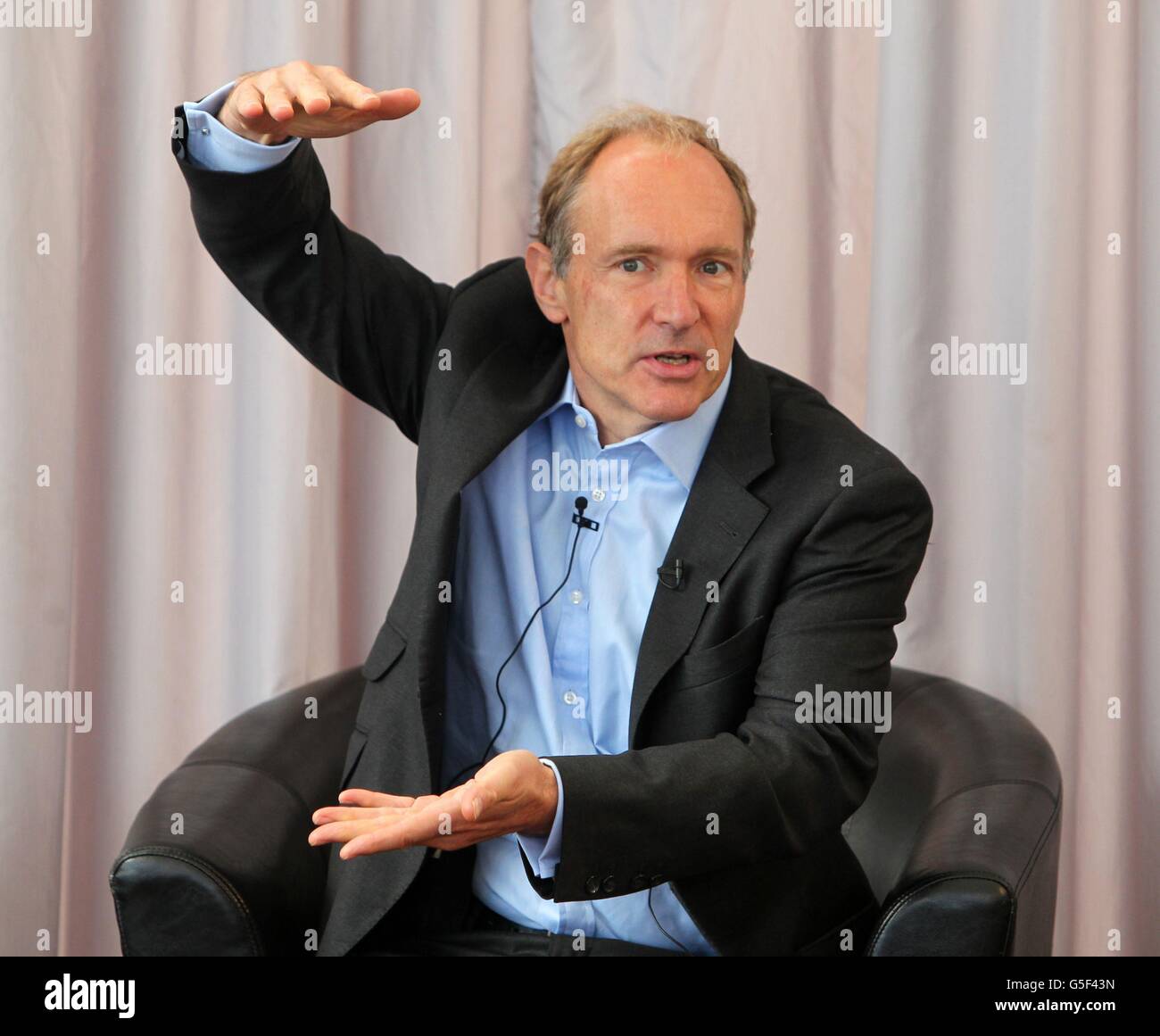
Sir Tim Berners-Lee is the British computer scientist who invented the World Wide Web in 1989 while working at CERN. Beyond his technical achievements, he is celebrated for releasing the technology for free, founding the W3C, and his ongoing 2026 advocacy for a decentralized, privacy-focused internet through the Solid project.
1. Born into a Family of Computer Pioneers
Long before Tim Berners-Lee became a household name in technology, he was immersed in the world of mathematics and early computing. Both of his parents, Conway Berners-Lee and Mary Lee Woods, were mathematicians who worked on the Ferranti Mark 1, the world’s first commercially available electronic stored-program computer.
Growing up in such an environment meant that "computer talk" was the dinner table norm. This early exposure to the logic of machine language and the potential of automated calculation provided him with a unique perspective on how information could be processed. He often credits his parents with teaching him how to think about things in a non-linear fashion, which later influenced his vision of "hypertext"—the ability to jump from one piece of information to another regardless of its location.
2. He Was Banned from Using Oxford’s Computers
While studying at The Queen’s College, Oxford, Berners-Lee’s curiosity sometimes pushed boundaries. During his undergraduate years, he and a friend were caught hacking into the university's computer systems. As a punishment, the university banned him from using their computers.
Rather than letting this stifle his progress, Berners-Lee demonstrated the resourcefulness that would define his career. He built his own computer from scratch using a soldering iron, an M6800 processor, and an old television set he bought for a few pounds. This "DIY" approach to hardware gave him a deep understanding of the layers of technology, from the physical circuitry to the high-level software, a foundation that was essential when he later designed the protocols that would link the entire world.
3. The Web Was a Solution to a "Filing Cabinet" Problem at CERN
In the late 1980s, Berners-Lee was working as a fellow at CERN (the European Organization for Nuclear Research) in Switzerland. The problem he faced wasn't about physics, but about organization. CERN was a massive international hub where scientists from all over the world brought different types of computers and incompatible data formats.
Information was constantly being lost because it was stored on individual machines or in physical binders. In March 1989, Berners-Lee wrote a proposal titled "Information Management: A Proposal." He envisioned a "web" of documents linked by hypertext that could be accessed from any computer. His boss at the time, Mike Sendall, famously scribbled a note on the cover of the proposal: "Vague but exciting..." That cautious endorsement was enough to allow Berners-Lee to begin his work on the first web server and browser.
4. The First Web Server Ran on a NeXT Computer
To build the World Wide Web, Berners-Lee used a NeXTcube computer, a high-end workstation developed by Steve Jobs’ company, NeXT, after he was ousted from Apple. The NeXT system was significantly ahead of its time, featuring an object-oriented operating system that made it much faster for Berners-Lee to write the code for the first browser.
The original NeXTcube used at CERN still exists and is a piece of technological history. Because it was the only machine hosting the early web, Berners-Lee had to leave a hand-written note taped to the front of the computer in red ink: "This machine is a server. DO NOT POWER IT DOWN!!" If someone had accidentally flipped the switch, the entire World Wide Web would have gone offline.
5. He Refused to Patent the Web
Perhaps the most consequential decision in the history of the digital age was Berners-Lee’s refusal to monetize the World Wide Web. In 1993, he convinced CERN to release the source code of the Web into the public domain.
Had Berners-Lee decided to charge royalties for the use of URL structures, HTML, or HTTP, the internet likely would have fragmented into several competing, proprietary networks (like AOL or CompuServe). By making it free and open, he ensured that anyone, anywhere, could build a website without asking for permission or paying a fee. This decision prioritized global connectivity over personal wealth, a philosophy he continues to champion in 2026.
6. Understanding the Difference: Internet vs. World Wide Web
A common misconception is that the Internet and the World Wide Web are the same thing. In reality, Berners-Lee invented the Web, which sits on top of the Internet. To understand his contribution, it is helpful to use the "tracks and train" analogy.
| Feature | The Internet | The World Wide Web |
|---|---|---|
| Analogy | The tracks and infrastructure | The trains and the cargo |
| Components | Hardware, cables, routers, TCP/IP | HTML, HTTP, URLs, Browsers |
| Inception | 1960s (ARPANET) | 1989 (CERN) |
| Primary Function | Connectivity and data transmission | Information sharing and navigation |
| Key Protocols | IP, TCP, UDP | HTTP, HTTPS |
Berners-Lee’s genius was in creating the software layer that made the underlying internet hardware useful for the average person.
7. The "Double Slash" Regret
Despite being a visionary, Berners-Lee has admitted to a few design choices he would change if he could go back. One of the most famous is the "//" (double slash) that follows the "http:" in every URL.
In a 2009 interview, he confessed that the double slash was unnecessary. At the time, it seemed like a good way to separate the protocol from the address, but in hindsight, the colon alone would have sufficed. He jokingly apologized for the amount of time, ink, and paper wasted by millions of people typing those two extra characters over the last three decades.
8. Knighted by the Queen and Honored at the Olympics
In 2004, Queen Elizabeth II knighted Tim Berners-Lee, promoting him to Knight Commander of the Order of the British Empire (KBE). This honor was specifically for his services to the global development of the internet.
He reached an even broader audience during the 2012 Summer Olympics Opening Ceremony in London. Sitting at a desk with a glowing computer in the middle of the stadium, he sent a live tweet that was projected onto the seats of the 80,000 spectators: "This is for everyone." The message reinforced his lifelong commitment to the idea that the web is a universal human right and a tool for collective empowerment.
9. Founder of the World Wide Web Consortium (W3C)
In 1994, Berners-Lee founded the World Wide Web Consortium (W3C) at the Massachusetts Institute of Technology (MIT). He realized that without a central body to agree on technical standards, the web would break as different companies created different versions of HTML.
The W3C remains the primary international standards organization for the World Wide Web. Under his leadership, the W3C has ensured that the web remains "interoperable." This means that whether you are using a browser in Tokyo or a smartphone in New York, the website you visit looks and functions the same way because everyone follows the same "rulebook" established by the W3C.
10. His 2026 Mission: Fixing the "Broken" Web with Solid
As of 2026, Sir Tim Berners-Lee is not retired; he is actively working to "fix" what he believes has gone wrong with his invention. He has expressed deep concerns about data silos, surveillance capitalism, and the loss of personal privacy on the modern web.
His current major project is Solid (Social Linked Data), a decentralized web project. The goal of Solid is to give users back control of their data. Instead of your data living on the servers of tech giants, it lives in a personal "Pod" (Personal Online Data Store). You decide which apps or companies can access specific parts of your Pod. This "re-decentralization" of the web is his attempt to return to the original vision of an open, peer-to-peer ecosystem where the user, not the corporation, is in charge.
Frequently Asked Questions
Did Tim Berners-Lee get rich from inventing the web?
No, he did not become a billionaire from the invention itself because he chose not to patent it. While he has had a successful career as a professor at MIT and Oxford and as a consultant, he famously passed up the opportunity to own the technology. He has often stated that if he had tried to control it, the web likely wouldn't have taken off at all.
What was the first website ever created?
The first website was hosted at CERN on Berners-Lee's NeXT computer. Its URL was http://info.cern.ch/hypertext/WWW/TheProject.html. The page contained information about the World Wide Web project, explaining how to create your own web server and how to use the hypertext system. CERN has since restored the page to its original URL for historical preservation.
Why is he called the "Father of the Web" and not the "Father of the Internet"?
The terms are often confused, but they represent different layers of technology. Vint Cerf and Bob Kahn are generally considered the "Fathers of the Internet" for developing the TCP/IP protocols that allow computers to talk to each other. Berners-Lee is the "Father of the Web" because he created the applications (HTML, HTTP, and Browsers) that allow us to view and share pages over that internet connection.
What is the Solid project he is working on now?
Solid is a specification that lets people store their data securely in decentralized containers called Pods. In the current web model, users give their data to platforms in exchange for services. With Solid, users own their data and grant permission to platforms to "view" it. This shifts the power balance back to the individual and is the primary focus of Berners-Lee’s work in 2026.
How can you support an open and free web?
To follow the principles set out by Sir Tim Berners-Lee, users can support organizations like the World Wide Web Foundation, which advocates for policy changes to protect digital rights. Additionally, adopting privacy-focused tools and exploring decentralized technologies like Solid helps move the needle toward a more equitable digital future. Supporting net neutrality and digital literacy programs are also practical steps to ensure the web remains "for everyone."