A 10 carat diamond weighs exactly 2.0 grams and represents the pinnacle of luxury, commanding attention through sheer scale and rarity. In a standard round brilliant cut, a 10 carat diamond measures approximately 14 millimeters in diameter. Pricing varies dramatically based on origin and quality, ranging from roughly $25,000 for lab-grown stones to well over $1,000,000 for top-tier natural diamonds.
While gold purity is measured in karats (with 10 karat indicating 41.7% pure gold), gemstone mass is measured in metric carats. One metric carat equals 200 milligrams (0.2 grams). Therefore, a 10 carat (10 ct) gemstone is a substantial 2,000-milligram piece. At this elite weight category, the standard rules of diamond evaluation shift: natural inclusions become far more visible to the naked eye, body color concentrates more heavily in the pavilion, and structural mounting requires specialized engineering.
Physical Dimensions and Visual Scale of a 10 Carat Stone
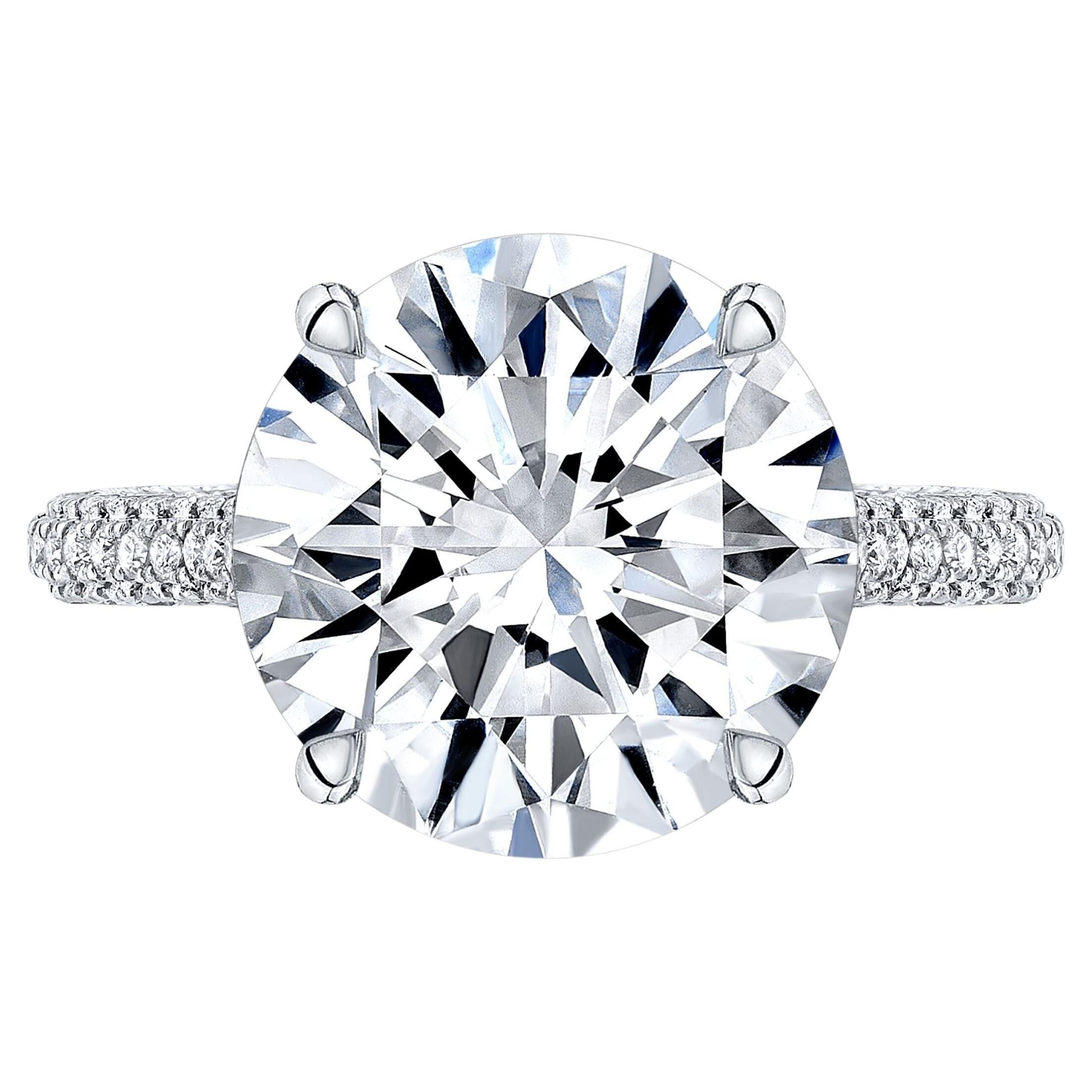
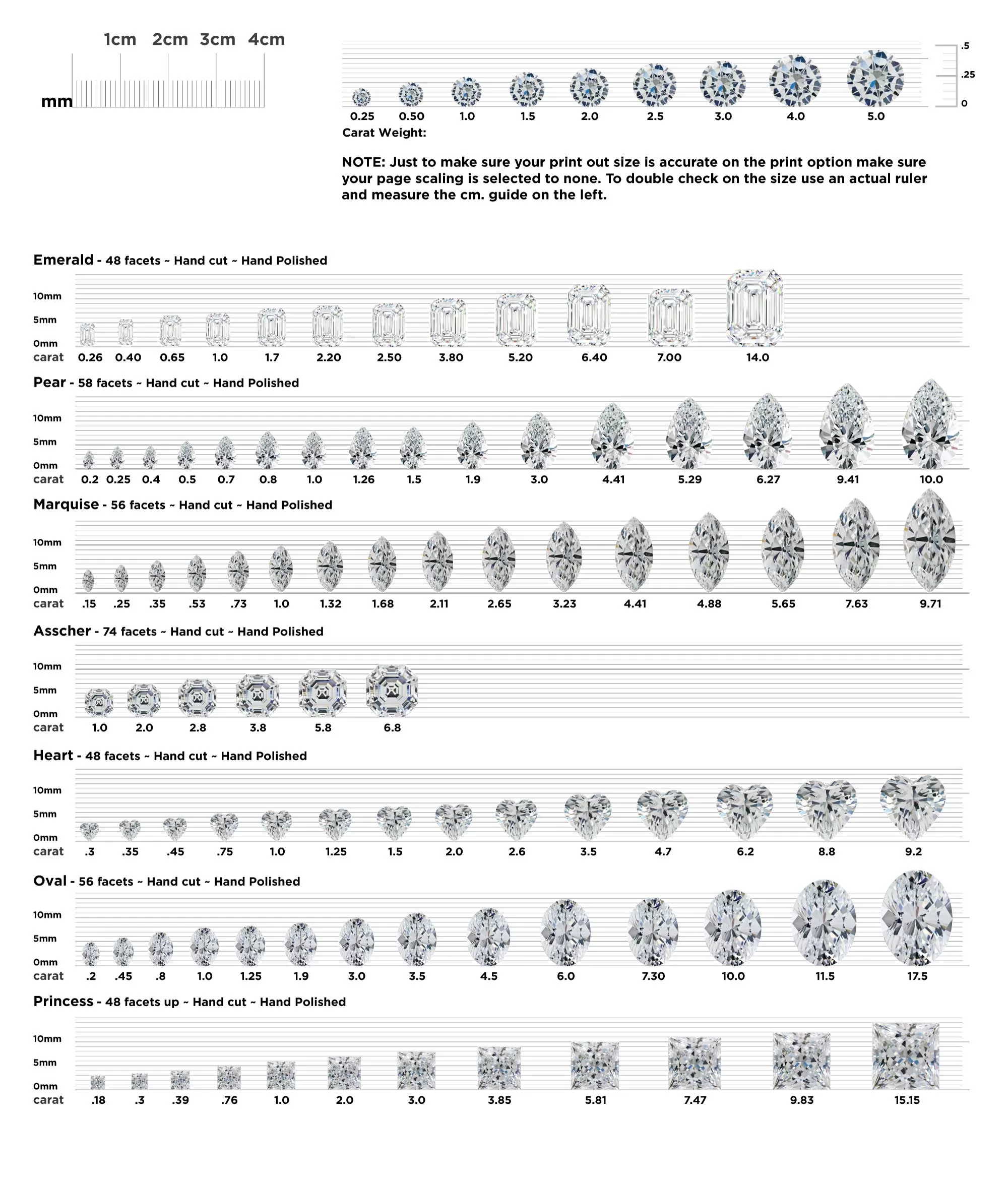
Carat refers strictly to weight, not surface area. However, because cut standards dictate proportional depth, diamonds cut to ideal parameters display predictable face-up dimensions. A 10 carat round brilliant diamond typically measures between 13.9 mm and 14.2 mm across. To provide practical perspective, this diameter closely matches the face of an ordinary pencil eraser or roughly two-thirds the diameter of a standard United States dime.
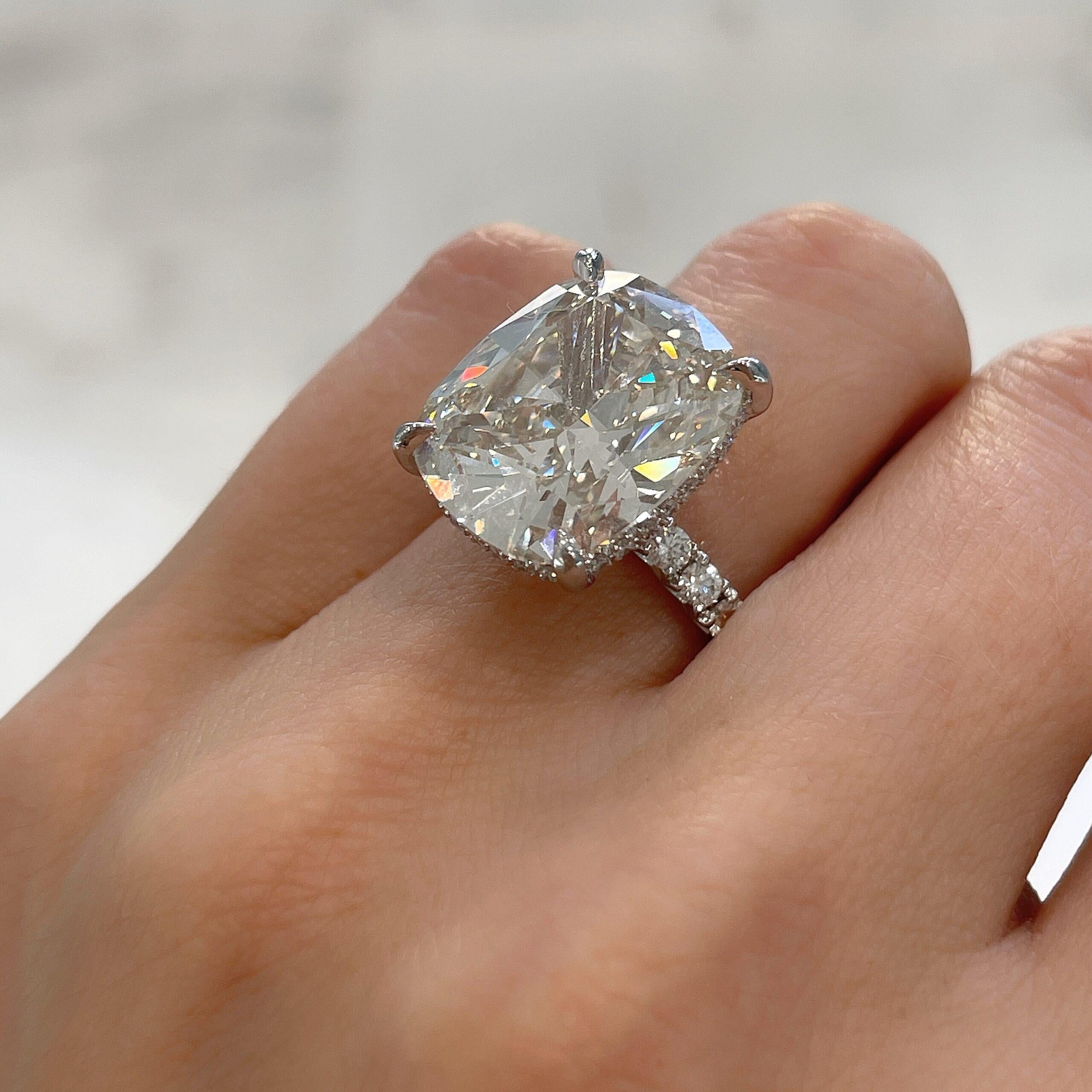
Shape dramatically alters how large a 10 carat diamond appears when viewed from above. Elongated shapes distribute weight across a greater surface plane, creating a larger visual footprint than round or square cuts of identical weight.
- Round Brilliant: ~14.0 mm diameter. Offers balanced light return, high brilliance, and classic symmetry, though it carries a premium price per carat due to rough crystal loss during cutting.
- Oval Cut: ~16.5 mm × 11.5 mm. Elongates the finger and maximizes surface coverage while maintaining brilliant faceting.
- Emerald Cut: ~14.5 mm × 10.5 mm. Step-cut facets highlight absolute optical clarity. Any internal flaw or color tint within a 10 carat emerald cut is immediately obvious.
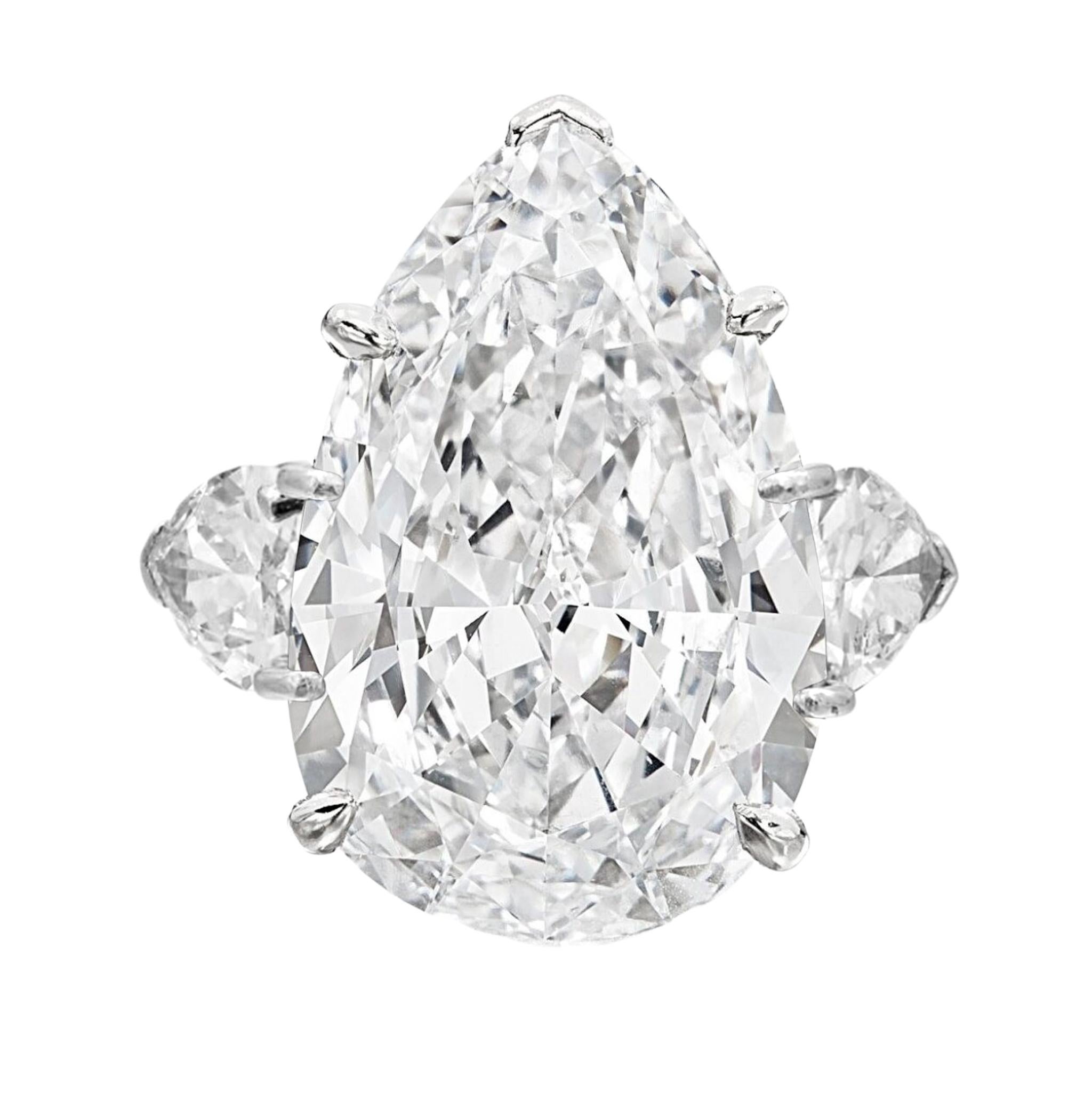
- Pear Shape: ~18.0 mm × 11.0 mm. Combines round and marquise profiles, presenting one of the largest face-up surface areas per carat.
- Cushion Cut: ~13.0 mm × 12.0 mm (square-modified) or ~14.5 mm × 11.0 mm (elongated). Features rounded corners and large facets that emphasize fire and scintillation, though weight often hides within a deeper belly.
10 Carat Diamond Pricing: Natural vs. Lab-Grown
The valuation of a 10 carat diamond depends fundamentally on its origin: mined (natural) or synthetic (laboratory-grown). While both share identical physical, chemical, and optical properties, their supply dynamics and market values diverge completely.
Natural 10 Carat Diamonds
Natural diamonds of 10 carats or higher represent an extreme geological anomaly. For every million carats of rough diamonds mined, only a minuscule fraction yields an intact, gem-quality crystal large enough to produce a finished 10 carat polished stone. Consequently, natural diamonds in this category trade on an exponential pricing curve.
Quality factors determine the baseline. A commercial-grade 10 carat natural diamond with noticeable warmth and minor inclusions (such as J color and SI2 clarity) may trade between $150,000 and $250,000. Conversely, an investment-grade stone exhibiting top-tier color (D or E) and exceptional clarity (VVS2 to Flawless) routinely commands between $800,000 and $1,500,000 on the open wholesale and retail markets.
Lab-Grown 10 Carat Diamonds
Advances in Chemical Vapor Deposition (CVD) and High Pressure High Temperature (HPHT) synthesis allow growers to produce large, high-purity single-crystal diamonds consistently. As diamond synthesis yields have scaled, the cost of manufacturing large carats has declined significantly.
A 10 carat lab-grown diamond of exceptional visual quality—typically graded F to G in color and VS1 to VVS2 in clarity—costs between $15,000 and $35,000. For buyers seeking physical scale and optical performance without the six- or seven-figure capital commitment of an ultra-rare mined crystal, lab-grown stones provide an accessible alternative.
Technical Specifications: 10 Carat Diamond Comparison by Shape
The following table outlines the standard physical dimensions, typical depth ratios, and face-up surface areas across standard diamond cuts for a well-proportioned 10 carat stone.
| Diamond Shape | Typical Dimensions (mm) | Recommended Depth % | Recommended Table % | Approximate Surface Area (mm²) |
|---|---|---|---|---|
| Round Brilliant | 14.0 × 14.0 | 59.5% – 62.5% | 54% – 58% | ~154 mm² |
| Oval | 16.5 × 11.5 | 60.0% – 64.0% | 53% – 62% | ~149 mm² |
| Emerald Cut | 14.5 × 10.5 | 63.0% – 69.0% | 61% – 68% | ~152 mm² |
| Pear Shape | 18.0 × 11.0 | 58.0% – 63.0% | 53% – 61% | ~155 mm² |
| Radiant | 13.5 × 11.5 | 62.0% – 68.0% | 61% – 69% | ~155 mm² |
| Cushion (Elongated) | 14.0 × 11.5 | 64.0% – 70.0% | 58% – 66% | ~150 mm² |
| Princess Cut | 12.0 × 12.0 | 69.0% – 75.0% | 67% – 73% | ~144 mm² |
Evaluating the 4Cs at the 10 Carat Threshold
The standard grading criteria developed by the Gemological Institute of America (GIA) apply to diamonds of any mass, but evaluating a 10 carat stone demands far tighter tolerances than evaluating a standard 1.0 or 2.0 carat gem.
Cut Quality: Preserving Fire and Preventing Light Leakage
Cut quality determines how effectively incoming light reflects off internal pavilion facets and returns to the observer as brilliance (white light return) and fire (spectral dispersion). In a 10 carat stone, a cut that is too deep hides excess carat weight inside the base of the stone where it adds no visual width, causing dark centers (extinction). Conversely, a cut that is too shallow creates a "fisheye" effect, allowing light to leak straight through the bottom of the pavilion.
For brilliant shapes, select stones with table percentages between 54% and 58% and total depth percentages under 62.5%. Excellent polish and symmetry grades are non-negotiable at 10 carats, as subtle surface misalignments or asymmetric facet junctions are easily spotted under ambient lighting.
Clarity: The Windowing Effect
At smaller weights, diamonds graded Slightly Included (SI1 or SI2) frequently qualify as "eye-clean," meaning internal blemishes cannot be resolved without 10x magnification. At 10 carats, this tolerance vanishes.
Because facet surfaces and internal chambers are physically large, inclusions such as dark crystals, feathers, or clouds stand out plainly. For brilliant cuts (Round, Oval, Cushion), a minimum clarity grade of VS2 is strongly recommended to guarantee eye-clean performance. For step cuts (Emerald and Asscher), which feature open, parallel facets that act like clear windows, buyers must prioritize a minimum of VS1 or VVS2 to ensure no visible internal markings interrupt the visual line.
Color: Body Tint Saturation
Diamond color grading tracks the absence of color on an alphabetical scale from D (colorless) to Z (light yellow or brown). As gemstone volume increases, the total optical path that light travels through the stone lengthens. Consequently, even low concentrations of trace nitrogen emit a noticeably stronger yellow or brownish hue.
In a 1 carat diamond, an H or I color stone often looks crisp and white face-up. In a 10 carat diamond, an H or I color stone will exhibit an unmistakable warm yellow tone, particularly along the outer edges and tips. To maintain an icy-white presentation in platinum or white gold mounts, aim for F color or higher. If setting the diamond in rich 18-karat yellow gold or rose gold, a G or H color diamond provides an elegant, coherent appearance while optimizing budget allocation.
Structural and Ring Setting Considerations
Mounting a 10 carat stone requires architectural and structural engineering that far exceeds standard ring assembly. A stone of this size encounters significant leverage during daily movement, placing immense stress on prongs, the basket, and the band.
- Multiple Heavy-Duty Prongs: Standard four-prong solitaire mountings are inadequate for daily security on a 10 carat gem. Jewelers recommend six heavy-duty round prongs, double-claw prongs, or platinum V-prongs (for pointed cuts like pears and princess cuts) to anchor the stone firmly.
- Low-Profile Gallery Basket: A 10 carat stone features a total physical depth often exceeding 8.5 millimeters. Setting the gem too high creates an impractical center of gravity, causing the ring to spin continually around the wearer’s finger. A low-set basket that rests flush or near-flush to the finger maintains balance and mitigates impact against hard surfaces.
- Shank Thickness and Width: The ring band (shank) should feature a minimum width of 2.5 mm to 3.0 mm and substantial cross-sectional thickness. A band that is too thin will warp under the lateral leverage applied by the massive head assembly.
- Counter-Balancing and Sizing Mechanics: Because top-heavy rings tend to rotate ("spin") to the side, integrating sizing beads, an internal comfort-fit bridge, or a European-style squared-off bottom shank prevents lateral sliding and maintains upright presentation.
- Metal Selection: Platinum (such as 950 Platinum) is the preferred metal for the center stone’s structural head. Platinum does not wear away metal molecules when scratched; rather, the metal displaces (develops a patina). It holds its grip on heavy stones far more reliably over decades than white gold, which can become brittle over prolonged wear.
Verification, Certification, and Risk Mitigation
Acquiring an asset of this magnitude requires absolute verification. Never purchase a 10 carat diamond without a comprehensive grading report issued by an independent, globally recognized gemological laboratory.
The two primary authoritative institutions for certifying stones of this scale are:
- Gemological Institute of America (GIA): The global benchmark for natural diamonds. GIA reports detail facet proportions, precise measurements, color, clarity, and structural plot maps.
- International Gemological Institute (IGI): The dominant authority for high-carat laboratory-grown diamonds, providing definitive spectroscopic verification of diamond growth methods and color treatments.
Beyond paper documentation, verify that the physical stone matches the certificate:
- Microscopic Laser Inscription: Ensure the diamond’s unique report number is laser-inscribed directly onto the girdle and matches the accompanying paperwork under 20x magnification.
- Independent Third-Party Appraisal: Secure a formal valuation from an independent gemologist who does not sell jewelry and charges a flat hourly rate rather than a percentage-based fee.
- Specialized Insurance Underwriting: Standard homeowners or renters policies feature strict limits on jewelry coverage (typically capped between $1,500 and $5,000). A 10 carat diamond requires a dedicated personal articles inland marine floater. High-value natural stones over $250,000 frequently require specialized private client group underwriting, scheduled insurance appraisals every two years, and documented safe-storage protocols.
Frequently Asked Questions
Is a 10 carat diamond too large for everyday wear?
A 10 carat diamond is generally impractical for heavy daily physical activity due to its height, weight, and susceptibility to snagging. While comfortable for social settings and formal occasions, wearing a 14 mm wide, 9 mm deep gem during manual tasks, exercise, or routine domestic chores introduces structural risks to both the setting and the diamond’s girdle.
What is the difference between a 10 carat diamond and 10 karat gold?
A 10 carat diamond refers to gemstone mass (10 carats equals 2.0 grams), whereas 10 karat gold refers to metallurgical purity. In gold alloys, 24 karats represents pure gold; therefore, 10 karat (10k) gold contains 10 parts gold and 14 parts alloyed metals, yielding an overall gold purity of 41.7%.
What clarity grade is best for a 10 carat emerald cut?
A clarity grade of VVS2 or higher is optimal for a 10 carat emerald cut diamond, with VS1 serving as the baseline minimum. Emerald cuts feature elongated step cut facets that provide an unobstructed view straight into the center of the stone. Flaws that remain invisible in brilliant cuts become easily detectable in large step cuts.
Can a 10 carat diamond chip or break?
Yes, diamonds are the hardest known natural mineral, but they are not unbreakable. Hardness measures resistance to scratching, while toughness measures resistance to fracturing. Diamonds possess four directional cleavage planes along which internal atomic bonding is weaker; a direct, sharp impact against a hard corner can chip or fracture even a 10 carat stone.
How much does insurance cost for a 10 carat diamond?
Jewelry insurance premiums typically range between 1% and 2% of the appraised value per year. For a lab-grown 10 carat diamond valued at $20,000, insurance typically runs $200 to $400 annually. For a natural 10 carat diamond valued at $500,000, specialized high-value insurance policies usually range from $5,000 to $10,000 annually, depending on local theft risk and home security measures.
Acquisition Strategy and Next Steps
Acquiring a 10 carat diamond requires a methodical procurement process that separates emotional appeal from technical verification. If pursuing a natural stone, begin by consulting with an independent, non-commissioned gemological advisor or an established high-jewelry concierge with direct access to primary bourses (such as Antwerp, Tel Aviv, or New York's Diamond District). Demand an original, unmodified GIA grading report and insist on a gemological inspection under dual light conditions—balanced daylight and spot lighting—to evaluate natural fluorescence and optical performance.
For those pursuing lab-grown stones, request uncompressed video inspections under 40x magnification alongside an IGI dossier to verify that the CVD or HPHT crystal exhibits no residual strain patterns, striations, or metallic flux inclusions.
Finally, partner with an experienced master bench jeweler specializing in high-carat mountings. Prioritize custom-cast platinum designs with reinforced double-prongs and an engineered low-profile basket to safeguard both the security and wearability of your investment.